

 By
By Quick Takeaways:
- Yao Chi means Jade Pool or Jasper Pool and is the sacred body of water within Xiwangmu’s palace complex on Kunlun Mountain
- It’s the specific location where the Queen Mother of the West receives worthy visitors, the threshold points where divine and mortal worlds most directly interact in her mythology
- Its waters are associated with immortality, divine vitality, and the specific purifying quality that jade symbolizes in Chinese cosmological tradition
- The most famous historical encounter at Yao Chi, King Mu of Zhou’s visit, is one of Chinese mythology’s earliest accounts of mortal-divine meeting
- Several real lakes in China are named Yaochi as earthly reflections of the mythological pool, demonstrating the living connection between mythology and geography
Twenty years of studying mythology has taught me that the most interesting mythological locations are usually the ones that serve as thresholds, the specific places where the ordinary world and the divine world meet and overlap.
Yao Chi is exactly that kind of location. It’s the sacred pool at the heart of Xiwangmu’s mountain palace, where the most significant divine-mortal encounters in the Queen Mother mythology take place. It’s where she receives the exceptional visitors who make the journey to Kunlun. It’s where the Pantao Banquet’s most sacred moments occur. And its name encodes a specific cosmological claim about what kind of water this is and what it does.
Let me walk you through all of it.
The Name: What Yao Chi Actually Means
The Characters
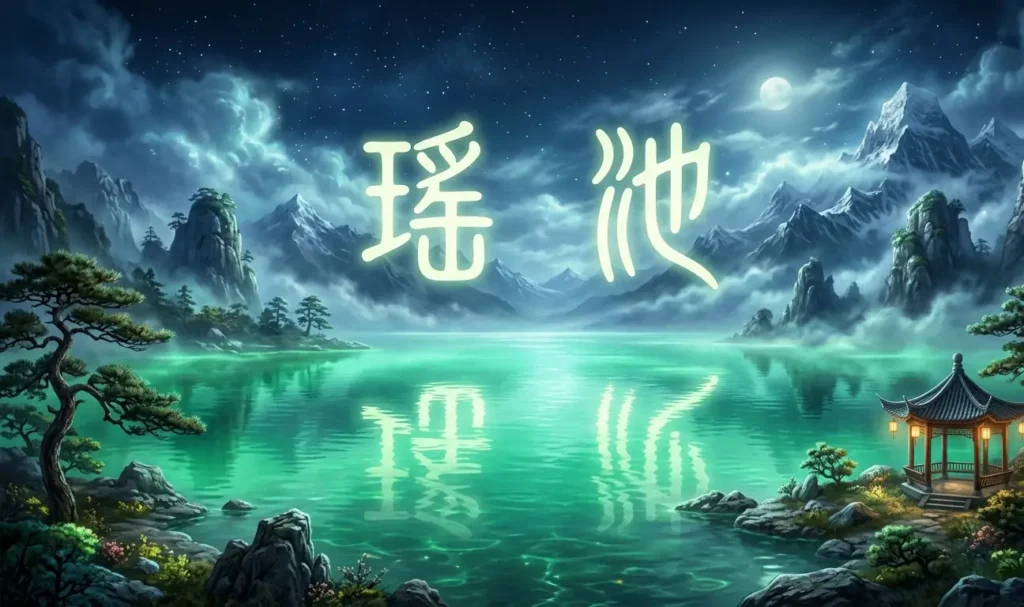
Yao Chi is composed of two characters:
Yao (瑤): A specific type of precious jade, not the most common jade designation but one associated with exceptional quality, luminosity, and divine connotations. The word appears in classical Chinese poetry as a marker of sacred beauty and heavenly association.
Chi (池): Pool, pond, or body of water. Not an ocean or river, a contained body of water with defined boundaries and a still quality.
Together: the Jade Pool. Or more specifically, the Pool of Luminous Jade, a body of water whose defining quality is the specific kind of luminous preciousness that the best jade embodies.
Why Jade Specifically
The choice of jade (rather than gold, silver, or another precious material) as the pool’s defining quality is philosophically deliberate.
In classical Chinese tradition, jade (yù) represents:
- Moral virtue – jade’s smooth beauty was associated with the cultivated character of the gentleman-scholar
- Celestial purity – jade was considered the most celestially connected of all earthly materials
- Endurance – jade doesn’t corrode, doesn’t tarnish, maintains its beauty indefinitely
- Cosmic connection – ritual jade objects were used to communicate with heaven in ancient Chinese religious practice
A pool whose water has the quality of luminous jade is a pool whose water participates in all of these symbolic associations. Bathing in or drinking from such water would theoretically transmit those qualities, which is precisely what the mythological tradition attributes to Yao Chi’s waters.
The name isn’t decorative. It’s a theological description of what the pool’s water actually is.
Location: Where Yao Chi Sits

Within The Kunlun Palace Complex
Yao Chi is located within Xiwangmu’s palace complex on Kunlun Mountain, the axis mundi of Chinese mythology, the cosmic mountain at the world’s center where heaven and earth most directly connect.
This location is cosmologically precise. The pool that serves as the threshold of divine encounter should be at the world’s threshold, the place where the ordinary and extraordinary most directly overlap.
Within the palace complex, Yao Chi occupies a specific architectural and symbolic position:
- It’s adjacent to or within the divine peach garden where the immortality peaches grow
- It sits before or beside Xiwangmu’s throne hall where formal audiences occur
- It’s where the Pantao Banquet takes place during the peach ripening celebrations
- It’s where Xiwangmu’s blue birds return from their messenger journeys
The pool isn’t just background scenery. It’s the specific site of the mythology’s most important encounters.
The Pool’s Described Appearance
Classical texts describe Yao Chi with specific visual qualities that encode its nature:
- Waters of luminous clarity that shimmer with the quality of the finest jade
- A still, mirror-like surface that reflects the celestial imagery above
- Surrounding shores of precious stones and jade formations
- Lotus flowers of supernatural size and beauty growing at its edges
- A quality of cool, clear air around the pool that differs from the mountain’s other zones
The emphasis on stillness and clarity is philosophically significant. A mirror-like pool reflects rather than distorts. Meeting Xiwangmu at a pool with this quality is meeting her at a location that shows things as they truly are, another threshold quality.
The Waters: What Yao Chi is Said to Do
The Immortality Association
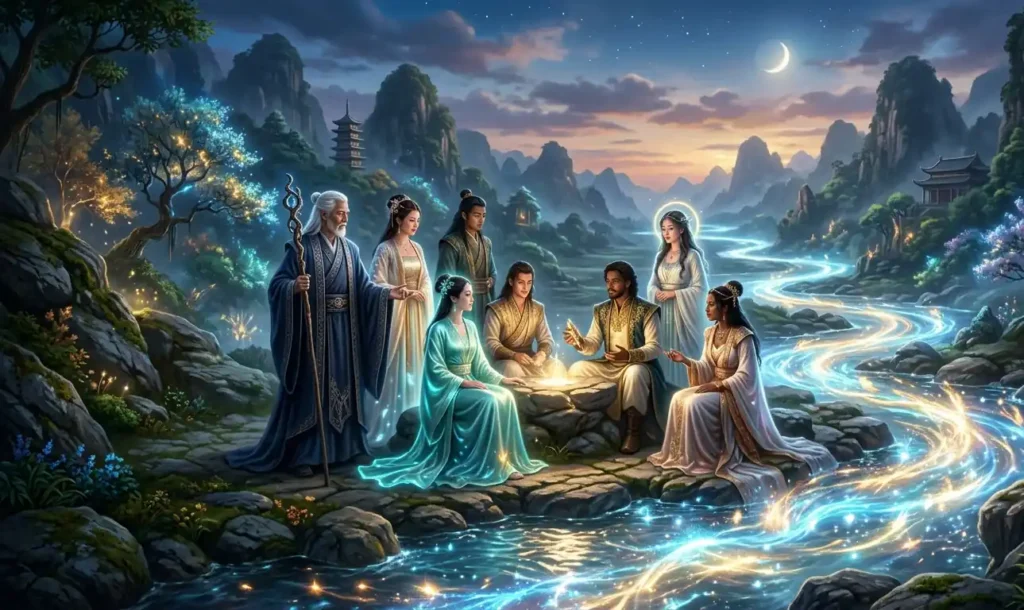
Yao Chi’s waters carry immortality associations that are distinct from but related to the immortality peaches. The pool’s waters are understood as having specific vitalizing and purifying properties, not conferring the complete immortality of the highest-tier peaches, but cleansing, renewing, and extending vitality in ways that make the pool significant in its own right.
The specific properties attributed to Yao Chi’s waters across classical texts include:
- Longevity enhancement – drinking from or bathing in the waters extends lifespan
- Spiritual purification – the jade-quality water cleanses accumulated spiritual impurities
- Clarity of perception – the pool’s waters enhance the drinker’s capacity for clear understanding
- Divine vitality – the immortal beings who gather at Yao Chi for the Pantao Banquet are renewed by the complete environment, not just the peaches
The Jade Water Logic
The water’s properties follow from the pool’s name. If jade embodies moral virtue, celestial purity, and endurance, and if the pool’s water has the quality of jade, then the water transmits those qualities.
This is Chinese cosmological thinking operating as it usually does: the name describes the nature, the nature produces the effects, and the effects reflect the name. Yao Chi’s waters do what jade symbolically represents, applied to a body of water rather than a stone.
The Famous Encounter: King Mu of Zhou at Yao Chi
The Most Important Mortal Visit
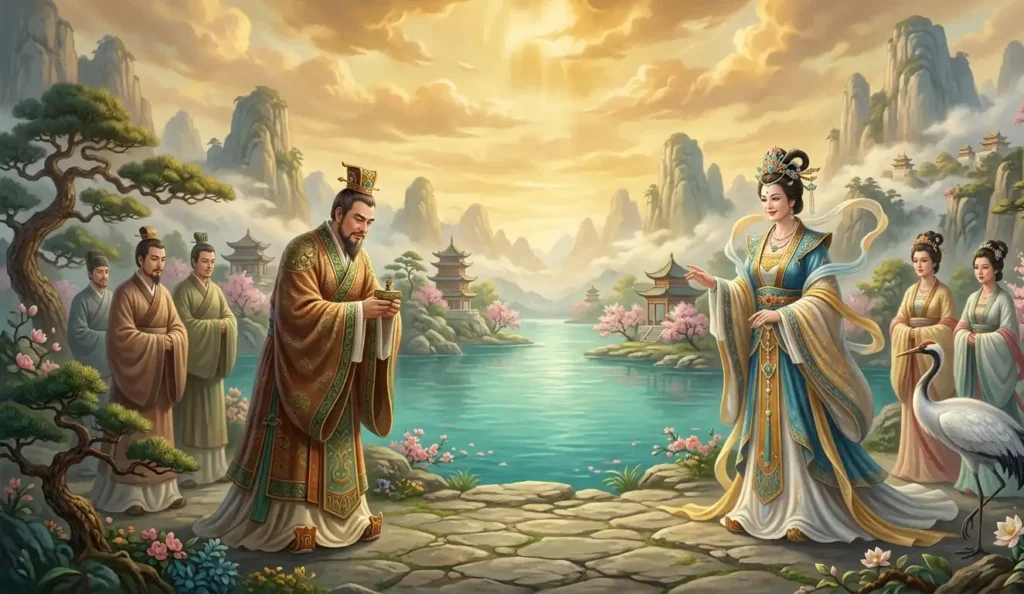
The most historically significant meeting recorded at Yao Chi is the visit of King Mu of Zhou (Zhōu Mùwáng), the legendary Zhou Dynasty monarch who drove his eight famous horses to Kunlun and met Xiwangmu at the Jade Pool.
This encounter is recorded in the Mu Tianzi Zhuan (Account of the Son of Heaven Mu), one of classical Chinese literature’s most ancient and most fascinating texts. The text was discovered in a tomb in 281 CE and is believed to date to approximately the 4th century BCE, making it one of the earliest detailed accounts of a human-divine encounter in Chinese mythology.
What Happened at Yao Chi
The Mu Tianzi Zhuan describes the meeting with unusual intimacy and detail. At Yao Chi:
- Xiwangmu received King Mu with songs. She sang to him from the pool’s edge
- King Mu responded with songs of his own
- They feasted together at the pool
- She presented him with specific gifts from her divine domain
- He expressed his desire to return
The exchange of songs is particularly significant. In classical Chinese culture, shared musical and poetic performance at a gathering is the highest form of intimate intellectual and spiritual exchange. Xiwangmu singing to the mortal king at the Jade Pool isn’t casual entertainment. It’s the most intimate form of divine-mortal contact available.
The account has a specific poignancy that I’ve always found affecting. King Mu doesn’t want to leave. The text records his expressed desire to return, to rule well enough to be invited back. Yao Chi is presented as a location so significant that reaching it once makes the mortal visitor immediately desire to reach it again.
What The Encounter Means
The Yao Chi encounter mythology establishes several important precedents:
- Mortals of exceptional virtue and royal standing can reach Kunlun and be received at Yao Chi
- The encounter produces both cosmic gifts (the divine experience itself) and practical responsibilities (King Mu is expected to rule virtuously enough to merit his having been there)
- The meeting is experienced rather than simply witnessed. Both parties are transformed by being at the pool together
This meeting template, the exceptional mortal received by Xiwangmu at the Jade Pool, becomes the standard form for significant mortal-divine encounters in the Queen Mother tradition.
Yao Chi and the Pantao Banquet
The Pool as Banquet Setting
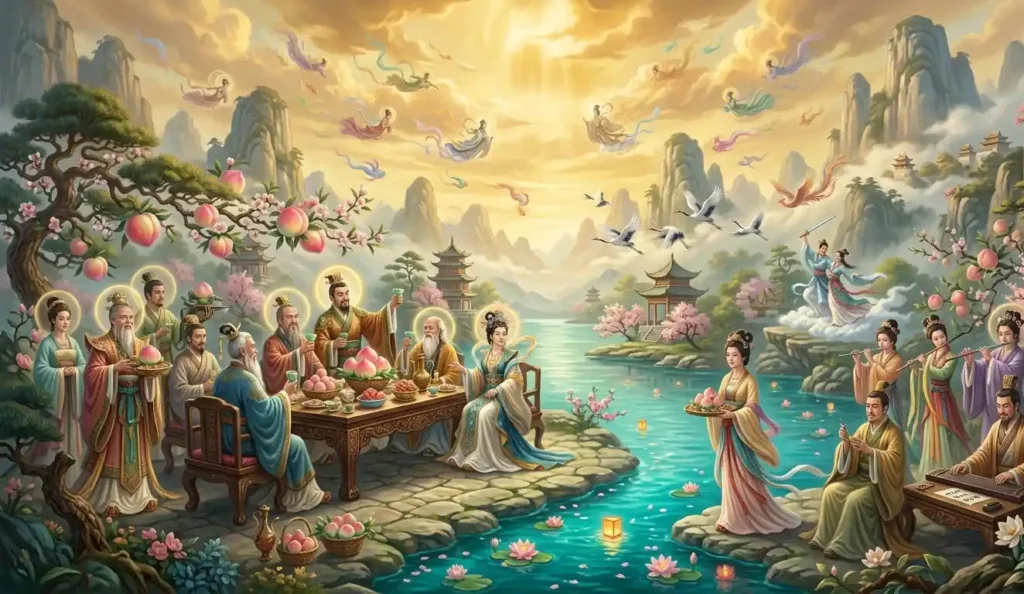
The Pantao Banquet, the divine feast that occurs when Xiwangmu’s immortality peaches ripen, takes place at Yao Chi. The pool isn’t just the location backdrop; it’s an integral element of what makes the banquet what it is.
The gathering of divine figures at the pool’s edge, the consumption of the immortality peaches in the pool’s presence, the renewal of divine vitality in this specific environment all of these are parts of a single ceremonial whole.
The pool’s renewal properties and the peaches’ renewal properties work together. The complete Pantao ceremony involves the place as much as the food.
This is why Sun Wukong’s theft of the peaches was so catastrophically disruptive. He didn’t just take the fruit. He made the complete Pantao ceremony, dependent on its setting at Yao Chi, impossible to conduct.
The Three Birds
Xiwangmu’s three blue messenger birds (qīngniǎo) are closely associated with Yao Chi. They serve as her messengers to the mortal world and return to the pool as their base. Classical accounts of Yao Chi consistently mention the birds as part of its environmental description.
The messenger birds connect Yao Chi to the broader world. They’re the point of contact between the enclosed divine environment of the pool and the ordinary world from which worthy mortals might seek audience with Xiwangmu.
Real Lakes Named Yaochi

Living Mythology in Geography
Several real lakes and pools in China carry the name Yaochi, a reflection of the living mythological tradition rather than mere historical place-naming.
The most significant is the Tianchi (Heavenly Pool) on Changbai Mountain in Jilin Province, which is sometimes referred to as Yaochi in certain religious and literary contexts. It’s a crater lake of striking beauty at high altitude, with the visual qualities that make a location feel genuinely otherworldly.
Various Daoist sacred mountains also have pools designated as Yaochi, local expressions of the mythological tradition that make the cosmic pool accessible through pilgrimage to specific earthly locations.
The practice of naming real sacred pools Yaochi reflects a specifically Chinese relationship between mythology and geography: the mythological location isn’t exclusively in an unreachable cosmic realm but has earthly expressions that can be visited, prayed at, and engaged with as genuine sacred sites.
This is mythology functioning as living religious tradition rather than historical narrative.
Frequently Asked Questions
What does Yao Chi mean in English?
Yao Chi is most accurately translated as Jade Pool or Jasper Pool, a sacred pool whose waters possess the luminous beauty of celestial jade. The character 瑤 (yáo) refers to precious, radiant jade, making Luminous Jade Pool the translation that best captures its full symbolic meaning.
Is Yao Chi the same as the Pantao Garden?
They’re closely related but distinct. The Pantao Garden is the orchard where Xiwangmu’s peaches of immortality grow. Yao Chi is the sacred pool within her Kunlun palace complex, where she receives guests and hosts the Pantao Banquet. Both belong to the same divine realm but serve different purposes in the mythology.
Can mortals visit Yao Chi?
In the mythology, yes, but only those of exceptional virtue, spiritual attainment, or royal stature. To reach Yao Chi, visitors must journey to Kunlun and overcome its many barriers, including rivers of weak water, burning mountains, and supernatural guardians. These trials separate worthy seekers from ordinary mortals. King Mu of Zhou is the most famous mortal said to have been received by Xiwangmu.
Are there real places called Yaochi?
Yes. Several lakes and pools across China bear the name Yaochi as sacred designations. Often found at Daoist holy sites, these places serve as pilgrimage destinations and are regarded as earthly reflections of the mythological Yao Chi. They are believed to embody a closer connection to Xiwangmu’s realm, where the boundary between the mortal and divine worlds feels especially thin.
What does Yao Chi symbolize?
Yao Chi symbolizes spiritual attainment, divine wisdom, immortality, and the meeting point between the earthly and celestial realms. It is often portrayed as a place of transformation, blessing, and sacred communion.
Final Thoughts

Yao Chi rewards careful attention for the same reason that the best mythological locations always do. It’s doing more than providing a setting.
The name describes a theology of water that has jade’s qualities. The location at Kunlun places it at the cosmic threshold. The encounters that occur there, mortal kings received by the divine Queen Mother, immortals renewed at the Pantao Banquet, messenger birds returning from their journeys to the world, are all shaped by the pool’s specific character as a threshold between ordinary and divine.
Twenty years of following mythology has made me particularly attentive to threshold locations, the places where the membrane between worlds is thinnest and where the most significant encounters occur.
Yao Chi is one of the finest examples I’ve encountered in any tradition. Still, clear, jade-luminous, at the world’s centre, guarded by a divine Queen and her blue birds. The place where exceptional mortals discover what ordinary life can’t contain, and where divine beings discover what renewal requires.
Some pools are just water. Yao Chi is something else entirely.
Related Articles
- Pantao Banquet: Queen Mother of the West’s Heavenly Feast
- The Peaches of Immortality: The Sacred Fruit of Eternal Life
- Kunlun Mountains: The Sacred Home of China’s Queen Mother
References
- Birrell, Anne. Chinese Mythology: An Introduction.
- Kohn, Livia. Daoism and Chinese Culture.
- Shanhaijing (Classic of Mountains and Seas).
- Journey To The West
- The Taoist Body – Kristofer Schipper
- Eberhard, Wolfram. A Dictionary of Chinese Symbols.
- Lewis, Mark Edward. The Construction of Space in Early China.
- Mu Tianzi Zhuan
- Daozang – Daoist Canon
- The Legend of Chang’e and Hou Yi
- Yun Ji Qi Qian
- Chu Ci – Chinese Text Project
Written by Batin Khan | Mythology and philosophy reader across world cultures (20 years), Cultivation novels reader for the past 10 years | Specialist in Xianxia, Eastern and Western mythological traditions, and fantasy worldbuilding