
 By
By Takeaways:
- Fafnir gave the trope its psychology, greed transforming a person into a monster, but he isn’t the oldest surviving hoarding dragon in the written record.
- That distinction belongs to the unnamed dragon in Beowulf, generally considered the first fire breathing, treasure hoarding dragon documented in European literature.
- Beowulf itself contains an earlier reference to the Fafnir story under a different name, which means these two traditions were never actually separate.
- Tolkien, a professional Beowulf scholar, fused both dragons directly into Smaug, and Smaug is the reason the modern trope looks the way it does.
- I’ll flag exactly where the evidence gets uncertain rather than pretend this question has one clean answer.
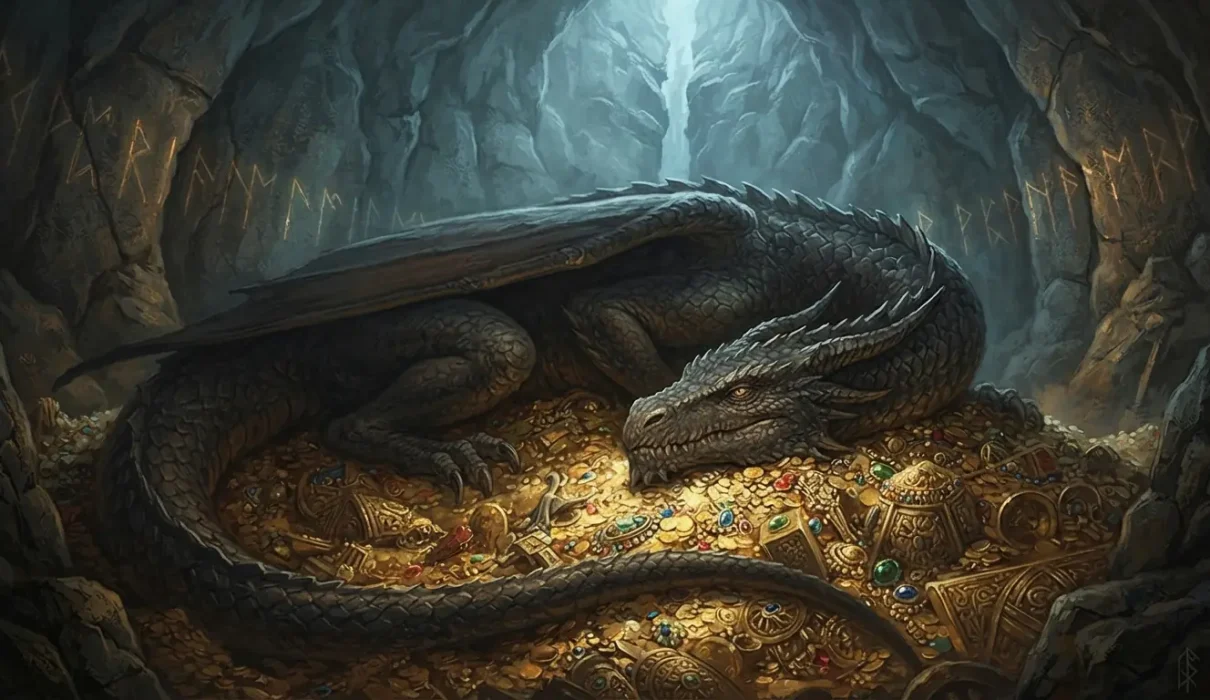
Many people think that Fafnir is the answer to why dragons hoard gold. But they are only half right. Fafnir gave the hoarding dragon its psychology.
He didn’t give it its first appearance in writing. That distinction sounds minor until you look at Beowulf, where a dragon is already sitting on a treasure hoard centuries before the surviving Fafnir texts were written down. The best part is that Tolkien knew both traditions, and Smaug looks like the place where the two finally come together.
Fafnir’s Actual Story
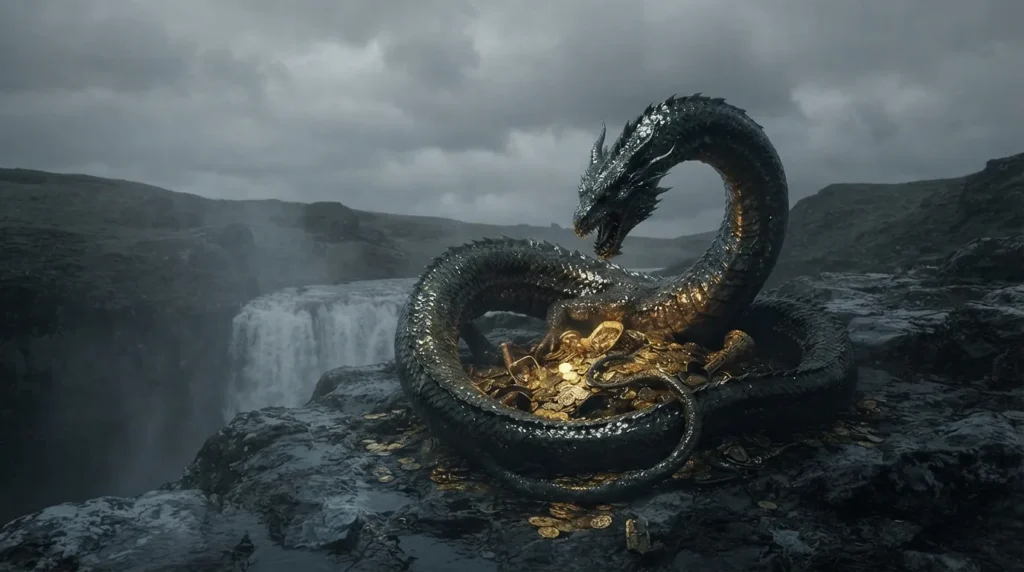
Fafnir starts the Volsung Cycle as a person, not a dragon. He murders his own father, Hreidmar, specifically to seize a cursed treasure hoard that had belonged to the dwarf Andvari before Loki forcibly took it. Greed is the entire motive, stated plainly.
He then shapeshifts into a dragon form specifically to guard what he’s stolen, and it’s this detail that makes him so useful to later writers.
The transformation isn’t incidental. It’s presented as what unchecked greed literally does to a person.
The fullest surviving versions of this, the Fáfnismál in the Poetic Edda and the Völsunga Saga, come down to us in a thirteenth century Icelandic manuscript. Scholars including Christine Rauer note the underlying material is almost certainly older, but the writing we actually have dates to that century specifically.
The Older Dragon Nobody Credits Enough
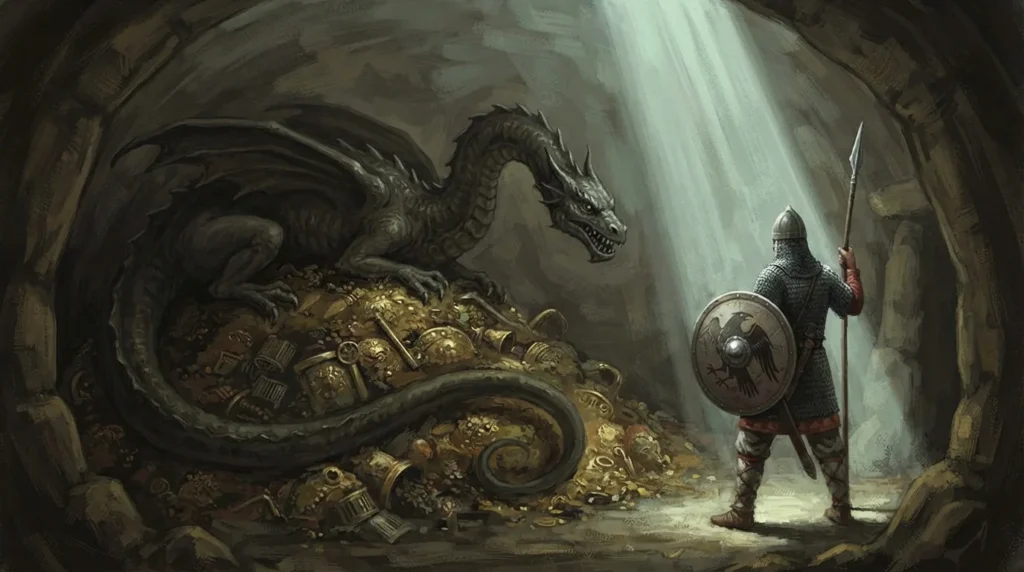
Beowulf is generally considered the earliest surviving European literary depiction of a fire-breathing dragon guarding a treasure hoard. By the time the poem begins, its dragon has guarded the barrow for three hundred years. Then an enslaved man steals a single cup from the hoard, the dragon discovers the theft, and its retaliation devastates the surrounding land.
If you’ve read The Hobbit, that sequence should sound familiar. Bilbo also steals a single cup from a sleeping dragon’s hoard, and Smaug responds by hunting for the thief before turning his fury on Lake-town.
The similarity isn’t simply that both dragons own treasure. Tolkien took one of the most distinctive sequences in Beowulf and rebuilt it around Smaug.
But Beowulf doesn’t give Tolkien everything. Its dragon has no human past and no explanation for why it became a hoarder. Fafnir does. He begins as a man whose greed for treasure leads him to murder and ultimately become a dragon.
Beowulf gives Smaug the mechanics; Fafnir gives him the psychology.
The Twist Almost Nobody Mentions
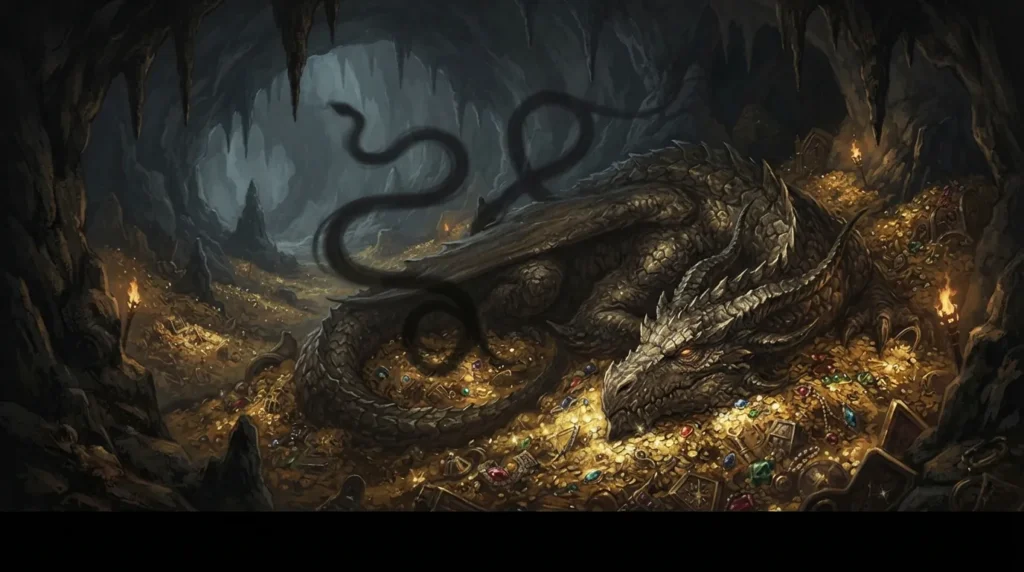
The detail that complicates any clean version of this story. Beowulf itself contains an earlier passage describing a dragon slain by a hero named Sigemund, and scholars have long recognized this as the earliest known reference to the Volsung dragon slaying legend, the same story tradition that later produces Fafnir and Sigurd.
The catch is that later Norse sources credit the killing to Sigurd, Sigemund’s son, not Sigemund himself. Scholars read this discrepancy two ways, either as an error by the Beowulf poet, or as evidence of parallel oral traditions circulating before either poem was written down.
Either reading points to the same conclusion. These weren’t two separate dragon traditions that happened to resemble each other. They’re branches of one older Germanic story, already in circulation, that both poems were drawing on independently.
What Fafnir Actually Contributed That Beowulf Didn’t
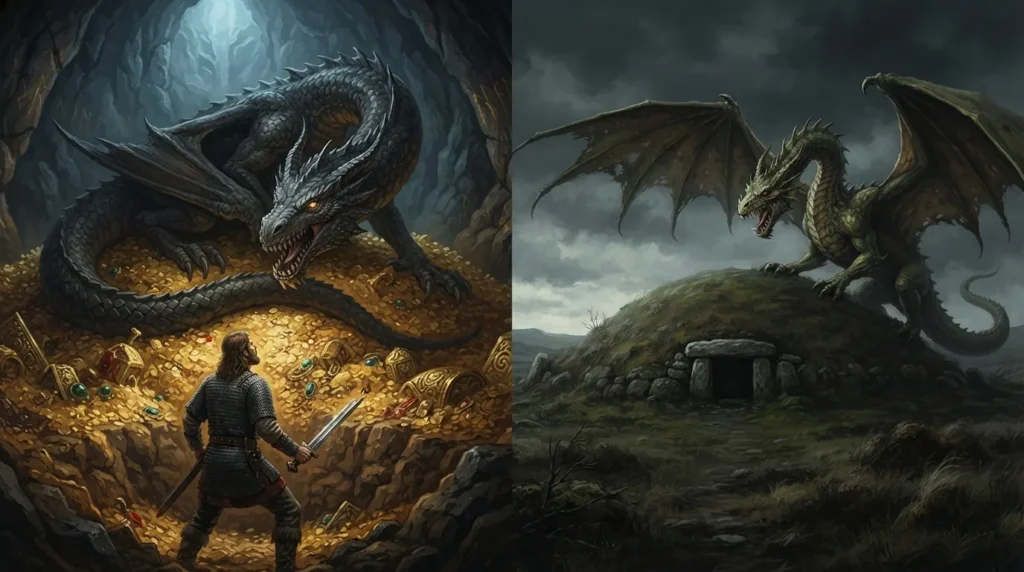
So if Beowulf’s dragon came first in writing, why does the title’s instinct, that this started with Fafnir, still feel worth taking seriously? Because the two dragons aren’t doing the same narrative job.
Beowulf’s dragon has no given backstory as a person. It’s simply an ancient guardian, night prowling and vengeful once disturbed, but the poem never tells you it used to be anything else. Its hoarding reads as its established nature rather than a consequence of anything.
Fafnir’s hoarding is explicitly a moral event. He was a person. He chose murder for gold. The dragon body is what that choice cost him. That’s a specific, transferable idea, greed as literal transformation, that Beowulf’s dragon simply doesn’t offer.
Modern fantasy inherited Fafnir’s version of this idea rather than Beowulf’s. When a story wants its dragon’s hoarding to mean something about the dragon’s own character, it’s reaching for Fafnir’s structure even when nobody involved has read the Volsunga Saga directly.
Tolkien Fused Both, on Purpose
| Feature | Fafnir | Beowulf dragon | Smaug |
|---|---|---|---|
| Treasure hoard | ✓ | ✓ | ✓ |
| Dragon guards stolen treasure | ✓ | — | ✓ |
| Human → dragon transformation | ✓ | — | — |
| Stolen cup triggers attack | — | ✓ | ✓ |
| Dragon speaks | ✓ | — | ✓ |
| Hero enters/approaches hoard | ✓ | ✓ | ✓ |
| Greed/corruption as theme | ✓ | weaker | ✓ |
J.R.R. Tolkien wasn’t guessing at any of this. He was one of the twentieth century’s most respected Beowulf scholars, and he stated directly that only two dragons in Northern European literature actually mattered to him as a writer, Fafnir and the dragon of Beowulf.
Smaug is the visible result of taking both seriously at once. The stolen cup, the three hundred years of undisturbed guardianship, the fury at discovering theft, all come from Beowulf.
The specific idea that gold corrupts whoever holds it, dramatized directly through Thorin’s own descent into what Tolkien’s narration calls dragon sickness once he reclaims the same hoard, comes from Fafnir.
That fusion is why Smaug reads as more than either source dragon alone. He has Beowulf’s age and menace and Fafnir’s psychology, and every hoarding dragon written since owes something to that specific combination whether the author knows it or not.
Why the Psychological Version Won
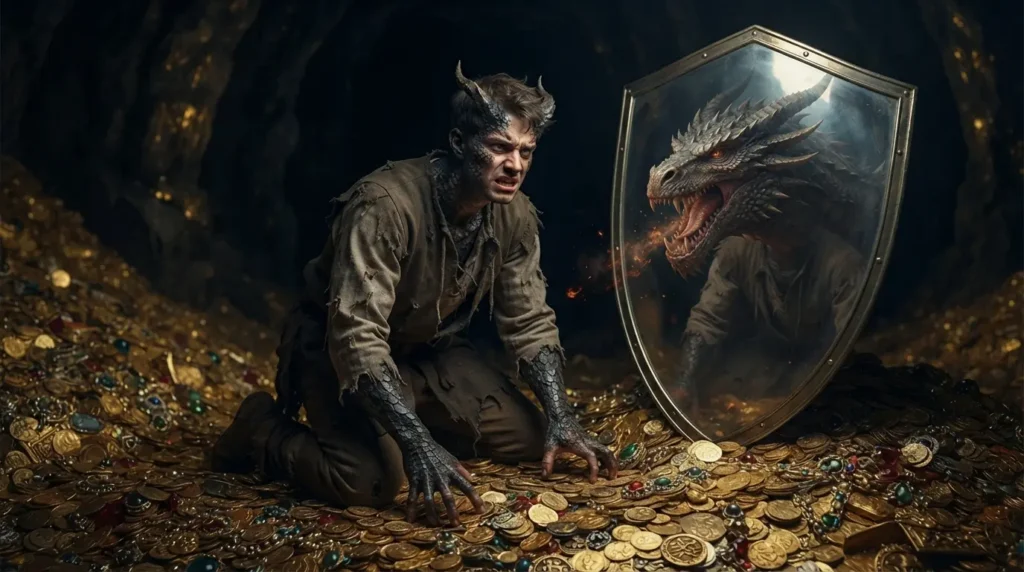
I think the reason Fafnir’s contribution outlasted Beowulf’s in popular imagination comes down to what a story actually needs a dragon’s hoard to do. A dragon that simply is a hoarder gives you a monster. A dragon whose hoarding proves that greed physically remakes a person gives you a warning.
Warnings travel further than descriptions. Tolkien clearly understood this, since the Ring of Power itself works on exactly the same logic Fafnir’s cursed gold does, corrupting whoever holds it regardless of their original character. That idea recurs across his entire body of work, not just in the dragon.
Tolkien’s treatment of the dragon makes this psychological dimension especially visible in modern fantasy. A dragon that’s just dangerous ends when you kill it. A dragon whose danger is a mirror for what greed does to anyone keeps working long after the specific creature is gone.
An Honest Counterargument
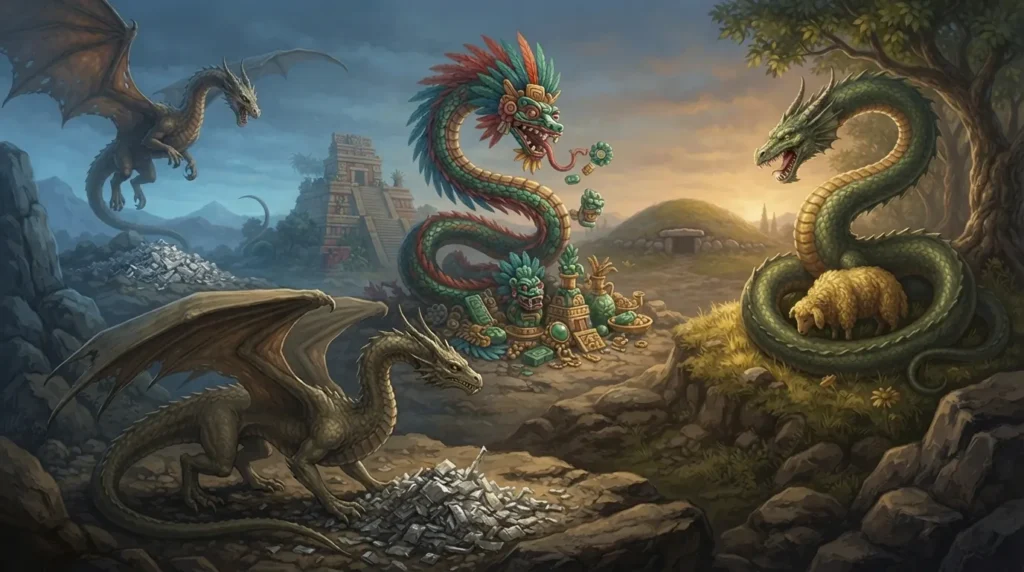
I want to push back on my own framing here, because there’s a real version of this argument that doesn’t fully agree with me.
Some scholars would say the Sigemund passage inside Beowulf makes the whole question of which dragon came first almost meaningless, since both poems are plausibly drawing on the same older oral material we simply don’t have direct access to.
If that’s true, then neither Fafnir nor Beowulf’s dragon actually started anything. They’re both downstream of a Germanic dragon tradition old enough that its true origin point is permanently lost to us, and crediting either surviving text as the beginning is really just crediting whichever one happened to survive the accidents of manuscript preservation.
I think that’s a fair objection, and I don’t think it fully undermines the more specific claim this article is actually making. Even if the raw idea of a hoarding dragon predates both texts, Fafnir’s specific contribution, the person to dragon transformation through greed, is the part later fantasy actually kept.
Whoever first told that version of the story, it’s the version that won.
Frequently Asked Questions
Is the Beowulf dragon named in the original poem?
No. The Old English text refers to it only as draca, meaning dragon, and wyrm, meaning serpent, without giving it a personal name, which distinguishes it from Fafnir, whose name and personal backstory are central to how his own story functions.
Did Fafnir invent the idea of a dragon hoarding gold?
Not exactly. Beowulf already contains a dragon guarding a treasure hoard, while Fafnir provides a different idea: a human transformed into a dragon through greed and obsessed with the treasure he acquired. Both traditions appear to preserve older Germanic material whose original beginning is unknown.
What makes Fafnir different from the dragon in Beowulf?
Fafnir begins as a human being whose greed for treasure leads him to murder and eventually become a dragon. The Beowulf dragon has no comparable human backstory. Its hoarding is presented as part of its established nature rather than the result of a transformation.
Why does the stolen cup in Beowulf matter?
The stolen cup creates one of the clearest parallels between the Beowulf dragon and Tolkien’s Smaug. In both stories, someone removes a cup from a dragon’s treasure hoard, the dragon discovers the theft, and its anger leads to violent attacks against the surrounding population.
Did Tolkien deliberately base Smaug on Fáfnir?
Smaug reflects several older dragon traditions rather than simply copying Fafnir. Tolkien drew strongly on Beowulf for the stolen cup, treasure hoard, and dragon’s retaliation, while Fafnir provides an important model for the relationship between treasure, greed, corruption, and dragonhood.
Did Fafnir influence Tolkien’s One Ring?
The similarities between Fafnir’s cursed treasure and Tolkien’s corrupting objects are striking, but direct influence should not be presented as proven without Tolkien’s own statement. Both traditions connect possession with corruption and destruction, making the comparison interesting even when the exact relationship cannot be established.
Final Thoughts

Fafnir gave the hoarding dragon its conscience, the idea that gold doesn’t just attract monsters, it makes them. Beowulf gave it its age and its fire. Tolkien is the reason you got both at once.
The next time someone tells you the trope started with one single myth, you’ll know the real answer involves two poems, a shared oral tradition neither one fully explains, and a professional medievalist who happened to also be one of the best fantasy writers of the twentieth century.
Sources & Further Reading
- Beowulf – Fordham University
- The Hoard Makes the Dragon: Fáfnir as a Shapeshifter – Shapeshifters in Medieval North Atlantic Literature
- The Story of the Volsungs, (Volsunga Saga)
- The Poetic Edda
- The Lay of Sigemund – Medieval Studies Research Blog: Meet us at the Crossroads of Everything
- Beowulf: The Monsters and the Critics – John Ronald Reuel Tolkien
- The Hobbit – J.R.R. Tolkien
- The Letters of J.R.R. Tolkien – J.R.R. Tolkien
- Putting the Spotlight on Smaug
Related Articles
- Dragon Mythology: How Dragons Are Depicted Across Cultures
- Chinese, Japanese & Korean Dragons: How They Actually Differ
- What If Dragons Were Real? Here’s What Would Happen
- Why Dragons Are Almost the Perfect Mythological Creature
- 14 Most Iconic Anime Dragons You Should Recognize
- 15 Elemental Dragon Types in Fantasy: Fire, Ice & Beyond
- What Is the Largest Dragon in Mythology? [Real Answer]
- Why Are So Many Mythical Creatures Hybrids?
Written by Batin Khan, a curious free spirit who loves reading and exploring the worlds of fantasy, mythology, and ancient stories. Through this blog, Batin hopes to share that sense of wonder with readers while building an exciting future along the way.