
 By
By Largest Dragon is a measurement question, and mythology almost never measures anything. Jörmungandr encircles the world. Tiamat becomes the world. Typhon’s head brushes the stars. Evocative, all of it, and completely useless if you’re trying to compare them.
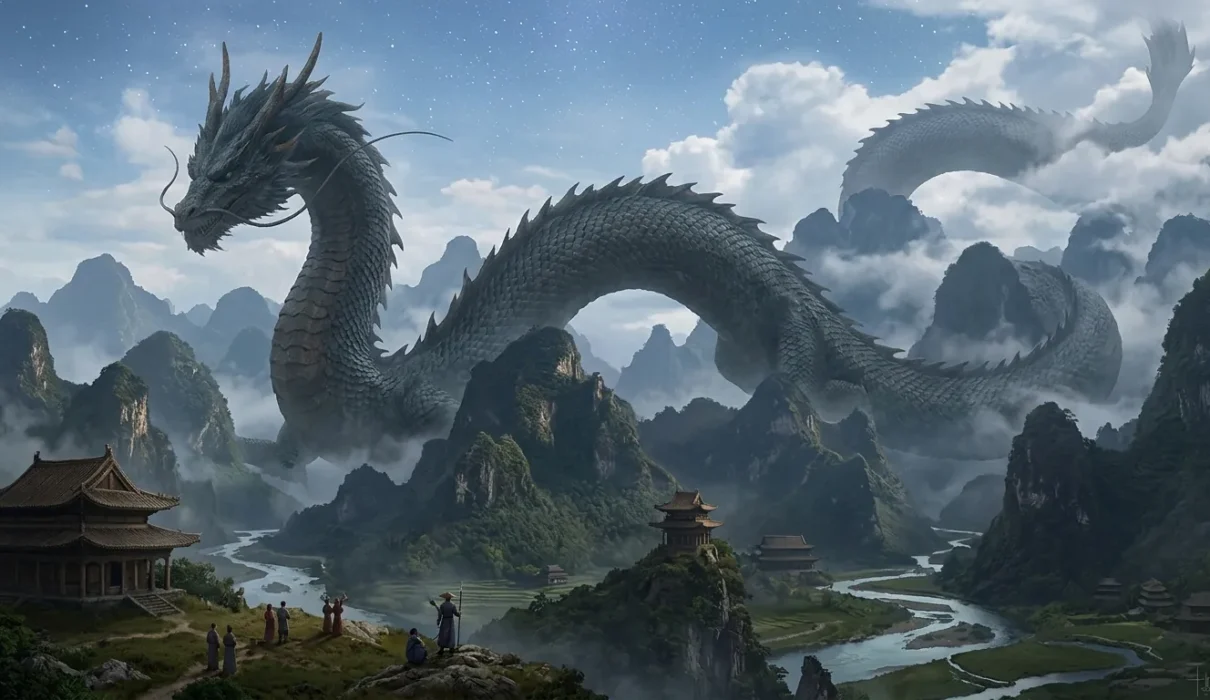
One tradition broke that pattern and gave an actual figure. That figure belongs to a Chinese dragon most Western readers have never heard of.
Why The Largest Dragon Question Is Harder Than It Sounds
Ancient Texts Describe Function, Not Dimensions
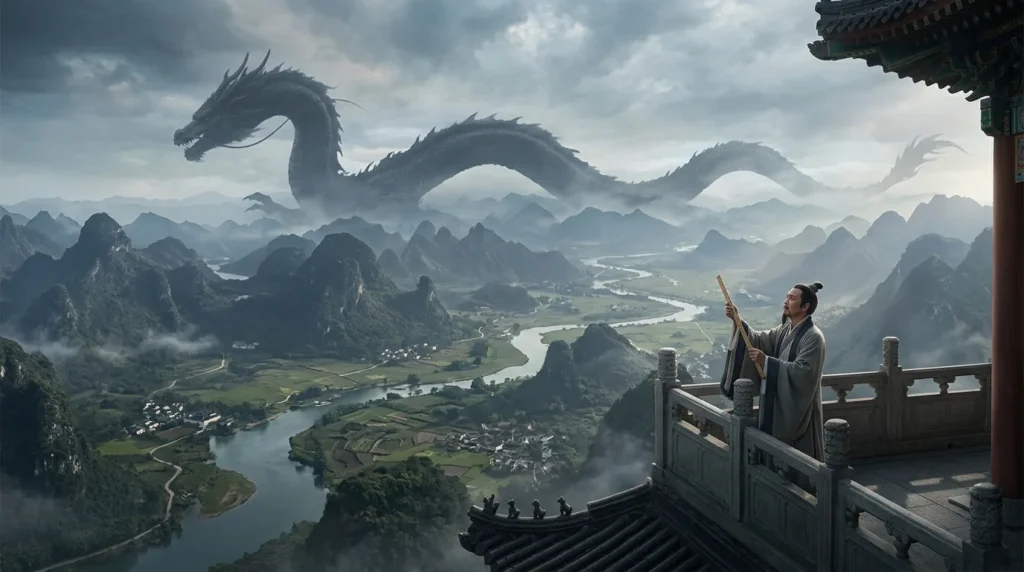
Mythological sources tell you what a creature does and what it means. They rarely tell you how long it is, because length was never the point. A dragon that encircles the earth is making a cosmological claim, not submitting to a survey.
Three Different Ways to Answer
You can answer by recorded measurement, meaning an actual number written in an actual ancient text. You can answer by implied scale, meaning descriptions that suggest enormous size without quantifying it.
Or you can answer by cosmological function, meaning how much of reality the creature actually constitutes.
Those three approaches produce three different winners, and the first one produces the clearest answer by a considerable margin.
The Winner by Recorded Measurement: Zhulong
Where the Text Comes From
The Shanhaijing, the Classic of Mountains and Seas, was compiled over an extended period generally placed from the Warring States era through the early Han dynasty, roughly the fourth century BCE through the second century BCE.
It records this dragon twice, under two names. The Classic of the Great Wilderness: North describes Zhulong at Mount Zhangwei, beyond the northwest sea and north of the Red River. The Classic of Regions Beyond the Seas: North describes Zhuyin at Mount Zhong.
The Jin dynasty commentator Guo Pu identified the two as the same being, and that identification has held in most scholarship since.
The Number
The Overseas North passage states it plainly. His body is a thousand li long.
That’s a real figure in a real text, not an inference. The li has varied across Chinese history, running roughly 415 to 420 meters during the Han dynasty and standardized at 500 meters in modern usage.
Applying either figure, a thousand li puts Zhulong somewhere around 400 to 500 kilometers in length. However, there is a strong reason not to treat that conversion as an actual physical measurement; more on that later.
What That Looks Like
Roughly the length of Iceland measured east to west. Longer than England is from its northern border to the south coast. About the distance from London to Newcastle, or from Paris to Lyon.
Laid along a coastline, this dragon would take most of a full day to drive past at highway speed.
The Rest of the Description
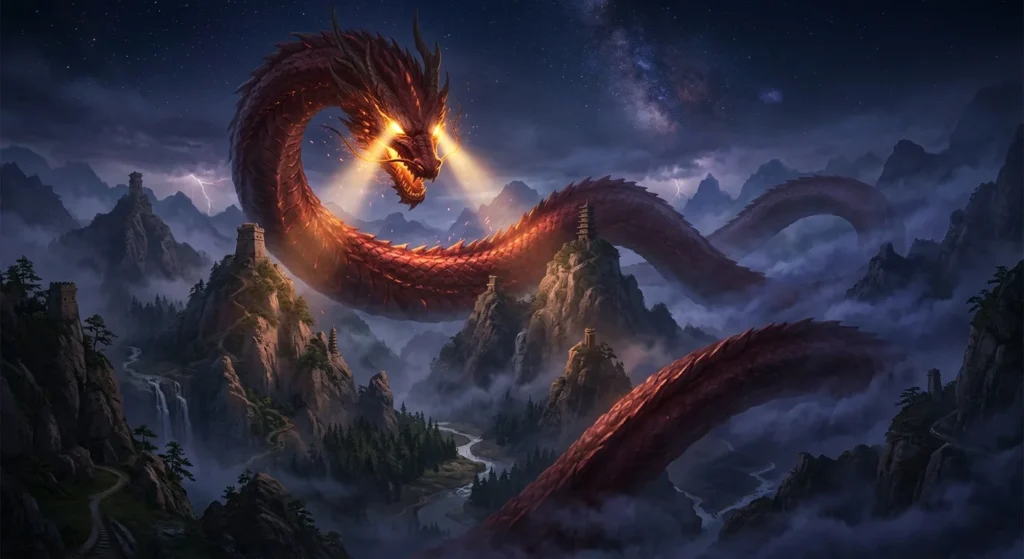
Sinologist Anne Birrell’s translation renders the Great Wilderness passage with unusual specificity. The creature has a human face, a serpent’s body, and is entirely scarlet. Its eyes are vertical, set in a straight seam.
When it closes those eyes, there is darkness. When it opens them, there is light. It neither eats, sleeps, nor breathes, and wind and rain answer to it.
The Overseas North version adds seasonal control. When it blows, winter comes. When it calls out, summer follows. If this god does breathe, the text says, there are gales.
The Name Carries the Meaning
The key character is 燭, zhú, meaning torch or shining. In Zhulong, it modifies 龍, lóng, dragon, producing a torch-bearing or torch-like dragon.
In Zhuyin, it sits beside 陰, yīn, covering both ordinary darkness and the feminine principle of yin and yang. Birrell renders this as Torch Shade. The earlier scholar Marinus Willem de Visser translated it as Enlightener of the Darkness.
The text describes it shining its torch over the jiuyin, the ninefold darkness, which is precisely why the dragon name gets used rather than the shade name in that passage.
The Competitors and Where They Fall Short
Jörmungandr Has No Number at All
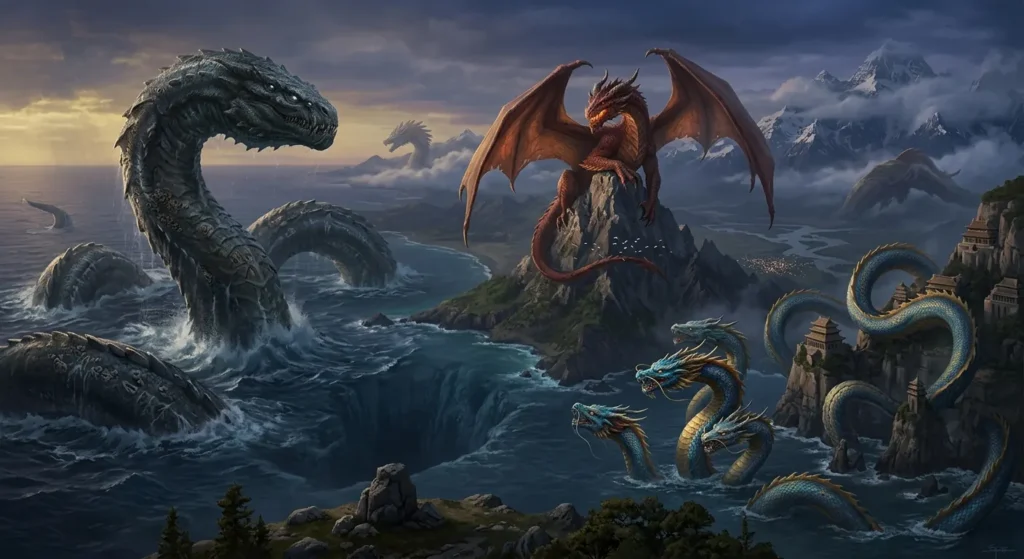
The Midgard Serpent grew large enough to encircle the entire world of men and grip its own tail, according to Norse tradition preserved in the Prose Edda.
That could imply something far larger than 500 kilometers, depending entirely on how you define the world being encircled. But the sources never say. The claim is structural, not dimensional, and no amount of interpretation turns it into a figure you can compare.
Typhon Is Described, Not Measured
Apollodorus describes Typhon as exceeding all mountains in size, with his head frequently brushing the stars and his outstretched arms reaching from the eastern to the western horizon, topped with a hundred dragon heads.
That’s genuinely vivid, and it’s also a description of proportion rather than length. You can picture it. You can’t compare it against 1,000 li.
Tiamat Doesn’t Have a Size Because She Has a Function
The Enuma Elish describes Marduk splitting Tiamat’s body after defeating her, using one half to form the sky and the other to form the earth.
She has no recorded measurement because measurement doesn’t apply. She isn’t a creature inside the world. She’s the material the world was made from, which is a genuinely different kind of claim than any figure could capture.
Why Only China Produced a Number

This is the part I find most genuinely interesting, and I think the answer sits in the source texts’ own genre rather than in anything about the dragons themselves.
The Shanhaijing Is Organized Like a Survey
Read the Shanhaijing’s structure and it behaves less like a mythology and more like a geographic gazetteer. It moves systematically through regions, listing mountains, rivers, the countries beyond specific seas, and the deities resident in each location.
The Zhulong passages sit inside exactly that framework. He appears as the deity of a named mountain, positioned relative to a named river and a named neighboring country, in a text whose whole organizing logic is spatial.
Geographic Texts Produce Measurements. Narrative Poetry Doesn’t.
Hesiod’s Theogony is a genealogy. The Prose Edda is a narrative compilation. The Enuma Elish is a liturgical creation epic. None of them is structured around describing where things are in relation to each other.
A text organized around geography naturally generates dimensional data, because that’s what geographic description requires. A text organized around lineage or narrative doesn’t need it and doesn’t supply it.
So Zhulong may hold the record less because Chinese mythology imagined larger dragons than anyone else, and more because Chinese mythology happened to record its dragons inside a text type that measures things.
A Thousand Li Is Probably Idiomatic
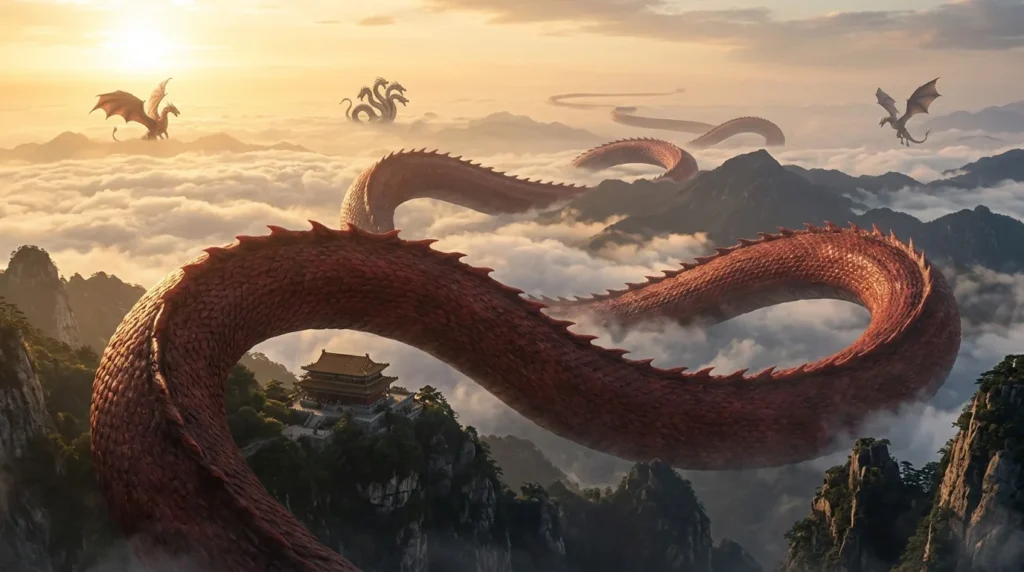
Here’s the problem with treating that figure as a literal survey measurement. Classical Chinese uses 千里, a thousand li, as a conventional expression for vastness rather than a precise quantity.
The famous proverb about a journey of a thousand li beginning with a single step isn’t specifying a 500 kilometer walk. It means a long journey, full stop.
Applied to Zhulong, a thousand li may well mean immeasurably long rather than four hundred and something kilometers. Which would make my entire measurement-based ranking a modern reading imposed on a phrase that was never meant to be taken with a ruler.
Which Means Tiamat Might Win
If the number isn’t literal, then comparison has to fall back on implied scale, and on that basis Tiamat has the strongest claim available.
Jörmungandr encircles the world. Typhon spans it from horizon to horizon. Tiamat’s body becomes it. A creature whose corpse constitutes the sky and earth is larger, in any meaningful sense, than one that merely wraps around them.
I still think the Zhulong answer is worth giving, because it’s the only figure anyone actually wrote down and that fact is genuinely interesting.
I just don’t think it survives scrutiny as a literal claim, and pretending otherwise would be the kind of confident nonsense this blog tries to avoid.
What This Reveals About Reading Mythology

The question assumes myth works like a record book, with entries that can be sorted and ranked. It doesn’t.
Scale in mythological texts is functional rather than dimensional. Zhulong is a thousand li long because he governs the boundary between day and night across the entire northern reach of the world, and a creature doing that job has to be described as vast.
The number isn’t a fact about his body. It’s a statement about his jurisdiction, and reading it as a measurement tells you more about modern habits of mind than about what the Shanhaijing’s compilers thought they were recording.
Frequently Asked Questions
Is Zhulong connected to the Chinese Dragon Kings or the Four Holy Beasts?
No. Zhulong belongs to a separate, older cosmological stratum recorded in the Shanhaijing, distinct from both the administrative Dragon Kings governing rainfall under the Jade Emperor’s court and the directional Four Symbols of Chinese astronomy.
Does Zhulong appear in any classical Chinese poetry outside the Shanhaijing?
Yes. The Chu Ci, the Songs of Chu, references the figure in its Tian Wen or Heavenly Questions section, posing a rhetorical question about the northwestern region where the heavens open, indicating the tradition circulated beyond the Shanhaijing alone.
What is the ninefold darkness that Zhulong illuminates?
The jiuyin refers to a layered or ninefold conception of darkness in early Chinese cosmology, associated with the shadowy far north and the underworld, which is why the illuminating torch dragon name is used in that specific passage.
Did Zhulong have any offspring in Chinese mythological tradition?
Some sources record a son named Gu, though this figure receives a lot less development than Zhulong himself and appears mainly in genealogical mentions rather than in narratives with any substantial content of their own.
Is there a Japanese or Korean equivalent to Zhulong specifically?
Not a direct one. Zhulong’s specific cosmological function (generating day and night through his eyes from a fixed northern mountain) doesn’t have a clear counterpart in Japanese or Korean dragon tradition, both of which lean a lot more toward water and sea associations.
Final Thoughts
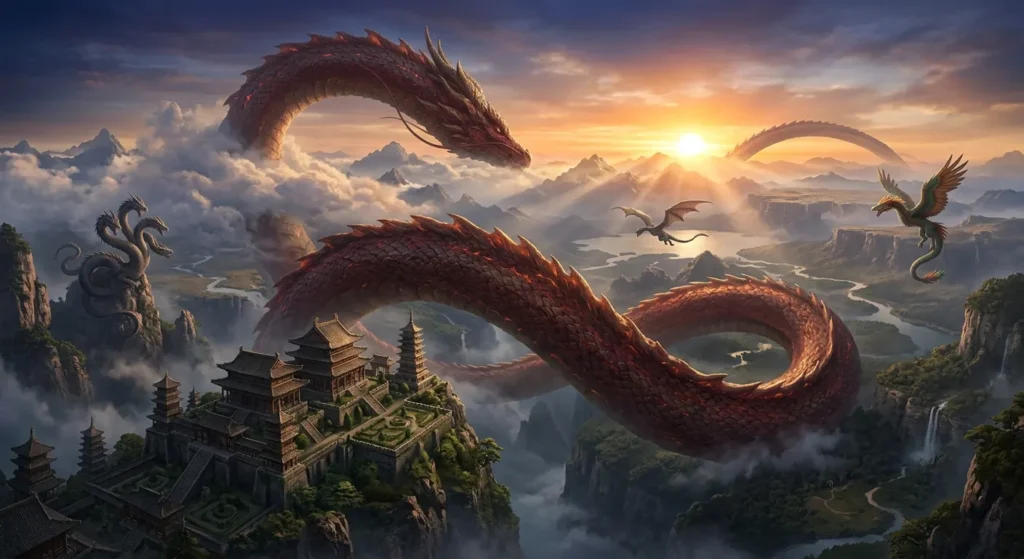
Four hundred kilometers of scarlet serpent lying somewhere north of the Red River, eyes opening to make the day and closing to end it, breathing out the seasons without ever needing to eat or sleep.
That’s the only dragon in world mythology anyone bothered to measure, and the measurement almost certainly means nothing more precise than enormous. Which is, honestly, the most mythologically appropriate answer this question could possibly have.
Sources & Further Reading
- Shan Hai Jing – Chinese Text Project
- Apollodorus, Library, book 1
- Enuma Elish: English Translation (L.W. King, 1902)
- The Poetic Edda
- HESIOD, THEOGONY
- Anne Birrell – The Classic of Mountains and Seas by Anonymous
Related Articles
- Dragon Mythology: How Dragons Are Depicted Across Cultures
- Chinese, Japanese & Korean Dragons: How They Actually Differ
- 10 Eastern Dragon Legends Still Shaping Fantasy Today
- Why Dragons Are Almost the Perfect Mythological Creature
- What If Dragons Were Real? Here’s What Would Happen
- 14 Most Iconic Anime Dragons You Should Recognize
- 15 Elemental Dragon Types in Fantasy: Fire, Ice & Beyond
- 11 Oldest Dragons in World Mythology: Sumeria to China
Written by Batin Khan, a curious free spirit who loves reading and exploring the worlds of fantasy, mythology, and ancient stories. Through this blog, Batin hopes to share that sense of wonder with readers while building an exciting future along the way.