
 By
By Ancient Chinese tradition never fully settled on one explanation for why day follows night.
It kept two, truly different mechanisms, running side by side for centuries, and neither text that preserves them ever bothers reconciling the contradiction. I want to actually sit with why that’s possible, using Zhulong specifically as the entry point.
The Dragon Who Runs Day and Night Like a Switch
What the Shanhaijing Actually Says
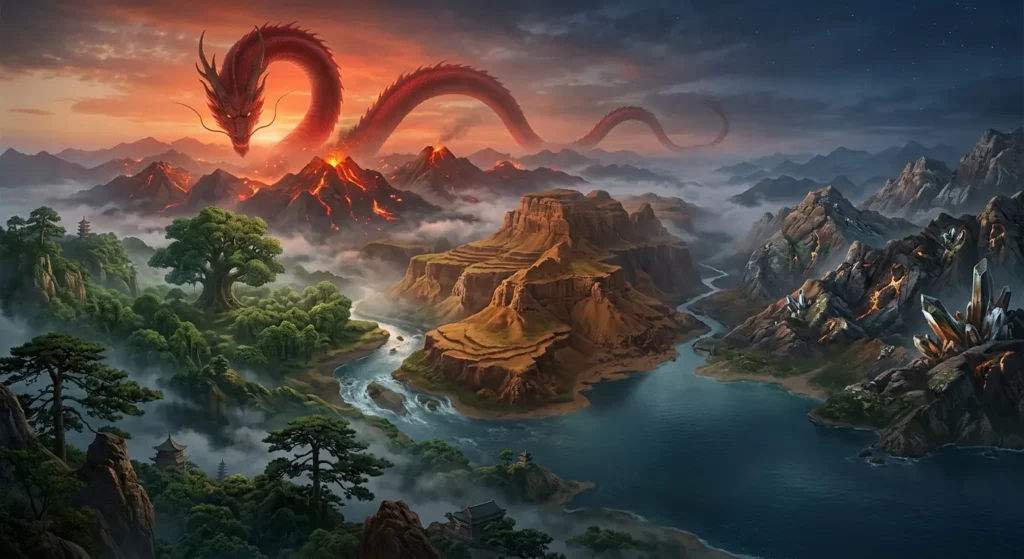
The Shanhaijing, compiled from roughly the fourth century BCE through the early Han dynasty, records this dragon twice, as Zhulong in the Classic of the Great Wilderness: North and as Zhuyin in the Classic of Regions Beyond the Seas: North.
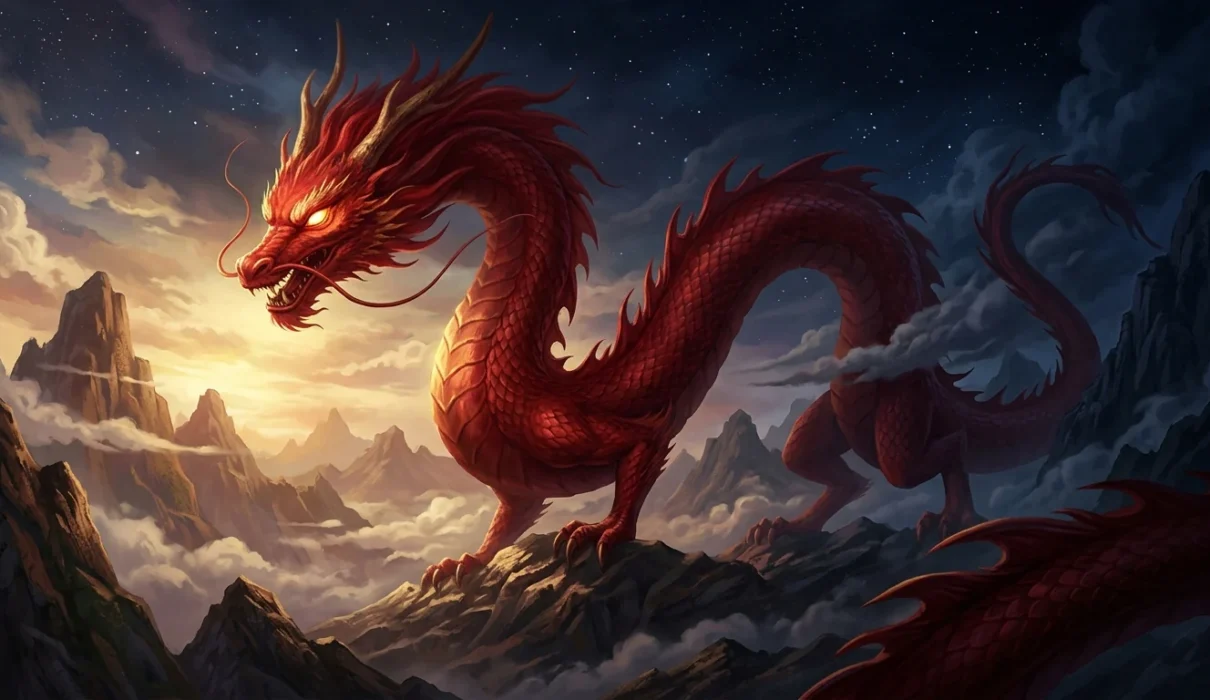
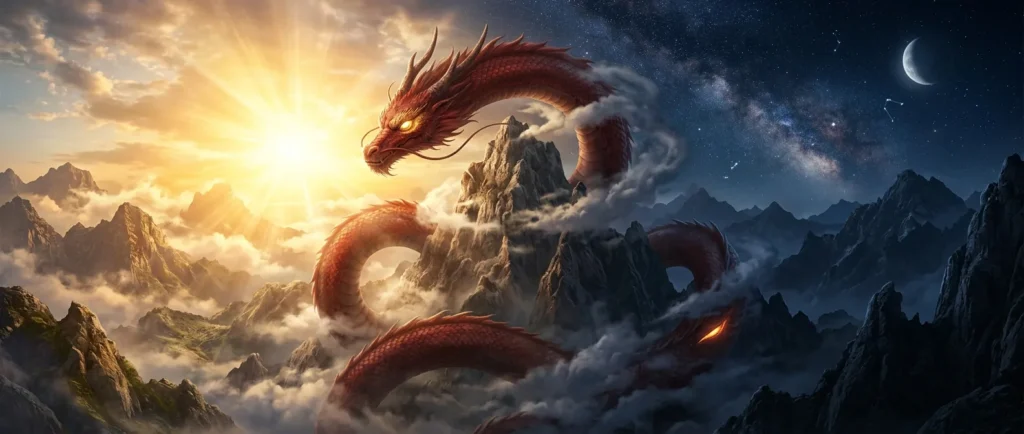
Scholar Anne Birrell’s translation describes a scarlet, serpentine body with a human face and vertical eyes set in a straight seam.
The mechanism is stated directly rather than left to inference. When the eyes close, there is darkness. When they open, there is light. The text adds that when the creature blows, winter comes, and when it calls out, summer follows.
This Is a Continuous, Ongoing Process
Notice the tense the myth actually uses. Zhulong’s control over day and night isn’t a completed event sitting in the past. It’s a repeating, present tense action, something the dragon is still doing every single time the eyes open or close, indefinitely.
That’s the detail worth holding onto before moving to the comparison, because it changes everything about how this myth actually functions cosmologically.
Pangu’s Eyes Do the Same Job a Completely Different Way
The Postmortem Transformation
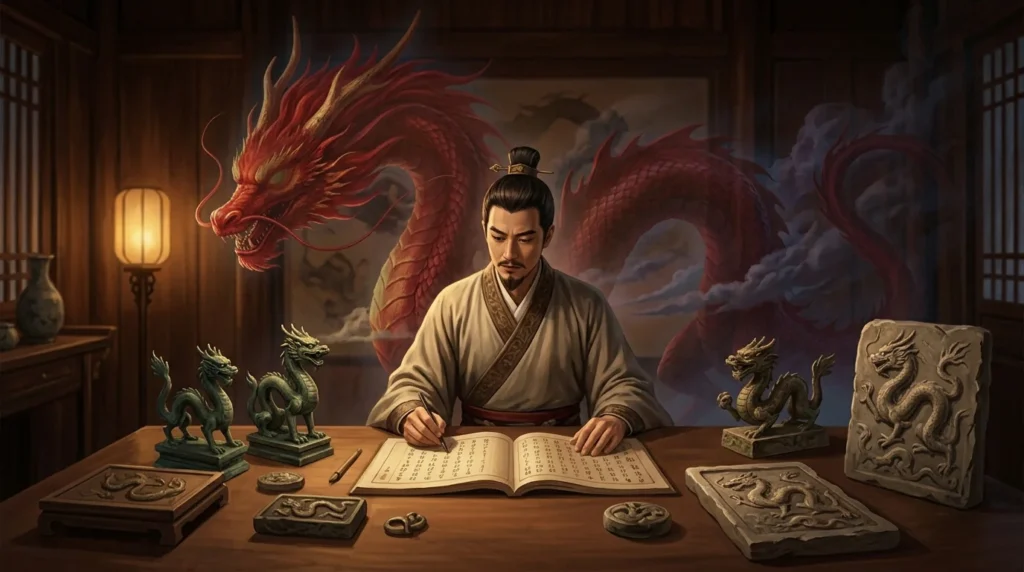
Xu Zheng, a Daoist author working during the Three Kingdoms period in the third century CE, recorded the earliest surviving account of Pangu in his Sanwu Liji, with the fuller postmortem transformation appearing in his separate fragment, the Wuyun Linianji.
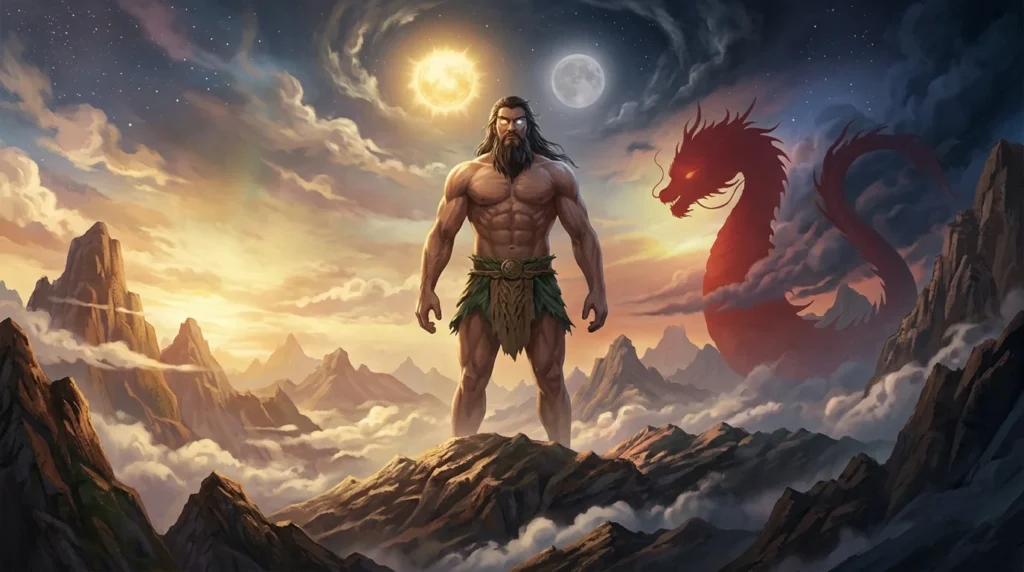
Pangu separates heaven from earth over eighteen thousand years, then dies, and his body becomes the physical world. His left eye becomes the sun. His right eye becomes the moon.
A Single Event, Not a Repeating Mechanism
This is structurally the opposite of what Zhulong is doing. Pangu’s eyes don’t open and close to produce an ongoing cycle. They transform once, permanently, at the moment of his death, and that single transformation is what gives the world its sun and moon from that point forward.
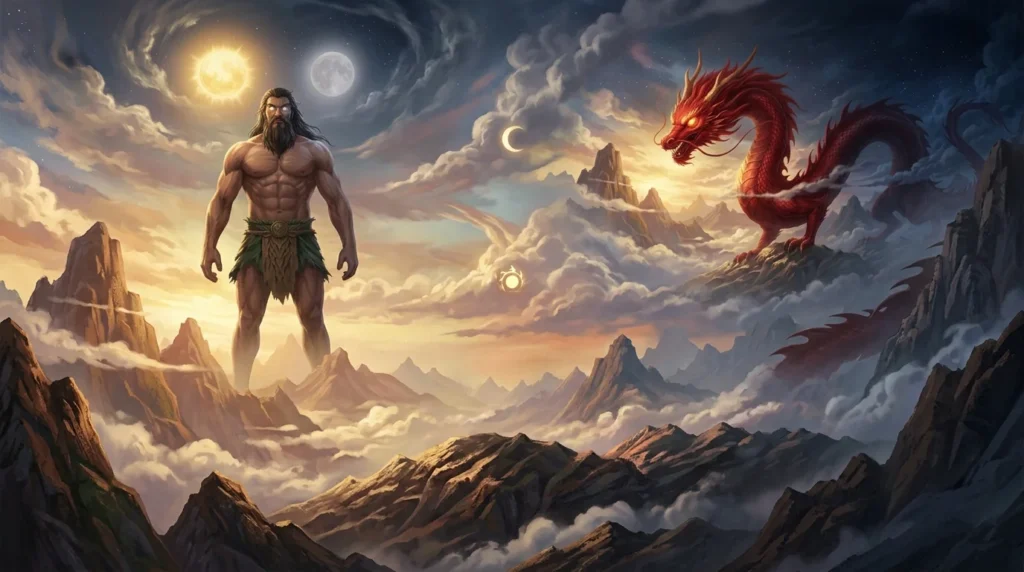
Two dragons, sorry, one dragon and one primordial giant, both using eyes to explain exactly the same cosmic phenomenon, and neither account treats the mechanism the other one uses as necessary or even relevant.
The Timing Gap Matters Enormously
Zhulong’s textual record predates Pangu’s by several centuries. The Shanhaijing material is generally dated centuries earlier than Xu Zheng’s third century CE writing.
Whatever cultural work Pangu’s myth was doing when it finally got written down, it wasn’t replacing or correcting Zhulong’s account, since the two never functioned as competing versions of the same explanation circulating at the same time and needing to be reconciled.
They’re better understood as two separate cosmological answers, developed considerably apart from each other in time, that happened to survive into the same broader tradition without either one displacing the other.
Why a Culture Can Hold Both Without Discomfort
Myth Doesn’t Need the Consistency a System Requires
Treating an inherited body of story as a single coherent system misreads what these traditions actually are. The same principle applies here directly.
Zhulong answers a specific, localized question, why does day follow night at all, with a mechanism, opening and closing eyes, that a listener can picture concretely.
Pangu answers a much larger question, why does the entire physical universe, sun, moon, mountains, rivers, exist in the shape it does, with an origin story that happens to use the same body part for one small piece of a much bigger transformation.
They’re Not Actually Competing for the Same Job
Once you notice that Pangu’s myth is fundamentally about cosmic origin and Zhulong’s is fundamentally about cosmic maintenance, the apparent contradiction mostly dissolves.
Pangu explains why the sun and moon exist as physical objects in the first place. Zhulong explains the ongoing behavior of the sky, day, night, the seasons, on a continuing basis, long after any single act of creation would have already finished.
A culture doesn’t need to choose between an origin story and a maintenance story. It can keep both, because they were never actually trying to answer the identical question in the first place.
The Wu Xing Layer Most Coverage of Zhulong Skips
Where This Fits Into Broader Chinese Cosmology
The Wu Xing, the Five Phase system underlying enormous amounts of traditional Chinese cosmological thought, and about Qinglong specifically, the eastern dragon among the Four Symbols tied to the Wood element, spring, and a fixed position in the sky.
Zhulong doesn’t belong to that same directional system. He isn’t one of the Four Symbols, and he isn’t assigned a fixed cardinal position the way Qinglong is.
His role is genuinely distinct, governing the sky’s actual temporal behavior, day, night, the changing seasons, rather than holding one fixed spatial post the way the directional guardians do.
A Different Kind of Cosmic Job Entirely
This distinction matters for understanding Chinese dragon mythology as a genuine system rather than a single undifferentiated category. Some dragons hold space. Qinglong anchors the eastern sky permanently.
Zhulong instead governs time itself, the actual mechanism by which one moment becomes the next, which is a considerably rarer and more specific cosmic function than most popular treatments of Chinese dragons bother distinguishing.
An Honest Counterargument
I want to complicate the comparison I’ve just built, because Pangu’s own origins are genuinely more contested than most retellings admit.
Scholars have noted that Pangu’s myth bears real structural resemblance to the Norse giant Ymir, whose body similarly becomes the physical world after his death, and to the Babylonian Tiamat, whose corpse becomes sky and earth after Marduk splits her apart.
Some researchers have proposed the Pangu myth may reflect foreign influence reaching China rather than a purely indigenous development, and its documented spread specifically among the Miao and Yao peoples of southern China has led other scholars to argue for a southern minority origin rather than a Han Chinese one.
If Pangu’s myth genuinely arrived from outside, or emerged first among a specific regional minority tradition before being absorbed into wider Han cosmology.
Then my comparison above is measuring two texts that may not actually share the same cultural point of origin at all, an old, textually documented northern Chinese dragon against a considerably later account whose own roots remain a real, unresolved scholarly question.
That uncertainty doesn’t break the comparison. It just means I should be honest that one half of it rests on considerably shakier ground than the other.
Frequently Asked Questions
Did the Shanhaijing itself ever attempt to connect Zhulong to Pangu or any origin story for the sun and moon generally?
No. The Shanhaijing simply presents Zhulong’s day and night mechanism as an established feature of its own geography without connecting it to any broader creation account, since Pangu’s own myth wasn’t recorded in writing until several centuries after the relevant Shanhaijing material was compiled.
Is there a term specifically distinguishing origin myths from maintenance myths in comparative mythology scholarship?
Not a single universally standardized term, though scholars of comparative religion do regularly distinguish cosmogony, myths explaining a world’s original creation, from ongoing cosmological maintenance myths explaining ordinary, repeating natural phenomena, which is the functional distinction this article is drawing between Pangu and Zhulong specifically.
Did later Chinese texts ever attempt to reconcile Zhulong and Pangu into a single unified account?
Not in any widely documented, authoritative way. Chinese mythological tradition generally tolerated multiple, non integrated cosmological accounts existing alongside each other without a centralized effort to produce one official, fully reconciled system covering every tradition.
Is Xu Zheng’s Sanwu Liji the original source, or does it survive only through later citation?
The original Sanwu Liji is no longer extant as a complete standalone text. Its Pangu material survives specifically because later works, including the Tang dynasty encyclopedia Yiwen Leiju, quoted directly from it, which is how the myth reached later readers at all.
Does the Miao and Yao association with Pangu suggest he was worshipped as an ancestor rather than purely a cosmological figure?
Yes, in some traditions specifically. Certain Miao and Yao communities have historically treated Pangu as an actual ancestral figure rather than purely an abstract cosmological one, and some groups have continued this association into more recent cultural practice, distinct from his purely creation myth role in wider Han tradition.
Final Thoughts
Two explanations for the same daily event, recorded centuries apart, never once forced to agree with each other. Zhulong keeps blinking the world into day and night on an ongoing, continuous basis. Pangu did his version once, at the cost of his own body, and then the job was permanently finished.
Chinese tradition kept both stories rather than picking a winner, and I think that’s a genuinely better outcome than tidying them into one official answer would have been.
Related Articles
- Dragon Mythology: How Dragons Are Depicted Across Cultures
- Western Dragon vs Eastern Dragon [Myth, Power & Origin]
- Fenghuang: Chinese Phoenix Origins & Sacred Meaning
- Dragon & Phoenix: Chinese Myth’s Most Sacred Bond
- What Is the Heavenly Court? Chinese Myth’s Divine Authority
- What Is the Largest Dragon in Mythology? [Real Answer]
- 9 Chinese Dragon Colors & What Each One Means in Mythology
- 11 Oldest Dragons in World Mythology: Sumeria to China
References
- Birrell, Anne. Chinese Mythology: An Introduction.
- Major, John. Heaven and Earth in Early Han Thought.
- Kohn, Livia. Daoism and Chinese Culture.
- The Classic of Mountains and Seas – Anne Birrell
- Evolution of Mythological Motifs in Transmission – Taking the Pangu Mythological Narrative as an Example
- Chinese Oral Traditions
Written by Batin Khan, a curious free spirit who loves reading and exploring the worlds of fantasy, mythology, and ancient stories. Through this blog, Batin hopes to share that sense of wonder with readers while building an exciting future along the way.