
 By
By Quick Takeaways:
- The Fenghuang is consistently translated as Chinese phoenix, but this translation is misleading, as it doesn’t die by fire and rise reborn, and it has an entirely different symbolic role
- The Fenghuang is a cosmic harmony bird. Its appearance signals that the world is in right order, that a virtuous ruler reigns, and that heaven and earth are properly aligned
- The characters Feng and Huang originally referred to a male and female pair, though later tradition often treated the Fenghuang as a single composite figure
- The Fenghuang encodes five Confucian virtues in its physical body and incorporates the qualities of five different birds in its composite form
- The Fenghuang’s pairing with the dragon is one of Chinese iconography’s most important symbolic unions, the dragon representing imperial masculine energy, the Fenghuang representing imperial feminine virtue
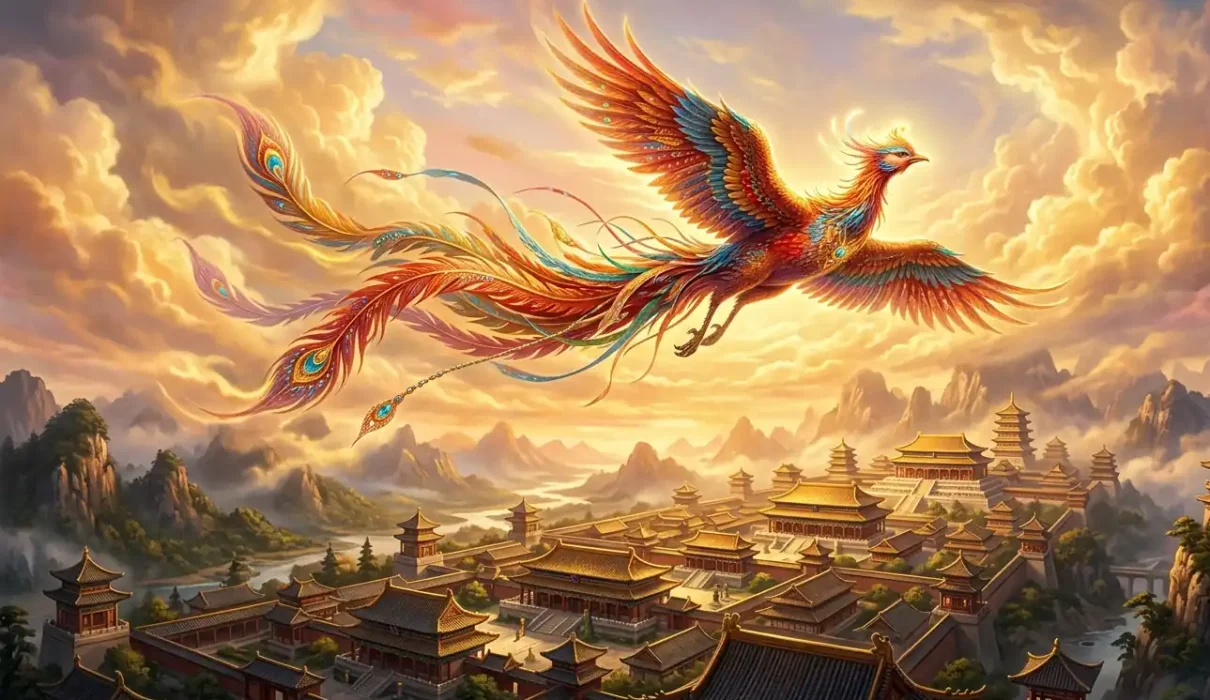
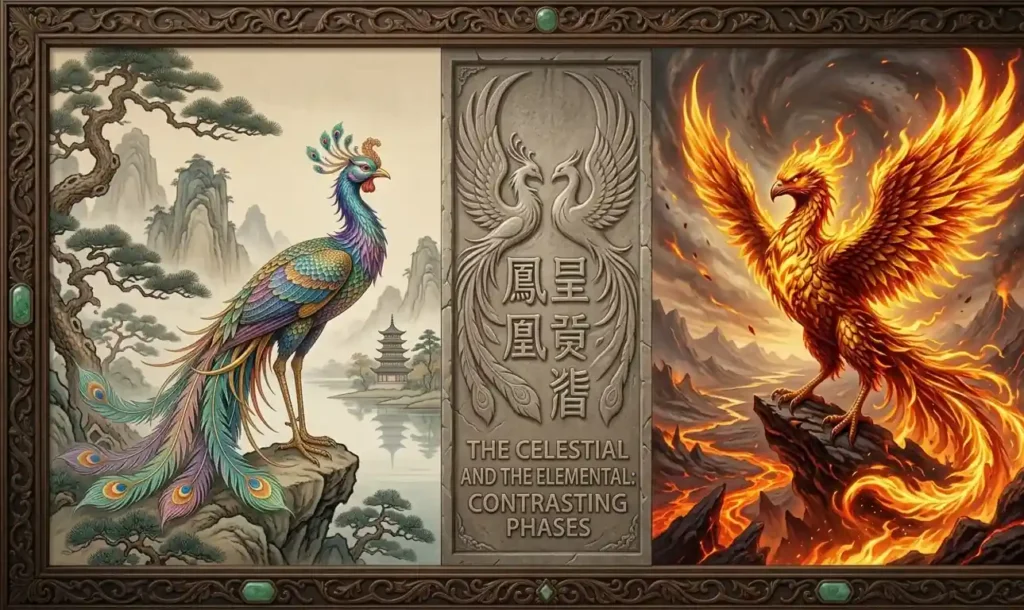
Fenghuang is not simply the Chinese version of the phoenix. Unlike the Western phoenix, it does not die and rise from ashes. Instead, it symbolizes cosmic harmony, virtuous rule, and the proper balance between heaven and earth.
For years after I first encountered the Fenghuang in Chinese mythology and in my novel readings, I kept processing it through the Western phoenix lens, fire, rebirth, the dramatic cycle of destruction and renewal.
Eventually, I put the Western phoenix entirely aside and read the Fenghuang on its own terms for the first time. What I found was considerably more interesting and philosophically coherent than the “Chinese phoenix” label had suggested, A figure whose meaning is inseparable from classical Chinese cosmological and ethical thinking, and whose symbolic role in Chinese culture is unlike anything in the Western phoenix tradition.
What Fenghuang Actually Means
The Characters
The name Fenghuang (鳳凰) is a compound of two characters, and the original distinction between them matters.
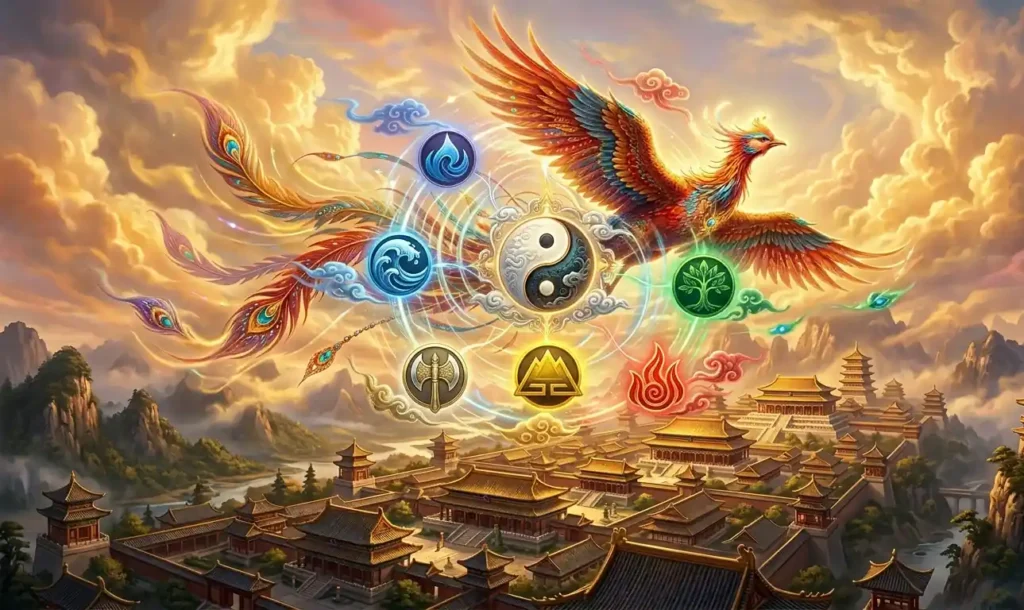
Feng (鳳) – the male bird, associated with yang energy, with the sun, with the south.
Huang (凰) – the female bird, associated with yin energy, with the moon, with certain celestial associations that complement the feng’s solar qualities.
This male-female pairing is the original structure. The Fenghuang was a divine pair of cosmic birds whose union represented the harmonious balance of complementary principles. Later tradition increasingly treated the Fenghuang as a single composite figure rather than a pair, particularly in imperial contexts where it was paired with the dragon (the emperor) as a single female counterpart.
But the original paired structure is worth knowing, because it reveals the Fenghuang’s foundational symbolic logic: this is a figure about harmony, balance, and the right relationship between complementary forces, not about fire, death, or individual dramatic renewal.
The Auspicious Presence
The single most important thing to understand about the Fenghuang is this: its appearance is an omen, not a story.
The Western phoenix has a narrative. It burns, it dies, it rises. The Fenghuang doesn’t have that kind of narrative. It appears. And its appearance means something specific: the world is in the right order. A ruler of exceptional virtue is reigning. Heaven approves of the current state of affairs. The cosmic harmony of yin and yang, of heaven and earth, of human governance and natural principle, is properly aligned.
When the Fenghuang disappears or fails to appear, it signals the opposite. that something in the cosmic or human order has gone wrong.
This makes the Fenghuang a moral and political diagnostic, not a personal spiritual figure. It’s not about what happens to you. It’s about the state of the world.
Read: Dragon & Phoenix: Chinese Myth’s Most Sacred Bond
Origins: Where The Fenghuang Came From
Shang Dynasty Beginnings
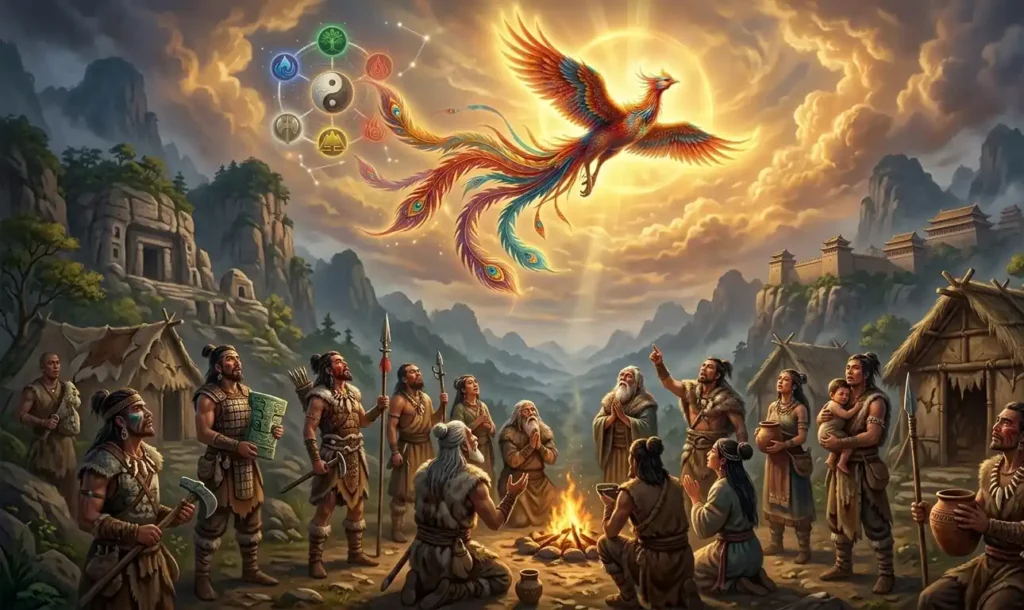
The earliest traceable origins of the Fenghuang appear in the Shang Dynasty (roughly 1600–1046 BCE), in oracle bone inscriptions and bronze vessel decorations. The Shang had a complex bird mythology, and bird figures, possibly the feng, appear in contexts associated with divine communication and royal legitimacy.
Some scholars connect the earliest feng imagery to an actual large bird, possibly the argus pheasant or peacock, whose elaborate plumage may have suggested divine magnificence to early Chinese observers. The composite, supernatural Fenghuang developed from this real-bird foundation through the same mythologizing process that produced the Long (dragon) from real crocodile and snake observations.
The Zhou and Classical Period Development
The Fenghuang as a fully developed symbolic figure appears prominently in Zhou Dynasty (1046–256 BCE) and classical period texts. The Shanhaijing (Classic of Mountains and Seas), one of the most important Chinese mythological texts, describes the Fenghuang’s appearance in specific detail:
“There is a bird. Its shape resembles a chicken. Its plumage is of five colours and has patterns on it. It’s called Fenghuang. Its head patterns read ‘virtue’, its wing patterns read ‘righteousness’, its back patterns read ‘propriety’, its breast patterns read ‘humanity’, and its abdomen patterns read ‘trustworthiness’.”
This is not describing a fire bird. It’s describing a walking embodiment of Confucian virtues, a living diagram of the ethical principles that correct human governance should express.
The Confucian Resonance
The timing of the Fenghuang’s full symbolic development coincides with the rise of Confucian thought, and that’s not a coincidence.
Confucianism placed the cultivation of virtue at the center of its social and political philosophy. A bird whose body literally inscribes the five cardinal virtues and whose appearance signals the presence of virtuous governance is the perfect Confucian symbolic figure, celestially confirming that the ethical framework Confucianism prescribed for human governance has been properly implemented.
The Fenghuang and Confucian ethics developed in dialogue with each other across the classical period, each reinforcing the other’s significance.
The Fenghuang’s Physical Description
A Composite Creature
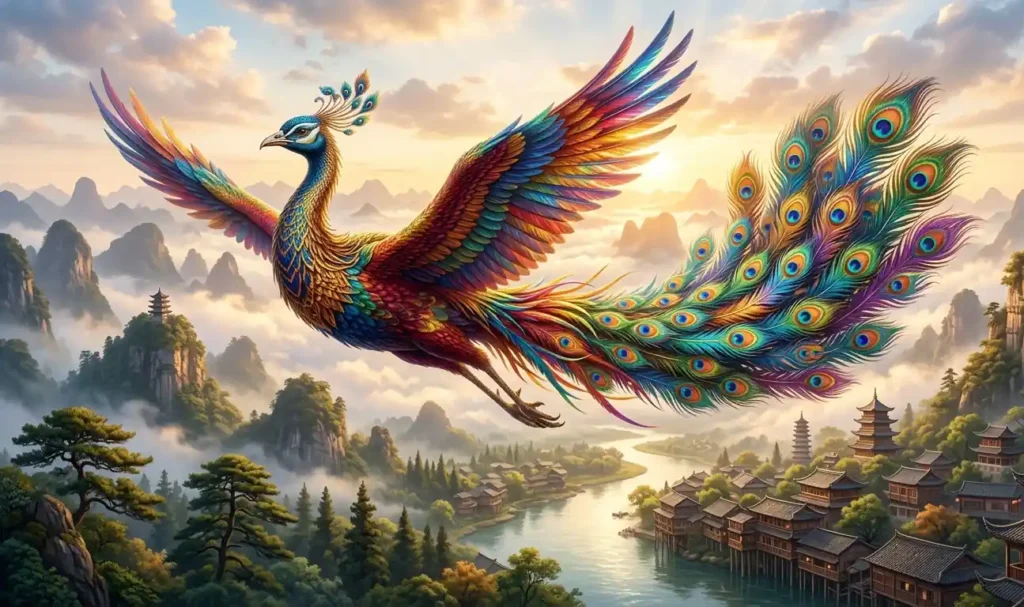
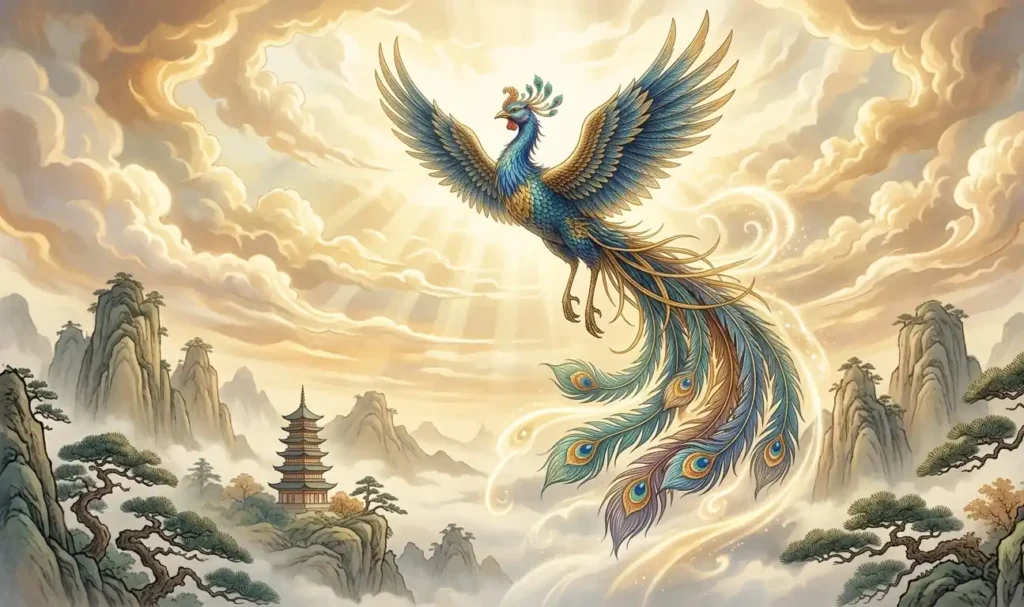
Like the dragon, the Fenghuang is composite. Its body incorporates specific features from several birds. Classical texts describe different combinations, but a common account includes:
- The head of a golden pheasant – beauty, dignity, solar brightness
- The body of a mandarin duck – conjugal harmony, the proper relationship between yin and yang
- The tail of a peacock – magnificence, the display of the five-color plumage
- The wings of a roc or great eagle – vast power, the ability to traverse the sky
- The legs of a crane – longevity, uprightness, the capacity to stand in both water and land
- The beak of a parrot – wisdom, the capacity for communication
The composite form is philosophically deliberate. The Fenghuang isn’t any single bird. It’s the synthesis of the finest qualities of multiple birds into a single divine figure, the way a virtuous ruler synthesizes the finest qualities of human nature into a single exemplary person.
The Five Colours
The Fenghuang’s plumage incorporates all five elemental colours:
- Red (fire, south)
- Black (water, north)
- Blue-green (wood, east)
- White (metal, west)
- Yellow (earth, centre)
This five-color plumage makes the Fenghuang a symbol of the completeness of the Wu Xing (five element) system. It doesn’t belong to any single element but incorporates all five, making it a figure of total cosmic integration rather than elemental specialization.
This is one of the clearest markers of the Fenghuang’s cosmic harmony role. It doesn’t rule any single direction or element like the four guardian beasts do. It embodies the harmony of all directions and all elements simultaneously.
The Five Virtues
Following the Shanhaijing description, the Fenghuang’s body inscribes five Confucian virtues:
- De (Virtue) – on the head
- Yi (Righteousness) – on the wings
- Li (Ritual propriety) – on the back
- Ren (Benevolence) – on the breast
- Xin (Trustworthiness) – on the abdomen
I find this aspect of the Fenghuang mythology genuinely beautiful. The divine bird doesn’t just represent virtue abstractly. It literally wears virtue on its body. Every part of the Fenghuang is ethical content made visible.
This is the Fenghuang’s role as a Confucian symbolic figure made most explicit. A celestial confirmation that virtue has an actual presence in the world, that it’s not a human abstraction but a cosmic reality that can appear, be perceived, and be recognized.
The Fenghuang and the Dragon: The Cosmic Pair
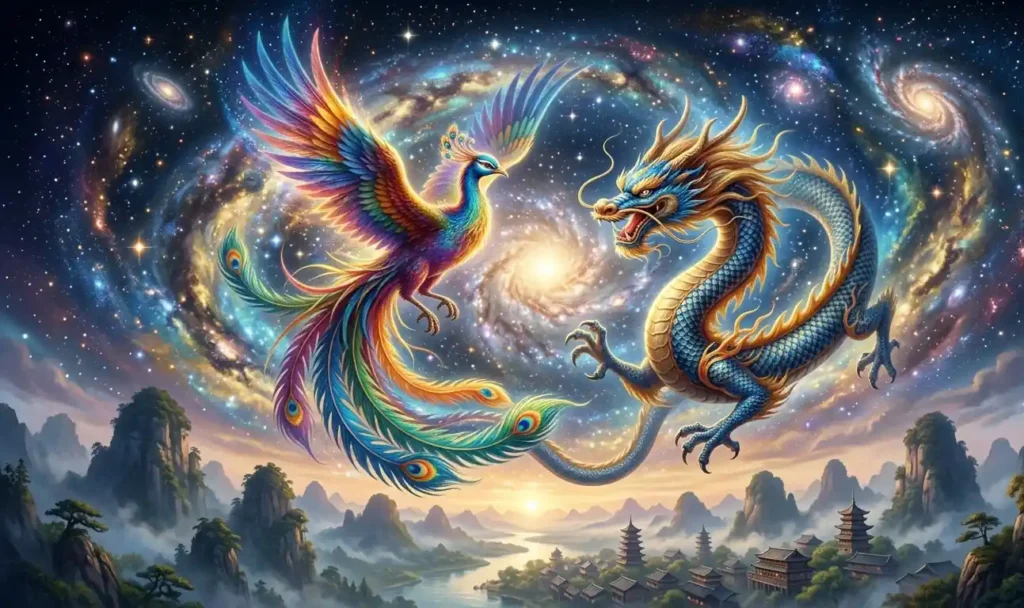
The Most Important Symbolic Relationship
The Fenghuang’s pairing with the dragon is one of Chinese iconography’s most significant symbolic relationships, and understanding it is essential for understanding what the Fenghuang represents in imperial and cultural contexts.
The dragon (Long) represents:
- The emperor
- Yang energy, masculine principle
- Heaven, the sky
- Imperial authority, cosmic order
The Fenghuang represents:
- The empress
- Yin energy, feminine principle
- Earth (in some traditions), the terrestrial order
- Imperial virtue, the quality of governance
Together, the dragon-Fenghuang pair represents the complete cosmic and human order, the harmonious union of masculine and feminine principles, of heaven and earth, of authority and virtue. When you see them paired in Chinese art and architecture, you’re seeing a cosmological statement about the proper relationship between the two poles of existence.
Why This Matters for Gender Symbolism
The Fenghuang’s association with the empress and feminine virtue has had a long and complex history in Chinese culture.
During the Han Dynasty and later, the Fenghuang became specifically associated with the empress as the dragon became specifically associated with the emperor. This gave the Fenghuang a distinctive role as the supreme symbol of female excellence, not submission or secondary status, but the complementary and equally necessary yin principle without which the yang dragon’s energy lacks the receptive ground in which to manifest.
This is a more sophisticated symbolic framework than simple gender hierarchy. The dragon without the Fenghuang is incomplete. The yang without the yin is unbalanced. The cosmic pair needs both poles to constitute the whole.
In contemporary Chinese culture, the dragon-phoenix pair appears at weddings, on ceremonial items, and in architectural decoration as a symbol of the harmonious union of masculine and feminine, the cosmic template for the human marriage relationship.
The Fenghuang In Chinese History
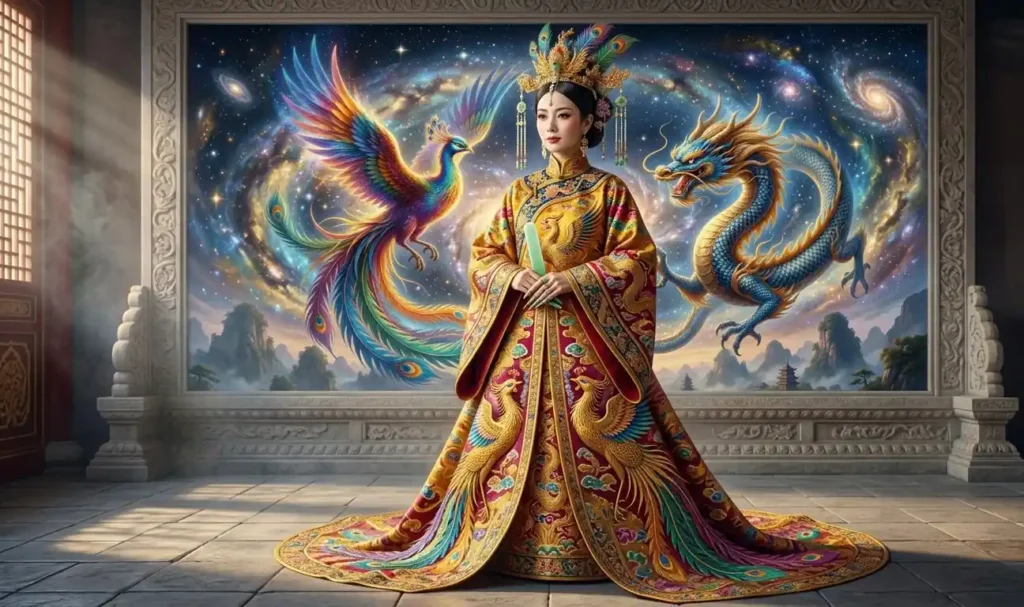
Imperial Usage
The Fenghuang’s imperial associations made it one of the most regulated symbols in Chinese dynastic history.
During the Han Dynasty, Fenghuang imagery was used on imperial robes, tiles, and ceremonial objects. The association with the empress became increasingly formalized.
By the Tang Dynasty, the dragon-phoenix pairing was so thoroughly established as an imperial symbol that unauthorized use by commoners was prohibited, similar to the restrictions on the five-clawed dragon that reserved it for imperial use.
The Ming and Qing Dynasties saw the Fenghuang reach its most elaborate imperial iconographic expression, with specific rules about which imperial family members could display Fenghuang imagery and in what contexts.
Literary Appearances
The Fenghuang appears throughout classical Chinese literature as an omen and a standard of comparison.
In the Analects, Confucius mourns its absence: “The phoenix does not come. The river gives forth no diagram. It’s all over for me.” The phoenix’s failure to appear is the sign that the Dao is absent from the world, that virtuous governance has failed, and the cosmic harmony that would draw the Fenghuang is broken.
In the Zhuangzi, there’s a memorable story in which the Cook Wren laughs at a Peng bird’s vast flight: “What’s all that? I make a great leap and fly from tree to tree. What’s the use of going ninety thousand li to the south?” But the Peng (which may be related to the Fenghuang tradition) is not subject to the Cook Wren’s judgment. Its scale of existence is simply incomprehensible from the smaller bird’s perspective.
Fenghuang vs Phoenix vs Suzaku: The Definitive Distinction
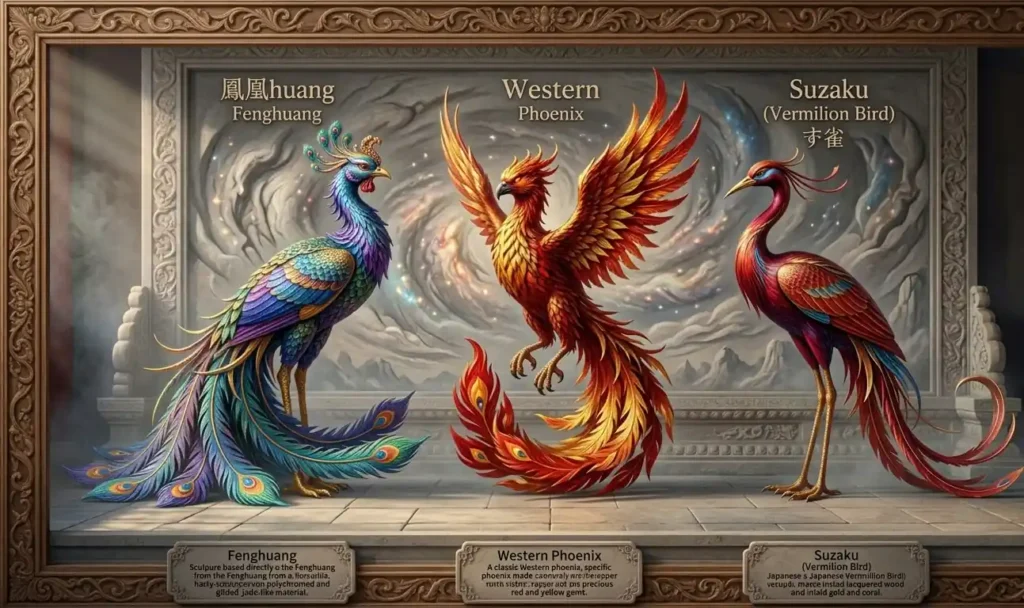
I’ve covered this comparison in my phoenix bird mythology post on this blog, but it deserves clear treatment here for readers who arrive specifically looking for the Fenghuang.
Fenghuang vs Western Phoenix
| Dimension | Fenghuang | Western Phoenix |
|---|---|---|
| Core meaning | Cosmic harmony, virtue, right governance | Death and rebirth, cyclical renewal |
| Fire relationship | Associated with Fire element (secondary) | Dies in fire and rises reborn (primary) |
| Rebirth narrative | None – appears when conditions are right | Central defining feature |
| Gender | Originally male (feng) and female (huang) as a pair; later single figure with feminine associations | Generally masculine in classical sources |
| Moral content | Five Confucian virtues literally embodied | Renewal, resurrection, endurance |
| Appearance trigger | Virtuous rule, cosmic harmony | Fixed life cycle (500 years) |
| Paired figure | The dragon | No traditional pairing |
The short version: the Western phoenix is about what happens after destruction. The Fenghuang is about what happens when things are going right.
Fenghuang vs Suzaku (Zhuque)
Fenghuang and Vermilion Bird are constantly confused, and they shouldn’t.
Fenghuang: Divine composite bird symbolising cosmic harmony and imperial virtue. Appears auspiciously. Embodies five virtues and five elemental colours. Paired with the dragon.
Suzaku (Zhuque): Cosmological guardian of the South, one of the Four Holy Beasts. Associated specifically with the Fire element, summer, and the southern direction. Part of the Si Xiang system alongside the Azure Dragon, White Tiger, and Black Tortoise.
They share fire association and bird form, which is why the confusion happens. But the Fenghuang’s fire association is about cosmic completeness (it incorporates all five elemental colors, including red/fire), while the Suzaku’s fire association is about directional and elemental governance.
The Fenghuang is a virtue figure. The Suzaku is a cosmological guardian. Different jobs, different traditions, different symbolic content.
The Fenghuang In Contemporary Culture
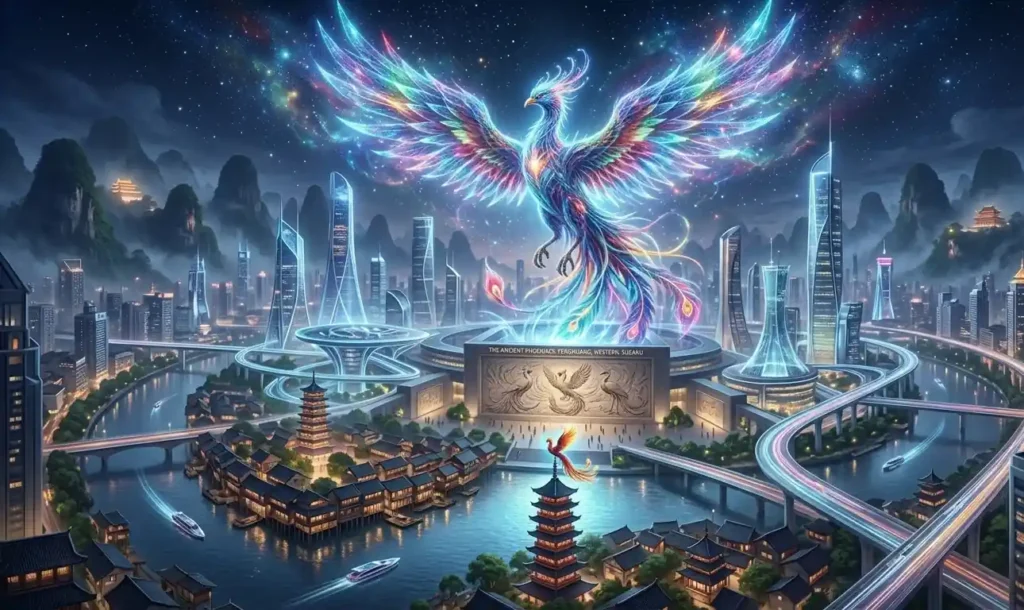
Modern China
The Fenghuang remains an active cultural symbol in contemporary China and Chinese diaspora communities worldwide.
It appears in:
- Wedding iconography – the dragon-phoenix pair as the symbol of harmonious marriage
- Architecture – particularly on temples, government buildings, and ceremonially significant structures
- Decorative arts – ceramics, textiles, jewellery, embroidery
- Brand naming – multiple Chinese companies and products use Fenghuang or phoenix imagery to signal excellence and auspiciousness
The city of Fenghuang (Phoenix Ancient Town) in Hunan Province takes its name from the Fenghuang, and its traditional architecture incorporates extensive phoenix imagery.
Popular Culture
The Fenghuang appears in Japanese popular culture most visibly through Ho-oh, the legendary Pokémon from Generation II designed explicitly as a Ho-oh (the Japanese reading of the same characters as Fenghuang), appearing in rainbow colors and associated with resurrection narratives that blend Western phoenix elements with the Fenghuang’s auspicious presence.
This is a good example of how the Fenghuang has been reinterpreted through Japanese cultural transmission, acquiring Western phoenix rebirth qualities that the original Chinese figure doesn’t traditionally have.
If you are a fan of the fantasy genre, you should check out cultivation novels and progression fantasy. Fenghuang appears quite frequently in both.
Why The “Chinese Phoenix” Translation Fails
I want to end with a direct statement of the thing that motivated this entire article.
The translation of Fenghuang as “Chinese phoenix” is understandable. It’s a divine bird, it has fire associations, it’s magnificent and rare. But it sets up the wrong expectations and obscures what makes the Fenghuang genuinely interesting.
What “Chinese phoenix” makes you expect:
- A bird that dies and rises from fire
- A symbol of personal rebirth and renewal
- A dramatic narrative of destruction and regeneration
- A figure about what happens after things go wrong
What the Fenghuang actually is:
- A bird that appears when the world is in right order
- A symbol of cosmic harmony and collective virtue
- A living diagram of the five Confucian ethical principles
- A figure about what happens when things go right
The difference matters. The Fenghuang’s fundamental symbolic logic is optimistic and prescriptive. It’s a vision of what the world looks like when human virtue and cosmic order are aligned. It’s not comforting in the way that resurrection mythology is comforting. It’s inspiring in the way that a vision of genuine flourishing is inspiring.
Fenghuang is one of the figures I find distinctively and irreducibly Chinese in its philosophical content. You couldn’t have invented it in a culture without the specific Confucian ethical framework, the five-element cosmological system, and the imperial governance tradition that gave it its specific symbolic weight.
That’s what gets lost when we call it a phoenix. And that’s what I hope this article has begun to restore.
Frequently Asked Questions
Is the Fenghuang male or female?
Originally, the characters feng (鳳) and huang (凰) referred to the male and female birds of a cosmic pair. Over time, the Fenghuang became a single figure associated with the empress and feminine principle, paired with the masculine dragon. Today, the Fenghuang is generally viewed as feminine, though its paired origins remain historically important.
Does the Fenghuang die and rise from ashes?
No, this is the Western phoenix’s narrative, not the Fenghuang. The Fenghuang appears when the world is in harmonious order and disappears when harmony declines. Classical Chinese mythology does not give it a death and rebirth cycle. The confusion comes from the “Chinese phoenix” translation, which applies Western phoenix traits to a figure with entirely different symbolism.
What’s the difference between the Fenghuang and the Suzaku?
The Fenghuang symbolizes cosmic harmony and virtue, appearing when governance is just and order is aligned. The Zhuque, or Suzaku, is the southern guardian among the Four Holy Beasts, associated with fire, summer, and the southern direction. While both share avian and fire symbolism, they belong to distinct cosmological traditions and serve different symbolic roles.
What does the Fenghuang eat?
Classical texts describe the Fenghuang as eating only bamboo seeds, drinking only pure spring water, and perching only in the Chinese parasol tree. These associations symbolize purity, moral uprightness, and refinement, reinforcing the Fenghuang’s role as a figure that appears only in times of exceptional virtue and harmony.
Why is the Fenghuang paired with the dragon?
The Chinese dragon represents yang energy, the masculine principle, the emperor, and heaven. The Fenghuang represents yin energy, the feminine principle, the empress, and earthly virtue. Together, they symbolize the harmonious union of complementary cosmic forces, appearing in weddings, imperial imagery, and architecture as expressions of balance, proper governance, and cosmic order
Final Thoughts
The Fenghuang is called a phoenix because “divine bird that represents cosmic harmony and the embodiment of Confucian virtues whose appearance signals the proper alignment of heaven, earth, and human governance” doesn’t fit on a museum label. I understand the practical need for shorthand.
But the shorthand has real costs. It makes the Fenghuang sound like a variation on something familiar when it’s actually something distinctively and irreducibly its own tradition. It focuses attention on fire and rebirth when the Fenghuang’s real interest is in harmony and virtue. It makes a figure about collective flourishing sound like a figure about individual renewal.
The Fenghuang you find when you read it on its own terms, the composite bird with five-elemental plumage, with Confucian virtue inscribed on its body, that appears when a genuinely virtuous ruler creates the conditions in which cosmic harmony becomes visible, is considerably more interesting than the Chinese phoenix.
It always was. It just needed the phoenix label moved out of the way so you could see it.
Related Articles
- Suzaku: Vermilion Bird symbolism, myths and sacred meaning
- The Four Holy Beasts: complete guide to the Si Xiang
- Dragon mythology: East, West, and every culture in between
- Phoenix Bird Mythology: Origins, Symbolism & Sacred Meaning
- Fenghuang & Vermilion Bird: Not as Similar as You Think
- Loong: Chinese Dragon Myths, Symbolism & Sacred Power
References
- Birrell, Anne. Chinese Mythology: An Introduction.
- Eberhard, Wolfram. A Dictionary of Chinese Symbols.
- Major, John. Heaven and Earth in Early Han Thought.
- The Chinese Sky
- Lewis, Mark Edward. The Construction of Space in Early China.
- Kohn, Livia. Daoism and Chinese Culture.
- Allan, Sarah. The Shape of the Turtle.Hanshu (Book of Han).
- UNESCO World Heritage Centre – Complex of Goguryeo Tombs
- The Protocol of the Gods: A Study of the Kasuga Cult in Japanese History – Allan G. Grapard
- The Rites of Zhou – Chinese Text Project
- Shanhaijing (Classic of Mountains and Seas).
- Shiji (Records of the Grand Historian).
Research notes
This article was prepared using primary Chinese texts (where available), modern scholarly works on Chinese mythology and art history, and museum catalogues. Where sources disagree, the article follows the interpretation supported by the majority of current scholarship.