
 By
By Quick Takeaways:
- The phoenix, as most people know it, is a bird that burns and rises reborn from its own ashes. It is a late Greco-Roman synthesis of several older and more complex traditions
- The oldest phoenix figure is the Egyptian Bennu bird, a heron-like solar deity associated with the primordial moment of creation and the daily renewal of the sun, not a rebirth-from-fire story at all
- The Persian Simurgh, the Chinese Fenghuang, the Hindu Garuda, and the Slavic Zhar-Ptitsa are related traditions with their own distinct philosophies that don’t reduce to the “dies and rises from fire” formula
- The Chinese Fenghuang and Japanese Suzaku are frequently confused with the Western phoenix. They’re related but distinct figures with different symbolic roles
- Understanding the full global tradition makes the phoenix considerably more interesting than its pop-culture version suggests
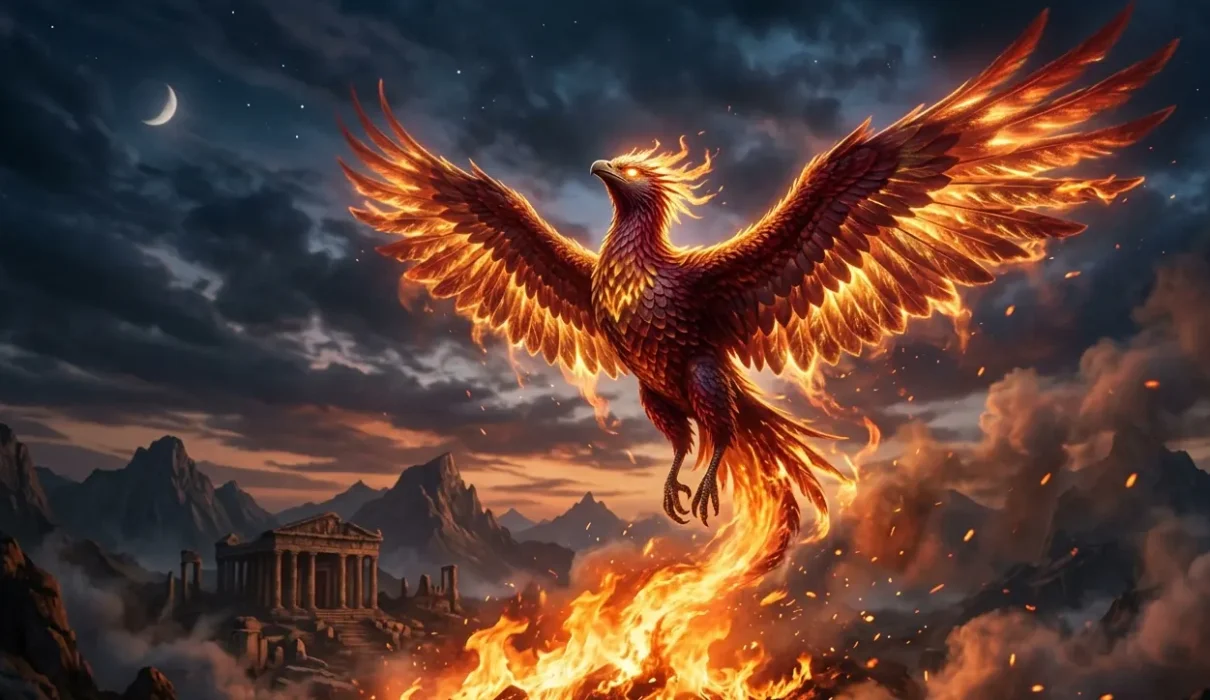
I’ll start with a confession that might surprise you coming from someone who’s spent twenty years studying mythology. The phoenix as most people picture it, burning dramatically, collapsing into ash, rising reborn, is actually one of mythology’s most successfully simplified figures.
Not falsified. Simplified. The rebirth-from-fire narrative is genuinely present in ancient sources. But it’s a late synthesis of earlier traditions that were individually richer, stranger, and more philosophically interesting than the pop-culture version suggests.
The Egyptian original is a solar heron that embodied the primordial moment of creation. The Persian tradition is a bird so old it has witnessed the world’s destruction three times. The Chinese Fenghuang is the divine emblem of cosmic harmony and imperial virtue, not a firebird at all in its classical form. Each of these is genuinely fascinating on its own terms, and they’ve been partially flattened into the familiar “rises from ashes” story.
That’s what this article is for. The full picture, from the oldest sources forward.
Why The Phoenix Bird Matters
Before diving into specific traditions, let me explain why I think this figure deserves a proper deep-dive rather than a quick overview.
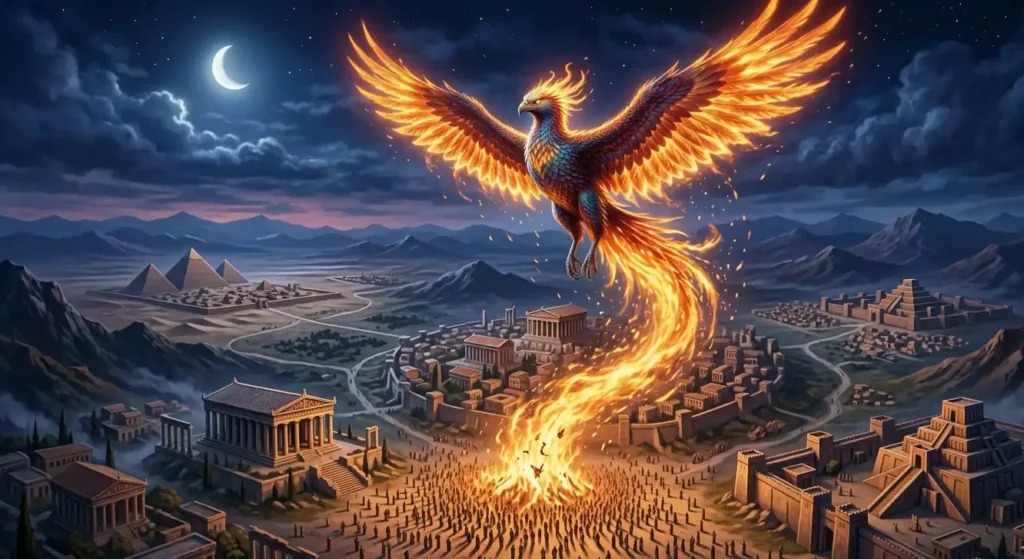
The phoenix is probably the single most widely recognized mythological bird in the world. It appears in contexts ranging from the flags of San Francisco and Atlanta to Harry Potter’s Fawkes, to the logos of dozens of financial institutions that want to suggest resilience and renewal. It’s entered common metaphorical language “rising from the ashes” is used by people who’ve never thought about mythology in their lives.
That ubiquity is both the phoenix’s greatest cultural success and the thing that obscures its actual complexity. When a mythological figure becomes a general-purpose metaphor for renewal, the specific, strange, philosophically rich details of the original traditions get smoothed away.
Twenty years of mythology has made me deeply interested in recovering those specific, strange details. They’re better than the smooth version.
The Egyptian Bennu: The Original Firebird

What The Bennu Actually Was
The Bennu (also spelled Benu) is the Egyptian figure that most scholars consider the origin of the Western phoenix tradition. And the first thing to know about the Bennu is that it wasn’t primarily a rebirth-from-fire figure. It was a solar creation deity.
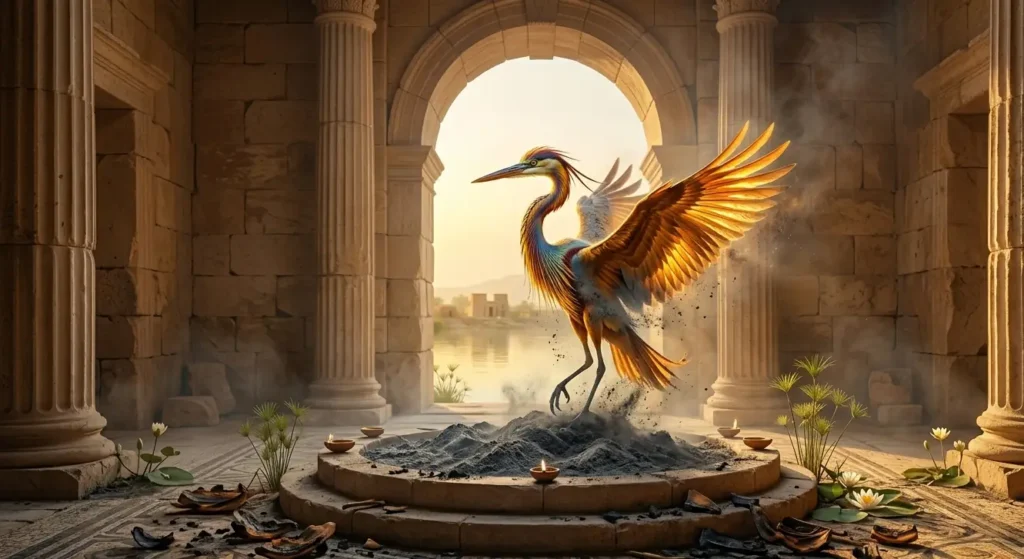
The Bennu was associated with the god Ra (and later Atum and Osiris), depicted as a heron. Specifically, some scholars suggest, modelled on the large now-extinct Goliath heron that inhabited the Nile Delta. Its physical form was a grey or blue-grey heron with a distinctive two-feathered crown.
The Bennu’s mythological role was cosmogonic, connected to the origin of the world. In the Heliopolitan creation tradition, the Bennu was the first being to land on the benben stone (the primordial mound that emerged from the waters of chaos at the moment of creation) and let out a cry that broke the primordial silence and initiated existence.
That’s the Bennu’s primary cosmological significance. Not death and rebirth. The first moment. The cry that started everything. It’s so fascinating and wonderful if you just try to imagine it.
The Solar Renewal Connection
The Bennu was also associated with the sun’s daily journey. It was understood to fly to the solar temple at Heliopolis each morning as Ra’s sun barque completed its overnight journey through the underworld and rose again.
This is where the renewal theme genuinely enters the tradition. The Bennu’s daily appearance at Heliopolis corresponded to the sun’s daily rebirth, not death by fire and resurrection, but the cyclical renewal of the cosmic order that the sun’s daily journey represented.
The Bennu was also connected to the phoenix palm tree (the date palm, Phoenix dactylifera) and to the cyclical flooding of the Nile, both patterns of renewal that operate through cyclical return rather than dramatic self-immolation.
What Herodotus Made of it
The Greek historian Herodotus visited Egypt in the 5th century BCE and recorded a version of the Bennu story that’s clearly a Greek interpretation of what he was told. His account includes:
- A bird that comes from Arabia every 500 years
- It brings its dead parent wrapped in myrrh to the temple at Heliopolis
- It’s like an eagle in size and shape, with gold and red plumage
This is already a significant transformation of the Bennu tradition. The heron has become an eagle-like creature, the solar cosmogonic role has been replaced by a filial duty narrative, and the 500-year cycle has appeared.
The shift from heron to eagle-like bird, and from daily solar renewal to quincentennial dramatic return, tells you something important about how mythological figures transform when they cross cultural boundaries.
The Greco-Roman Phoenix: The Rebirth Myth Solidifies
How The Classical Tradition Developed
The phoenix, as most people know it, crystallized in the Greco-Roman period through a combination of the Herodotus account and elaborations by later writers.
Ovid’s Metamorphoses (1st century CE) gives one of the most famous classical accounts of the phoenix lives 500 years, builds its own funeral pyre of spices and herbs, dies in the flames, and a new phoenix rises from the corpse. Ovid’s version is explicitly a transformation story, fitting his book’s central theme.
Pliny the Elder’s Natural History describes the phoenix as a unique bird, always the sole member of its species, returning to Arabia and then to Egypt every 540 years, with a distinctive plumage of gold and purple. Pliny treats it as a matter of natural history record while acknowledging some uncertainty about the details.
Tacitus records a phoenix sighting in Egypt in 34 CE as a historical event, with different traditions about the cycle length and the precise mechanics of the renewal.
What’s consistent across these classical accounts:
- The phoenix is singular. There’s only one at any given time
- It has an extremely long lifespan (500 to 540 years is common)
- Its renewal is connected to fire, though the specific mechanism varies
- It’s associated with the sun and with Arabia or Egypt
- It carries its dead predecessor’s remains to the temple at Heliopolis
What The Classical Phoenix Symbolized
By the Greco-Roman period, the phoenix had become a symbol of:
- Imperial eternity: Roman emperors used phoenix imagery on coins and public monuments to suggest the eternal renewal of imperial power
- Cosmic cyclicality: The phoenix embodied the Stoic concept of the eternal return, the universe’s periodic destruction and renewal
- Unique excellence: “Like a phoenix” meant singular, incomparable, without equal
The early Christian tradition adopted the phoenix with enthusiasm as a symbol of resurrection, and the phoenix appears in early Christian texts as a proof-by-analogy for the resurrection of the dead. If a bird can renew itself after death, so can a human soul.
The Persian Simurgh: The Wisest Bird in the World
What the Simurgh is
The Simurgh is the Persian firebird tradition, and it’s so different from the Greco-Roman phoenix that it deserves to be understood entirely on its own terms.
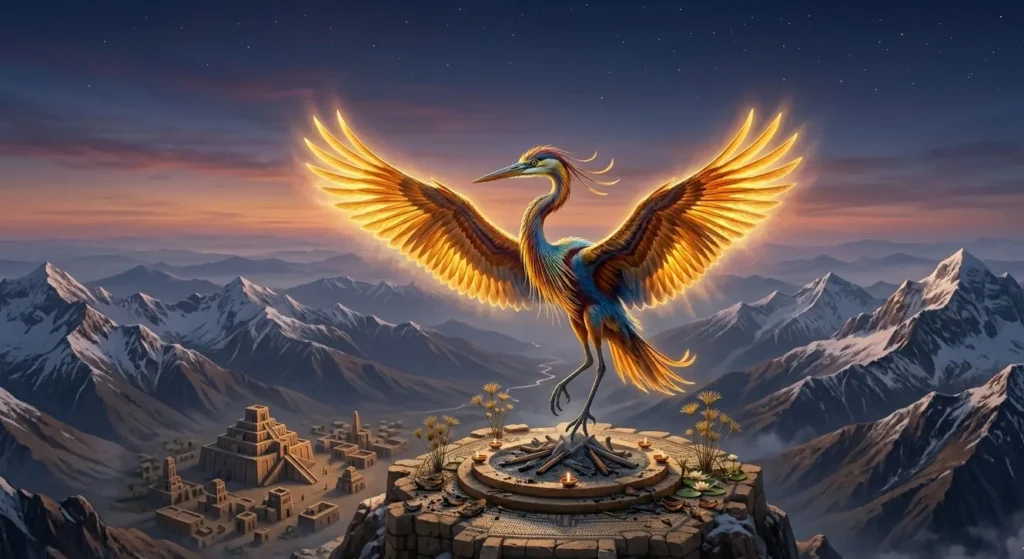
The Simurgh isn’t primarily a bird of fire and rebirth. It’s a bird of wisdom accumulated across cosmic time. Classical Persian texts describe the Simurgh as so ancient that it has witnessed the world’s destruction and renewal three times. It has gathered every kind of knowledge. It nests on the Tree of Knowledge (Gaokerena, the tree that contains the seeds of all plants) and its feathers carry medicinal and magical properties.
In Ferdowsi’s Shahnameh (Book of Kings, 10th century CE), the Simurgh is the foster parent of the hero Zal, a white-haired child abandoned by his father, raised on the Simurgh’s mountaintop, and given three of the Simurgh’s feathers to burn in times of need so that it will appear and help him.
This is an entirely different phoenix story. Not fire and death and rebirth. A cosmic elder, an adoptive parent, a giver of wisdom and protection.
The Simurgh in Sufi Poetry
The Simurgh’s most philosophically profound appearance is in the Sufi poet Attar’s 12th-century masterpiece Conference of the Birds (Mantiq al-Tayr).
In this allegory, all the birds of the world decide to seek their king, the Simurgh. Guided by the hoopoe, they undertake a journey through seven valleys (representing seven stages of spiritual development). Most birds make excuses and turn back. Only thirty birds complete the journey.
When they arrive at the Simurgh’s dwelling and are finally admitted to its presence, they discover that the Persian word for “thirty birds” is si morgh, and the Simurgh is themselves.
It’s one of the most elegant mystical allegories in world literature, and the Simurgh is its vehicle. The divine presence they sought at the end of their journey was the consciousness they’d developed through undertaking it.
The Chinese Fenghuang: The Bird That Isn’t a Phoenix
What The Fenghuang Actually is
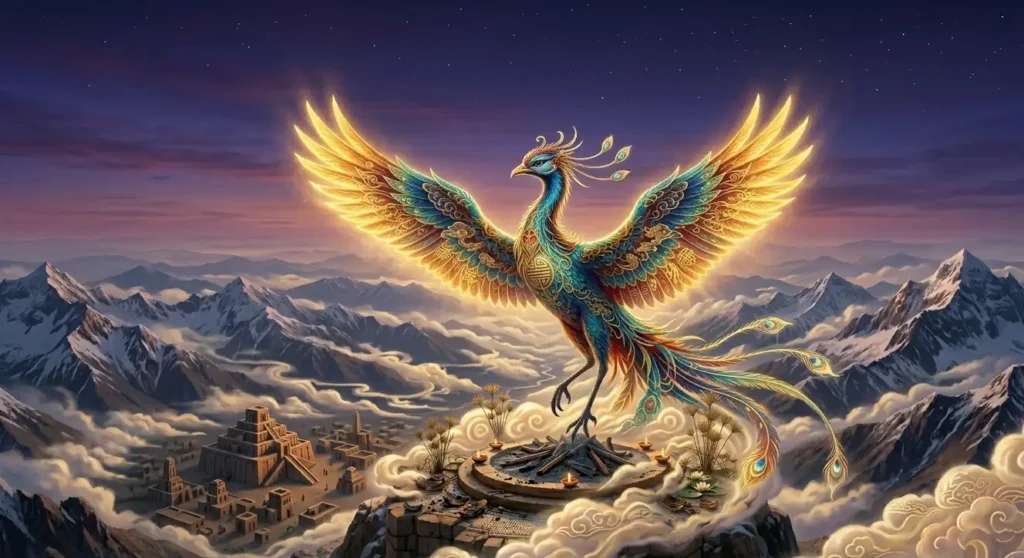
Let me be direct about something that took me years of following Chinese mythology to fully appreciate. The Fenghuang is not a phoenix. It’s consistently translated as “Chinese phoenix” in English, and that translation has caused an enormous amount of mythological confusion.
The Fenghuang is a composite divine bird that combines features of multiple birds, peacock, pheasant, crane, swallow, and embodies the principles of cosmic harmony, imperial virtue, and the auspicious union of complementary forces.
It does not die and rise from fire. It does not have a 500-year cycle. It does not burn. The association of Fenghuang with fire is a secondary quality in some texts (it’s associated with the Fire element and the South in some cosmological frameworks), but it’s not the defining feature of the bird’s mythology.
What the Fenghuang Symbolizes
The Fenghuang’s actual symbolic content is considerably richer than the phoenix label suggests:
Cosmic harmony: The Fenghuang’s appearance was understood as a sign that the natural and human orders were in perfect alignment. Its presence indicated that a ruler of exceptional virtue was reigning and that heaven approved of the current state of the world.
The yin-yang union: The Fenghuang is often paired with the dragon, the dragon representing the emperor and yang energy, the Fenghuang representing the empress and yin energy. Together, they symbolize the harmonious union of complementary principles.
The Five Virtues: Classical texts describe the Fenghuang as embodying five Confucian virtues. Its head represents virtue (de), its wings benevolence (ren), its back ritual propriety (li), its breast humanity (zhong), and its abdomen trustworthiness (xin).
The five colors: The Fenghuang’s plumage incorporates all five elemental colors, black, white, red, yellow, and green, making it a symbol of the completeness of the five-element system.
The Fenghuang is not the Suzaku
I need to address another confusion that I see constantly in discussions of Chinese mythology.
The Fenghuang and the Suzaku (Zhuque, Vermilion Bird) are not the same figure.
The Fenghuang is a divine composite bird that symbolises cosmic harmony and imperial virtue. It appears when a virtuous ruler reigns.
The Zhuque is the cosmological guardian of the South, one of the Four Holy Beasts, associated with the Fire element, the summer season, and the southern direction in the Si Xiang system.
They share fire associations and bird form, which is probably why they get confused. But they have different cosmological roles, different mythological traditions, and different symbolic content.
The Hindu Garuda: The Eagle-King
What the Garuda is
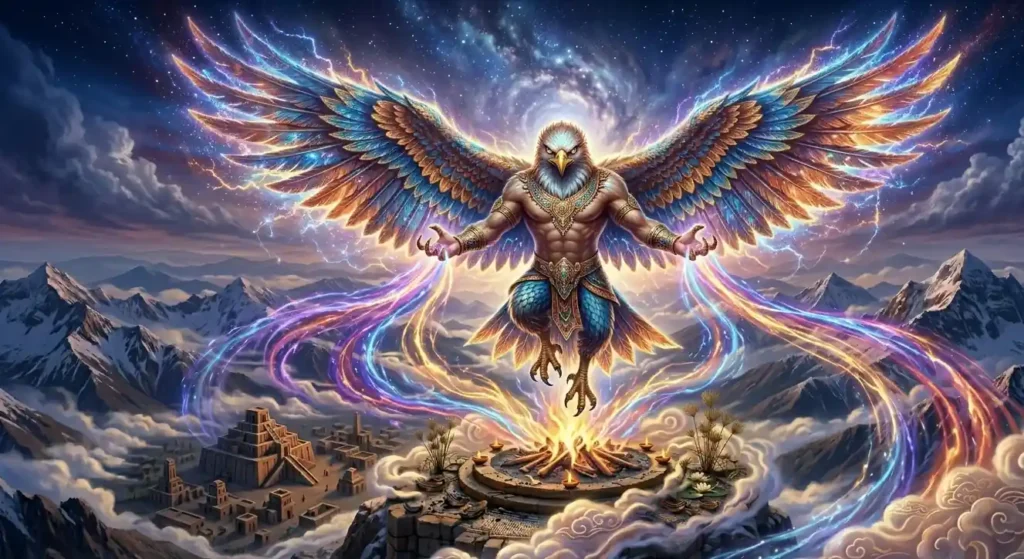
The Garuda is the divine eagle of Hindu mythology, the mount of the god Vishnu, the king of all birds, and the eternal enemy of the Nagas (serpent beings). Its image is the national symbol of Indonesia and Thailand.
The Garuda isn’t a phoenix in the rebirth-from-fire sense, but it belongs to the same cluster of divine solar bird figures that appears across South Asian and Southeast Asian traditions.
The Garuda’s mythological origin story involves it breaking free from its egg fully formed and immediately blazing with such intensity that the gods mistook it for the god Agni (fire) and begged it to dim its radiance.
This solar brilliance the bird so radiant it resembles fire is the connection point to other phoenix traditions. The Garuda is not a fire bird in the death-and-rebirth sense. It’s a fire bird in the radiance-of-the-sun sense, which is much closer to the Egyptian Bennu than to the Greco-Roman phoenix.
The Garuda across Southeast Asia
The Garuda spread throughout Southeast Asia with Hinduism and Buddhism, appearing in the mythologies and artistic traditions of:
- Thailand: The Garuda (Krut) is the national symbol, appearing on the royal coat of arms
- Indonesia: The Garuda is the national symbol and the name of the national airline
- Bali: Garuda imagery is central to Balinese Hindu religious art
- Cambodia: The Garuda appears extensively at Angkor Wat
- Japan: The Tengu of Japanese mythology carries Garuda ancestry through Buddhist transmission
The Garuda’s spread across Southeast Asia demonstrates how a divine bird figure can migrate across cultures through religious transmission, acquiring new associations in each context while retaining its core characteristics.
The Slavic Zhar-Ptitsa: The Magical Firebird
What the Firebird is
The Zhar-Ptitsa (Firebird) of Slavic mythology is one of the most visually distinctive phoenix-related figures in world mythology and one of the least known outside of Russian folk culture and Stravinsky’s famous ballet.
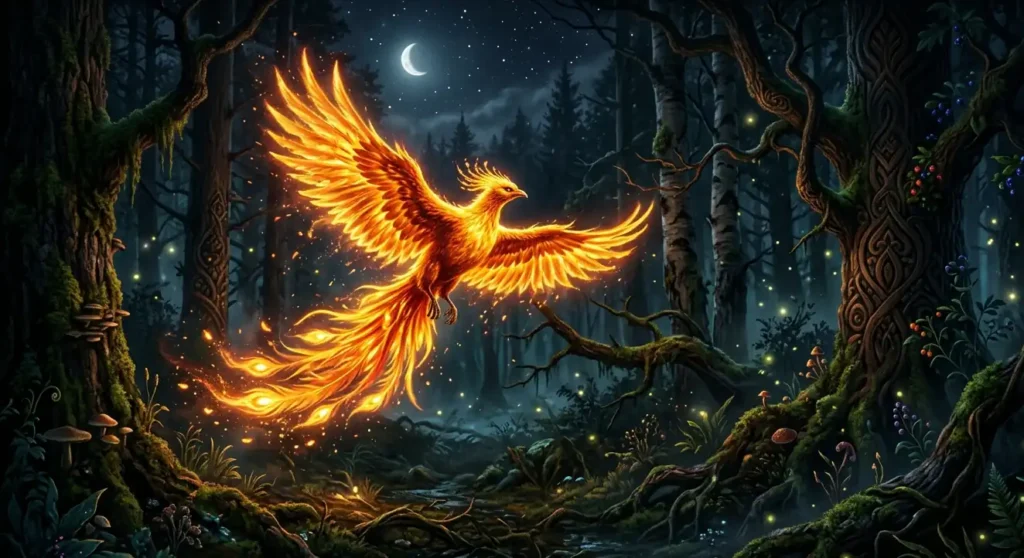
The Zhar-Ptitsa is a magical bird with feathers that glow like living fire, not fire itself, but luminous, blazing plumage that illuminates everything around it. A single feather, if you hold it, will light a room. The bird itself, if seen at night, appears to be made of flame.
Unlike the Western phoenix, the Zhar-Ptitsa doesn’t die and rebirth. It’s an elusive, magical creature that heroes quest for, catching the Firebird (or one of its feathers) is the archetypal Russian heroic challenge. It’s a symbol of both beauty and danger, of divine gifts that are difficult to obtain and potentially destructive if mishandled.
The most famous Zhar-Ptitsa stories appear in collections of Russian fairy tales including Afanasyev’s anthology, where Ivan Tsarevich is sent to catch the Firebird and embarks on adventures that determine his destiny.
The Firebird in Russian Art
The Zhar-Ptitsa entered global cultural consciousness primarily through Igor Stravinsky’s 1910 ballet The Firebird (L’Oiseau de Feu), commissioned by Sergei Diaghilev for the Ballets Russes. Stravinsky’s score drew on Russian folk melodies and created one of the 20th century’s most celebrated musical works.
The ballet’s popularity gave the Zhar-Ptitsa a global presence it might not otherwise have achieved, and the visual iconography of the Firebird, blazing, radiant, extraordinary entered the Western imagination through this artistic transmission.
The Arabian and Talmudic Phoenix Traditions
The Arabian Anqa
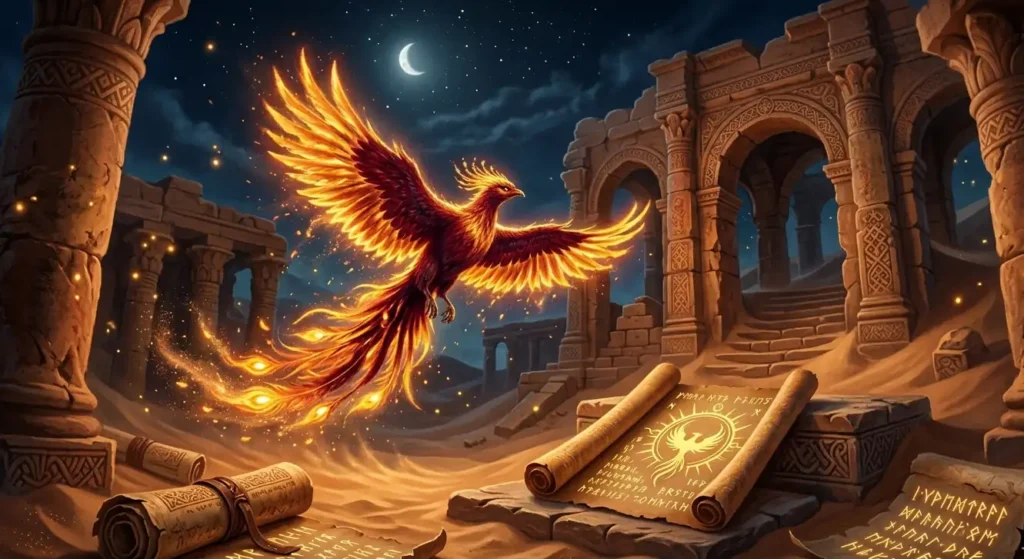
Anqa is the phoenix figure of Arabian and Islamic mythology a vast, miraculous bird of great age and power. The Anqa is described in classical Arabic literature as enormous, ancient, and extraordinarily rare, dwelling in distant mountains.
In some Islamic traditions, the Anqa was originally created perfect but became a predator and was finally vanished by divine decree, it exists but cannot be found. This “vanished rare bird” narrative is interesting in contrast to the Greco-Roman phoenix’s regular return.
The Anqa is sometimes identified with the Simurgh across Persian-Arabic literary exchange, creating a tradition of the single wise ancient bird that influences multiple later phoenix accounts.
The Milcham in Jewish Tradition
The Milcham or Chol is the phoenix figure of Talmudic and Midrashic tradition. When Eve offered the fruit of the Tree of Knowledge to every creature, one bird the Milcham refused. As a reward, this bird was granted immortality.
Different Talmudic sources describe this immortality differently. Some say the bird simply never dies, living perpetually in its walled city of Luz. Others describe it as renewing itself after an extremely long life cycle through fire and resurrection.
The Jewish phoenix tradition is notable because it frames the bird’s immortality as a reward for moral choice. The Milcham lives forever because it was the only creature that refused to participate in the original sin. That’s a completely different framework from any other phoenix tradition.
Japanese Ho-oh: The Sacred Phoenix
What Ho-oh is
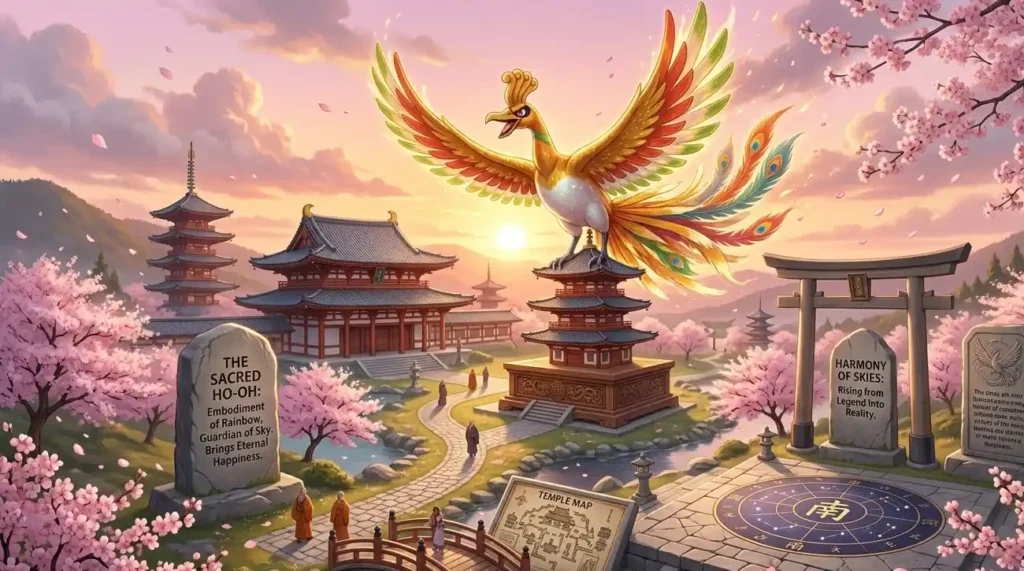
Ho-oh (in Japanese, the same characters as Fenghuang in Chinese) is the Japanese divine bird figure derived directly from Chinese Fenghuang traditions. It’s the sacred bird that appears at the beginning of a new era, whose song encompasses all the world’s sounds, and whose feathers display the five sacred colors.
The connection between Ho-oh and the Suzaku is often confused. They’re related but distinct:
- Ho-oh: The divine bird of virtue and auspicious omen, derived from Chinese Fenghuang, appearing at the dawn of a virtuous era
- Suzaku: The cosmological guardian of the South, one of the four directional guardian beasts of East Asian astronomy
In Japanese popular culture, Ho-oh is most widely known internationally as the legendary Pokémon introduced in Generation II designed explicitly as a Ho-oh reference, with its rainbow tail and connection to resurrection.
The Ho-oh in Japanese Buddhism
In Japanese Buddhist architecture, Ho-oh appears frequently as a decorative motif, particularly on temple rooftops. The golden phoenix ornaments on the roof of the Byodoin temple in Uji (near Kyoto) are some of the most famous examples, they appear on the Japanese 10-yen coin.
The Buddhist context adds a specifically Japanese dimension to the Ho-oh’s meaning, the divine bird that heralds the coming of a Buddha or a bodhisattva, whose appearance marks a moment of cosmic spiritual significance.
Phoenix vs Fenghuang vs Suzaku: The Definitive Comparison
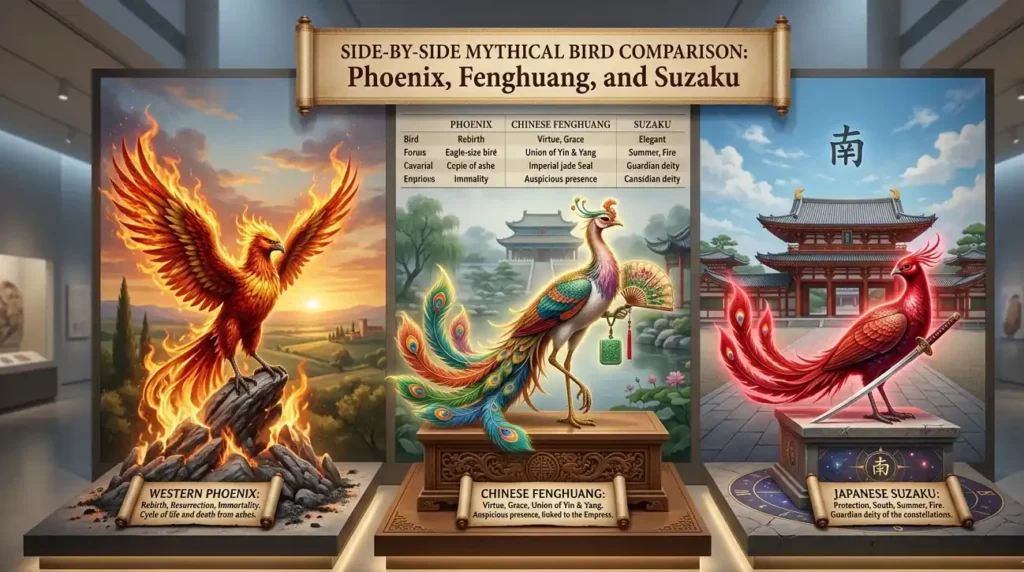
This is the comparison I get asked about most often, and it deserves a complete, clear answer rather than a vague “they’re all fire birds.”
| Dimension | Phoenix (Western) | Fenghuang (Chinese) | Suzaku (Japanese/Chinese) |
|---|---|---|---|
| Primary origin | Egyptian Bennu via Greco-Roman synthesis | Chinese composite bird tradition | Chinese astronomical cosmology |
| Core symbolism | Death and rebirth, renewal | Cosmic harmony, imperial virtue | Southern direction, Fire element, summer |
| Fire relationship | Dies and rises from fire | Associated with fire element (secondary) | Rules the Fire element domain |
| Uniqueness | Only one exists at a time | Multiple can exist, appear auspiciously | Eternal cosmological presence |
| Rebirth cycle | Yes – central defining feature | No – appears when conditions are right | No – it’s a permanent cosmic guardian |
| Paired figure | None traditionally | The Dragon (cosmic union) | Azure Dragon, White Tiger, Black Tortoise |
| Moral meaning | Renewal, resurrection | Virtue, harmony, the quality of the ruler | Cosmological authority, seasonal governance |
| Gender | Usually masculine in classical sources | Often associated with feminine principle | Neither – cosmic force |
| Imperial use | Roman imperial eternity symbol | Chinese imperial and feminist symbol | Directional guardian in architecture |
The short version I use when explaining this:
- Phoenix: The bird that dies by fire and rises reborn. About cycles of renewal.
- Fenghuang: The bird that appears when the world is in harmonious order. About virtue and cosmic alignment.
- Suzaku: The celestial guardian of the South. About cosmological structure and seasonal governance.
Three birds. Three completely different jobs.
What Phoenix Symbolism Means Across Traditions
The Common Threads
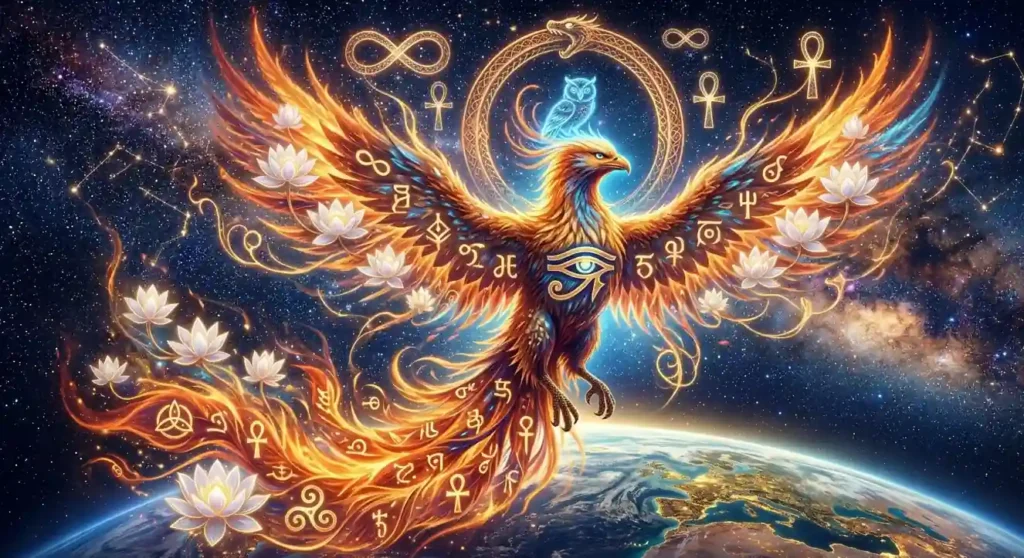
Despite their differences, the global phoenix traditions share certain symbolic themes:
Solar association: Every major phoenix tradition connects its fire bird to the sun. The Egyptian Bennu was Ra’s companion. The Greco-Roman phoenix had gold and red solar plumage. The Fenghuang is associated with the Fire element and the south. The Garuda is so radiant it resembles the god of fire.
The solar connection makes sense, the sun is itself the great celestial fire that renews daily, the light that returns after darkness, the cycle made visible every morning. Any fire bird that represents renewal is drawing on the sun’s cosmological role as the ultimate renewal figure.
Rarity and singularity: Most phoenix traditions describe their bird as unique or extremely rare. The Greco-Roman phoenix has only one member of the species alive at any time. The Simurgh dwells in inaccessible mountains. The Zhar-Ptitsa is elusive and difficult to find. The Fenghuang appears rarely, only when conditions are right.
Rarity amplifies significance. A bird that appears whenever you look for it doesn’t carry the same meaning as one whose appearance is a once-in-a-generation event.
The herald function: Many phoenix traditions give the bird a role as a herald of significant change. The Fenghuang heralds a virtuous reign. The Simurgh appears to those it has chosen for a special destiny. The Ho-oh heralds a new era. The Western phoenix’s regular return marks the end of one cosmic cycle and the beginning of the next.
Where the Traditions Diverge
The most significant divergence is on the fire/rebirth question.
The Western phoenix tradition makes fire and rebirth central. This is what most people know and it’s genuinely in the ancient sources. But it’s a specific cultural emphasis, not a universal feature.
Most Asian traditions don’t share this emphasis. The Fenghuang’s fire is elemental, not transformative in the death-rebirth sense. The Simurgh’s wisdom transcends any single life cycle. The Garuda’s radiance resembles fire but doesn’t involve burning.
The fire-and-rebirth phoenix is, I’d argue, primarily a Mediterranean synthesis of the Egyptian solar renewal concept with broader cultural interest in cycles of transformation. It’s beautiful and symbolically potent. But it doesn’t represent the full global phoenix tradition.
The Phoenix in Global Religious Traditions
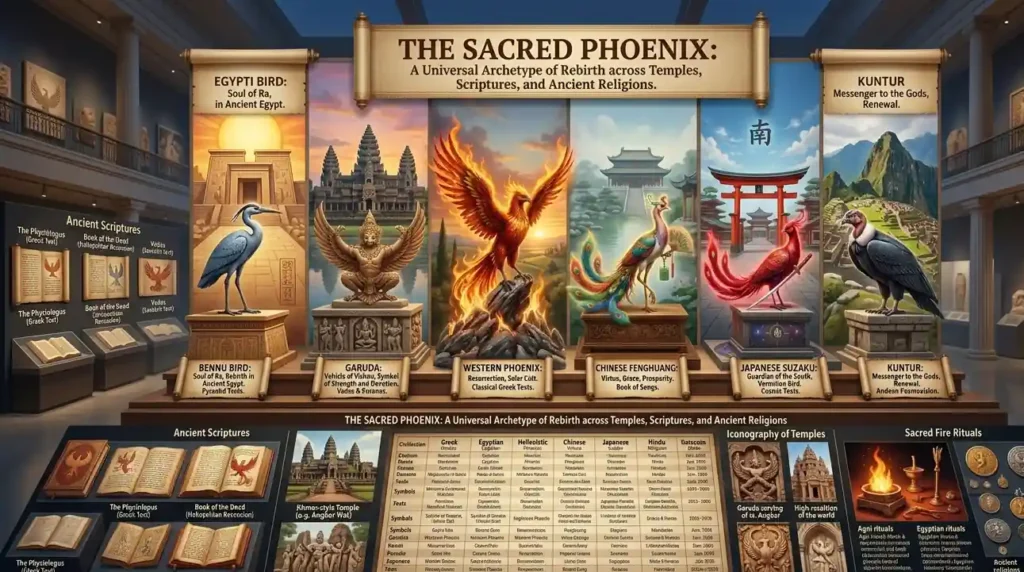
Early Christianity
The phoenix entered Christian theological literature early and enthusiastically. Clement of Rome (1st century CE) used the phoenix as an argument for the resurrection of the dead in his First Epistle to the Corinthians: if a bird can renew itself after death through natural processes, how much more can God renew a human soul?
The phoenix appeared in early Christian funerary art, on sarcophagi and in catacombs, as a symbol of the resurrection promise. Its imagery on Roman coins, where it represented imperial eternity, was adapted to represent Christian resurrection hope.
Physiologus, a Greek Christian text of the 2nd to 4th centuries CE that was hugely influential in shaping medieval natural history, included the phoenix as one of its symbolic animals with explicit Christian typological meaning.
Medieval Islamic Tradition
The Anqa/Simurgh complex was integrated into Islamic cosmological thinking, particularly in Sufi philosophical traditions. Attar’s Conference of the Birds (discussed above) is the most significant example, but the divine bird appears throughout Persian-Islamic poetry as a symbol of the divine presence that the spiritual seeker approaches.
East Asian Buddhism
The Ho-oh/Fenghuang complex was integrated into Buddhist iconography throughout East Asia, often appearing in temple architecture alongside the dragon and other auspicious figures. The divine bird’s association with virtue and cosmic harmony fitted naturally with Buddhist aesthetic and symbolic programs.
Frequently Asked Questions
What is the oldest phoenix myth?
The Egyptian Bennu is widely considered the phoenix’s oldest precursor, linked to the sun temple at Heliopolis long before Greek accounts. The Bennu appears in Middle Kingdom texts around 2000 BCE or earlier. The familiar rebirth by fire story emerged later in the Greco Roman world, with Herodotus providing the earliest clear Greek account.
Is the Fenghuang the same as the phoenix?
The Fenghuang is often called the “Chinese phoenix,” but the comparison is misleading. The Fenghuang is a divine bird symbolising harmony, virtue, and balance, not rebirth through fire. Unlike the phoenix, it appears as an auspicious sign when the world is in proper order, making the two distinct mythological figures.
What’s the difference between the phoenix and the Suzaku?
The phoenix is a Mediterranean mythological bird defined by rebirth through fire. The Suzaku, known as Zhuque in Chinese tradition, is the southern guardian in East Asian cosmology, linked to fire and summer. While both share fire symbolism and bird form, they have different origins, roles, and meanings.
What does the phoenix symbolize?
In Western tradition, the phoenix symbolizes renewal, resurrection, transformation through destruction, and cyclical time. Across global traditions, related birds carry broader meanings: solar renewal in the Egyptian Bennu, wisdom in the Persian Simurgh, harmony in the Chinese Fenghuang, divine protection in the Hindu Garuda, wonder in the Slavic Zhar Ptitsa, and moral reward in the Jewish Milcham.
How long does a phoenix live?
In the Greco Roman tradition, the phoenix’s lifespan varies between 500, 540, or 1,000 years, though the 500 year cycle became the most widely accepted. The Persian Simurgh is portrayed as effectively eternal, having witnessed the world’s destruction multiple times. The Fenghuang has no fixed lifespan, appearing only when the world is in harmony.
Is the Garuda the same as the phoenix?
The Garuda belongs to the broader tradition of divine solar birds linked to phoenix mythology, but it is a distinct figure in Hindu and Buddhist traditions. As the mount of Vishnu and enemy of serpents, Garuda represents solar radiance, power, and protection. Its connection to the phoenix comes from shared blazing imagery, not rebirth through fire.
Final Thoughts
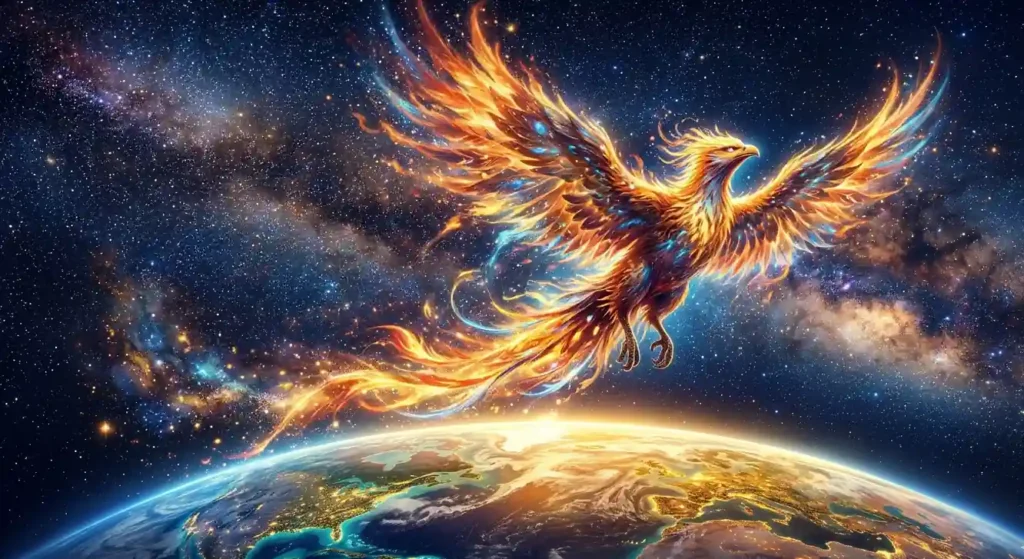
Twenty years of following mythology has taught me that the most popular version of a mythological figure is almost never the richest version.
The phoenix most people know, burning, dying, rising from ash, is genuinely present in the ancient sources. I’m not saying it’s wrong. But it’s a late synthesis of older traditions that were individually more complex, more philosophically sophisticated, and more distinctly useful to the cultures that produced them.
The Egyptian Bennu isn’t about rebirth, it’s about the first moment of creation, the cry that broke the primordial silence. The Persian Simurgh isn’t about fire. It’s about wisdom accumulated across cosmic time, the elder presence that has witnessed everything and still shows up to help those who need it. The Chinese Fenghuang isn’t about transformation, it’s about the world being in the ,right order, the moment when heaven and earth are aligned and something magnificent appears to acknowledge it.
These are different ideas. Richer ideas, in some ways, than the popular synthesis. And they’re worth knowing on their own terms rather than as variations on the familiar story.
The phoenix is everywhere on coins, flags, and corporate logos and fantasy novels precisely because the idea it represents is genuinely powerful. Renewal is powerful. Survival of destruction is powerful. The possibility that what seems like an ending might be a transformation is one of the most sustaining ideas in the human imaginative repertoire.
But the full tradition is bigger and stranger and more interesting than the pop-culture version. It always is.
Related Articles
- Suzaku: Vermilion Bird symbolism, myths and sacred meaning
- The Four Holy Beasts: complete guide to the Si Xiang
- Dragon mythology: East, West, and every culture in between
- Yin Yang Sun and Moon: Duality, Myth, and Spiritual Meaning
- Fenghuang: Chinese Phoenix Meaning, Symbolism & Origins
- Fenghuang & Vermilion Bird: Not as Similar as You Think
Written by Batin Khan | Mythology and philosophy reader across world cultures (20 years), Cultivation novels reader for the past 10 years | Specialist in Xianxia, Eastern and Western mythological traditions, and fantasy worldbuilding