
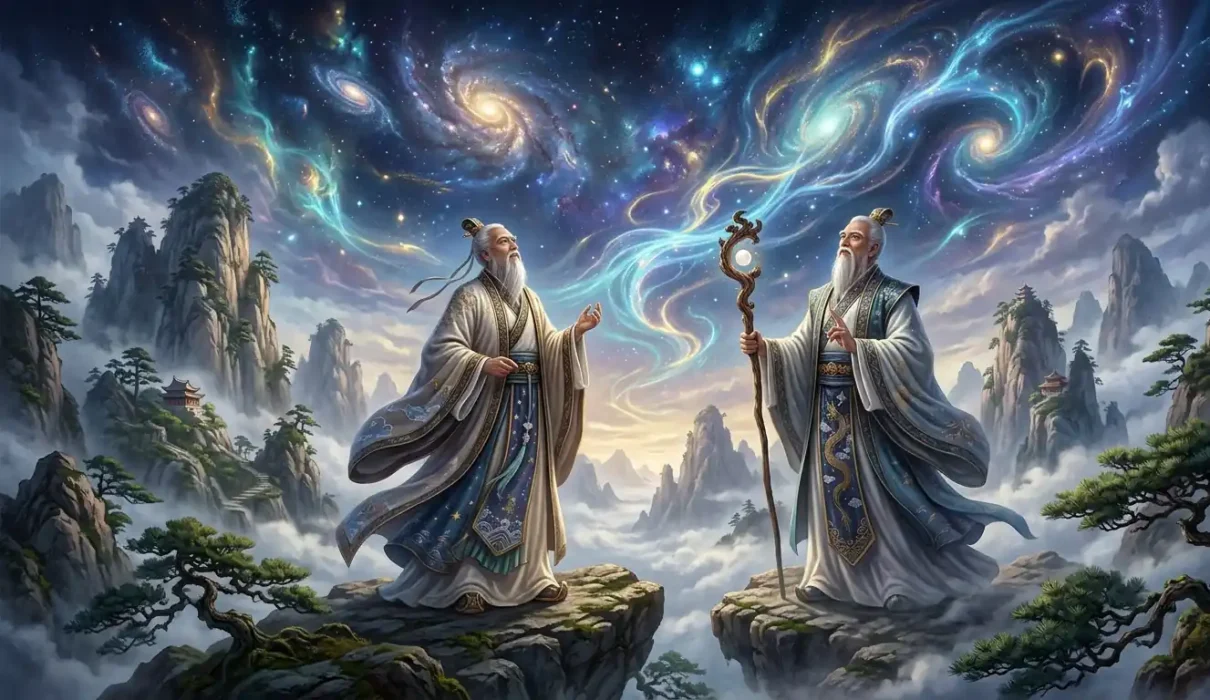
 By
By Quick Takeaways:
- Simple fear of death is the least interesting and least accurate explanation for why Daoist masters pursued immortality
- The real motivations include philosophical inevitability (if the Dao is eternal and you’re cultivating alignment with it, death signals incomplete practice), transformation hunger (the desire for a fundamentally different kind of existence, not just more of the same), and service commitment (longer life means more time to help and transmit)
- Several of Daoism’s greatest figures, including Zhuangzi, were explicitly skeptical of or indifferent to literal immortality, which complicates the popular picture considerably
- Imperial patronage created powerful practical incentives that shaped which practitioners pursued immortality and how loudly they proclaimed it
- Understanding these motivations changes how you read Daoist philosophy, Chinese religious history, and the entire cultivation tradition
Here’s the assumption I want to challenge right at the start.
Most people, if you ask them why Daoist masters pursued immortality, will give you some version of it. They didn’t want to die. They were afraid. They wanted more time. And while that’s not entirely wrong, it’s about as accurate as saying people climb mountains because they want to be higher up.
The motivations behind the immortality tradition are considerably more interesting than simple death-avoidance and considerably more diverse. Some practitioners were indeed motivated by something like conventional fear of death. But others were motivated by philosophical commitments that made immortality feel like a logical consequence of their worldview. Others were driven by genuine compassion. Others were pursuing a radical transformation of their own existence that had nothing to do with prolonging ordinary life.
And some of the tradition’s greatest figures thought the whole project was slightly missing the point.
Let me walk through the real reasons, one by one.
Reason 1: Philosophical Inevitability

The Logic from the Inside
This is the motivation that most surprised me when I first worked it out properly, and it’s the one I find most intellectually compelling.
If you accept the core Daoist cosmological framework, the Dao is eternal, it’s the ground of all existence, and cultivating alignment with the Dao through specific practices genuinely refines the practitioner’s fundamental nature, then death starts to look philosophically awkward.
Here’s the logic. The Dao doesn’t die. It precedes existence and will outlast it. If you’re successfully cultivating deep alignment with the Dao through decades of dedicated practice, refining jing into qi, qi into shen, shen progressively integrating with the Dao’s own nature, what exactly is supposed to kill you?
Death, in this framework, isn’t an inevitability to be accepted. It’s evidence that the cultivation project is incomplete. The practitioner’s nature hasn’t been sufficiently refined and aligned to persist beyond the dissolution of the body. Death is a diagnostic, not a fate.
The Tao Te Ching’s Hint
Chapter 33 of the Tao Te Ching gives us: “He who dies without being lost has longevity.”
The phrase “without being lost” is doing significant philosophical work here. Laozi isn’t saying that living a long time is the goal. He’s saying that the person who is so thoroughly the Dao that their individual identity is continuous with it isn’t really lost when the body dissolves.
This frames immortality not as the continuation of a person but as the completion of a transformative project, the moment when the distinction between individual and Dao has been so thoroughly dissolved that the concept of personal death no longer applies in the ordinary sense.
That’s a much more interesting motivation than “I don’t want to die.” It’s the motivation of someone who’s pursuing the completion of the most ambitious philosophical project imaginable.
Reason 2: Transformation Hunger Not Life Extension

The Most Misunderstood Motivation
Most serious Daoist masters weren’t seeking more of ordinary life. They were seeking a fundamentally different kind of existence.
The Daoist immortal, as described in classical texts, isn’t simply an old person who hasn’t died yet. They’re something qualitatively different, capable of things ordinary humans can’t do, dwelling in realms ordinary humans can’t access, perceiving reality in ways ordinary human consciousness doesn’t permit.
The classical descriptions of immortal existence include:
- Direct perception of the Dao’s nature not conceptual understanding but immediate experiential contact
- Freedom from ordinary physical constraints, the ability to move through the world in ways the physical body normally prevents
- A quality of awareness so clear and spacious that ordinary human consciousness looks like perpetual sleepwalking by comparison
- The cessation of the suffering produced by desire, fear, and the ordinary ego’s constant reactive relationship with experience
This isn’t a description of a longer human life. It’s a description of a different kind of existence entirely. The Daoist master who pursues immortality isn’t motivated by the desire for more Tuesday mornings eating rice and watching the river. They’re motivated by the desire for a state of being that ordinary Tuesday mornings can barely hint at.
The Zhuangzi’s Vision
The Zhuangzi’s descriptions of the “true person” (zhen ren) make this transformation hunger vivid:
“The true people of ancient times did not know how to be pleased by life or how to hate death. They emerged without delight, submerged without resistance. Quickly they came, quickly they went, and that was all.”
This isn’t someone clinging to existence. It’s someone whose relationship with existence has been so thoroughly transformed that the ordinary categories of life-clinging and death-fear no longer apply.
The Zhuangzi’s immortals aren’t desperately prolonging their lives. They’ve achieved a quality of being in which the distinction between living and not-living has become philosophically interesting rather than emotionally overwhelming.
Reason 3: Service And The Transmission Imperative
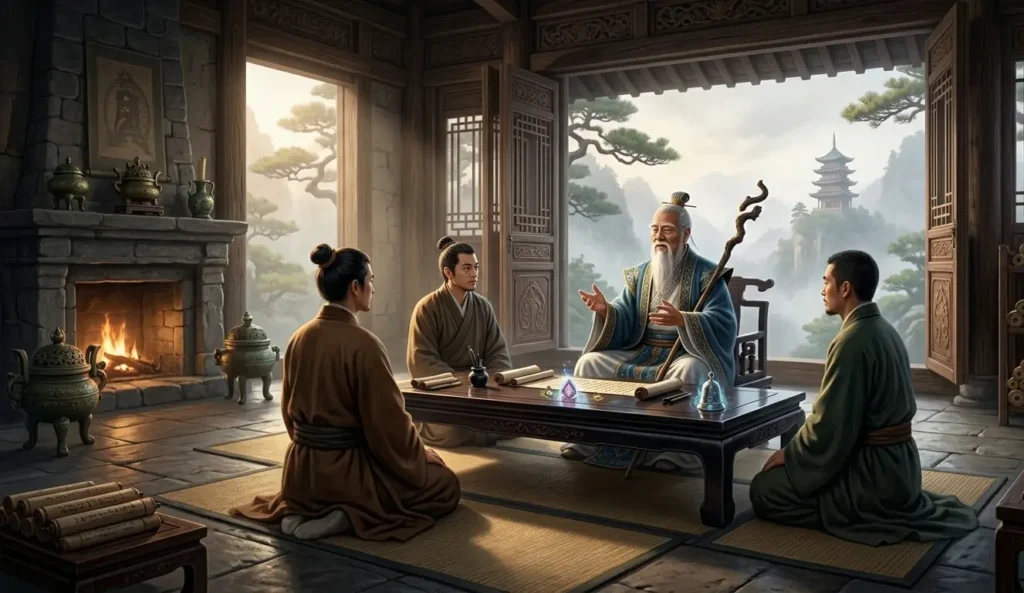
Time as a Resource for Compassion
This is the motivation that gets the least attention in popular discussions, and it’s one I find genuinely moving.
The Daoist tradition places enormous value on the transmission of genuine teaching from teacher to student, the passing of direct experiential knowledge through lineages that can span centuries. This isn’t book learning. It’s the transmission of specific states of consciousness, specific refined perceptions, specific ways of inhabiting one’s own body and mind that can’t be adequately conveyed through text alone.
A teacher who dies has a limited number of students they can properly instruct. A teacher who lives for centuries can transmit the tradition to hundreds of students across multiple generations, watch those students develop and deepen the practice, refine their own teaching based on what they observe, and eventually produce a depth of transmission that no single human lifespan can achieve.
The Compassionate Immortal
The figure of the immortal who returns to teach those who have achieved their own liberation but comes back to help others is one of the Daoist tradition’s most compelling images.
The Eight Immortals in popular Chinese mythology are striking precisely because of this quality. They didn’t retreat to some inaccessible celestial realm and leave humanity behind. They remain accessible, they intervene, they teach, they help those who encounter them. Their immortality is in service of something larger than themselves.
This motivation, the compassionate desire to serve, to transmit, to help more people over more time, is philosophically serious and emotionally genuine. It’s the motivation of someone who loves the tradition and loves the people who might benefit from it, not someone simply afraid of their own mortality.
Reason 4: The Completion Ethic
Daoist Masters as Committed Craftspeople
I have developed a certain perspective on practitioners who pursue their craft with total dedication. There’s a specific quality of motivation that emerges when someone is deeply committed to a long-term project, a drive not just to continue the project but to see it through to completion.
Daoist masters who had spent decades in dedicated practice were, in a real sense, deeply invested in their work. The cultivation of jing into qi, qi into shen, and the progressive alignment of shen with the Dao, this is a project that classical texts describe as taking decades to complete properly. Some texts suggest centuries.
For someone thirty or forty years into this project, death isn’t just personally unfortunate. It’s a practical obstacle to completing work that has deep meaning and that serves purposes larger than individual survival. The immortality pursuit is, in part, the practitioner’s determination not to have their work cut off before it reaches fruition.
The Artisan Metaphor
The Zhuangzi contains some of the most vivid descriptions of this quality in Chinese literature, the famous passages about Cook Ding cutting the ox, the craftsman carving the bell stand.
In each case, the craftsman’s mastery is described not as the accumulation of technique but as the alignment of the practitioner’s own nature with the nature of the work. The master doesn’t force the material. They find the natural lines and follow them.
Daoist cultivation practice has the same quality. The practitioner isn’t forcing anything. They’re progressively aligning with what’s already natural, already present, already the case. Death interrupts that alignment process before it reaches its natural completion. The desire to complete the project is the craftsperson’s instinct translated into spiritual practice.
Reason 5: The Political And Social Dimensions
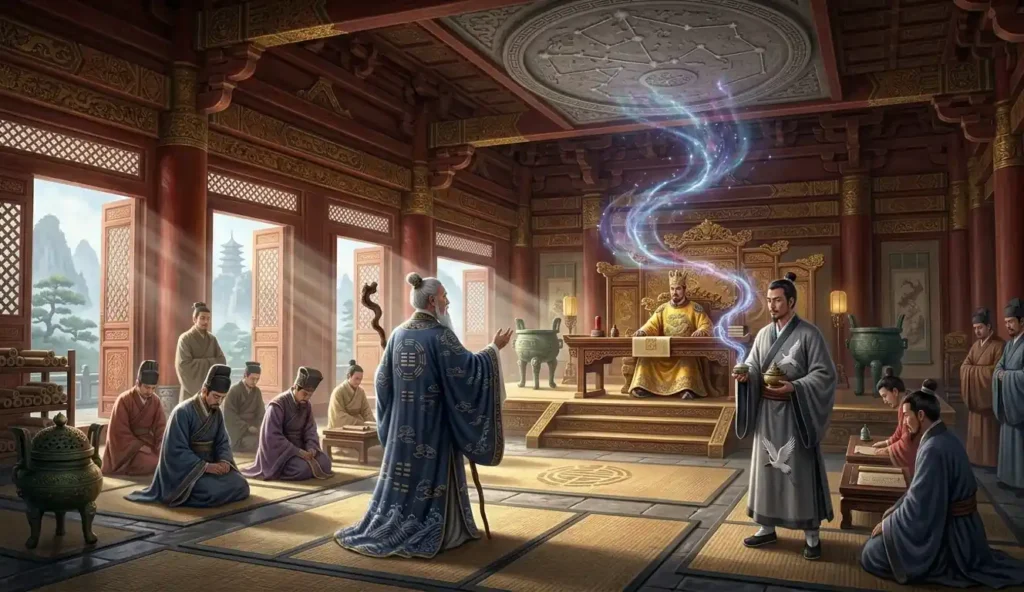
Imperial Patronage and its Effects
I want to be honest about something that pure philosophical accounts of Daoist immortality motivation often underplay: the political and social incentives that shaped who pursued immortality and how.
Several Chinese emperors were fascinated by immortality and lavishly patronized practitioners who claimed progress toward it. The First Emperor Qin Shi Huang sent multiple expensive expeditions to find the legendary immortal islands. The Han Emperor Wu patronized extensive Daoist immortality research. Tang emperors took immortality elixirs despite or perhaps because of their frequently lethal nature.
This created a significant practical incentive. A Daoist practitioner who could persuasively claim progress toward immortality could secure imperial support, resources, protection, and influence. The immortality tradition wasn’t just a philosophical commitment. It was, for some practitioners, a career.
Want to understand the Chinese Heavenly Court clearly? Read my complete guide here
The Honest Assessment
I want to be clear that I don’t think this economic dimension explains away the genuine philosophical motivations. Most of the most serious and accomplished Daoist practitioners weren’t primarily motivated by imperial favor. Many of them actively avoided court life.
But pretending the incentive structure didn’t exist would be dishonest. The history of any spiritual tradition includes people pursuing genuine transformation alongside people pursuing prestige and resources through the tradition’s vocabulary. Daoism is no exception, and acknowledging this makes the genuine practitioners’ motivations more clearly visible by contrast.
The Complication: Zhuangzi’s Skepticism
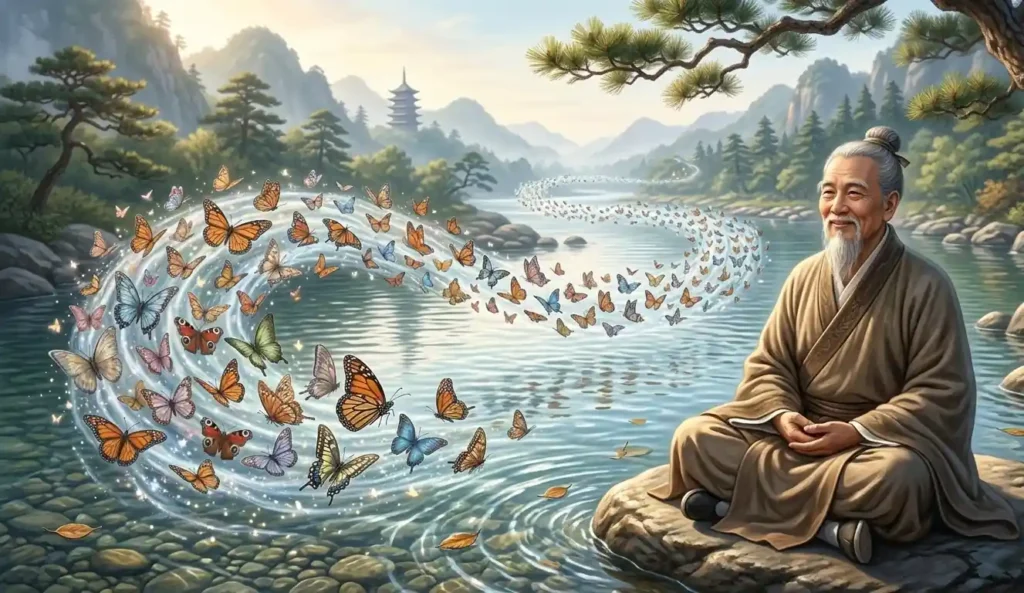
The Great Tradition’s Internal Critic
Here’s the part of this story that I find most interesting and that most popular treatments of Daoist immortality completely miss.
Zhuangzi was skeptical of the immortality tradition as literally pursued. Not hostile to it but genuinely, philosophically skeptical of the idea that the point of cultivation was to produce a practitioner who physically doesn’t die.
The famous passage describing Zhuangzi’s response to his wife’s death is the most vivid example:
When his wife died, Zhuangzi’s friend Huizi found him singing, beating on a bowl. Huizi was appalled. Zhuangzi’s response:
“When she first died, do you think I didn’t grieve like anyone else? But I looked back to her beginning and the time before she was born. Not only the time before she was born, but the time before she had a body. Not only the time before she had a body, but the time before she had a spirit. In the midst of the jumble of wonder and mystery, a change took place and she had a spirit. Another change and she had a body. Another change and she was born. Now there’s been another change and she’s dead. It’s just like the progression of the four seasons.”
This is not the psychology of someone who desperately wants to avoid death. This is someone who has genuinely worked through the fear of dissolution and arrived somewhere much calmer.
What Zhuangzi Thought the Real Goal was
Zhuangzi’s real vision wasn’t a practitioner who doesn’t die. It was a practitioner who has so thoroughly transformed their relationship with existence that death loses its terror and its grip.
The “true person” of the Zhuangzi isn’t immortal in the conventional sense. They’re someone who moves through the world with such complete alignment with the Dao that the boundary between living and not-living has become philosophically interesting rather than emotionally overwhelming.
This is a significant critique of the waidan external alchemy tradition, the practitioners desperately ingesting mercury elixirs trying to achieve physical immortality from within the Daoist tradition itself. Zhuangzi’s implicit question is: if you’ve genuinely aligned with the Dao, why do you still care so much whether the body continues?,
The Synthesis: Multiple Motivations One Tradition
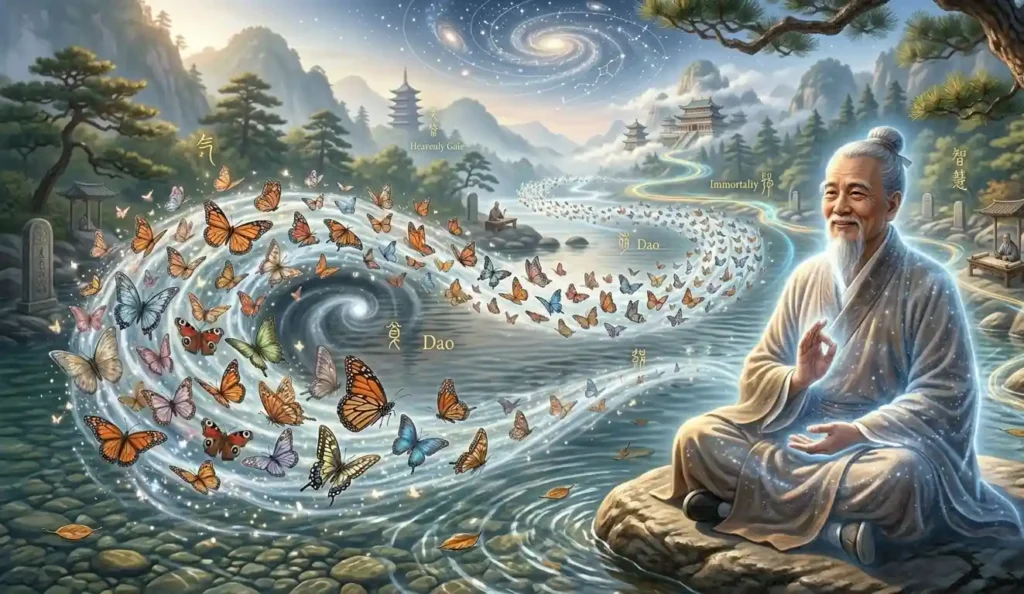
What all these Motivations Share
Looking across all five of the real motivations I’ve described, there’s a common thread:
None of them are primarily about self-preservation in the ordinary sense. They’re about completing something, serving something, becoming something, or understanding something. The self that would be preserved by immortality is, in the most serious accounts, precisely what the practice is designed to dissolve.
This is the subtlety that most popular accounts of Daoist immortality miss entirely. The practitioner pursuing immortality through genuine cultivation isn’t trying to keep their ordinary self alive indefinitely. They’re engaged in a project that progressively transforms that self into something that relates to existence completely differently.
Whether that transformation ultimately produces something that escapes physical death is, from this perspective, almost secondary to the question of whether the transformation is genuinely occurring.
The Hierarchy of Motivations
here’s how I’d rank the motivations by philosophical seriousness:
Most serious:
- Philosophical inevitability – the logical completion of the cultivation project
- Transformation hunger – the desire for a fundamentally different kind of existence
- The completion ethic – the craftsperson’s determination to finish their work
Genuinely serious but secondary:
- Service and transmission – the compassionate desire to help more over more time
- The teacher’s responsibility to students still developing
Real but least defensible:
- Continuation of ordinary life – the simple fear of death and desire for more time
- Imperial patronage incentives – the professional and social rewards of the immortality claim
The most accomplished Daoist practitioners I’ve studied were motivated primarily by the first category, complicated by the second, and occasionally corrupted by the third.
Frequently Asked Questions
Did Daoist masters actually believe they could become physically immortal?
Many did, and the historical record suggests this belief was sincere, not merely rhetorical. Multiple Tang Dynasty emperors died from mercury poisoning after taking elixirs, indicating genuine faith in their power. The latter Complete Reality school shifted toward internal cultivation as evidence mounted that physical immortality through elixirs was unattainable.
What did Zhuangzi think about immortality?
Zhuangzi’s position is nuanced and often misrepresented. He valued transformation and the cultivation of an extraordinary way of being, but remained skeptical of anxiety driven quests for physical immortality through external means. For him, the “true person” was not someone who escaped death, but someone whose relationship to existence had changed so deeply that death no longer held power over them.
Why did some Daoist masters live to very old ages?
The lifestyle practices associated with Daoist cultivation, including dietary moderation, qigong, dao yin, meditation, and avoidance of excess, are now recognized as genuine contributors to longevity. Practitioners who followed them seriously often lived longer than their contemporaries, reinforcing Daoism’s association with extraordinary lifespan. The leap from exceptional health to literal physical immortality, however, was immense.
Is there a difference between longevity cultivation and immortality pursuit?
Yes, and the distinction matters. Longevity cultivation (yang sheng) refers to Daoist practices aimed at health maintenance and extending ordinary human life. The pursuit of immortality was a more radical project, seeking a transformation of existence beyond normal human limits. Most practitioners focused on the former, while a smaller number pursued the latter.
How did the motivation to pursue immortality change across Daoist history?
The motivations shifted significantly across periods. Early Daoist philosophy, especially the Tao Te Ching and Zhuangzi, focused more on transforming one’s way of living than on literal immortality. The Han Dynasty saw the rise of external alchemy under imperial patronage and genuine philosophical belief. After multiple Tang emperors died from elixirs, external alchemy declined, and the Song era’s Complete Reality school turned toward internal cultivation and more spiritually defensible forms of transcendence.
Final Thoughts
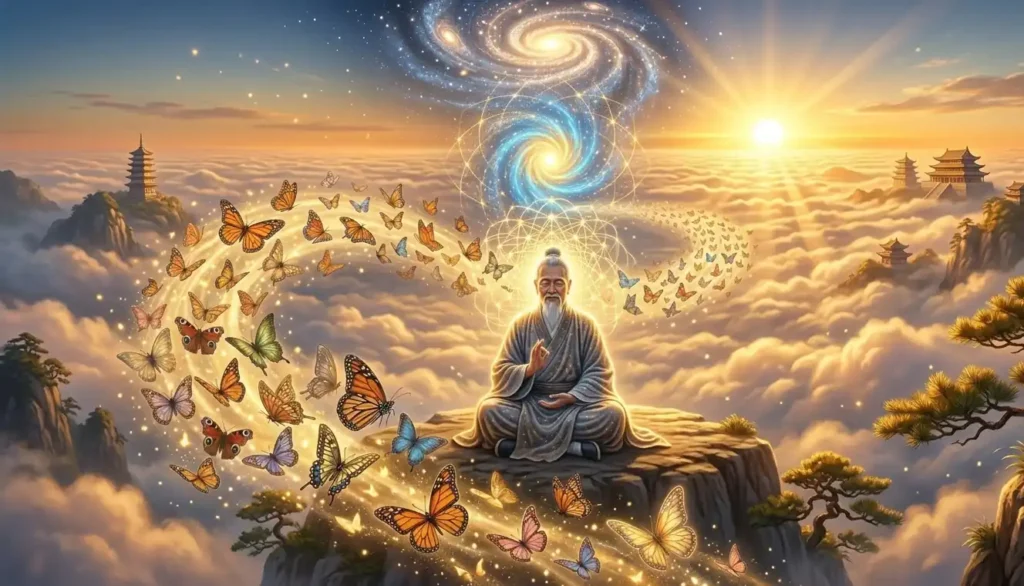
The simple answer to “why did Daoist masters pursue immortality?” They were afraid of death and wanted to live forever, which is not entirely wrong, but it’s about as useful as saying that painters paint because they like colors.
The real motivations are more interesting, more philosophically serious, and more humanly recognizable. The desire to complete a meaningful project rather than have it cut off. The hunger for a quality of existence that ordinary life only hints at. The compassionate wish to serve and transmit more over more time. The philosophical logic that says: if the Dao is eternal and I’m cultivating alignment with the Dao, what exactly is supposed to kill me?
And then the great internal complication Zhuangzi sits by his dead wife, singing, having worked through the grief to arrive somewhere that doesn’t need immortality because it’s no longer running from mortality.
Both of those are genuinely Daoist. Both are philosophically serious. Both deserve to be understood rather than reduced to the simple story of people who didn’t want to die.
The tradition is big enough to hold both. It always was.
Related Articles
- How Daoist Meditation Became the Root of Cultivation
- How to Become Immortal According to Chinese Myth & Daoism
- Yin Yang in Daoism: Meaning, Symbolism & Sacred Origins
- Meridians in Cultivation: Meaning, Function & Sacred Energy
- 3 Dantian in Cultivation: Meaning, Function & Sacred Energy
- The 3 Paths of Cultivation: Taoism vs Buddhism vs Confucianism
- Eight Immortals: Symbols, Sacred Roles & Daoist meaning
References
- Stanford Encyclopedia of Philosophy – Daoism
- Joseph Needham, Science and Civilisation in China
- Dao De Jing (Tao Te Ching)
- Zhuangzi
- Daoism and Chinese Culture – Livia Kohn
- Huainanzi
- Yin-Yang and the Nature of Correlative Thinking – Angus Charles Graham
- Book of Changes: Yi Jing – Chinese Text Project
- Legend of Immortals – Chinese Philosophy Book Digitization Project
- Baopuzi by Hong Ge | Project Gutenberg
- The Taoist Body – Kristofer Schipper
Written by Batin Khan, a curious free spirit who loves reading and exploring the worlds of fantasy, mythology, and ancient stories. Through this blog, Batin hopes to share that sense of wonder with readers while building an exciting future along the way.