 By
By This article explores Daoist immortality as mythology and religious scholarship, not medical advice. Some historical practices were harmful. Consult qualified professionals before trying any new practice.
Quick Takeaways:
- Daoism developed the most elaborate and systematically practical immortality tradition in human history, with multiple distinct methods and a sophisticated cosmological framework explaining how to become immortal
- The tradition distinguishes between different grades of immortality, from physical immortals who transcend death entirely to spiritual immortals who achieve union with the Dao after death
- The three main practical approaches are waidan (external alchemy, refining physical elixirs), neidan (internal alchemy, refining the body’s own energy), and a cluster of supplementary practices including breath work, diet, meditation, and moral cultivation
- The key concept underlying all of it is the refinement of the body’s three fundamental energies, jing (essence), qi (vital breath), and shen (spirit), into an increasingly subtle and purified form
- Understanding the real Daoist immortality tradition changes how you read Chinese mythology, Chinese medicine, Chinese martial arts, and Chinese religious history simultaneously
I’ll be honest about what drew me to this topic.
I have been a fan of the fantasy and sci-fi genre, being a curious person myself, I would always explore if I saw something interesting in a movie or read something in a book, which led me to my long journey of exploring mythology, philosophy, and history related to them. And I think that fantasy and sci-fi authors are some of the best and most intelligent writers of all time. You can call it escapism, but these genres can lead to something special. Sometimes, they inspire people.
As a passionate fan of the fantasy genre, it led me to the Chinese fantasy scene, where I learned about the concept of cultivation and Daoism, and started exploring cultivation novels and TV shows. which in turn led me to exploring Chinese mythology and philosophical concepts related to it. And it’s been almost 11 years.
After 11 years of following this material, what strikes me most isn’t the mythology surrounding immortals. It’s the extraordinary sophistication of the practical framework Daoism developed for actually becoming one. This isn’t wishful thinking dressed up in mystical language. It’s a systematic, internally coherent tradition with specific methods, specific practices, specific physiological theories, and a complete cosmological framework explaining why it should work.
That tradition is what this article covers. All of it. The cosmological foundation, the different types of immortals, every major method, the specific practices, and the genuinely fascinating history of how this tradition developed across two thousand years. I know the intro is a little long.
Note this article is for information purpose only.
What Daoism Actually Means by Immortality
Before anything else, let’s get precise about what the Daoist tradition means by immortality, because it’s more nuanced than the simple “living forever” that the English word suggests.
The Spectrum of Immortal Achievement
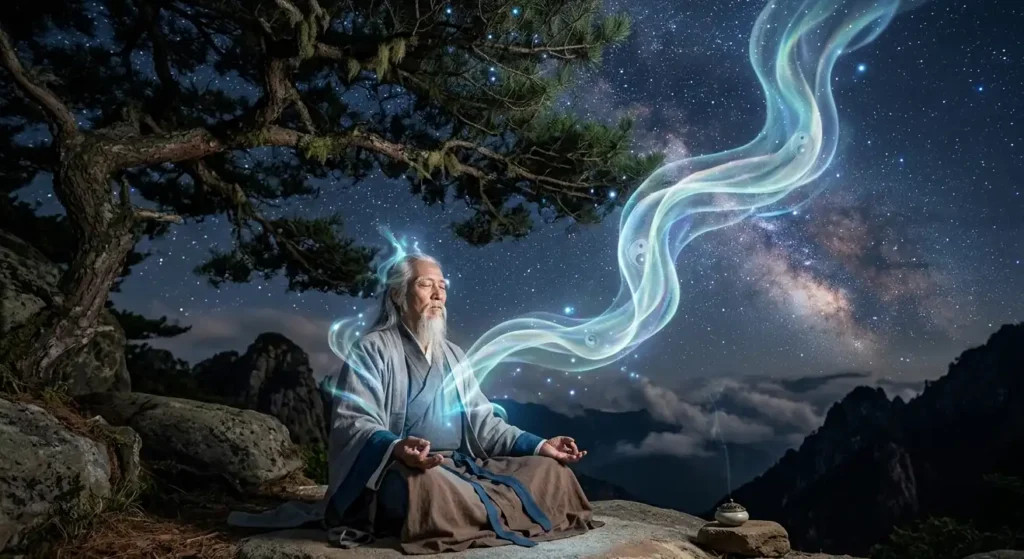
Daoist texts describe immortality as a spectrum rather than a binary. The key classical text Baopuzi by Ge Hong (4th century CE), one of the most systematic treatments of Daoist immortality practice, distinguishes several grades:
Celestial immortals (tian xian): The highest grade physical immortals who ascend bodily to the celestial realm, retaining full physical form but transformed into something beyond ordinary human nature. These are the immortals of popular Chinese mythology who dwell on sacred mountains or in celestial palaces.
Earth immortals (di xian): Immortals who remain on earth, living indefinitely in the physical world. They don’t ascend but they don’t die. They inhabit remote mountains, hidden valleys, and sacred sites, occasionally interacting with mortals who seek their teaching.
Corpse-free immortals (shi jie xian): A particularly fascinating category. These immortals appear to die. Their bodies are found, but the corpse is discovered to be a transformation, a shed skin. The actual person has left through a process of body-substitution. Witnesses report seeing the deceased alive elsewhere afterward.
Spiritual immortals (ling xian): Those who achieve spiritual transcendence without necessarily retaining physical form. Their spirit continues to exist and operate after the body’s death, integrated with the Dao rather than annihilated by death.
How To Become Immortal in Daoism
This is the question that most Western readers bring to the tradition, and it deserves a direct answer.
Daoist cosmology holds that the human body is a microcosm of the universe that the same forces and principles that govern the cosmos also operate within the individual. This isn’t metaphorical. It’s a literal claim about the relationship between human physiology and cosmological structure.
If the Dao is eternal and the human body participates in the Dao through its vital energies, then the possibility of aligning oneself so completely with the Dao that death becomes optional is philosophically coherent within the system’s own framework.
The tradition doesn’t claim immortality is easy or common. It claims it’s possible for those with sufficient dedication, the right practices, the right teacher, and sometimes the right innate constitution.
The Three Treasures: The Physiological Foundation
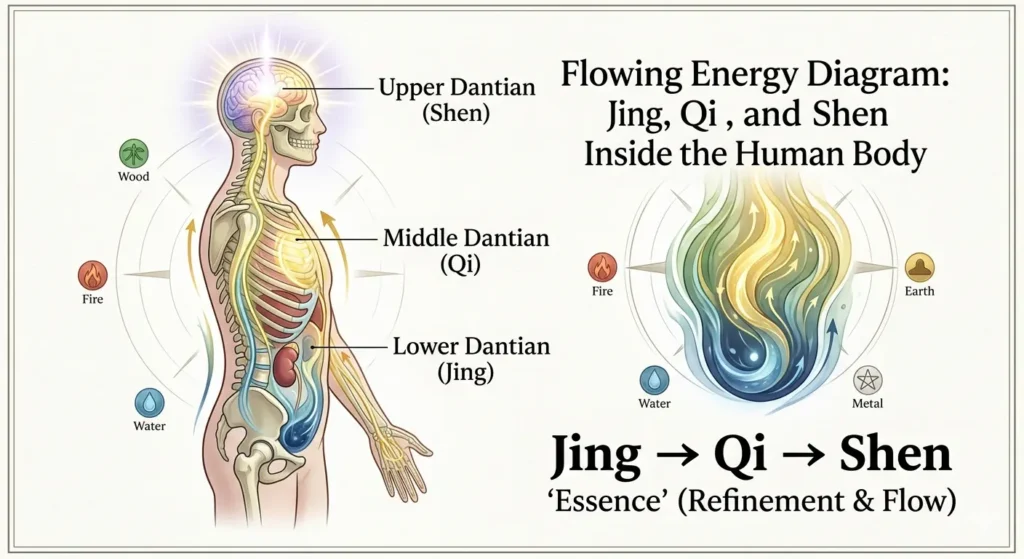
Everything in the Daoist immortality tradition rests on a specific theory of human physiology, the doctrine of the Three Treasures (sān bǎo): Jing (essence), Qi (vital energy), and Shen (spirit).
These three are the fundamental energies of the human body, and their relationship to each other determines whether a person moves toward vitality and potential immortality or toward depletion and death.
Jing: The Foundational Essence
Jing is the densest and most fundamental of the three treasures. It’s the essence that we’re born with a finite constitutional endowment from our parents, stored primarily in the kidneys, that determines our basic vitality and lifespan.
Jing is depleted by:
- Excessive sexual activity (the most commonly cited cause in classical texts)
- Overwork, chronic stress, and insufficient rest
- Emotional excess – chronic anger, fear, grief
- Poor dietary choices and irregular eating
- Environmental exposure to extreme cold
The crucial point is that jing is difficult to replenish but easy to deplete. Classical Daoist texts treat jing conservation as the foundation of all longevity practice you can’t build anything on an empty foundation.
Qi: The Vital Breath
Qi is the active, circulating vital energy that animates the body’s processes. Where jing is the body’s constitutional reserve, qi is its daily operational energy. It’s both produced from jing and from breath, food, and environmental sources, and it’s what flows through the meridian channels that traditional Chinese medicine works with.
Qi can be:
- Cultivated through breath work, meditation, and qigong
- Strengthened through appropriate diet and lifestyle
- Depleted through the same factors that deplete jing, though less severely
- Directed through specific practices to circulate through the body in beneficial patterns
Shen: The Spirit
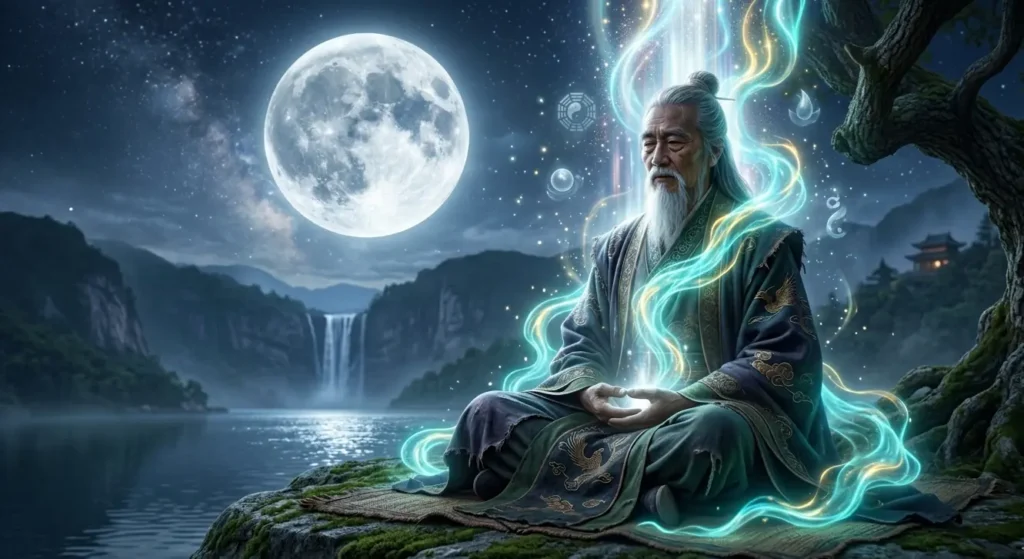
Shen is the subtlest of the three. The spirit, consciousness, and divine essence. It’s what makes you you, rather than a sophisticated biological machine. Shen is housed primarily in the heart, in the TCM understanding, and it manifests as intelligence, awareness, emotional capacity, and spiritual perception.
The refinement of shen is the highest goal of Daoist practice. A person with bright, clear, refined shen is recognisably different from a person with turbid, depleted shen, calmer, clearer, more present, more genuinely wise.
The Refinement Sequence
The relationship between the three treasures produces the Daoist immortality path’s fundamental sequence:
Jing transforms into qi → Qi transforms into shen → Shen returns to emptiness (xu) → Emptiness unites with the Dao
This sequence is the spine of Daoist internal alchemy. Each stage refines the previous one into something subtler and more fundamental. The person who completes this sequence has transformed their gross physical constitution into something so thoroughly aligned with the Dao that physical death becomes, in some traditions, genuinely optional.
Understanding this sequence makes everything else in the tradition make sense. Every practice, breath work, dietary discipline, meditation, and sexual cultivation is aimed at facilitating this refinement process.
Waidan: The External Alchemy Path
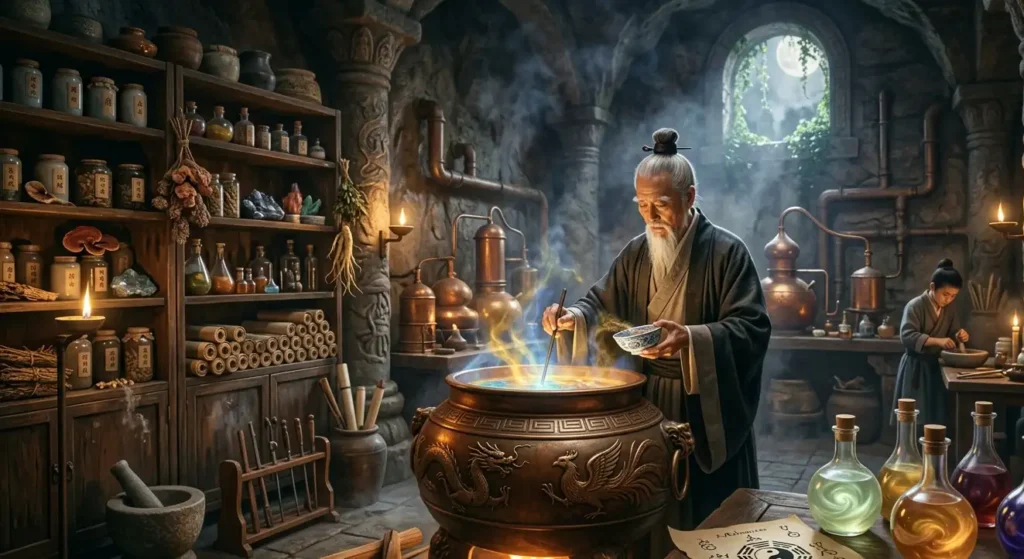
The first great branch of Daoist immortality practice is waidan (external alchemy), the attempt to produce a physical elixir that, when ingested, would confer immortality on the practitioner.
The Cosmological Logic
Waidan’s logic follows directly from the Daoist understanding of the relationship between the cosmos and the human body. If specific minerals and substances contain concentrated forms of the same cosmic energies that the body needs to achieve immortality, then refining those substances into their purest form and ingesting them should, in principle, accelerate the transformative process that internal cultivation takes decades to achieve.
It’s not as naive as it sounds to modern ears. The waidan tradition developed sophisticated metallurgical and chemical techniques across several centuries. Its practitioners included some of the most educated people in Chinese history. They were wrong about the mechanism, but they weren’t stupid about the project.
The Cinnabar Elixir
The substance most central to waidan is cinnabar (dānshā), mercuric sulphide, a brilliant red mineral. Cinnabar was considered the supreme alchemical substance for several reasons:
- Its red colour associated it with fire, yang energy, and vital force
- Heating it produces mercury, which when heated again produces cinnabar, a cyclical transformation that seemed to demonstrate the reversal of ordinary decay
- It was rare enough to be considered cosmically special rather than mundanely common
The production of the “gold elixir” (jīndān), the perfected alchemical product, was the central goal of the waidan tradition. Texts described elaborate furnaces, specific ingredient ratios, precise heating sequences, and ritual requirements for the alchemical process.
The Tragic History
I find the history of waidan genuinely poignant.
Several Tang Dynasty emperors died from mercury poisoning after ingesting alchemical elixirs. The Emperor Xuanzong’s court saw multiple deaths from elixir ingestion. The same Emperor Taizong, who conquered vast territories and is considered one of China’s greatest rulers, died at fifty-one, almost certainly from mercury poisoning from elixirs he was taking to prolong his life.
The waidan tradition gradually declined after the Tang Dynasty, as the evidence mounted that its elixirs killed practitioners rather than making them immortal. The response of the tradition was instructive: rather than abandoning the alchemical framework, it internalized it. The furnace became the body. The cinnabar became the internal essence. External alchemy became internal alchemy.
Neidan: The Internal Alchemy Path
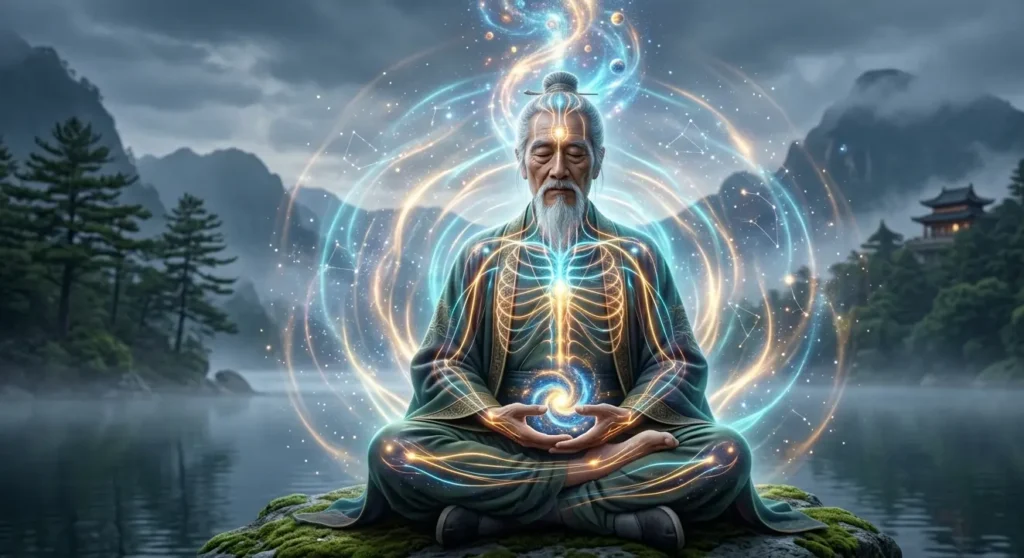
Neidan (內丹, internal alchemy) is the most sophisticated and most philosophically rich branch of the Daoist immortality tradition. It uses the vocabulary and conceptual framework of external alchemy but applies it entirely to processes within the body.
The furnace is the Dantian. The cinnabar is the jing. The alchemical reaction is the refinement sequence of jing into qi into shen. The gold elixir is the immortal embryo cultivated within.
The Three Dantians
Neidan maps its alchemical process onto three energy centres in the body:
The lower dantian: Located below the navel, this is the primary storage and refinement center for jing. It’s where the first stage of the neidan process begins, the refinement of jing into qi. Most qigong and Daoist meditation practices focus attention here as the starting point.
The middle dantian: Located at the chest level, this is associated with shen and the emotional-spiritual dimension of the person. Qi refined in the lower dantian rises to engage with shen in the middle dantian in the second stage of the refinement process.
The upper dantian: Located at the space between and behind the eyebrows, which Indian yoga calls the third eye. This is the site of the most refined shen, of spiritual perception beyond ordinary consciousness, of what the tradition calls the “spirit light” that, fully developed, constitutes the immortal essence.
The Microcosmic Orbit
The Microcosmic Orbit is the most fundamental neidan practice, the circulation of refined qi through the body’s two primary extraordinary vessels.
- Du Mai (Governing Vessel): runs up the spine from the base to the crown
- Ren Mai (Conception Vessel): runs down the front of the body from crown to base
Completing this circuit, guiding the breath and attention through both channels in a continuous loop, is the first major milestone in neidan practice. It’s simultaneously a physiological, energetic, and spiritual exercise.
The imagery is alchemical: the refined qi is heated in the lower dantian, rises up the Du Mai like steam rising through a still, collects and cools at the crown, and descends down the Ren Mai to the lower dantian for another cycle of refinement.
The Immortal Embryo
The culminating concept of neidan is the shen tai, or immortal embryo, a spiritual entity that develops within the practitioner through sustained refinement of jing into qi into shen.
The immortal embryo is cultivated within the upper dantian, growing over years of sustained practice. When it reaches maturity, it can separate from the physical body first temporarily during meditation (the practitioner’s consciousness expands beyond the body), then potentially permanently at death (the immortal embryo survives the body’s dissolution and continues to exist).
This is the neidan tradition’s answer to mortality. You don’t prevent the body’s death. You cultivate something within yourself that survives it, something so thoroughly composed of refined shen aligned with the Dao that it doesn’t need the physical body to continue.
Supplementary Practices: The Full Daoist Cultivation System
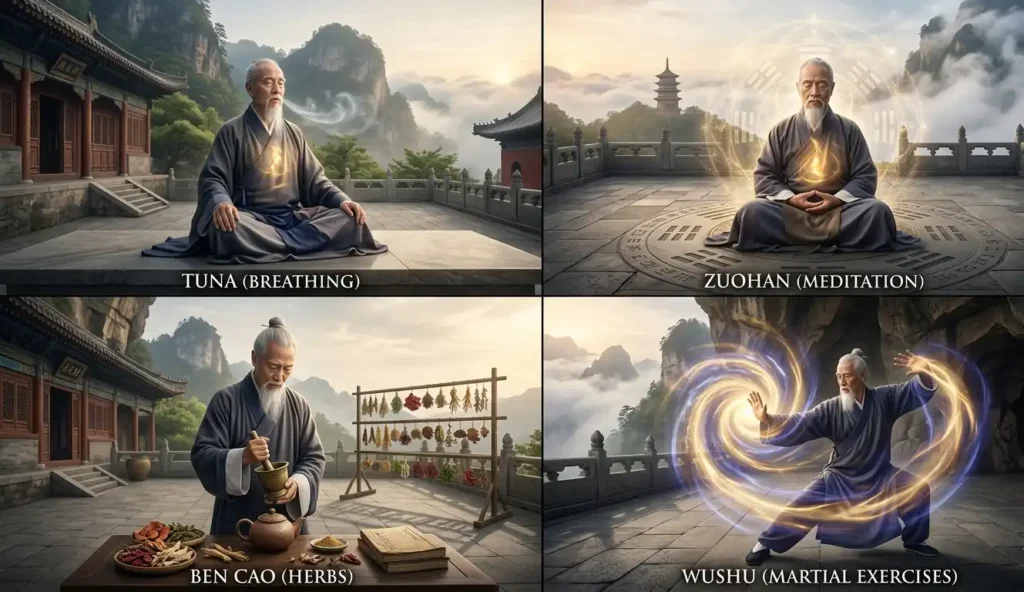
Waidan and neidan are the two great theoretical traditions, but the actual practice of Daoist immortality cultivation involves a much broader cluster of disciplines that support and enable the alchemical processes.
Breath Cultivation: Tu Na and Qi Gong
Tu na (literally “exhaling and inhaling”) is the classical Daoist breath cultivation tradition, the deliberate cultivation of qi through regulated breathing.
The specific practices vary across lineages, but the common principles include:
- Slow, deep, abdominal breathing that activates the lower dantian
- Retention practices that build qi pressure in specific locations
- Embryonic breathing – the advanced practice of breathing so subtly that the practitioner seems not to breathe at all, described in advanced neidan texts as the breath becoming entirely internal
The connection to qigong is direct. Modern qigong is largely a secularised development of traditional Daoist breath and movement cultivation practices. When you see someone doing slow, deliberate movement exercises in a park, they’re working within a tradition that developed specifically as a longevity and immortality practice.
Dietary Cultivation: Bigu and Food as Medicine
Bigu (literally “avoiding grains”) is the Daoist dietary practice of gradually reducing dependence on ordinary food and, in its most extreme form, subsisting on breath, water, pine needles, sesame seeds, or other substances believed to be closer to cosmic qi than ordinary food.
The logic is connected to the refinement sequence. Ordinary food is dense and heavy. It sustains the body but also anchors it to the gross physical level. Lighter, more refined foods were believed to nourish the body without the anchoring weight of grains.
The dietary practices that most practitioners actually followed were considerably less extreme:
- Avoiding strong-flavoured foods: garlic, onions, strong meats, believed to disturb the shen
- Eating in moderation: never filling the stomach completely
- Seasonal eating: adjusting diet to the five-element and yin-yang seasonal framework
- Pine pollen, sesame, and special herbs: specific substances believed to tonify jing and support the refinement process
The connection to traditional Chinese medicine is obvious. TCM’s dietary therapy developed from the same framework, the understanding that food has energetic qualities that interact with the body’s own energetic constitution.
Physical Cultivation: Dao Yin and the Martial Arts Connection
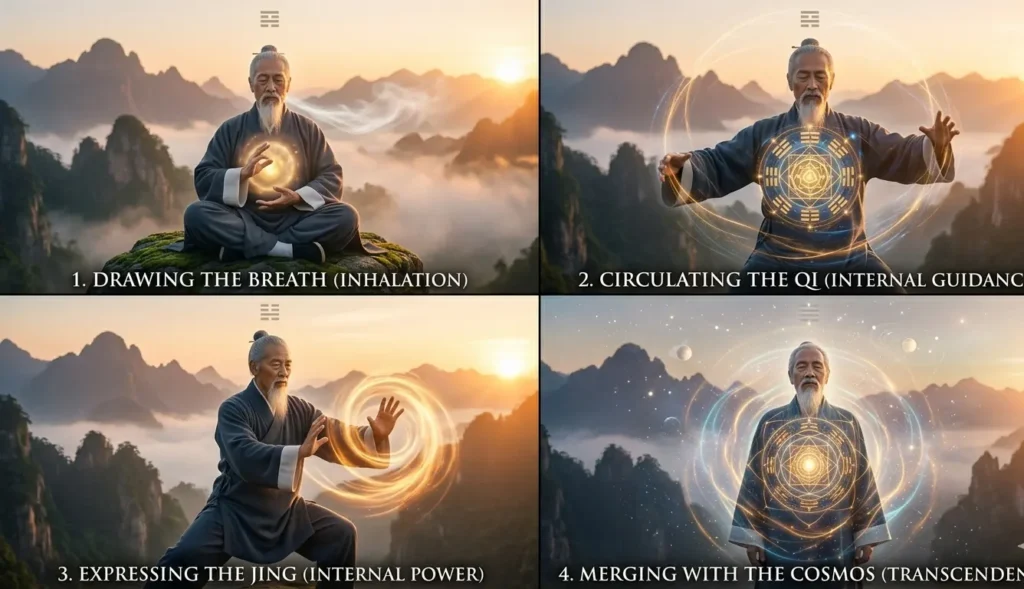
Dao yin (guiding and pulling) is the Daoist physical cultivation tradition – practices that combine breath, movement, and intention to guide qi through the body’s channels and cultivate physical vitality.
Classical dao yin texts from the Han Dynasty include exercises named after animals, the Five Animals Play (Wǔ Qín Xì), attributed to the physician Hua Tuo, that prefigure both qigong and traditional Chinese martial arts.
The martial arts connection is real and important. The internal martial arts styles Tai Chi Chuan, Bagua Zhang, and Xing Yi Quan developed from the same Daoist cultivation tradition as neidan. Their slow, deliberate movements are explicitly designed to cultivate and circulate internal qi rather than simply to develop fighting ability.
The famous martial arts traditions of Wudang Mountain developed in direct connection with Xuanwu (the Black Tortoise) worship and with Daoist neidan practice. The Wudang internal styles embody the Daoist cultivation principles physically stillness as the foundation of power, yielding as the expression of Water’s paradoxical strength, and the cultivation of internal qi as the source of martial capability.
Sexual Cultivation: The Most Controversial Practice
The Daoist tradition includes a branch of practice fang zhong shu (bedroom arts), that involves the conscious cultivation and management of sexual energy as part of the immortality project.
I’m including this because it’s a genuine part of the tradition and omitting it would be dishonest. But I want to be precise about what it actually involves.
The core principle follows from the jing theory. Sexual energy is jing energy, the body’s most concentrated vital essence. The ordinary pattern is for jing to be depleted through sexual activity. The fang zhong shu tradition develops practices that either prevent jing loss during sexual activity (for male practitioners, this involves specific techniques for experiencing pleasure without ejaculation) or that cultivate and circulate sexual energy through the body for refinement.
At its most sophisticated, these practices are integrated with neidan, the sexual energy is guided upward through the Governing Vessel rather than expelled, contributing to the refinement sequence.
This is one of the more controversial aspects of the tradition in both historical and modern contexts. It was criticized by competing Daoist schools (particularly the Complete Reality school, which emphasized celibacy) and by Confucian moralists. Its actual practice in historical contexts is difficult to assess accurately from textual sources alone.
Moral Cultivation: The Ethical Foundation
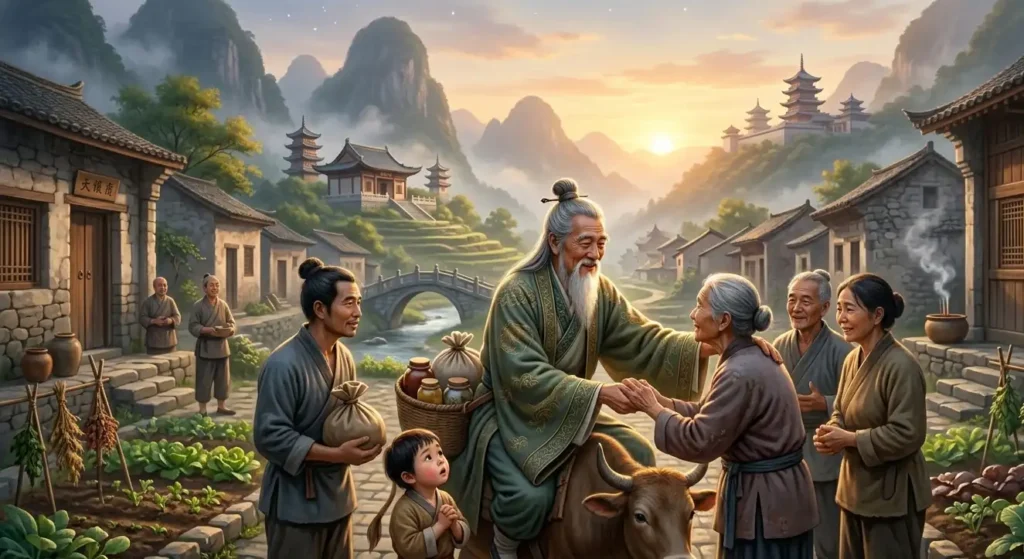
Here’s something that often gets overlooked in accounts of Daoist immortality practice: ethics matter.
Most classical Daoist texts on immortality include substantial discussions of the moral requirements for successful cultivation. The tradition holds that moral failings, such as greed, cruelty, deception, and excessive desire, directly damage the shen and create obstructions in the qi channels that prevent the refinement process from completing.
Ge Hong’s Baopuzi is explicit about this. Specific good deeds accumulate merit that contributes to immortality. Specific transgressions create debits that must be balanced before advancement is possible.
This ethical dimension is sometimes framed in terms of a heavenly bureaucracy, a celestial record-keeping system that tallies virtuous and non-virtuous acts. It’s also framed in more direct physiological terms. The emotional disturbances caused by moral wrongdoing literally disrupt the calm, clear shen that the refinement process requires.
The Types of Immortals: Who Got There and How
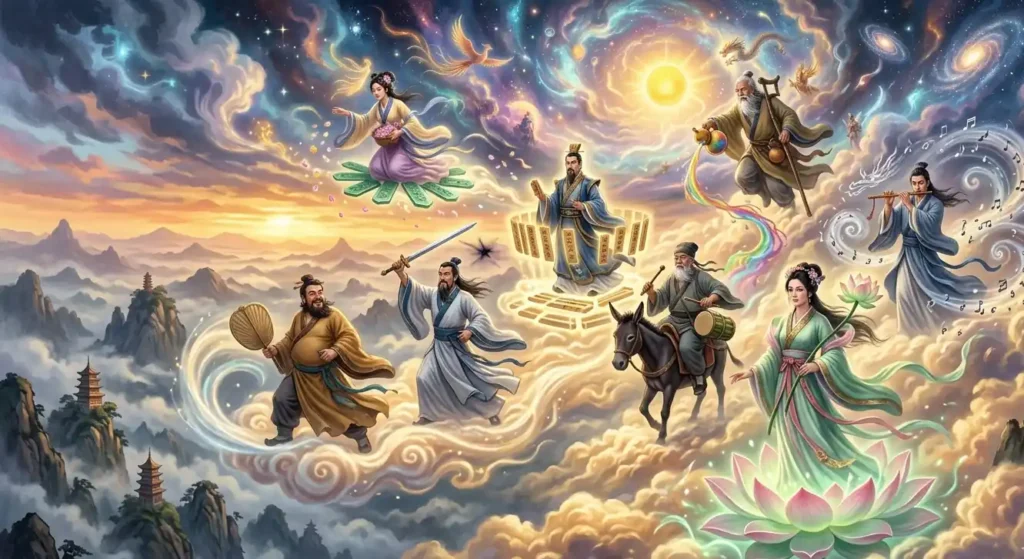
The Daoist tradition has produced a rich mythology of specific immortals, real or legendary practitioners who achieved the goal. Understanding the different types illuminates the range of methods the tradition acknowledges.
The Eight Immortals (Ba Xian)
The Eight Immortals are the most famous group in Chinese popular culture, eight distinct figures, each with their own backstory, each representing a different aspect of Chinese society, each having achieved immortality through different circumstances.
They are:
- He Xiangu, the only female of the eight, who ate a supernatural peach and achieved immortality, represents unmarried women
- Cao Guojiu, a figure of noble background who gave up his position, represents nobility
- Li Tieguai, the oldest and most powerful, depicted as a lame beggar with an iron crutch, represents the sick and disabled
- Lan Caihe, the most ambiguous of the eight, depicted as neither clearly male nor female, represents the poor and wandering
- Lü Dongbin, the most popular in religious practice, was a former scholar-official who became a Daoist adept, patron of barbers and scholars
- Han Xiangzi, a flute player associated with music and poetry, represents musicians
- Han Zhongli, the eldest of the group in most accounts, a former general who achieved immortality in retirement, represents military men
- Zhang Guolao, a figure associated with reversed logic, famous for riding a donkey backwards, represents the elderly
What I find most interesting about the Eight Immortals is precisely what you’ve noticed. They’re diverse. They didn’t all achieve immortality through the same method or from the same starting point. They represent the tradition’s implicit claim that the path is accessible from many different positions in life.
The Yellow Emperor: The Founding Immortal
Huangdi, the Yellow Emperor, is the mythological founder of Chinese civilization and its first great immortal. His immortality isn’t achieved through solitary practice. It’s the culmination of his virtuous reign, his cultivation of the arts of government and medicine, and his eventual completion of the great bronze tripod that served as his vehicle to heaven.
The story goes that when the tripod was completed, a divine dragon descended from the sky. Huangdi climbed onto the dragon’s back, and with him went seventy of his ministers and concubines. His court attempted to follow but could only grasp the dragon’s beard, which came away in their hands, leaving them behind as Huangdi ascended to immortality.
This is celestial immortality in its most literal form, the bodily ascent to heaven of the complete person, transformed.
Laozi: The Founder Who Vanished
The founder of Daoist philosophy, Laozi, has an immortality story that’s characteristically understated. He simply leaves. He rides west through the Hangu Pass on a water buffalo, dictates the Tao Te Ching to the gate-keeper Yin Xi, and continues west until he disappears from recorded history.
Some traditions hold that he went to India and became the Buddha. Some hold that he transformed into a divine figure. The Huahujing (Conversion of the Barbarians), a text of dubious authenticity that caused considerable religious controversy, has Laozi founding Buddhism in India.
What’s consistent across accounts is the departure from ordinary human history into something else. Laozi’s immortality is philosophical in character. The sage who embodies the Dao simply exits the ordinary world’s logic when his teaching work is complete.
The Sacred Geography of Immortality
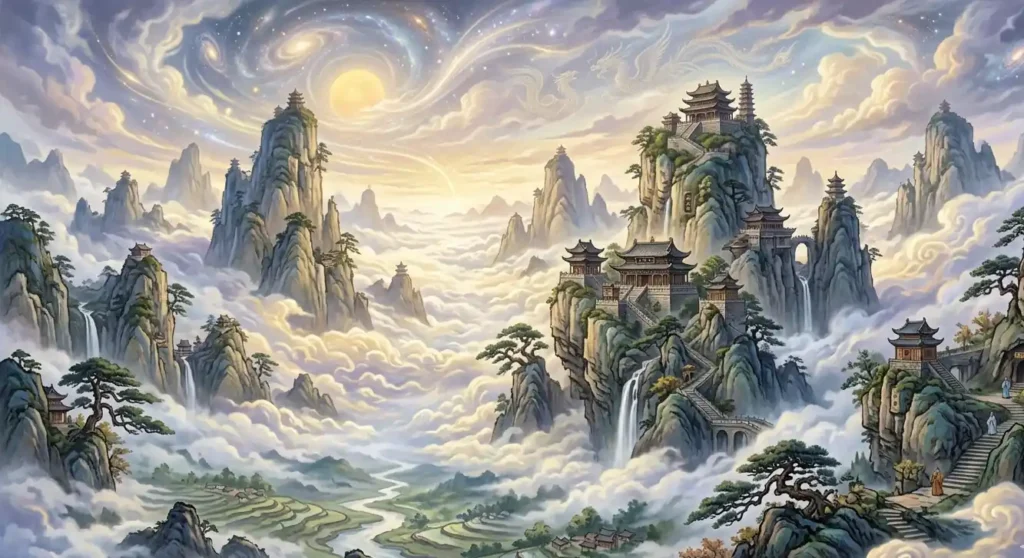
Daoist immortality practice has a geography specific places understood as particularly conducive to cultivation, as inhabited by immortals, or as thresholds between the ordinary world and the immortal realm.
The Five Sacred Mountains
The Five Sacred Mountains (wǔ yuè) of China are simultaneously geographical sites, cosmological axes, and immortal dwelling places. The Eastern Mountain (Taishan), Southern Mountain (Hengshan-south), Western Mountain (Huashan), Northern Mountain (Hengshan-north), and Central Mountain (Songshan) are each understood as concentrations of specific elemental and directional energies.
Mount Tai in Shandong is particularly significant. It’s the place where the emperor performed the feng and shan sacrifices that legitimized his cosmic mandate, and it’s associated with the afterlife judgment of souls. Immortals were believed to dwell on all five mountains, accessible to practitioners who sought them out with sufficient sincerity.
Penglai: The Island of Immortals
Penglai (蓬萊) is the mythological island in the eastern sea where the immortals dwell. Multiple Chinese emperors, most famously Qin Shi Huang (the first emperor of unified China), sent expeditions to find it. The expeditions all failed. Penglai remained always just over the horizon.
I’ve always found Penglai fascinating as a concept, the immortal’s paradise that’s real enough to send ships after but elusive enough to never be found. It’s the geography of aspiration rather than of achievement.
Wudang Mountain: The Living Tradition
Wudang Mountain is the most significant living site of Daoist immortality practice. As I discussed in the Xuanwu article, the Wudang complex developed under Ming Dynasty imperial patronage as a center of Xuanwu worship and Daoist practice. Its internal martial arts traditions, the Wudang styles, remain active today as a living expression of the neidan and dao yin traditions.
The Cosmological Framework: Why Immortality is the Natural Goal
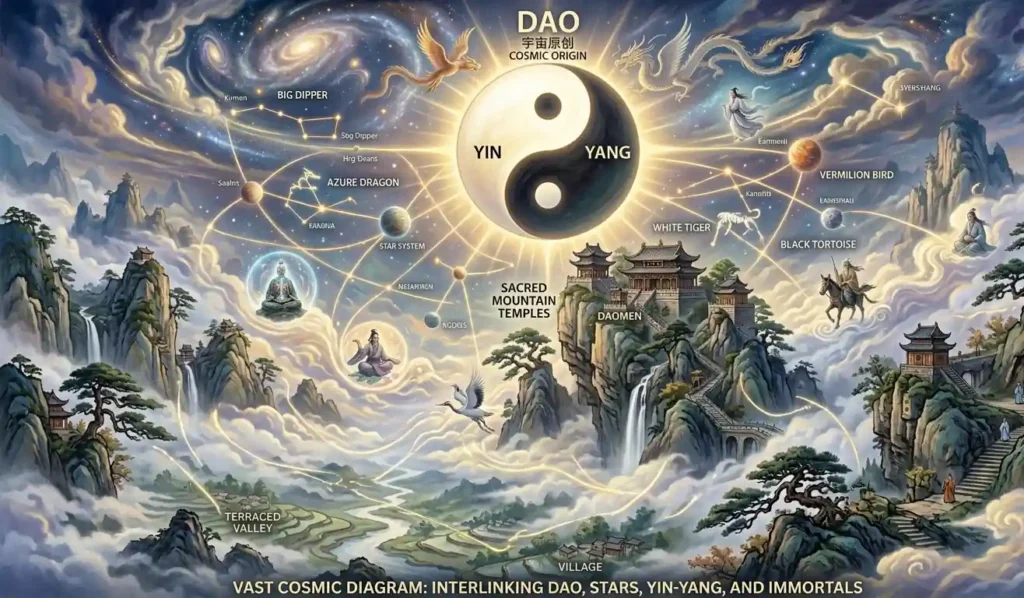
I want to make explicit something that’s implicit in everything above. Daoist cosmology frames immortality not as an exceptional achievement but as the natural expression of complete alignment with the Dao.
Death as Misalignment
In the Daoist view, death isn’t the natural conclusion of a life well lived. It’s the consequence of a life that has progressively depleted its jing, failed to refine its qi into shen, and ended with the person’s spirit not sufficiently purified to persist independently of the body.
This is actually an optimistic framework, once you sit with it. Death is contingent rather than inevitable. It results from specific conditions that can, in principle, be altered through specific practices.
The Dao as the Source of Immortality
The Dao itself is eternal. It precedes the universe and will outlast it. Everything that participates fully in the Dao participates in its eternity. The immortality project is the project of achieving complete participation in the Dao rather than the compromised, partial participation of ordinary human life.
The Tao Te Ching’s famous verse “He who dies without being lost has longevity” points toward exactly this. The person who is so thoroughly the Dao that their individual identity is continuous with it doesn’t really die when the body dissolves. Only what was separate from the Dao can be lost.
Frequently Asked Questions
Did anyone actually achieve immortality through Daoist practice?
Historical records contain no verified cases of physical immortality. What traditions do document is extraordinary longevity among dedicated practitioners, along with practical systems of health cultivation that produced measurable benefits. Whether these methods lead beyond extended vitality is where ancient belief and modern physiology continue to disagree.
What’s the difference between waidan and neidan?
Waidan, or external alchemy, pursued immortality through refined substances such as mercury based elixirs believed to transform the body from the outside inward. Neidan, or internal alchemy, sought immortality by refining jing, qi, and shen through meditation and breath cultivation. After the dangers of waidan became undeniable, neidan gradually became the dominant path.
How does Daoist immortality practice relate to traditional Chinese medicine?
Traditional Chinese Medicine and Daoist immortality practice share the same foundation: jing, qi, shen, the meridian system, and the balance of yin yang and the five elements. TCM focuses on health and healing, while Daoist cultivation seeks a deeper transformation of the body’s nature. Both use the same map, but pursue different destinations.
What is bigu and is it safe?
Bigu, or grain avoidance, is a Daoist dietary practice that ranges from eating lightly and reducing heavy foods to extreme fasting methods sustained by breath, water, and select substances. In moderate forms, it resembles a traditional health diet. In extreme forms it becomes physically dangerous, and even classical texts warned that ordinary practitioners should not attempt it.
What is the relationship between Daoist immortality practice and qigong?
Qigong is a modern term for practices once known as dao yin, tu na, and neigong within the Daoist tradition. Modern qigong presents these cultivation methods in a more secular and health focused form, often removing the religious pursuit of immortality. The techniques themselves, including breath work, slow movement, and energy cultivation, remain deeply connected to classical Daoist practice.
Final Thoughts
I have come into contact with many traditions that describe paths to transcendence, enlightenment, or liberation from ordinary human limitation. What consistently distinguishes the Daoist immortality tradition from most of them is its extraordinary specificity.
It is direct in its approach: here are the three energies you need to cultivate and refine. Here is the sequence in which they refine. Here are the specific practices, breath work, dietary discipline, meditation, and physical cultivation that facilitate each stage. Here is how you know when each stage is progressing. Here are the specific obstacles and how to address them.
That specificity is why the tradition produced both extraordinary longevity practitioners and, tragically, people who died from mercury poisoning. Specific claims can be tested. And the waidan tradition’s testable claims failed catastrophically, while the neidan and dao yin traditions’ claims about health, vitality, and psychological transformation have proven considerably more durable.
Whether anyone ever achieved literal physical immortality through these practices, I genuinely don’t know. What I do know is that the tradition asking that question developed one of the most sophisticated and practically detailed frameworks for human cultivation that any civilization has produced and that it shaped Chinese medicine, Chinese martial arts, Chinese religion, and Chinese mythology in ways that are still alive and active today.
That’s worth understanding, whatever you conclude about the ultimate question.
Related Articles
- Yin yang in Daoism: meaning, symbolism and sacred origins
- The Five Elements in Chinese mythology and cultivation novels
- Why Daoist Masters Pursued Immortality [The Real Reasons]
- Yin Yang and the Five Elements: Why neither works alone
- Eight Immortals: Symbols, Sacred Roles & Daoist meaning
- Dantian in cultivation: meaning, function and sacred energy
- Meridians in cultivation: meaning, function and sacred energy
- Qi cultivation: what it is and where it comes from
References
- Stanford Encyclopedia of Philosophy – Daoism
- Joseph Needham, Science and Civilisation in China
- Dao De Jing (Tao Te Ching)
- Zhuangzi
- Daoism and Chinese Culture – Livia Kohn
- Huainanzi
- Yin-Yang and the Nature of Correlative Thinking – Angus Charles Graham
- Book of Changes: Yi Jing – Chinese Text Project
- Legend of Immortals – Chinese Philosophy Book Digitization Project
- Baopuzi by Hong Ge | Project Gutenberg
- The Taoist Body – Kristofer Schipper
Written by Batin Khan, a curious free spirit who loves reading and exploring the worlds of fantasy, mythology, and ancient stories. Through this blog, Batin hopes to share that sense of wonder with readers while building an exciting future along the way.