 By
By Quick Takeaways:
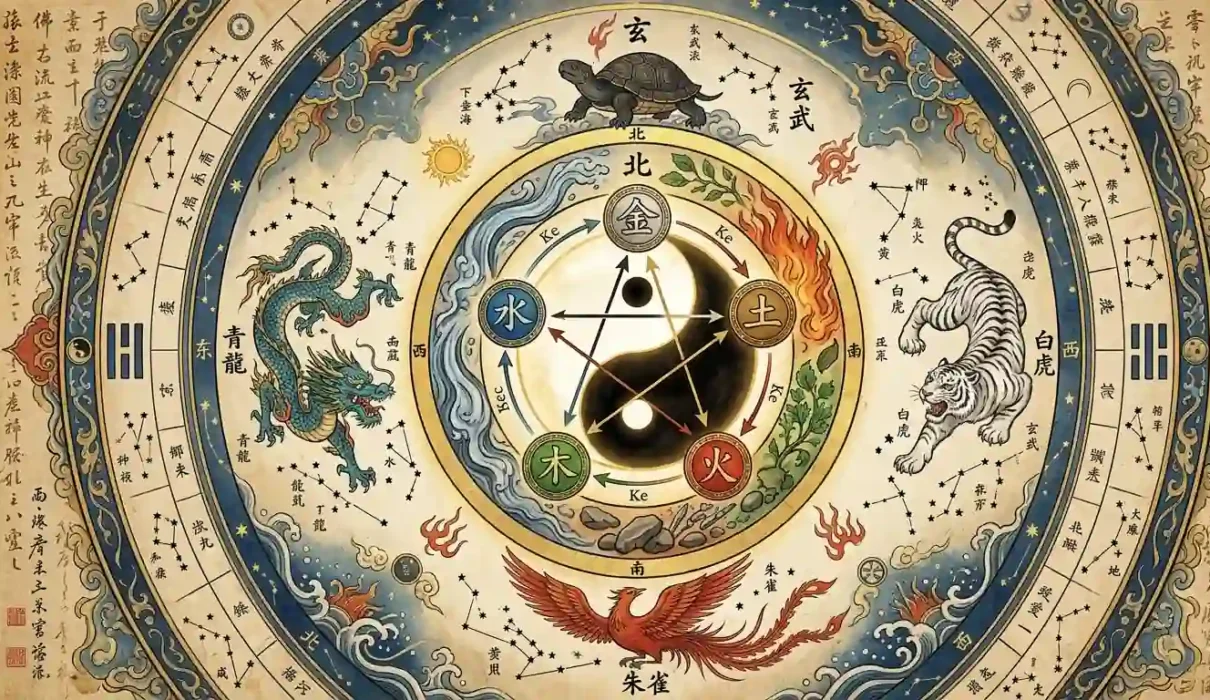
- Yin yang, the 5 Elements (Wu Xing), and the Four Holy Beasts are not three separate Chinese cosmological topics. They’re three layers of one unified system, each providing what the other two cannot
- Yin yang provides the dynamic cycling principle, the engine that makes the system move
- The Five Elements provide the qualitative vocabulary, the five distinct phases that differentiate how things move
- The Holy Beasts provide the living mythological embodiment, the system expressed as guardian beings with personalities, powers, and presences
- The system is most visible through its complete correspondence table. When all the layers align, the unified architecture is impossible to miss
I have already explained in my previous post how the five elements and yin-yang are connected and why the four holy beasts cannot exist without the Yin-Yang, and how the four symbols interact with the Five Elements. It’s been a journey, and if you are still with me from my first post, then thank you. You are awesome, thumbs up! And if you are a new reader, then you are also amazing.
Now back to the topic, as you may have already guessed, today I am going to explain to you how the 5 Elements, Yin Yang, and the Four are connected, not three separate topics with connections, one unified system with three layers. And once you see it that way, you can’t unsee it. So, let’s dive in.
The Problem With Learning These Systems Separately
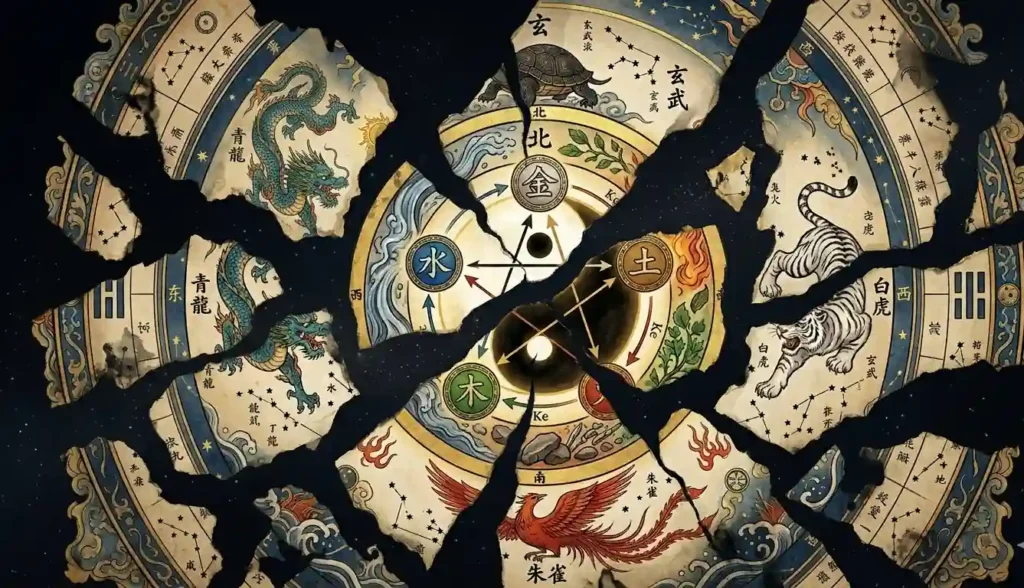
Here’s the thing about how most people encounter Chinese cosmology. The three frameworks get taught in isolation.
You learn yin yang from one source. You learn the Five Elements from another. You encounter the Four Holy Beasts in a third context, usually mythology or astronomy. By the time you’ve read about all three, you have three separate mental models, each internally coherent, each clearly related to the others but not obviously unified.
The problem isn’t that any of those individual accounts is wrong. It’s that teaching them separately obscures the architectural relationship between them.
It’s a bit like learning about bricks, mortar, and load-bearing structures as three separate topics, all true, all useful, and then standing in front of a cathedral and still not quite seeing how it holds together. The unified structure is the thing you need to see. And that’s what this article attempts to give you.
Three Systems – Three Specific Functions
Before showing how they unify, let me be precise about what each layer contributes. I covered this in depth in the individual articles, but the synthesis requires a clear summary.
Layer One: Yin Yang – The Dynamic Principle
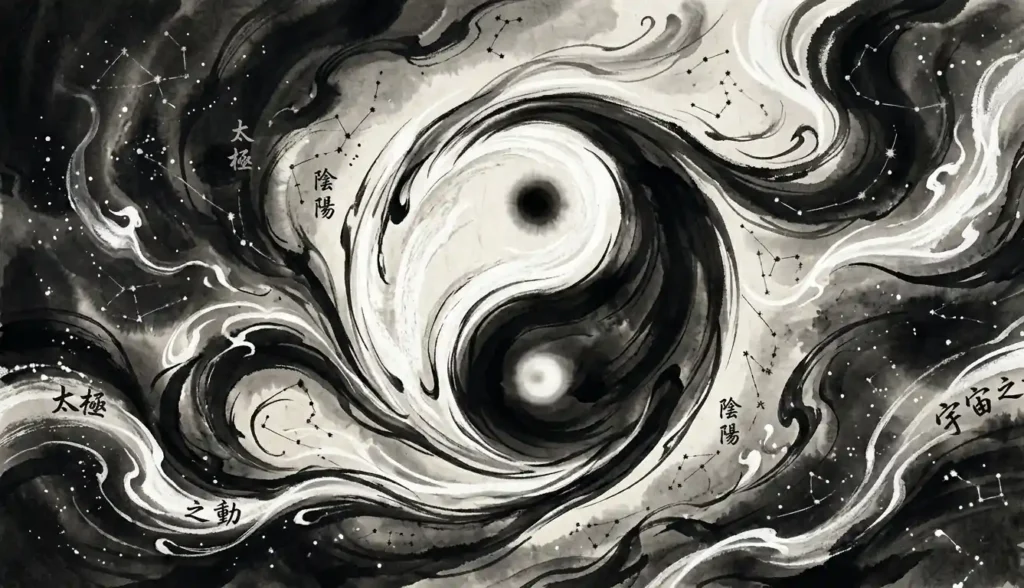
Yin yang contributes exactly one thing to the unified system, but it’s the most fundamental thing: the principle of motion itself.
Everything in the system cycles between complementary states. Active becomes receptive. Light becomes dark. Expansion becomes contraction. And then the return receptive becomes active, dark becomes light, and contraction becomes expansion.
Without this cycling principle, the system is static. You have categories, but no engine to move between them. Yin yang is the engine.
It’s also the system’s most abstract layer. Yin and yang aren’t things, they’re qualities of relationship. Something is yin or yang relative to something else, in a specific context. That contextual, relational character is why yin yang needs the other two layers to be practically useful.
Layer Two: 5 Elements – The Qualitative Map
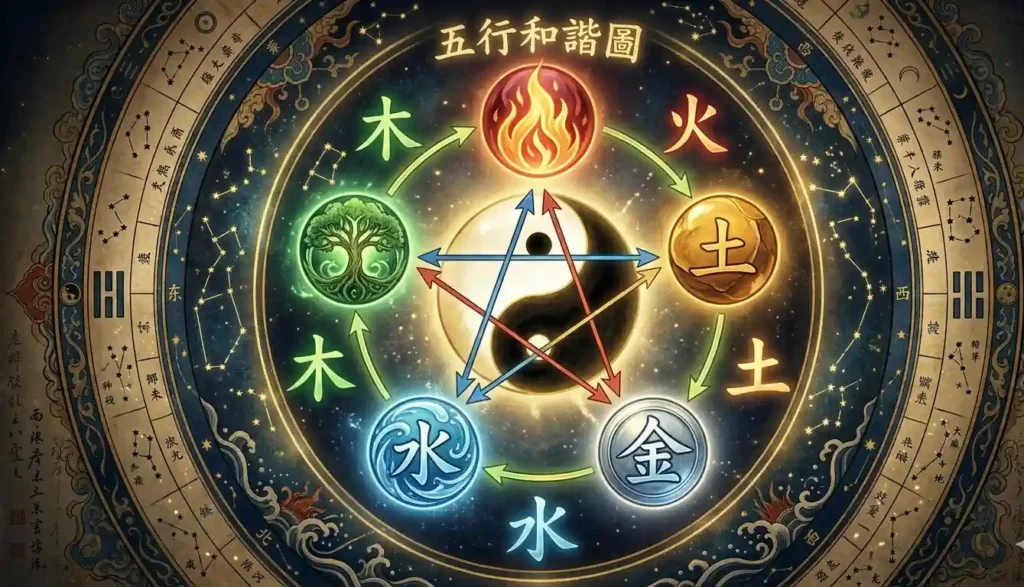
The Five Elements contribute what yin yang can’t provide: qualitative differentiation.
Yin yang tells you that change is happening. Wu Xing tells you what kind of change.
- Rising, expanding Wood-quality.
- Blazing, transforming Fire-quality.
- Stabilizing, nourishing Earth-quality.
- Contracting, refining Metal-quality.
- Deepening, reserving Water-quality.
Five distinct types of process, each with rich qualitative associations. Five phases that together map the full texture of natural phenomena.
Without the dynamic cycling principle of yin yang, the Five Elements are five static categories. Without the qualitative vocabulary of the Five Elements, yin yang is a useful binary without enough texture to describe reality in detail.
Layer Three: Four Symbols – The Living Embodiment
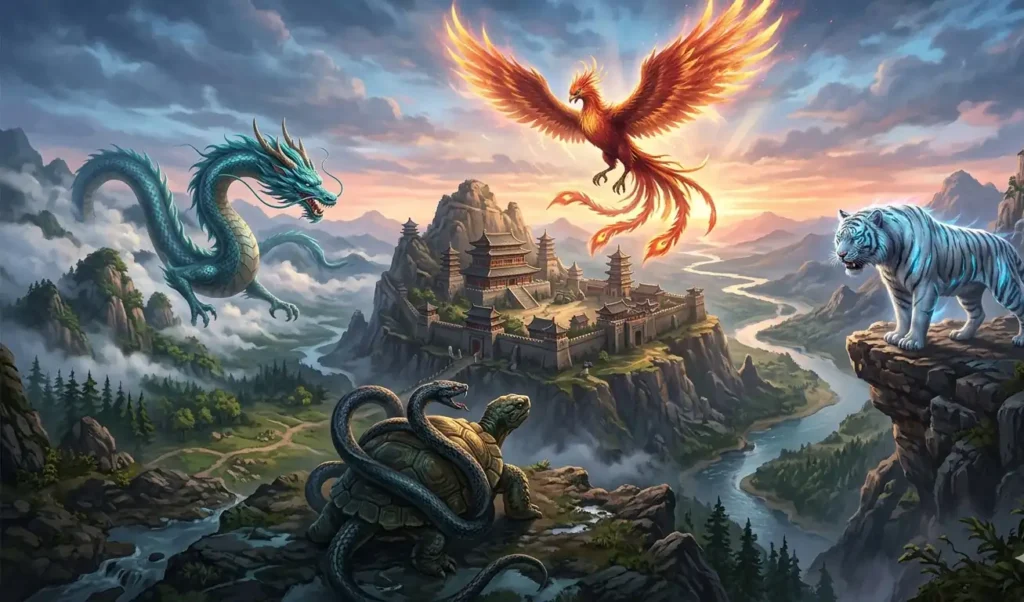
The Four Holy Beasts (and the Yellow Dragon at the center) contribute something that neither yin yang nor Wu Xing can provide: a mythological presence that makes the system accessible, memorable, and culturally alive.
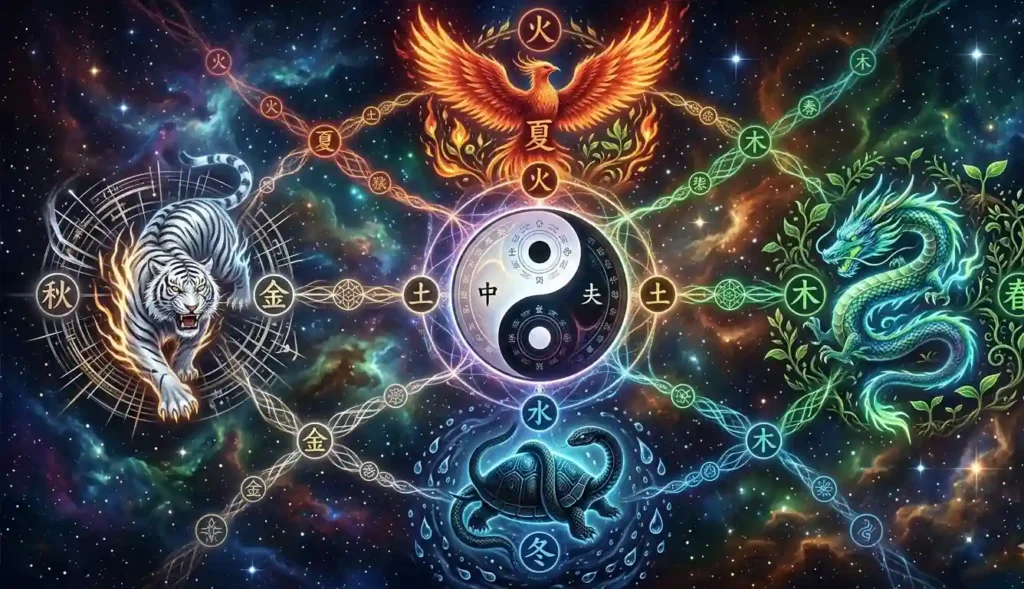
The Azure Dragon, Vermilion Bird, White Tiger, Black Tortoise, and Yellow Dragon are the unified yin yang + five elements system expressed as living beings with personalities, powers, cosmic roles, and guardian presences.
They’re not decorative additions to the philosophical framework. They’re the framework made visible and embodied, the way an equation becomes a graph, the abstract structure suddenly having a shape you can see.
A guardian beast has a direction it faces, a season it governs, an element it embodies, a yin-yang phase it expresses. That intersection of all three layers is what makes each beast what it is.
The Unified Architecture: How The Layers Connect
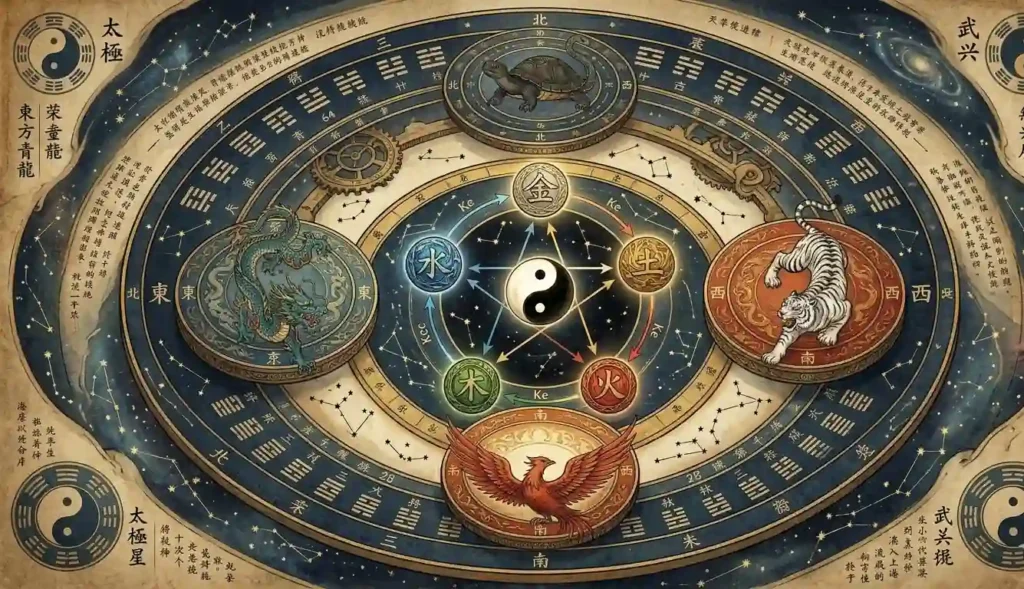
Here’s the moment where the system becomes visible as a single thing.
The Chinese cosmological tradition maps all three layers onto the same spatial and temporal framework: five directions (East, South, Centre, West, North) and five seasonal phases. Each direction-season combination has a yin-yang phase, a five-element quality, and a guardian beast. All three layers converge at the same point.
Let me walk through this convergence for each direction.
East: Where the System Begins
- Yin-yang phase: Lesser Yang – yang is ascending from yin, the motion from contracted winter toward the peak of summer is beginning
- Five elements: Wood – rising vital force, upward growth, flexibility, the quality of life pushing through resistance
- Guardian beast: Azure Dragon – the mythological embodiment of rising yang and Wood vitality combined
- Season: Spring – when Lesser Yang Wood energy visibly governs the natural world
- Direction logic: East is where the sun rises. Rising sun, rising yang, rising vital Wood force. The Azure Dragon governs the direction and season where yin-yang and Wu Xing both point toward the same quality.
South: The Peak of the Cycle
- Yin-yang phase: Greater Yang – yang at absolute maximum, the peak of outward expression
- Five elements: Fire – blazing transformation, maximum outward expression, the conversion of potential into energy
- Guardian beast: Vermilion Bird – the mythological embodiment of maximum yang and Fire blazing combined
- Season: Summer – when Greater Yang Fire energy governs the natural world at peak intensity
- Direction logic: South is the direction of the midday sun, maximum solar intensity. Maximum sun, maximum yang, maximum Fire quality. All three layers converge at the same point.
West: The Contraction

- Yin-yang phase: Lesser Yin – yin is ascending from yang, the motion from summer peak toward the depth of winter is beginning
- Five element: Metal – contraction, refinement, the reduction of summer’s abundance to essential form
- Guardian beast: White Tiger – the mythological embodiment of ascending yin and Metal precision combined
- Season: Autumn – when Lesser Yin Metal energy governs the harvest, the stripping back, the preparation for winter
- Direction logic: West is where the sun sets. Setting sun, yin ascending, Metal-quality refinement. The White Tiger governs where all three layers point toward completion and contraction.
North: The Depth
- Yin-yang phase: Greater Yin – yin at absolute maximum, the deepest inward contraction
- Five elements: Water – depth, stillness, hidden potential, the reservoir before the next cycle
- Guardian beast: Black Tortoise – the mythological embodiment of maximum yin and Water depth combined
- Season: Winter – when Greater Yin Water energy governs the natural world at its most contracted
- Direction logic: North is the direction of darkness and cold. Maximum darkness, maximum yin, maximum Water depth. All three layers converge again.
Centre: The Axis
- Yin-yang phase: Balance – not a phase of the cycle but the stable axis around which the cycle turns
- Five elements: Earth – stability, nourishment, the transitional ground beneath every seasonal shift
- Guardian beast: Yellow Dragon – the mythological embodiment of balanced Earth energy at the cosmic center
- Season: The transitions between seasons – the eighteen days before each seasonal shift that Earth governs
- Direction logic: Centre isn’t a compass bearing. It’s the point of integration. The Yellow Dragon doesn’t govern a direction. It governs the axis that makes all directions coherent.
The Correspondence Table: The System at a Glance
This is the table that, when I first saw it fully populated, finally made me see the unified architecture rather than three separate systems.
| Layer | East | South | Centre | West | North |
|---|---|---|---|---|---|
| Yin-yang | Lesser Yang | Greater Yang | Balance | Lesser Yin | Greater Yin |
| Five element | Wood | Fire | Earth | Metal | Water |
| Holy beast | Azure Dragon | Vermilion Bird | Yellow Dragon | White Tiger | Black Tortoise |
| Season | Spring | Summer | Transitions | Autumn | Winter |
| Colour | Azure/Green | Vermilion/Red | Yellow | White | Black |
| TCM organ | Liver/Gallbladder | Heart/Small Intestine | Spleen/Stomach | Lungs/Large Intestine | Kidneys/Bladder |
| Quality | Rising, growing | Blazing, transforming | Stabilising, nourishing | Contracting, refining | Deepening, reserving |
| Planet | Jupiter | Mars | Saturn | Venus | Mercury |
What strikes me every time I look at this table is the complete coherence across every row and every column. Nothing is assigned arbitrarily. The Azure Dragon governs the East because the East is where the sun rises, where Lesser Yang is born, where Wood’s rising quality is most visible.
The Black Tortoise governs the North because the North is where maximum yin, maximum Water depth, and the stillness of winter all converge.
The three systems aren’t three lenses pointed at the same phenomenon. They’re three layers of one coherent description.
The System in Action: How All Three Layers Work Together
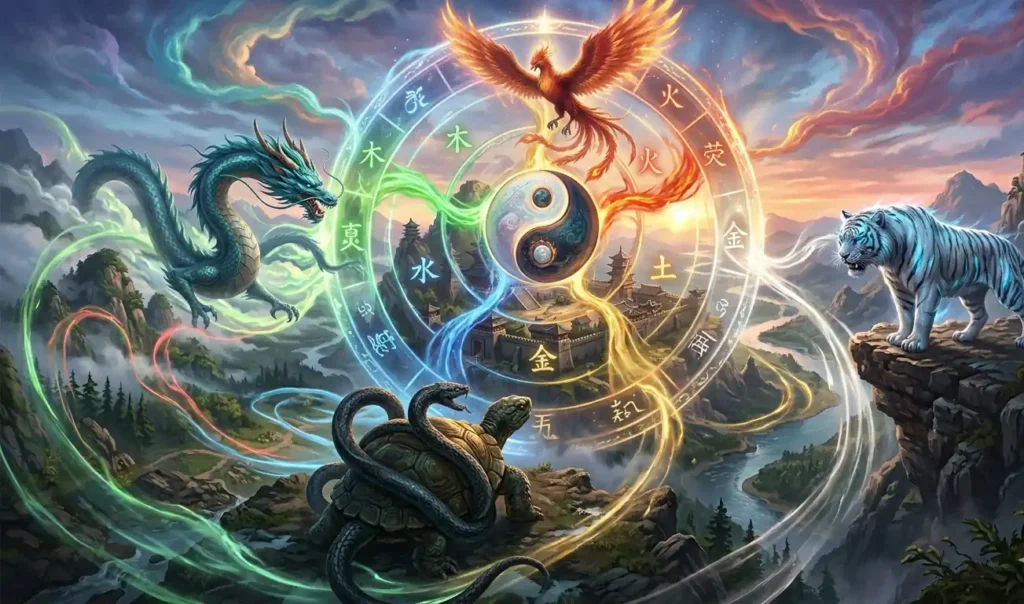
Understanding the unified architecture is one thing. Seeing it operate in practice is what makes it convincing.
In Traditional Chinese Medicine
TCM is the most elaborate practical application of the unified system. Every diagnosis and treatment simultaneously engages all three layers.
A patient presenting with liver dysfunction in TCM isn’t just experiencing a problem with a physical organ. They’re experiencing a disturbance in the Wood element domain (five elements layer), which is a disturbance in the Lesser Yang phase of the body’s yin-yang dynamics (yin-yang layer), which can be understood through the cosmological framework of the Azure Dragon domain (holy beast layer).
That’s not three separate diagnoses. It’s one diagnosis described at three levels of resolution and the treatment approach (acupuncture points on the liver meridian, herbs that tonify Wood energy, timing treatment to the spring season when Wood energy is most accessible) draws on all three layers simultaneously.
In Feng Shui
A feng shui analysis of a home involves assessing the yin-yang quality of each area (is the energy active or still, excessive or deficient?), the five-element quality of each direction (what elemental energies are present in the east, south, west, north, and centre zones?), and implicitly invoking the guardian beasts whose domains those directions represent.
Strengthening the east corner of a home isn’t just a five-element intervention (adding Wood energy). It’s engaging the Lesser Yang dynamic (yin-yang layer) and the Azure Dragon’s domain (holy beast layer) simultaneously. Practitioners who understand all three layers make more nuanced adjustments.
In the Chinese Calendar
The traditional Chinese calendar operates on a sixty-year cycle produced by combining the Ten Heavenly Stems and Twelve Earthly Branches, a system that encodes yin-yang qualities, five-element qualities, and by extension the guardian beast associations of each year.
The year 2026 in the traditional system is a Fire Horse year – Fire (five elements). Understanding what that means requires all three layers of the unified system.
Why the System is Greater than the Sum of its Parts
I want to address something that I think is worth saying directly.
Yin yang alone is a powerful but abstract framework. You can use it to describe any dynamic system. It’s so general that it applies almost everywhere. That generality is both its strength and its limitation.
The Five Elements alone are richly specific. But without the cycling principle, they’re five interesting categories that don’t explain their own dynamics.
The Four Holy Beasts alone are magnificent mythological figures. But without understanding their yin-yang compositions and five-element assignments, they’re four impressive animals at four compass points.
Here’s what the integration produces that none of them produce alone:
A complete description of reality at three levels simultaneously.
- At the level of pure dynamics: yin yang
- At the level of qualitative types: five elements
- At the level of living mythological presence: holy beasts
These aren’t three descriptions of the same thing at three different levels of abstraction. They’re three dimensions of a single description. The way length, width, and depth aren’t three descriptions of an object, they’re three dimensions that together define it.
What the unified system describes is the natural world as a living, cycling, qualitatively differentiated whole whose movements are governed by complementary dynamics, whose phases have distinct qualities, and whose guardians are present as real cosmic forces rather than abstract principles.
That’s a remarkable thing to have described, and it only exists as a complete picture when all three layers are operating together.
How I Think About This Now
After a long time of wrapping my head around these systems, here’s where I’ve arrived.
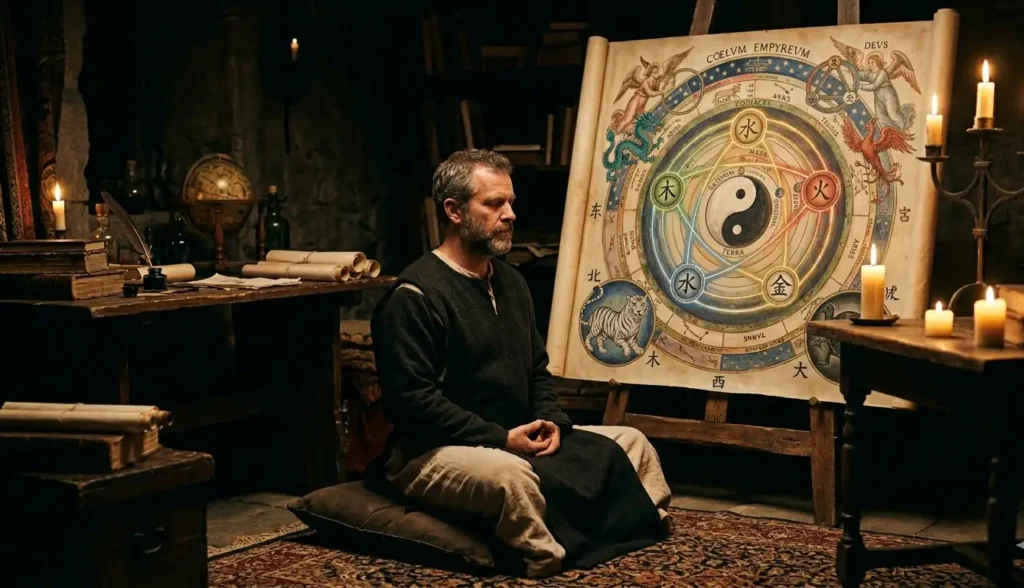
I don’t think of yin yang, the Five Elements, and the Four Holy Beasts as three topics in Chinese mythology anymore. I think of them as three ways of accessing the same cosmological architecture, the same way you can access a building through the front door, the back door, or the blueprint.
Each entry point is legitimate and informative. But what you’re always entering is the same building.
When I read the texts now, I don’t track which system is being deployed at any given moment. I track where the text is in the unified framework, which direction, which season, which elemental phase, which yin-yang ratio, and all three layers come along automatically.
That shift in how I read the material took years to develop. But once it clicked, everything in Chinese cosmology became more coherent, more interesting, and more alive than it had been when I was holding the three systems separately.
Frequently Asked Questions
Is there a classical Chinese text that presents all three systems as unified?
Yes, the Huangdi Neijing is the most comprehensive classical text integrating yin yang, Wu Xing, and directional cosmology throughout. It treats them as a unified framework for diagnosis and therapy rather than separate concepts. The Huainanzi and Lüshi Chunqiu also present similarly integrated cosmological systems.
Do the Holy Beasts have yin-yang and five-element associations in all classical sources?
The directional, seasonal, and elemental associations of the Holy Beasts remain consistent across classical sources from the Han Dynasty onward. The yin yang phase correspondences are the most consistently documented in scholarship. Sources may emphasize different layers of the system, but the underlying cosmological framework remains stable.
How does the Yellow Dragon fit into the yin-yang layer if it governs the Center rather than a direction?
The Yellow Dragon corresponds to the balanced state between the four yin yang phases rather than any single phase. In I Ching cosmology, this reflects the Tai Ji, the Supreme Ultimate from which yin and yang emerge, expressed at the center of the directional framework. Its Earth element governs transitions between phases, making it the axis of the cycle rather than a phase within it.
Can I use this unified framework without learning all three layers?
You can work with any single layer and still gain something valuable. But the most interesting questions only become fully satisfying within the unified framework: why the liver corresponds to spring, why the east aligns with Wood interventions, or why the Azure Dragon so precisely reflects its cosmological role. The individual layers are interesting. The integrated system is compelling.
Is this system still used in practice today?
Yes, actively. Traditional Chinese medicine practitioners use the unified framework in diagnosis and treatment. Feng shui practitioners use it in spatial assessment. Chinese astrologers use it in calendar interpretation. The system has been in continuous use for over two thousand years and remains alive in both traditional practice and contemporary academic study of Chinese cosmology.
Final Thoughts
I’ll close with the thing that strikes me most every time I sit with this material.
The Chinese cosmological tradition developed a unified system that describes the natural world through three simultaneously operating layers. A dynamic principle, a qualitative map, and a living mythological embodiment – and maintained the coherence of that unified system across thousands of years of philosophical, medical, astronomical, and artistic application.
That’s not an accident of cultural accumulation. It reflects something genuine about how the tradition understood reality, as a living, dynamic, qualitatively differentiated whole whose movements can be described at multiple levels of resolution simultaneously.
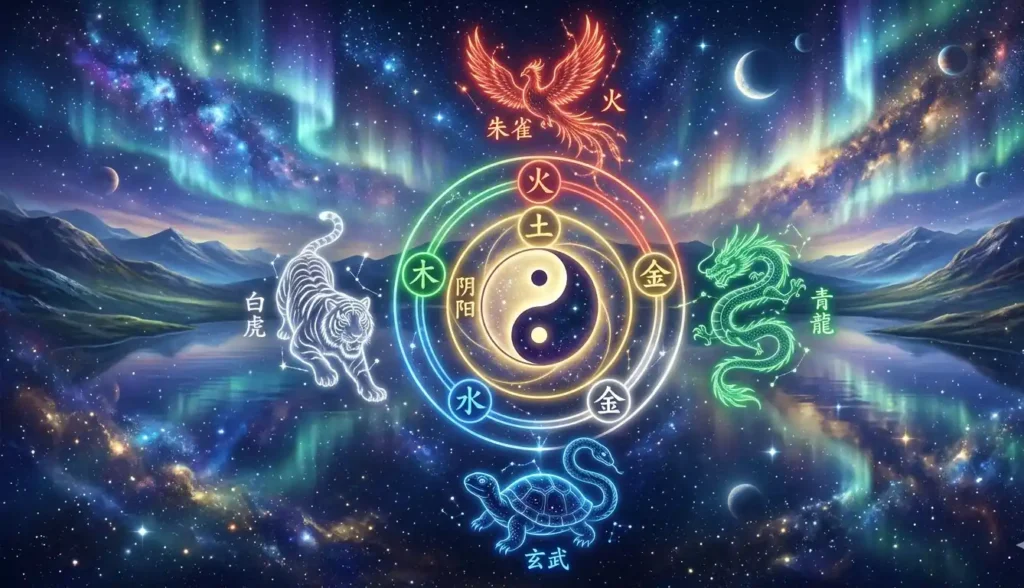
Yin yang, the Five Elements, and the Holy Beasts aren’t three things that happen to be related. They’re one system’s three faces, and the system is only fully visible when you’re looking at all three faces at once.
The moment when the three faces resolve into one face, and you see the whole thing for the first time.
Related Articles
- Yin Yang & the Five Elements: The Hidden Cosmological Link
- Why the Four Holy Beasts Cannot Exist Without Yin Yang
- The Five Elements Behind Every Holy Beast [Chinese Myth Map]
- Is Yin Yang Demonic? The Truth You Don’t Know
- Are the Four Heavenly Kings & Four Holy Beasts the Same?
- Ba Gua: Eight Trigrams, Meaning & Sacred Origins
References
- Stanford Encyclopedia of Philosophy – Daoism
- Joseph Needham, Science and Civilisation in China
- Dao De Jing (Tao Te Ching)
- Zhuangzi
- Daoism and Chinese Culture – Livia Kohn
- Lüshi Chunqiu (The Annals of Lü Buwei)
- Huainanzi
- Yin-Yang and the Nature of Correlative Thinking – Angus Charles Graham
- Lewis, Mark Edward. The Construction of Space in Early China.
- Huangdi Neijing
- Yinyang: The Way of Heaven and Earth in Chinese Thought and Culture – Robin Wang
- Shanhaijing (Classic of Mountains and Seas).
- Book of Changes: Yi Jing – Chinese Text Project
- Chun Qiu Fan Lu – Chinese Text Project