
 By
By Quick Takeaways:
- Daoist meditation isn’t one technique among many in the cultivation tradition. It’s the central project from which everything else radiates
- The philosophical foundation is in the Tao Te Ching and the Zhuangzi, which describe specific states of inner stillness as the direct method for aligning with the Dao
- Three main classical meditation traditions developed. Zuowang (sitting and forgetting), neiguan (inner observation), and the neidan internal alchemy practices centered on the three dantians
- The goal isn’t relaxation or stress relief, it’s a fundamental transformation of consciousness that the tradition believes can ultimately transcend ordinary human limitation
- Understanding Daoist meditation changes how you read Chinese philosophy, TCM, qigong, and martial arts, because they all draw on the same inner cultivation framework
Here’s something that took me years to fully appreciate.
When people talk about the Daoist cultivation tradition, the practices that ancient Chinese practitioners developed to pursue immortality, spiritual transcendence, and alignment with the Dao, they often focus on the visible external elements. The herbs and elixirs. The physical exercises. The dietary practices. The elaborate cosmological frameworks.
All of those are real parts of the tradition. But they’re the scaffolding around a central structure. The central structure is meditation, the direct, first-person engagement with consciousness itself that the entire Daoist tradition identifies as the most fundamental path to whatever the tradition is pointing at.
Years of following this material have convinced me that you can’t really understand Chinese cultivation as philosophy, as religious practice, or as cultural history, without understanding the meditation tradition at its core. That’s what this article is about.
What Daoism Thinks Meditation Is Actually For
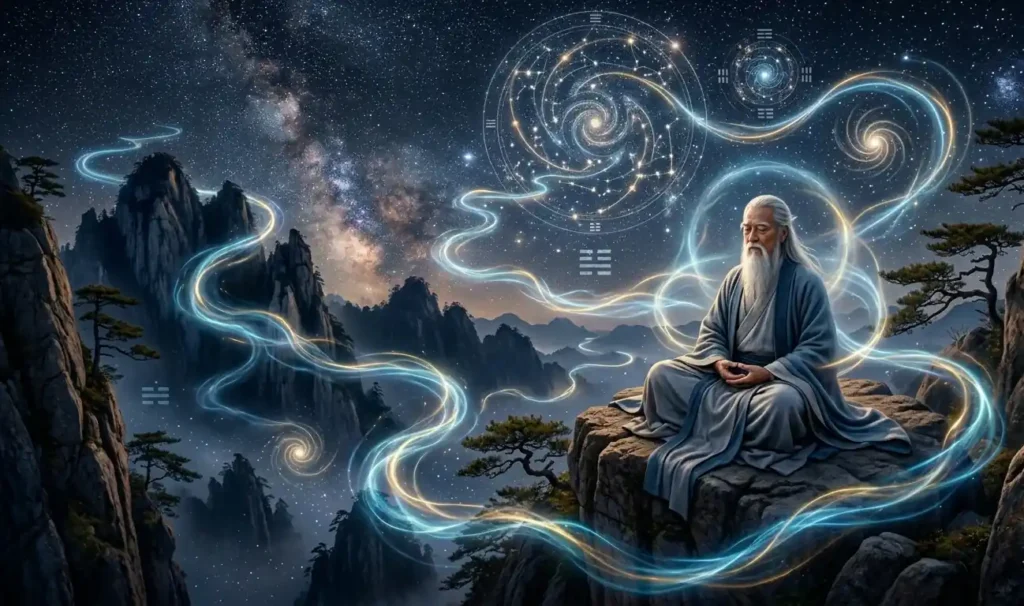
Before getting into specific practices, it’s worth establishing what the Daoist tradition thinks it’s doing when it meditates. Because the answer is very different from the contemporary wellness-culture answer.
It’s not stress relief
Contemporary culture has embraced meditation primarily as a stress-relief and mindfulness tool. Reduce anxiety. Improve focus. Sleep better. These are genuine benefits that meditation reliably produces. But they’re incidental to what the Daoist tradition was pursuing.
Daoist meditation is aimed at transformation of fundamental nature, not the management of ordinary experience, but the progressive refinement of consciousness itself, from its ordinary state to something qualitatively different.
The tradition’s most honest practitioners would say that stress relief is approximately what happens in the first few weeks. The actual project takes decades.
The cosmological foundation
The Daoist meditation tradition rests on a specific cosmological claim: the Dao is the ground of all existence, and the human mind in its ordinary state is separated from that ground by accumulated conditioning, desire, and the noise of active thinking.
Meditation’s function is to progressively thin that separation. To quiet the conditioned activity enough that the Dao’s own nature can begin to be directly perceived rather than conceptually described.
This is why stillness is so central to Daoist meditation. Not the stillness of suppression pushing thoughts away, but the stillness of the naturally settled mind, the deep pool when the surface disturbances have subsided enough for the bottom to become visible.
The physiological dimension
What distinguishes Daoist meditation from many other contemplative traditions is its explicitly physiological framework. Meditation isn’t just a mental exercise. It’s a practice that works with the body’s own energy jing, qi, and shen to facilitate the refinement process described in the neidan tradition.
This means Daoist meditation is always simultaneously a physiological and a spiritual practice. Breathing isn’t just a way to calm the mind. It’s the direct qi cultivation. Attention placement, where you put your awareness during meditation, isn’t just a focusing technique. It’s the direction of energy through specific channels and centers.
The mind and the body are working together in a specific relationship, and understanding that relationship is the key to understanding what Daoist meditation is actually doing.
The Philosophical Roots: Tao Te Ching And Zhuangzi
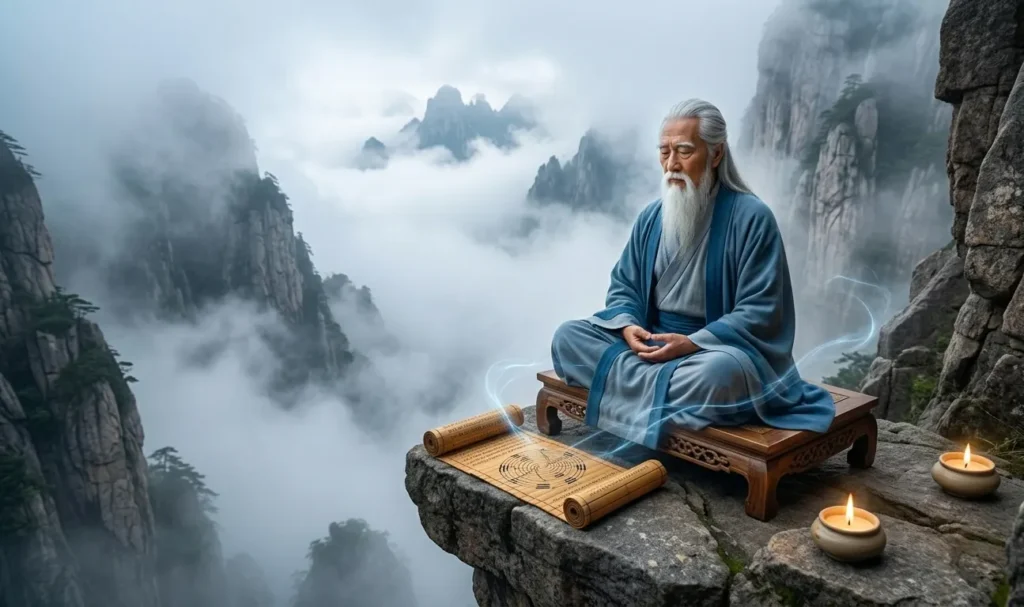
The Tao Te Ching’s contemplative vision
The Tao Te Ching, Laozi’s foundational text, isn’t a meditation manual. But it describes the inner state that meditation cultivates with extraordinary precision.
Chapter 16 is the most explicit:
“Reach the ultimate emptiness. Hold fast to stillness. Ten thousand things arise together, I watch their return. The ten thousand things flourish, and each returns to its root. Returning to the root is called stillness.”
This is a description of a specific meditative state, the emptied, stilled awareness that observes the arising and passing of phenomena without being carried away by them. Laozi isn’t describing a concept. He’s describing an experience.
The Tao Te Ching returns to this state repeatedly under different names: emptiness (xu), stillness (jing), returning to the root (gui gen), the uncarved block (pu). These are all pointing at the same fundamental quality of consciousness that the meditation tradition is attempting to cultivate.
Zhuangzi’s radical vision
The Zhuangzi is even more explicitly concerned with the inner states that meditation produces and more radical in what it claims those states reveal.
The concept of xin zhai (heart-fasting) appears in the dialogue between Confucius and Yan Hui in the Inner Chapters:
“Make your will one. Don’t listen with your ears, listen with your mind. No, don’t listen with your mind, but listen with your spirit. Listening stops with the ears, the mind stops with recognition, but the spirit is empty and waits on all things.”
This is a description of a specific contemplative practice, the progressive withdrawal of attention from sense perception, through conceptual mind, into something Zhuangzi calls “spirit” (qi, in this context) that receives experience directly without the filtering of conceptual interpretation.
It’s a sophisticated description of meditative depth that anticipates what later traditions would systematize into specific techniques. Zhuangzi got there through philosophy rather than an instruction manual, which is, I think, why his descriptions are so vivid.
The concept of zuowang (sitting and forgetting) also appears in Zhuangzi, the state of sitting in meditation in which the practitioner “forgets” their ordinary identity, their bodily sensations, their conceptual categories, and rests in direct contact with the Dao.
The Three Classical Meditation Traditions
The Daoist meditation tradition, as it developed historically has three main branches, each with its own emphasis and technique set. They’re related and often practised together, but they’re distinct enough to understand separately.
Zuowang: sitting and forgetting
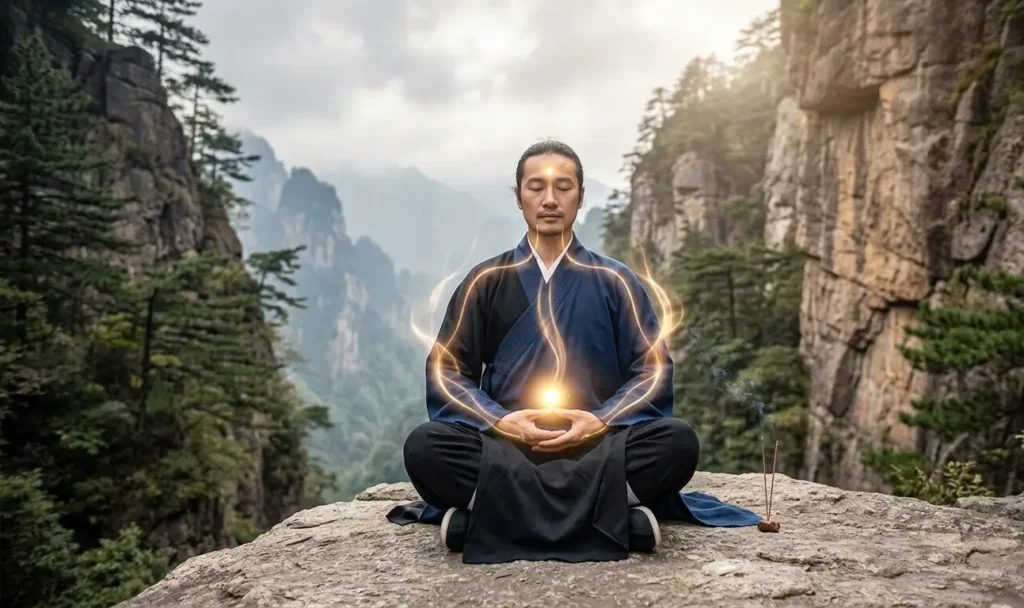
Zuowang is the most philosophically pure of the three classical Daoist meditation traditions and the most directly connected to the Zhuangzi’s vision.
The Tang Dynasty scholar Sima Chengzhen (647–735 CE) wrote the most systematic classical treatment of zuowang in his Zuowang Lun (Treatise on Sitting in Oblivion). He describes seven stages of the practice:
- Respect and trust – establishing the basic orientation of sincere practice
- Interception of karma – reducing the behavioral and relational entanglements that feed the active mind
- Taming the mind – learning to work with the mind’s tendency to wander and attach
- Detachment from affairs – progressively releasing the hooks of worldly concern that pull attention away from stillness
- True observation – the direct contemplative perception of the nature of phenomena
- Intense concentration – deepened one-pointed awareness
- Realizing the Dao – the culmination: direct alignment with the Dao’s own nature
What I find most interesting about this framework is how practical it is in its early stages. Stages one through four are about lifestyle, relationships, and habitual behavior, not about sitting technique. Sima Chengzhen understood that you can’t cultivate inner stillness if you’re spending your days in constant drama and entanglement. The meditation practice is inseparable from the life around it.
What zuowang actually feels like
The tradition describes the deepest zuowang states with remarkable consistency across texts:
- Cessation of bodily sensation: The practitioner loses awareness of their body’s weight and boundaries
- Cessation of conceptual activity: Ordinary thought processes quiet to the point of seeming to stop
- A quality of luminous clarity: Not darkness or blankness but a vivid, empty awareness
- Loss of the boundary between self and environment: The ordinary sense of being a separate entity inside a body in a world gradually releases
These descriptions appear in texts spanning over a thousand years of Daoist tradition. That consistency suggests they’re describing something real, specific states that the practice reliably produces in practitioners who commit to it seriously.
Neiguan: inner observation
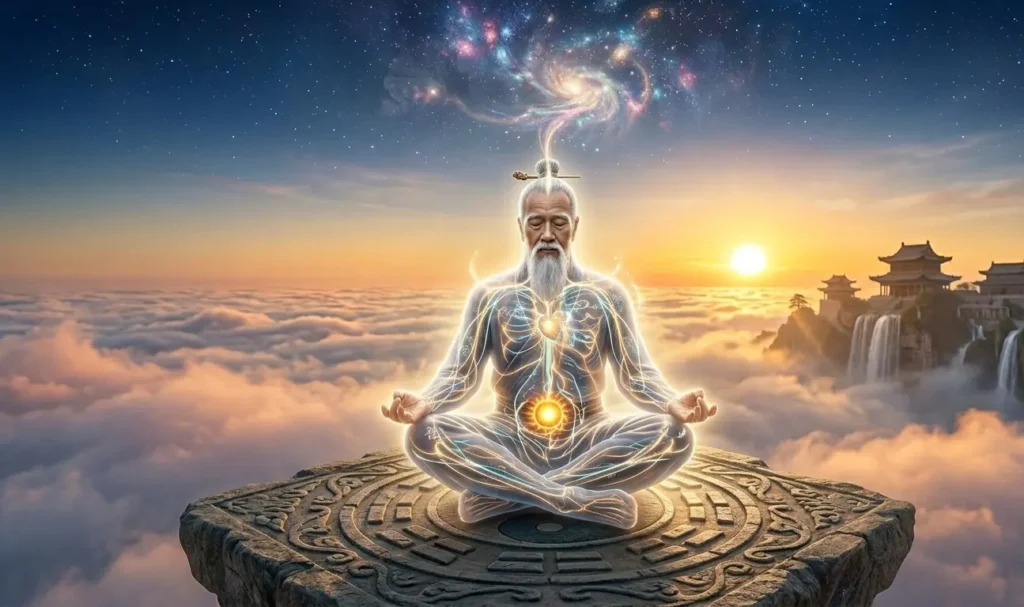
Neiguan (inner observation or internal visualization) is the meditation tradition that’s most explicitly connected to the physiological framework of the three dantians and the meridian system.
Where zuowang aims at complete cessation of conceptual activity, neiguan is more active it involves directed attention and deliberate visualization of specific internal structures. The practitioner observes and cultivates the body’s internal landscape with the same careful attention a field researcher might give to an external environment.
The key text is the Huangting Jing (Yellow Court Classic), one of the most important Daoist meditation texts and one of the most fascinating documents in the entire Chinese literary tradition. It’s written in verse, and it describes the body’s interior as a divine landscape populated by specific deities corresponding to specific organs and energy centers.
The liver has its own deity. The heart has its own deity. The spleen, the lungs, and the kidneys each have a divine resident whose name and appearance are specified. Meditation in this tradition involves cultivating a direct experiential relationship with these internal divine presences.
Modern readers sometimes find this bizarre. But I think the framing is worth taking seriously on its own terms. The tradition is using the language of divine presence to describe a direct, embodied awareness of specific interior processes, a kind of first-person phenomenology of the body that’s quite different from either anatomical observation or pure abstraction.
The three dantians in neiguan
The three dantians are the primary focal points of neiguan practice:
Lower dantian (below the navel): The primary focus for foundational qi cultivation. Most neiguan practice begins here, developing a felt sense of the qi reservoir and learning to direct attention and breath to cultivate it.
Middle dantian (chest level): The seat of shen and emotional-spiritual energy. As the lower dantian stabilizes, practice progressively engages the middle dantian and the heart-spirit that resides there.
Upper dantian (between the eyebrows): The seat of refined shen and spiritual perception. The most advanced neiguan practice cultivates the luminous awareness associated with this center, which some traditions call the “spirit light” or the “original face.”
The Microcosmic Orbit: circulation practice
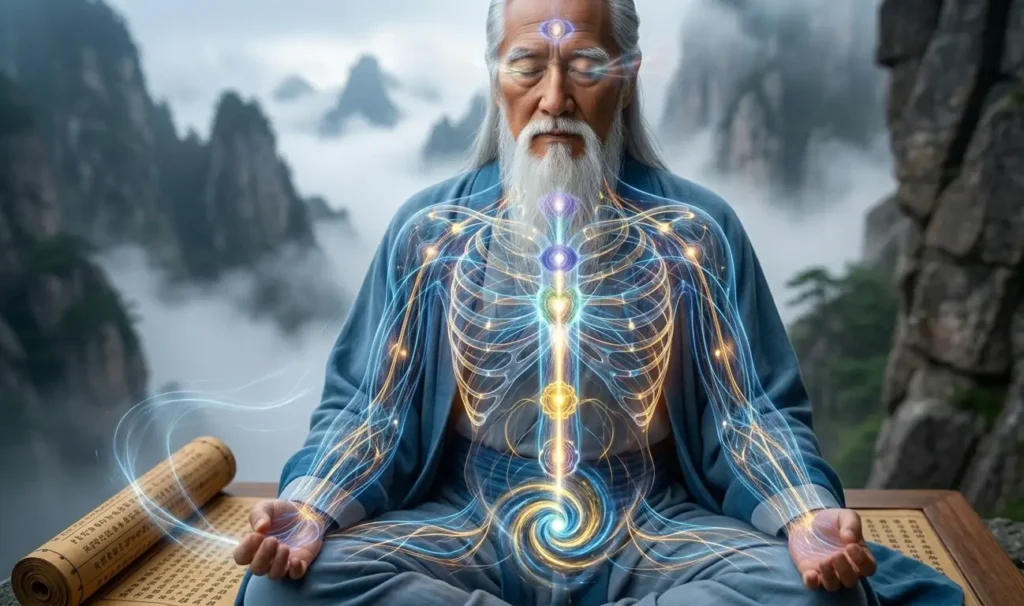
The Microcosmic Orbit (Xiǎo Zhōutiān) is probably the most widely known Daoist meditation practice in contemporary contexts, because it crossed over into popular qigong and energy cultivation teaching relatively early.
The practice involves circulating refined qi through the body’s two primary extraordinary vessels:
- Up the Du Mai (Governing Vessel) along the spine, from the base to the crown
- Down the Ren Mai (Conception Vessel) along the front midline, from crown to base
The practitioner guides their breath and attention through this circuit, completing the loop in a continuous flowing meditation.
The imagery is explicitly alchemical. The lower dantian is the furnace. The breath heats the qi. The rising of qi up the Du Mai is like steam rising through a still. The cooling and descent through the Ren Mai is the distillation product returning for another cycle. Each circuit refines the qi further.
Why this practice matters
The Microcosmic Orbit is the point where the philosophical traditions I discussed above, the Tao Te Ching’s emptiness, the Zhuangzi’s heart-fasting, and the neiguan internal landscape meet a specific, teachable technique.
You can tell someone to “empty the mind and align with the Dao.” That’s philosophically useful but practically opaque. You can tell someone to direct their breath and attention up the spine and down the front of the body in a continuous circuit. That’s something they can actually do.
The circuit practice works because attention and breath together genuinely do appear to move energy in the body in specific directions, something that practitioners of many traditions, not just Daoist ones, have independently described.
The Great Texts of Daoist Meditation
Understanding the tradition requires knowing its primary sources. These are the texts I keep returning to after twenty years of following this material:
The foundational texts
Tao Te Ching (attributed to Laozi): The philosophical foundation. Not a meditation manual but the most precise description of the meditative state that the entire tradition is cultivating. Essential reading before anything else.
Zhuangzi: The philosophical exploration of inner freedom that inspired the zuowang tradition. The Inner Chapters (especially chapters 1–7) contain the most important meditative concepts.
The Nei Pian section of Baopuzi (Ge Hong, 4th century CE): The most systematic early treatment of the full cultivation practice, including meditation as part of the immortality project.
The neidan meditation texts
Cantong Qi (Wei Boyang, 2nd century CE): The foundational neidan text, using I Ching cosmology as the framework for internal alchemy. Dense and allusive but essential.
Huangting Jing (Yellow Court Classic): The primary text for neiguan inner observation practice. Verse format. Describes the body’s interior divine landscape.
Zuowang Lun (Sima Chengzhen, 8th century CE): The most systematic classical treatment of sitting and forgetting practice. Accessible and practically oriented.
Complete Reality (Quanzhen) school texts: The Song Dynasty synthesis of Daoist meditation practice, developed by Wang Chongyang and his seven major disciples. Most accessible later Daoist meditation instructions come from this lineage.
The Lineages That Transmitted The Practices

Daoist meditation doesn’t exist as an abstract set of techniques. It exists as living transmissions passed from teacher to student across generations. Understanding the major lineages helps map the tradition.
The Complete Reality school (Quanzhen)
The Complete Reality school is the most important surviving Daoist meditation lineage, founded by Wang Chongyang in the 12th century and transmitted through his seven major disciples, the most famous of whom is Qiu Chuji, who is associated with the Wudang and Longmen sub-lineages.
Complete Reality Daoism Integrated Buddhism (particularly Chan/Zen) into Daoist meditation practice, emphasizing inner cultivation, ethics, and sitting meditation rather than external ritual or alchemical practice. Its meditation instructions are relatively systematic and have been transmitted through institutional Daoist temples to the present day.
The Maoshan school
The Maoshan (Mao Shan) school, centered on the Three Mao Mountains in Jiangsu province, was the lineage through which Sima Chengzhen (author of the Zuowang Lun) transmitted. It emphasized neiguan internal observation and the cultivation of inner divine presences, the tradition most directly connected to the Huangting Jing.
The Zhengyi tradition
The Zhengyi (Orthodox Unity) tradition is the other major surviving stream of Daoist practice, descended from the Celestial Masters lineage established in the 2nd century CE. It has historically been more oriented toward ritual and external ceremony than toward meditation, but it contains its own internal cultivation traditions that deserve recognition.
Why Daoist Meditation Became Cultivation’s Sacred Core
I want to bring this back to the article’s central claim, because it’s the thing I’ve come to most firmly believe after following this material.
The external cultivation practices, dietary practices, physical cultivation, and even external alchemy in its time are all in service of a central project that can only be done internally, in meditation.
You can refine your diet forever and still not achieve the inner stillness that transforms consciousness. You can practise physical qigong exercises for decades without ever touching the depth of the meditative states that the tradition is pointing at.
The reason meditation is the sacred core isn’t that other practices are useless. It’s that the other practices are preparation. They create the physiological conditions in which deep meditation becomes possible, a body stable enough, a nervous system calm enough, a life simple enough, but they can’t substitute for the direct engagement with consciousness that only meditation provides.
The Zhuangzi knew this. The Tao Te Ching knew this. Every major Daoist meditation text since knows this. The direct encounter with whatever the Dao actually is, not the concept, not the philosophical description, but the thing itself, happens in the stillness of meditation. Everything else is pointing toward the door. Meditation is walking through it.
Frequently Asked Questions
What’s the difference between Daoist meditation and Buddhist meditation?
Buddhist meditation seeks liberation from suffering through recognizing emptiness and ending craving. Daoist meditation seeks harmony with the Dao through cultivating jing, qi, and shen. Both traditions share breath awareness, concentration, and deep stillness, though Daoist practice emphasizes energetic physiology more explicitly. They also influenced each other heavily, especially in Zen Buddhism.
Can I practice Daoist meditation without a teacher?
The tradition strongly recommends a teacher, especially for advanced practices involving qi circulation and the three dantians, since improper practice can be destabilizing. Foundational methods like breath awareness and stillness can be learned from reliable texts and instruction. The Complete Reality tradition shaped modern transmission through figures like Liu Yiming and Mantak Chia.
How is Daoist meditation different from qigong?
Qigong is largely a secularized modern form of traditional Daoist cultivation, drawing from dao yin, breath work, and neiguan while removing much of the religious framework. Daoist meditation focuses more on inner stillness, consciousness transformation, and neidan refinement, whereas modern qigong emphasizes movement and health. The two overlap heavily, and many practitioners combine both.
What is zuowang and how do I practice it?
Zuowang, or “sitting and forgetting,” is a classical Daoist meditation described most fully by Sima Chengzhen in the Zuowang Lun. The practice cultivates progressive inner stillness through releasing conceptual thought and bodily identification, deepening toward empty, luminous awareness aligned with the Dao. Its seven-stage framework begins with simplifying life and reducing worldly entanglement before deeper meditation becomes possible.
How does Daoist meditation relate to traditional Chinese medicine?
Both draw on the same framework: the three treasures, the meridian system, the three dantians, and five element and yin yang theory. Traditional Chinese Medicine applies this model to health and disease treatment, while Daoist meditation applies it to consciousness cultivation and spiritual transformation. They use the same map, but aim at different outcomes.
Final Thoughts
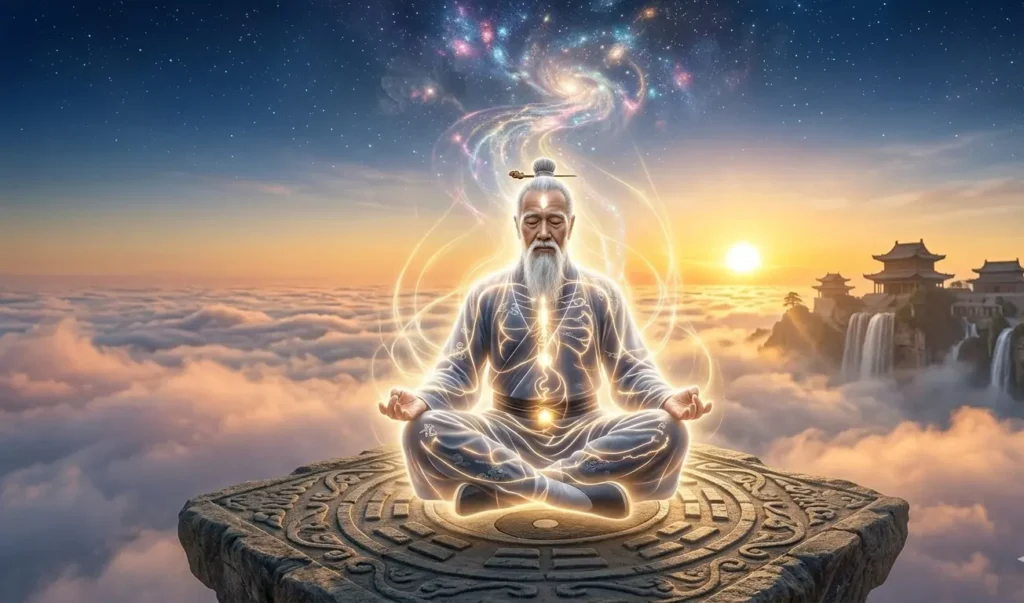
Twenty years of following mythology and philosophy across world traditions has given me deep respect for the Daoist meditation tradition, specifically not just as a piece of cultural history but as a genuinely sophisticated first-person investigation of consciousness.
The tradition got some things wrong. The immortality project as literally conceived almost certainly doesn’t work the way the texts describe. The physiological framework of qi and meridians doesn’t map onto biomedical anatomy.
But the phenomenological descriptions of what specific practices actually produce in terms of first-person experience are consistent across thousands of years and multiple cultural contexts in ways that demand serious attention. The states that zuowang practitioners describe, the inner landscape that neiguan cultivates, the specific qualities of awareness that the Microcosmic Orbit practice develops, these are descriptions of real experiences that real practitioners have had.
What those experiences ultimately mean, and where the tradition’s map is accurate versus metaphorical, is a question I’ve been sitting with for some time now. I don’t think I’ve finished with it.
What I do know is that Daoist meditation is the sacred core of the cultivation tradition in the most literal sense. It’s the practice without which none of the rest of the tradition makes sense. Strip away the cosmological framework, the dietary practices, the physical cultivation, the texts and lineages, and what remains is a person sitting in stillness, watching the mind settle, waiting for something quieter and more fundamental than ordinary consciousness to become visible.
That’s two thousand years old. It’s still worth doing.
Related Articles
- How to Become Immortal According to Chinese Myth & Daoism
- Yin Yang in Daoism: Meaning, Symbolism & Sacred Origins
- The 3 Paths of Cultivation: Taoism vs Buddhism vs Confucianism
- Why Daoist Masters Pursued Immortality [The Real Reasons]
- Eight Immortals: Symbols, Sacred Roles & Daoist meaning
Written by Batin Khan | Mythology and philosophy reader across world cultures (20 years), Cultivation novels reader for the past 10 years | Specialist in Xianxia, Eastern and Western mythological traditions, and fantasy worldbuilding