
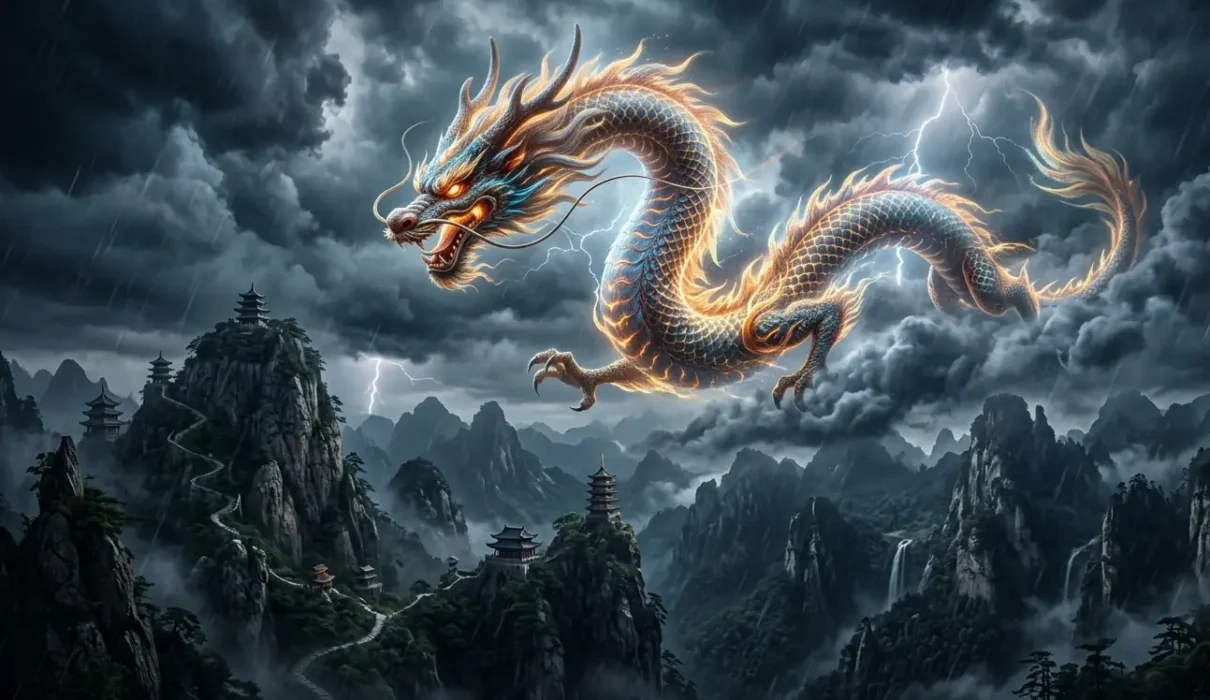
 By
By Quick Takeaways:
- The Chinese dragon, properly called Loong (Long), is fundamentally different from the Western dragon, and calling it a “dragon” has caused persistent mythological confusion
- The Loong is a benevolent divine being associated with water, rain, and cosmic order, not a fire-breathing adversary to be overcome
- Its composite physical form deliberately incorporates features from nine animals, each contributing specific symbolic qualities
- The Dragon Kings (Long Wang) are the most important Loong figures in Chinese religious practice, divine governors of water who control rainfall and are actively prayed to
- The Longmen (Dragon Gate) legend encodes one of Chinese culture’s most important ideas about transformation, merit, and the possibility of fundamental change
Let me start with the naming problem, because it matters more than it might seem.
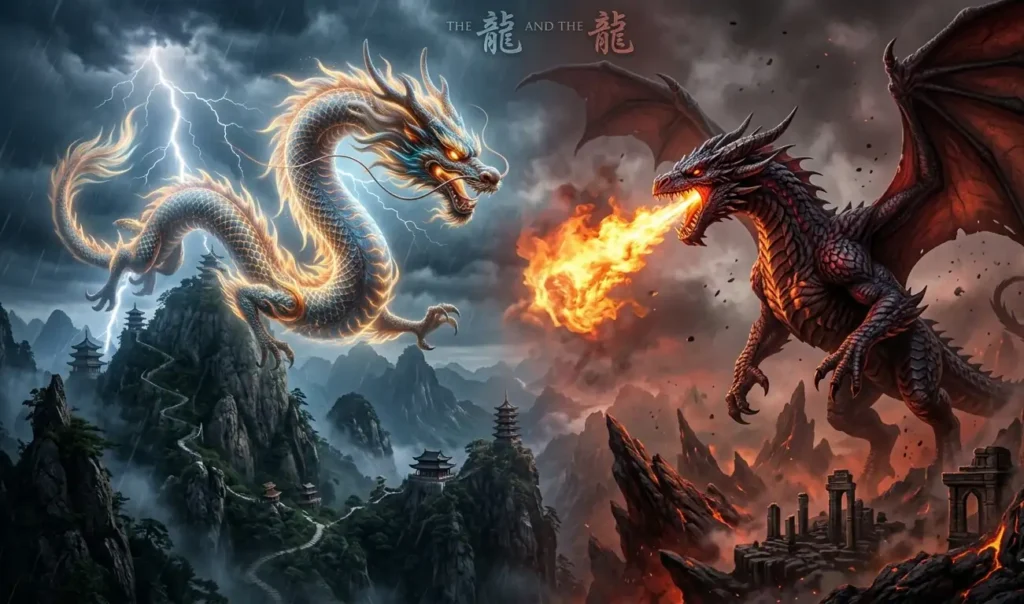
In English, we call the Chinese Loong a “dragon” and we call the creature in Saint George’s legend a “dragon” too. The same word for two completely different figures. One is a benevolent rain-bringing divine being that Chinese emperors claimed as their cosmic patron. The other is a monstrous adversary that heroes must kill to prove their virtue.
After studying Chinese mythology text like shanghaiing, I genuinely believe this naming collision is one of the most consequential translation errors in comparative mythology. It’s led generations of Western readers to assume the Chinese dragon is basically a nicer version of what they already know, a different cultural spin on the same underlying figure.
It’s not. The Loong is something else entirely. And understanding what it actually is changes how you read Chinese mythology, Chinese history, and Chinese culture all at once.
The Naming Question: Loong Versus Dragon
Why Scholars Are Pushing for “Loong”
A growing movement among Chinese scholars and cultural commentators advocates using “Loong” (a transliteration of the Cantonese pronunciation) rather than “dragon” in English specifically to create visual and conceptual distance from the Western dragon figure.
The argument is straightforward: if you write “Long” or “Loong” instead of “dragon,” an English reader knows immediately that they’re encountering something unfamiliar that requires explanation. If you write “dragon,” they import two thousand years of European dragon mythology into their reading before they’ve absorbed a single fact about the actual figure.
I find this argument compelling. I’ll use “Loong” throughout this article, but I’ll also note where the standard “dragon” translation has shaped how the figure is understood.
What Gets Lost in Translation
When the Loong becomes “dragon” in English, these things get lost:
- Its fundamental benevolence – Western readers expect a dangerous adversary
- Its water nature – Western readers expect fire
- Its cosmological role as a divine partner of imperial authority – Western readers expect a monster to overcome
- Its composite form’s philosophical meaning – Western readers see an exotic animal, not a deliberate cosmological statement
These aren’t minor misunderstandings. They’re the difference between understanding the figure and misunderstanding it.
Origins: Where The Loong Came From
The Earliest Evidence
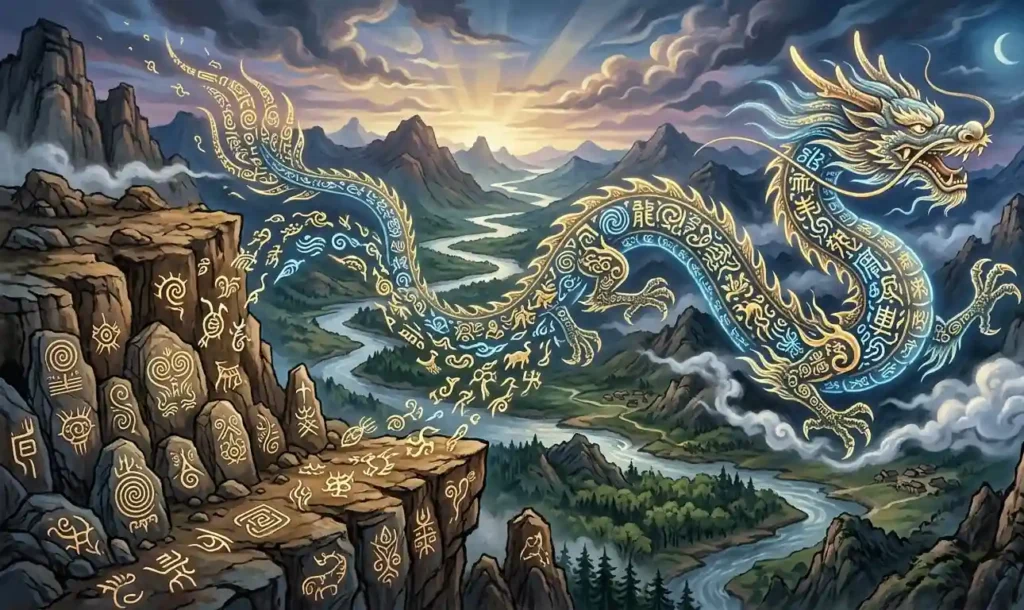
The Loong’s origins reach back further than reliable written records. Jade Loong carvings from the Hongshan culture (4700–2900 BCE) in northeastern China are among the earliest clear dragon-related artifacts, C-shaped jade figures identified as early Loong forms.
The Shang Dynasty (1600–1046 BCE) oracle bones contain Loong characters and references to Loong worship. The basic conceptual figure of a great serpentine divine being associated with water and cosmic power appears established in Chinese culture considerably before the classical period gave it its full symbolic development.
The Composite Origin Theory
One compelling theory about the Loong’s origin holds that it’s a genuinely composite figure in origin as well as form, that it emerged from the synthesis of multiple regional totems as early Chinese cultures merged.
Different tribal groups in early China had different sacred animals, serpents, fish, crocodiles, and birds. As these cultures unified, their sacred animals may have merged into a single composite divine being whose form incorporated elements from all of them.
This theory would explain both the composite physical form (which I’ll discuss in detail shortly) and the Loong’s unusual breadth of associations, it resonates with so many different natural contexts because it absorbed totem animals from so many different cultural traditions.
The Physical Form: What The Loong Actually Looks Like
The Nine Animal Resemblances
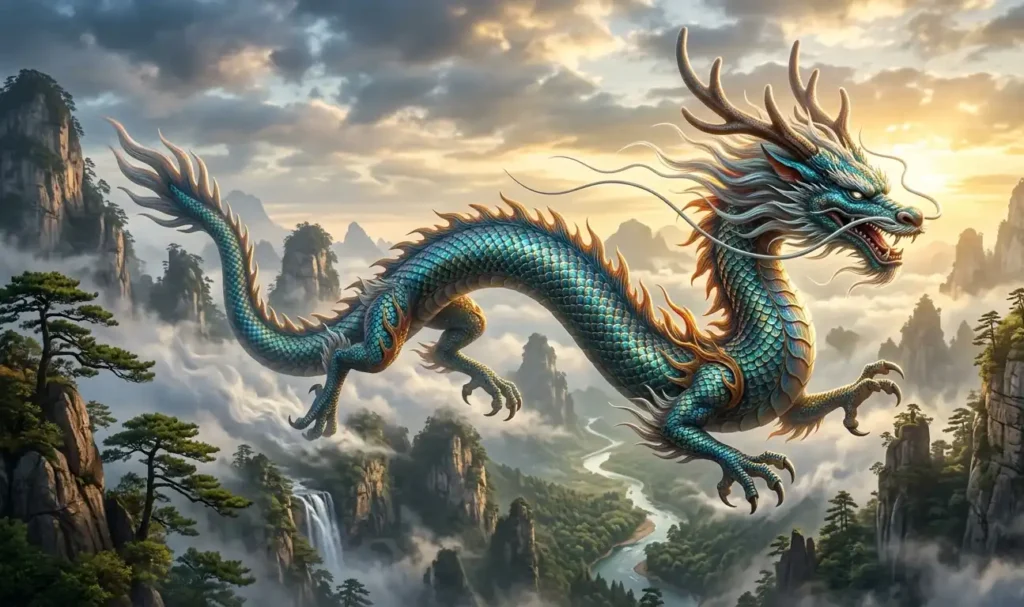
Classical Chinese texts describe the Loong’s body through what I consider one of mythology’s most deliberately designed physical descriptions: nine animal resemblances that each contribute specific symbolic content.
The nine animals and what they contribute:
- Head of a camel – endurance, the capacity to cross vast distances
- Antlers of a deer – longevity, masculine vitality, connection to the forest realm
- Eyes of a demon – supernatural perception, the ability to see what ordinary vision cannot
- Neck of a snake – fluid power, the capacity for graceful movement through any medium
- Belly of a clam – the treasure within, the protective container of vital essence
- Scales of a carp – connection to water, the fish that can become a Loong through transformation
- Claws of an eagle – aerial authority, predatory precision
- Paws of a tiger – terrestrial power, the authority of the land’s supreme predator
- Ears of a cow – the ability to hear everything, receptivity to the world’s sounds
This isn’t a random collection. Each animal contributes a specific quality to a figure that’s designed to encompass the full range of natural power, sky, earth, water, forest, and sea. The Loong isn’t one animal. It’s the synthesis of all animals’ finest qualities into a single divine being.
The 81 Scales
Classical texts also describe the Loong as having 81 scales, nine times nine, encoding the supreme yang number. The scales aren’t simply a protective covering. They’re a mathematical statement about the Loong’s cosmic nature: 9 × 9 represents the maximum expression of yang energy in the numerological framework that underlies classical Chinese cosmological thinking.
The Distinctive Features
Beyond the nine animal resemblances, the Loong has specific physical attributes that appear consistently in classical iconography:
- The luminous pearl carried beneath the chin or in the claws is a symbol of wisdom, cosmic knowledge, and the essence the Loong governs
- Whiskers and beard suggesting age and wisdom
- No wings in classical Chinese forms the Long flies through clouds and qi rather than through wing-powered flight
- Five claws for imperial Loong; four claws for royal nobility; three claws for general decorative use, a regulated hierarchy encoded in anatomy
The Loong’s Fundamental Nature: Water and Cosmic Order
Why it is a Water Being
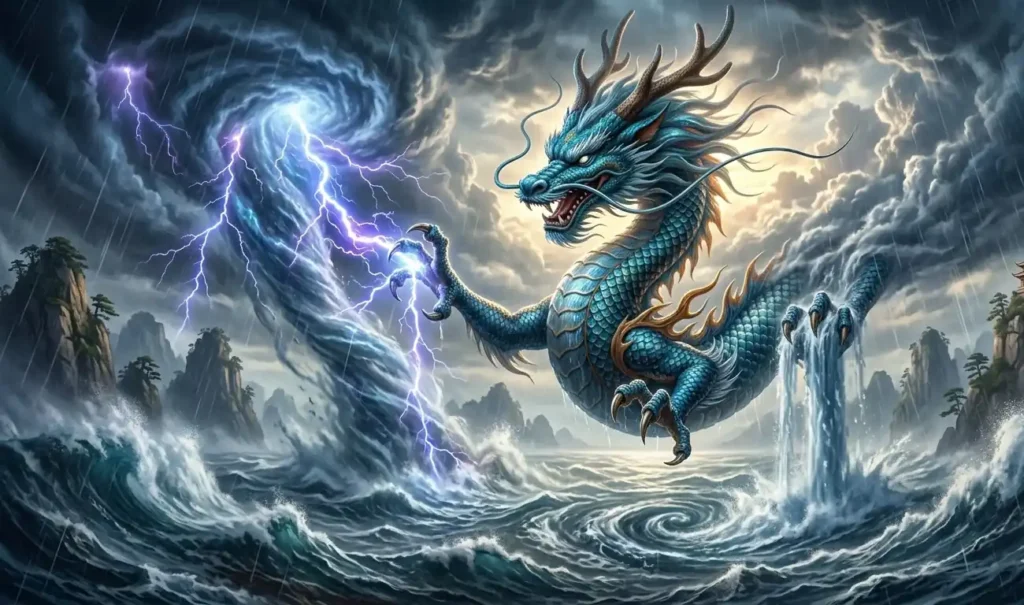
The Loong’s association with water is its most fundamental characteristic, more defining even than its iconic composite form.
Chinese civilization developed along rivers. The Yellow River and the Yangtze River are the civilizational heartlands. Agriculture in this context depends on water in a direct, life-or-death way. Too little rain means crop failure and famine. Too much means floods and destruction. The precision and timing of rainfall is the single most important environmental variable for most of Chinese history.
A divine being that controls water is therefore the most important divine being imaginable. And crucially, that divine being’s relationship with humanity has to be cooperative rather than adversarial. You can’t afford for your most important divine power to be an enemy.
The Water Realms
The Chinese Dragon governs water across every scale:
- The great oceans – through the Four Dragon Kings (Long Wang) of the Four Seas
- Rivers – each major river has its own river Loong and often its own Dragon King temple
- Rain clouds – Loong are cloud beings, their movement through the sky producing the weather that governs agricultural success
- Underground water – springs and groundwater sources are also within the Loong’s governance
This comprehensive water governance makes the long dragon present in every aspect of the water cycle that sustains Chinese agricultural civilisation.
The Dragon Kings: Mythology’s Most Powerful Water Officials
Who They Are
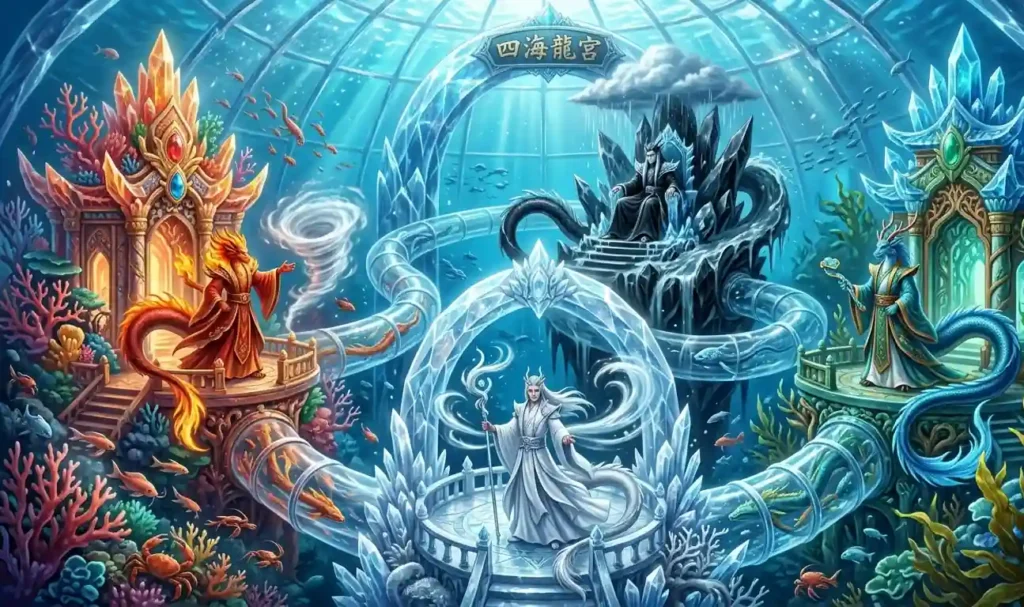
The Dragon Kings (Lóng Wáng) are the most important Dragon figures in Chinese religious practice, divine rulers of specific water domains who control rainfall and weather within their jurisdictions.
The four supreme Dragon Kings govern the four seas:
- Ao Guang – Dragon King of the East Sea
- Ao Run – Dragon King of the South Sea
- Ao Shun – Dragon King of the North Sea
- Ao Qin – Dragon King of the West Sea
Each inhabits a crystal palace beneath their respective sea and commands a vast court of marine beings. Their authority over water within their domains is real and specific. Farmers prayed to their local Dragon King temple when rain was needed, and temple records across centuries document the ritual relationship between communities and their divine water governors.
Read: Four Dragon Kings: Guardians of China’s Seas & Weather
The Dragon King’s Court
The Dragon King’s underwater palace is one of Chinese mythology’s most vivid otherworldly settings. It contains:
- Crystal halls lit by glowing pearls rather than sunlight
- Treasure vaults containing jewels, magical weapons, and supernatural artifacts
- Courts of marine beings – fish generals, crab officials, shrimp soldiers organized in the same bureaucratic structure as the human court
- The magical weapons stored there – most famously the Ruyi Jingu Bang, the iron pillar that Sun Wukong takes from the East Sea Dragon King in Journey to the West
The underwater court is, in Chinese mythology, the water domain’s direct parallel to the human imperial court, complete with ranks, ceremonies, and administrative hierarchy.
The Imperial Loong: Cosmic Legitimacy Made Visible
Why The Emperor Claims the Loong
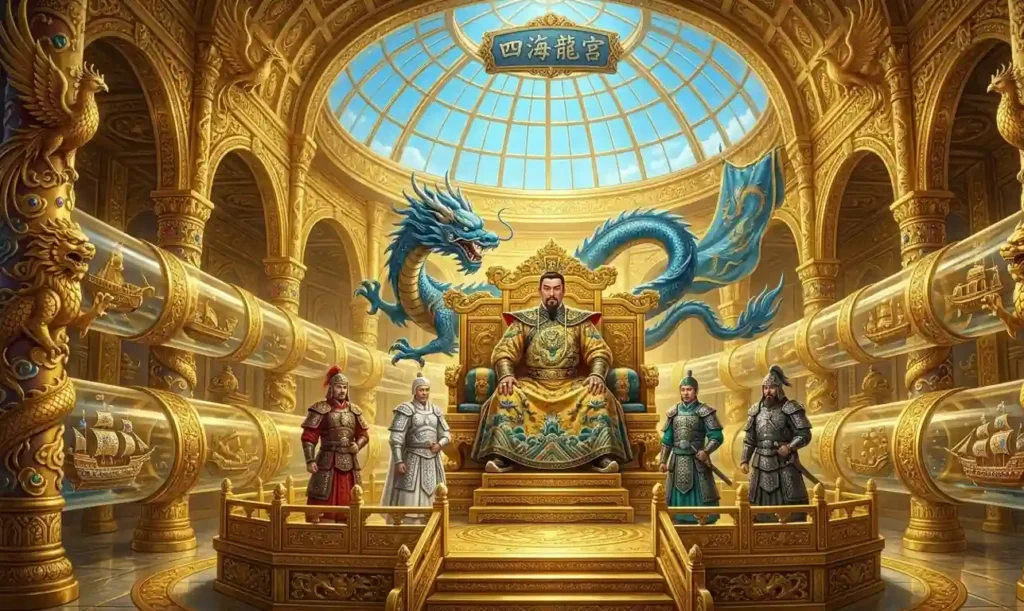
The Chinese emperor’s identification with the Dragon is one of mythology’s most politically sophisticated symbolic appropriations.
The Loong controlled water and, therefore, agriculture, and therefore the survival of the population. The emperor governed the human realm in alignment with heaven’s mandate. A figure that embodied cosmic governance of the natural world was the perfect symbol for a ruler whose legitimate authority came from cosmic alignment rather than mere military conquest.
The emperor was therefore called the Son of Heaven and the True Dragon, Son of Heaven. His throne was the Dragon Throne. His face was the Dragon Face. His robes were Dragon Robes. His heir was the Dragon Seed.
The Five-Claw Hierarchy
The toe count of the Loong’s claws became a regulated hierarchy of social status in Chinese imperial culture:
- Five claws: Imperial family only – unauthorized use was punishable by death
- Four claws: Royal nobility and high officials
- Three claws: Lesser nobility and general decorative use
This isn’t a minor distinction. It means that the Loong’s physical anatomy was legally regulated as a marker of social hierarchy. The number of claws on a dragon depicted on a robe, a vessel, or a building communicated the social rank of the person who owned it as precisely as any other official insignia.
The Longmen: The Most Important Loong Legend
The Dragon Gate Transformation
If I had to choose one Chinese mythology story that most clearly encodes what the Loong means culturally, it would be the Longmen (Dragon Gate) legend.
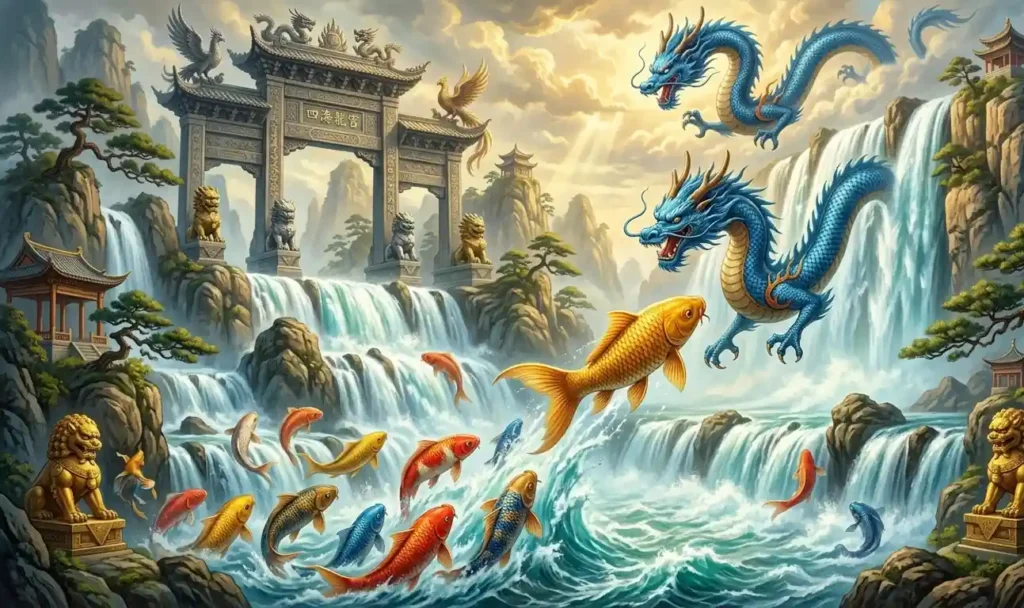
The story: on the Yellow River, there is a great waterfall called the Dragon Gate. Every spring, fish, particularly carp, swim upstream to attempt the leap through the waterfall. Those who succeed are transformed into Loong. Those that fail return downstream unchanged.
The legend is about fundamental transformation through merit and effort. Not gradual improvement. Not incremental advancement. The carp that crosses the Dragon Gate becomes something categorically different from what it was. The transformation is total.
The Longmen Theme is widely adopted in cultivation novels, especially for describing breakthroughs and cultivation stages.
Why This Legend Matters
In my readings I have seen very few stories encode a culture’s core values as efficiently as this one.
The Longmen legend says: the transformation of fundamental nature is possible. It requires effort to swim upstream against the current. It requires a specific moment of achievement, the leap through the gate. But it’s available to the common carp, not reserved for specially gifted beings.
This was the mythology applied directly to the imperial examination system. Candidates who passed the examinations were described as “carp who had crossed the Dragon Gate” commoners who had, through scholarship and effort, transformed themselves into the governing class. The divine and the human social logic mirror each other exactly.
The Loong in Chinese Religious Practice
Dragon King Temples
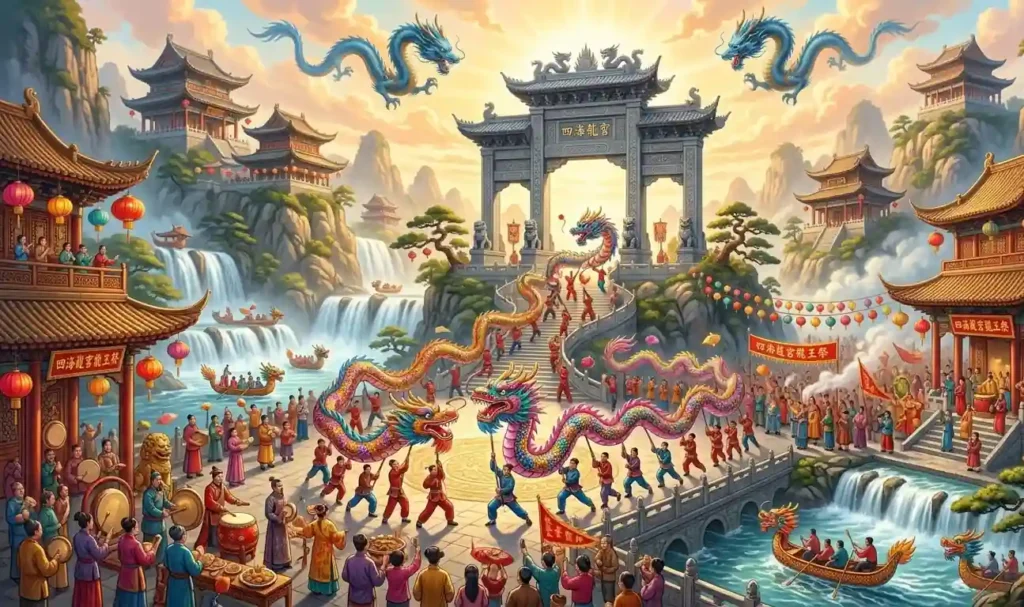
Dragon King temples (Long Wang Miao) were among the most common religious sites in traditional China, found in virtually every community that relied on specific water sources for agriculture or drinking water.
The relationship between communities and their Dragon King was practical and ongoing:
- Drought prayers: Communities performed elaborate rituals requesting rain, including processions of the Dragon King’s image through the streets
- Flood prevention: Rituals requesting that the Dragon King moderate his water governance
- First rain thanksgiving: Celebrations when the spring rains arrived at the right time
- Annual festivals: Regular observances maintaining the relationship between community and divine water governor
This isn’t historical practice. Dragon King temples are active today across China, Taiwan, and Chinese diaspora communities worldwide.
The Dragon Boat Festival
The Dragon Boat Festival (Duanwu Jie), celebrated on the fifth day of the fifth lunar month, has multiple origin stories, but one strand connects it directly to Loong worship and appeasement.
The dragon boat races represent the Loong’s power over water, and the rice dumplings (zongzi) thrown into the river in some traditions were originally offerings to water beings.
The festival’s Loong connection illustrates how deeply the divine water being is embedded in Chinese cultural practice, not as abstract mythology but as living ritual.
The Loong’s Nine Sons
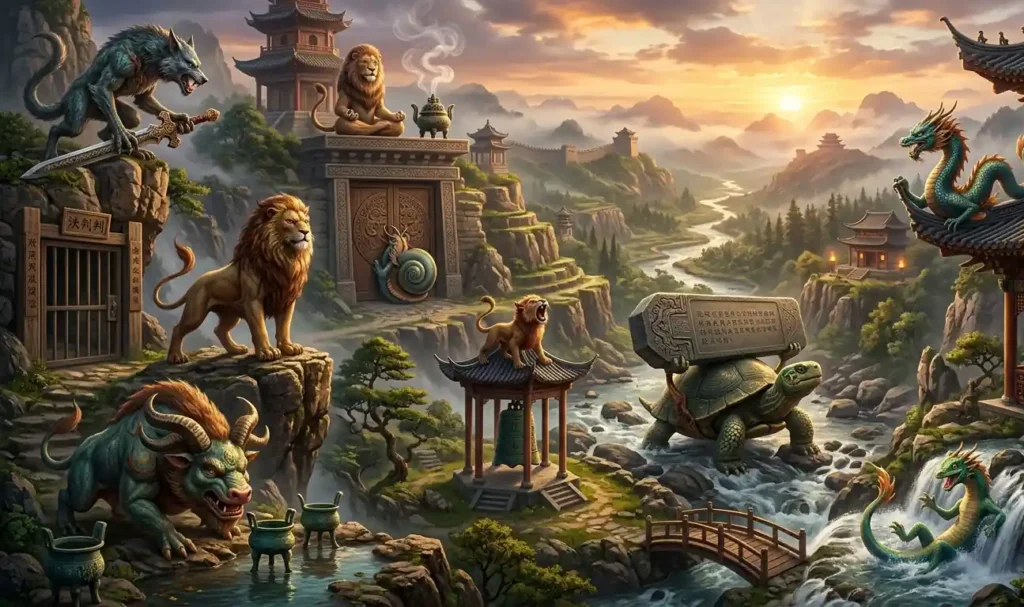
Classical Chinese mythology describes the Loong as having nine sons, each with a distinct personality and function, each serving as the divine patron of a specific craft or activity.
The nine sons and their roles:
- Bixi – carries heavy loads, depicted as a tortoise with a dragon’s head; appears as the base of stone monuments and steles
- Chiwen – protects against fire, appears at the ends of roof ridges on important buildings
- Pulao – known for loud crying, appears on bells as the handle; his sound amplifies the bell’s resonance
- Bi’an – associated with justice; appears on the gates of prisons and court buildings
- Taotie – associated with appetite and feasting; appears on food vessels and ritual bronzes
- Gongfu – loves water; appears on bridges and water infrastructure
- Yazi – fierce and warlike; appears on sword hilts and weapons
- Suanni – loves fire and smoke; appears on incense burners
- Jiaotu – protects homes by keeping gates closed; appears on door knockers
This system reveals something important about the Loong’s cultural function: its authority isn’t limited to water and imperial symbolism. Through its nine sons, the Loong’s divine patronage extends to every major domain of material culture construction, music, justice, warfare, domesticity, and fire protection.
Read: 9 Sons of the Dragon: What Each One Guards in Chinese Myth
Frequently Asked Questions
Why is the Chinese dragon called Loong instead of dragon?
“Loong,” from the Cantonese word for 龍, is used by some Chinese scholars to separate the Chinese creature from the Western dragon. The Loong is divine, linked to water and harmony, while the Western dragon is usually hostile, fire linked, and opposed to order.
Does the Chinese Loong breathe fire?
Fire breathing is a Western dragon trait, not a traditional Loong trait. The Loong is a water being linked to rain, rivers, storms, and weather. Some traditions connect it with thunder and lightning, but fire is outside its elemental domain. Fire breathing is a later Western influence projected onto the Loong.
What does the luminous pearl that Loong carry represent?
The pearl (míng zhu) linked to the Loong represents divine wisdom, cosmic power, and sacred knowledge. It is sometimes seen as the moon, sometimes as the essence of the five elements, or as the Loong’s own concentrated power. In Buddhist influenced traditions, it is also connected to the wish fulfilling jewel, the cintamani.
How many Dragon Kings are there in Chinese mythology?
The four supreme Dragon Kings rule the four seas: East, South, West, and North. Beneath them, many rivers, lakes, and important springs have their own Dragon Kings or water Loongs. The total number is therefore vast. The four sea Dragon Kings are the highest rank, while local water dragon deities govern individual water sources.
What’s the connection between the Loong and Chinese New Year?
The Loong appears prominently in Chinese New Year celebrations through the dragon dance, where dancers guide a long, decorated dragon figure through the streets to bring good fortune. Its flowing movement represents the Loong’s vital power entering the community. Because the Loong symbolizes auspicious beginnings, cosmic order, and divine blessing, it became a central symbol of new year celebrations.
Final Thoughts
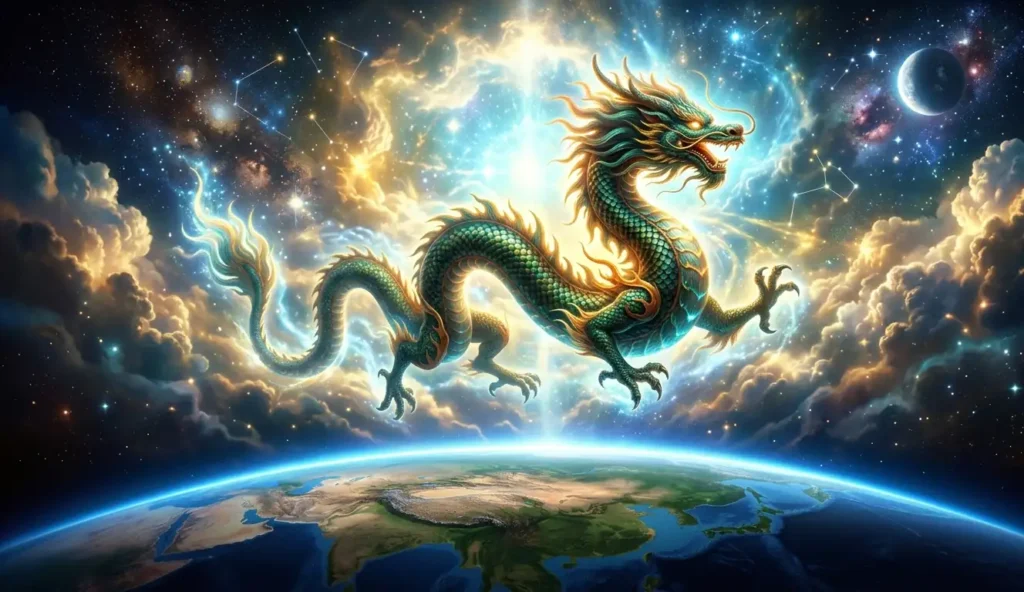
The Loong is one of the world’s most philosophically interesting divine figures. Its composite form is a deliberate cosmological statement about the synthesis of natural powers. Its water governance is a sophisticated response to the agricultural realities of Chinese civilization.
Its imperial symbolism encodes a specific theory of political legitimacy. Its Longmen mythology contains one of mythology’s most compact and powerful statements about the possibility of fundamental transformation.
None of this is accessible if you’re processing the Loong through the Western dragon lens.
When I encounter the Loong in a Chinese temple, a piece of imperial porcelain, or a classical text now, I don’t see “a dragon.” I see a figure that represents the full synthesis of natural forces, that brings rain to farmers, that transforms carp into celestial beings, that legitimises imperial authority through cosmic alignment, and that has been actively worshipped for several thousand years by more people than any Western dragon was ever taken seriously by.
That’s not a dragon. That’s the Loong. And it deserves to be understood as what it actually is.
Related Articles
- Dragon Mythology: How Dragons Are Depicted Across Cultures
- Qinglong: Azure Dragon Symbolism, Myths & Sacred Meaning
- Western Dragon vs Eastern Dragon [Myth, Power & Origin]
- Fenghuang: Chinese Phoenix Origins & Sacred Meaning
- 11 Chinese Dragon Types & the Legends Behind Their Powers
- Dragon & Phoenix: Chinese Myth’s Most Sacred Bond
- What Is the Largest Dragon in Mythology? [Real Answer]
- Zhulong: The Chinese Dragon Who Ruled Time Itself
References
- Birrell, Anne. Chinese Mythology: An Introduction.
- Major, John. Heaven and Earth in Early Han Thought.
- Kohn, Livia. Daoism and Chinese Culture.
- Allan, Sarah. The Shape of the Turtle.Hanshu (Book of Han).
- Shanhaijing (Classic of Mountains and Seas).
- Shiji (Records of the Grand Historian).
- Investiture Of The Gods
- Journey To The West
- The Book of Rites
- The Taoist Body – Kristofer Schipper
- Book of Changes: Yi Jing
- Huainanzi
Written by Batin Khan, a curious free spirit who loves reading and exploring the worlds of fantasy, mythology, and ancient stories. Through this blog, Batin hopes to share that sense of wonder with readers while building an exciting future along the way.