
 By
By Quick Takeaways:
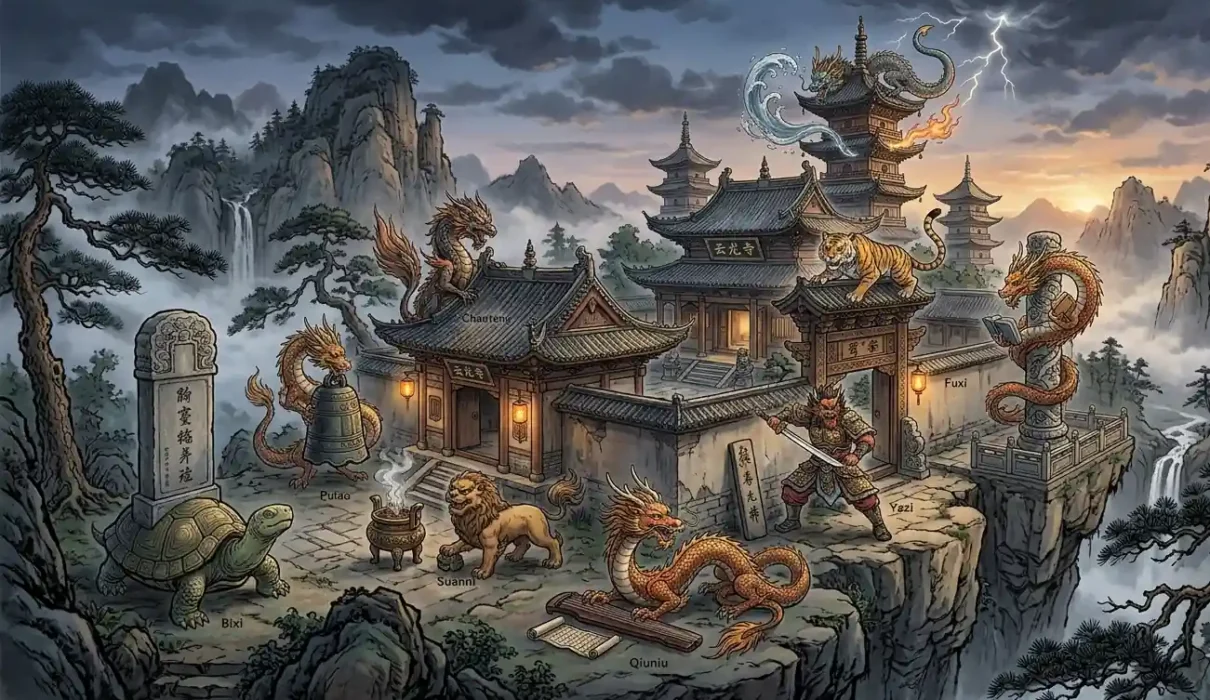
- Classical Chinese tradition describes 9 sons of the Chinese Dragon, each with a distinct personality, appearance, and sacred function
- None of the nine sons looks like a typical dragon. Each is a composite creature combining dragon features with characteristics specific to its function
- You can find all nine in Chinese architecture and art right now: on temple rooftops, bridge pillars, prison gates, incense burners, and the bases of imperial steles
- The cultural placement of each son is never arbitrary. The symbolic logic connecting each son to its specific location is worth understanding
- The primary source for this tradition is the Li Chao Jian Wen Lu by Yang Shen (1488 to 1559 CE) and related Ming Dynasty texts, which standardized the list
One of the first things I noticed when I started studying Chinese Mythology seriously was that dragon imagery appeared in more specific and varied forms than I’d expected. It wasn’t just generic dragon decoration everywhere. Different parts of the same building had different dragon types, each clearly distinct in form. It took me a while to understand that I was looking at a specific classificatory system: the nine sons of the Chinese dragon, each assigned to a precise architectural and ritual function.
The nine sons tradition is one of those aspects of Chinese culture that rewards close attention. Once you know who they are and where to find them, you can’t walk through a traditional Chinese building or look at classical bronze vessels without recognizing them.
Here’s the complete guide.
The Tradition’s Origin
The nine sons tradition was standardized during the Ming Dynasty, primarily through Yang Shen’s Li Chao Jian Wen Lu (Record of Things Seen and Heard in the Present Dynasty). Yang Shen compiled existing folk and literary accounts of dragon sons into the canonical list that subsequent tradition followed.
The tradition holds that the dragon’s nine sons each inherited a partial dragon nature while developing unique individual characters. None of them are typical Loong dragons. They’re hybrid beings whose dragon inheritance expresses itself differently in each case.
The phrase “the dragon’s nine sons are all different” became proverbial in Chinese, used to express the principle that children of the same parents can turn out entirely unlike each other. The nine sons tradition is both a mythological content and a widely recognized cultural saying.
The Nine Sons of the Chinese Dragon
1. Bixi: The One Who Carries Weight
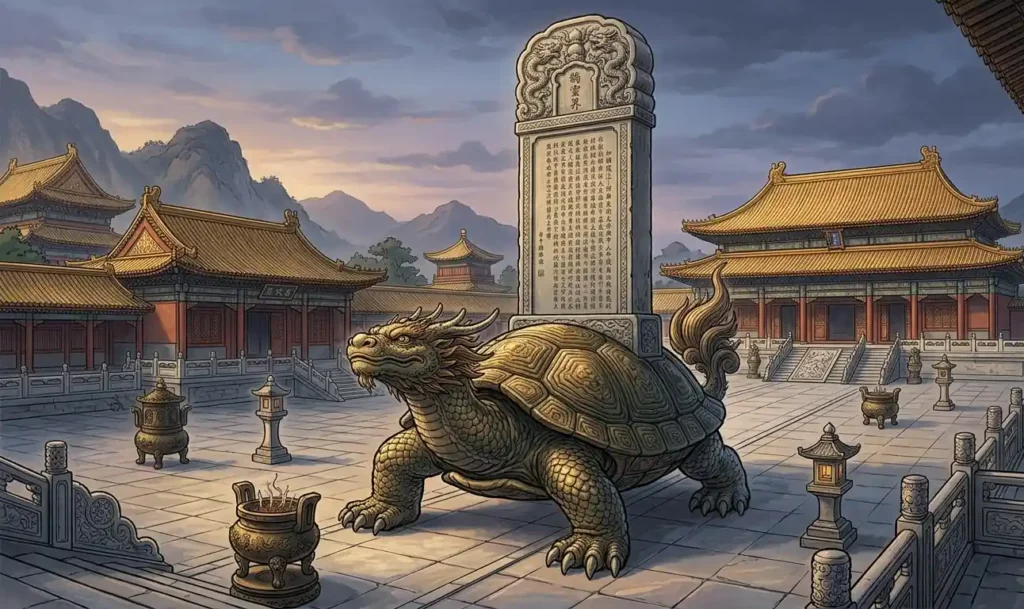
Appearance: A massive tortoise-like creature with a dragon’s head, capable of bearing enormous loads.
Sacred function: Bixi carries the weight of stone steles, the carved monumental tablets inscribed with important edicts, memorials, and records that stood outside imperial buildings, temples, and tombs.
Where to find it: The bases of stone steles throughout China. The most famous examples stand outside imperial tombs and significant temple complexes. If you see an inscription tablet standing on the back of what looks like a large tortoise with a dragon’s head, you’re looking at a Bixi.
The symbolic logic: The tortoise in Chinese tradition represents longevity and the capacity to support heavy burdens across vast time. The dragon’s head adds cosmic authority to that endurance. A stele carrying historical records or imperial proclamations needs to be supported by something that will last as long as the record matters. Bixi combines the tortoise’s durability with the dragon’s legitimacy.
Read: Chinese, Japanese & Korean Dragons: How They Actually Differ
2. Chiwen: The One Who Watches for Fire
Appearance: A fish-tailed dragon creature with a wide gaping mouth, typically depicted looking outward from the ends of roof ridges.
Sacred function: Chiwen devours fire. Its specific role is to protect buildings from burning, and it was placed at the highest points of rooftops precisely to intercept any fire before it could damage the structure below.
Where to find it: The ends of roof ridges on important buildings throughout China. Temples, palaces, and significant official buildings typically have Chiwen figures at each end of the main roof ridge.
The symbolic logic: Water and fire are elemental opposites in the Wu Xing system. Chiwen’s fish tail connects it to water. Placing a water-associated dragon figure at the roof’s highest point creates a permanent elemental protection against fire. The open mouth is directed outward rather than downward, consuming fire from the air before it reaches the structure.
3. Pulao: The One Who Amplifies Sound
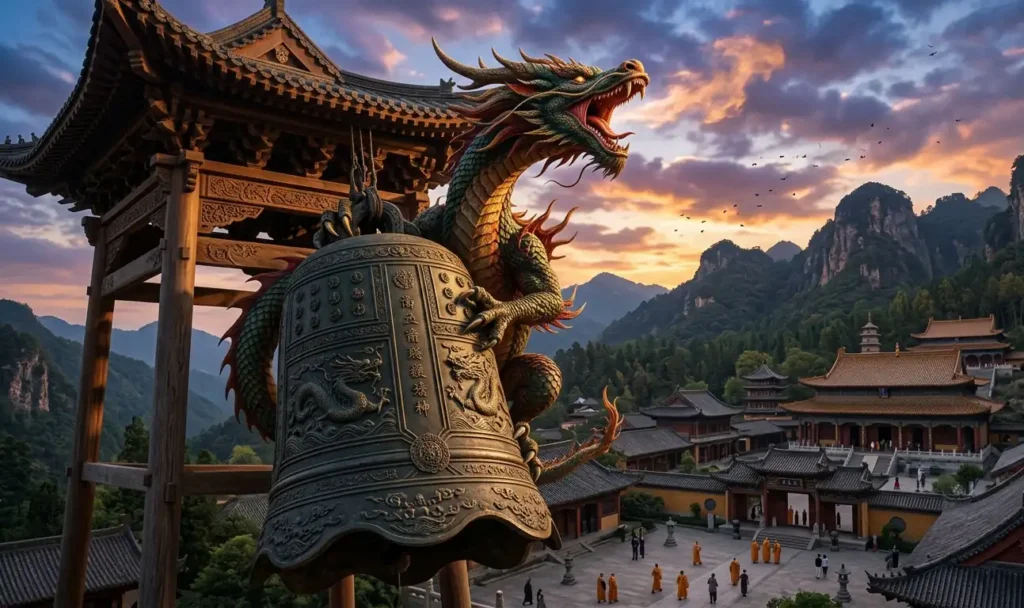
Appearance: A smaller dragon with a body that appears tense or about to cry out, often shown coiled or crouching.
Sacred function: Pulao is placed on the tops of large bells, specifically at the point where the bell’s hanging rope or chain attaches. The tradition holds that Pulao’s natural characteristic is a tendency toward loud vocalization, and that its presence amplifies the bell’s sound.
Where to find it: The crown and hanging mechanism of bronze bells in Buddhist temples and Daoist shrines. Many significant Chinese ceremonial bells have a Pulao figure at the top.
The symbolic logic: Bell sound in Chinese religious contexts was understood as capable of traveling between realms, reaching both divine and earthly listeners. Placing Pulao at the bell’s crown amplified the sound’s reach through the specific characteristic that Pulao naturally possesses. The son whose defining quality is crying out is exactly the right being to help a bell’s call travel further.
Read: 9 Rare Chinese Dragon Creatures Most People Never Encounter
4. Bi’an: The One Who Upholds Justice
Appearance: A tiger-like creature with dragon features, fierce in expression and posture, resembling a large cat more than a conventional dragon.
Sacred function: Bi’an guards the gates of prisons and courts of law, specifically associated with the enforcement of legal decisions and the deterrence of those who might escape or subvert justice.
Where to find it: Gates and entrance pillars of traditional law courts and prisons. The most elaborate examples appeared on the buildings where legal judgment was formally exercised.
The symbolic logic: The tiger in Chinese tradition represents martial authority and the application of overwhelming force when necessary. Bi’an combines tiger power with dragon legitimacy. Justice needs both force to be enforceable and cosmic sanction to be legitimate. A Bi’an at the prison gate said simultaneously that escape would be physically prevented and that the law it enforced had divine backing.
5. Taotie: The Face of Appetite
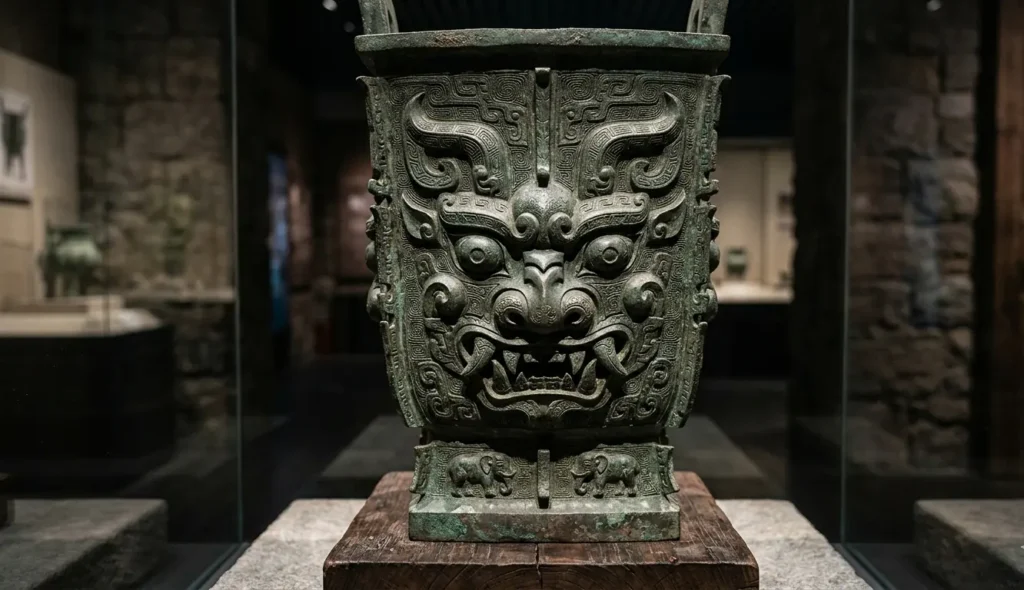
Appearance: A face without a lower body, often depicted as a symmetrical animal face staring outward with large eyes and no jaw below the cheekbones.
Sacred function: Taotie is associated with appetite and consumption, and appears on ritual bronze vessels used for food and drink offerings. Its presence on a vessel warns against overconsumption while simultaneously marking the vessel as appropriate for ritual use.
Where to find it: Bronze ritual vessels from the Shang Dynasty onward. The Taotie face is one of the most recognizable motifs in ancient Chinese art, appearing on ding cauldrons, gui vessels, and other bronzes used in ancestral and royal ritual.
The symbolic logic: The appetite association is specifically cautionary. A Taotie on a food vessel that will be used in ritual contexts reminds participants that ritual consumption differs from ordinary eating. The face with no lower body is sometimes interpreted as representing appetite without satisfaction, an endless desire that consumes without being fulfilled, serving as a visual warning about the consequences of excess.
6. Gongfu: The One Who Masters Water
Appearance: A water-loving creature resembling a dragon with features adapted for aquatic life, sometimes depicted with a distinctly amphibious character.
Sacred function: Gongfu protects bridges, docks, and water infrastructure. It appears on bridge pillars and the stone supports of structures built over or adjacent to water.
Where to find it: Stone bridge pillars and the bases of water gates throughout China. Traditional arched bridges with carved stone pillars often have Gongfu figures at water level.
The symbolic logic: A bridge crosses water but must not be overwhelmed by it. Placing a water-mastering dragon son at the bridge’s most vulnerable point (where the structure meets the water directly) creates a permanent divine presence asserting the structure’s authority over the element it spans. Gongfu doesn’t just protect against water damage. It represents the principle that human engineering can work with water’s power rather than being destroyed by it.
7. Yazi: The One Who Fights
Appearance: A wolf-headed or jackal-headed creature with a dragon’s body, fierce and aggressive in posture, often shown with weapons or attacking.
Sacred function: Yazi is placed on sword hilts, spear shafts, and other weapons, specifically chosen for its characteristic tendency toward violence and its particular enjoyment of combat.
Where to find it: Hilts of ceremonial and military swords, weapon racks in military and official contexts, and the decorative elements of weapons used in formal ceremonies.
The symbolic logic: A weapon that carries Yazi’s image is a weapon that embodies not just the soldier’s intent but a specifically martial divine presence. Yazi’s natural character is combative. It doesn’t merely tolerate being placed on a weapon; the tradition holds that it’s genuinely suited to the function in a way that makes the weapon more itself. The phrase “harboring a grudge and seeking revenge” entered Chinese as a proverb for the kind of fierce, unforgiving nature that Yazi exemplifies.
8. Suanni: The One Who Loves Smoke
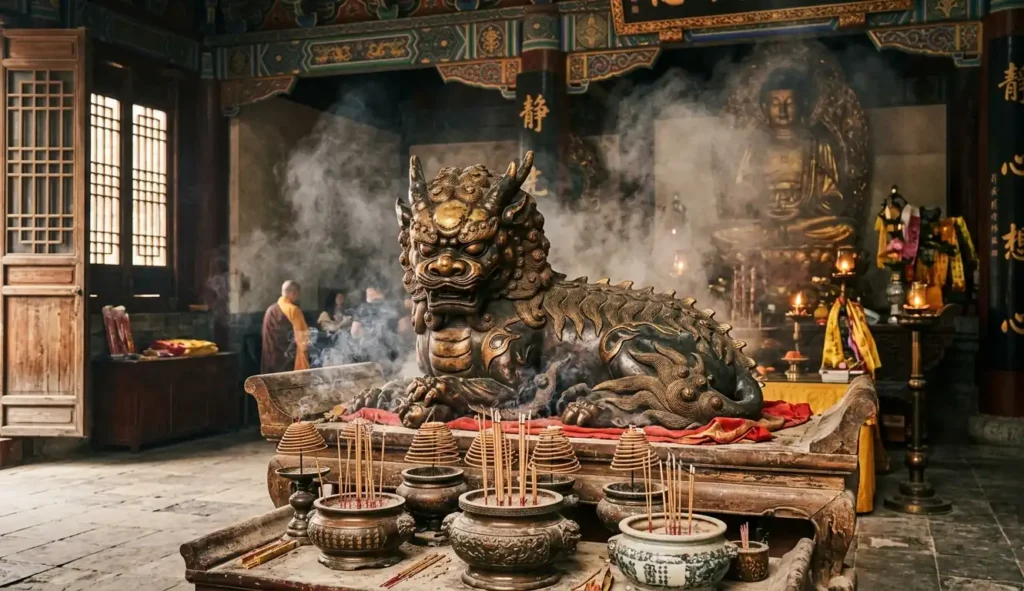
Appearance: A lion-like creature with dragon characteristics, depicted with a mane and a leonine face while retaining reptilian elements.
Sacred function: Suanni appears on incense burners, specifically at the point where smoke exits. Its defining characteristic is a love of smoke, making it the natural resident of any vessel designed to produce and channel incense.
Where to find it: Incense burners in Buddhist and Daoist temples, throne decorations, and ceremonial censers throughout Chinese religious spaces. Some of the most elaborate temple incense burners have Suanni figures integrated into the smoke vents.
The symbolic logic: Incense smoke in Chinese religious practice carries prayers upward and creates a connection between the earthly and divine realms. A being that naturally inhabits smoke and loves its quality is the appropriate guardian for the instrument that produces it. The Suanni sits where the smoke exits, ensuring that the connection being created travels properly to its intended recipients.
9. Jiaotu: The One Who Guards the Threshold
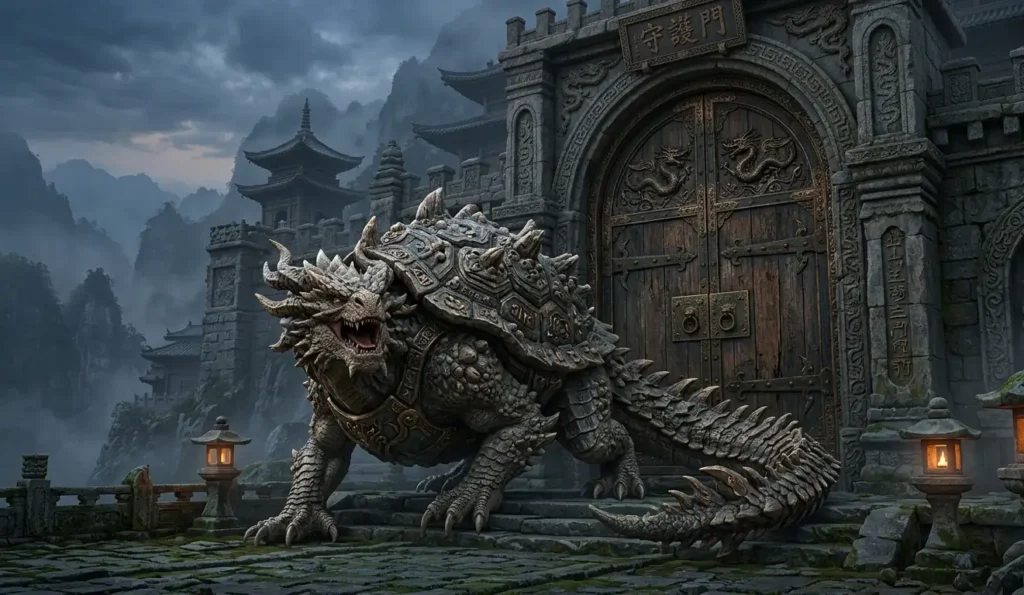
Appearance: A snail-like or shellfish creature with a tightly closed shell, self-protective and inward, depicted as resistant to opening.
Sacred function: Jiaotu appears on door knockers and the rings attached to gates and doors, specifically because its defining characteristic is a strong tendency to close itself off and prevent entry.
Where to find it: Door knockers and the large ring pulls on traditional Chinese gates, particularly on gates of temples, official buildings, and residences of importance.
The symbolic logic: This one I find particularly elegant. A threshold needs a guardian whose fundamental nature is to resist opening. Jiaotu’s tightly closed shell is not simply a design choice for a door knocker; it’s the specific characteristic that makes this dragon son appropriate for the function. The being whose whole nature is to remain closed and prevent access is exactly who you want guarding your door. Every time someone grasps the knocker ring, they’re handling a creature that fundamentally doesn’t want to let them in.
Frequently Asked Questions
Why exactly nine sons?
Nine is the supreme yang number in Chinese cosmological tradition (three times three, the most complete expression of odd-numbered cosmic energy). A dragon with nine sons encodes maximum generative completeness. The nine sons also span the full range of functional domains that traditional Chinese civilization needed to address: load-bearing, fire protection, sound, justice, appetite, water, combat, religious practice, and threshold protection.
Are there other traditions with different lists?
Yes. Different classical sources give slightly different lists of dragon sons, and the names and characteristics vary between sources. The Yang Shen list became canonical but wasn’t the only version in circulation. Some sources include different sons or attribute slightly different characteristics to the same named son.
Can I see these outside China?
Wherever traditional Chinese architecture exists, you’ll find the nine sons. Chinese temples in Southeast Asia, Taiwan, Hong Kong, and diaspora communities globally typically follow these conventions. If you visit a traditional Chinese Buddhist temple anywhere in the world, looking for Chiwen on the roof ridges, Bixi beneath any stele, and Suanni on the incense burners will show you most of the nine sons in a single visit.
Why are the 9 Dragon Sons found on ancient buildings?
The Dragon Sons were believed to bring protection, good fortune, and harmony. Craftsmen placed their images on temples, palaces, bridges, and gates to symbolize strength and safeguard important structures.
Which of the 9 Dragon Sons is the most famous?
Bixi is one of the most well known Dragon Sons. He is often depicted carrying heavy stone tablets and represents endurance, strength, and stability. Many ancient monuments across China feature Bixi statues as a symbol of lasting power.
Final Thoughts: Why The Placement System Matters
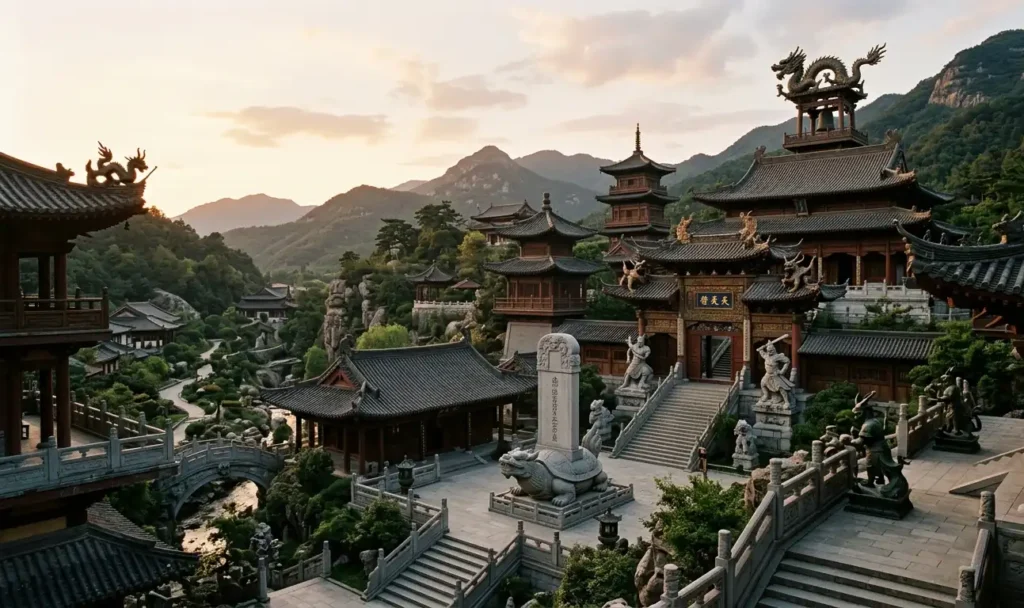
The most striking thing about the nine sons tradition, looked at as a whole, is how precisely each son’s natural character matches the function it serves.
Bixi endures. Chiwen consumes fire. Pulao cries out. Bi’an enforces. Taotie cautions against appetite. Gongfu masters water. Yazi fights. Suanni loves smoke. Jiaotu resists opening.
None of them are doing something external to their nature. Each one is expressing its most fundamental characteristic in the place it inhabits. Traditional Chinese religious and architectural thinking didn’t imagine divine protection as an external force applied to a location. It understood protection as the natural expression of a specific being’s fundamental nature placed in the context where that nature was most needed.
That’s a genuinely different philosophy of sacred space than simply placing protective symbols on buildings. The nine sons tradition is architecture as a system of matched natures: right being, right place, right function.
References
- A Ming Confucian’s World: Selections from Miscellaneous Records from the Bean Garden – Lu Rong
- Huai lu tang ji – Chinese Rare Books – CURIOSity Digital Exhibits
- Sheng’an wai ji – UC Berkeley
- Nine Offspring of Chinese Dragon: The Origin and Cultural Impact › SPBU Researchers Portal
- Shanhaijing (Classic of Mountains and Seas).
Related Articles
- Dragon Mythology: How Dragons Are Depicted Across Cultures
- 11 Chinese Dragon Types & the Legends Behind Their Powers
- Loong: Chinese Dragon Myths, Symbolism & Sacred Power
- 9 Chinese Dragon Colors & What Each One Means in Mythology
- The Forgotten Female Dragons of Chinese Mythology
- 9 Chinese Dragon Myths Born From Real Natural Disasters
- Dragon & Phoenix: Chinese Myth’s Most Sacred Bond