
 By
By Quick Takeaways:
- Several of the most confidently stated “facts” about Eastern dragon facts are directly contradicted by classical mythological sources
- The misconceptions often come from oversimplifying what are actually diverse, complex, and culturally specific traditions
- The biggest myth of all may be treating Eastern dragon traditions as a single unified thing rather than distinct Chinese, Japanese, Korean, and Vietnamese traditions
- Every correction in this post comes from documented classical sources, not from speculation
- Getting these right actually makes the traditions more interesting, not less
The things that “everyone knows.” In my experience, the claims stated most confidently with the least qualification are often the ones that deserve the most scrutiny.
Eastern dragons are a clear example. Several things that get repeated constantly about them are either significantly wrong or only half true when you actually check the classical sources. Here are seven of them.
Myth 1: Eastern Dragons are Always Benevolent
What People Believe
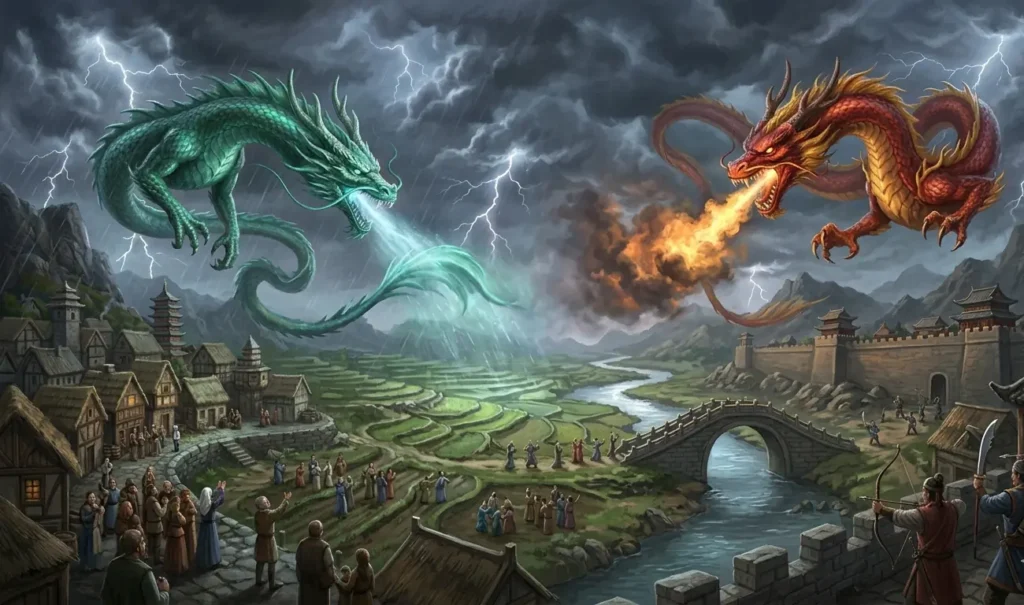
The contrast between Western and Eastern dragons almost always includes the claim that Eastern dragons are uniformly good. Western dragons are evil fire-breathers. Eastern dragons are kind, wise, rain-bringing beings that humans should revere rather than fear.
Why This is Wrong
The benevolent rain-bringer description is accurate for many Chinese dragon types. It’s not accurate for Eastern dragon traditions as a whole.
Yamata no Orochi, the eight-headed serpent of Japan’s oldest mythological texts, the Kojiki and Nihon Shoki, demanded annual human sacrifice, killing seven daughters of a local couple before the storm god Susanoo defeated it. It had no benevolent qualities. It was simply dangerous.
The Wani Sea creatures of Japanese mythology were threatening beings whose encounters with humans were not characterized by benevolence. Korean water dragons, in certain regional traditions, were associated with destructive floods rather than beneficial rain.
Even within Chinese tradition, the Shanhaijing describes dragons that cause storms and disasters when encountered. The Fucanglong that erupts from the earth causes seismic and volcanic activity. The Dilong’s movements produce floods.
The benevolent rain-bringer is the dominant type in Chinese religious practice, not the only type in Eastern dragon mythology broadly. The blanket “Eastern dragons are good” claim flattens significant diversity within these traditions.
Myth 2: All Eastern Dragons Control Water
What People Believe
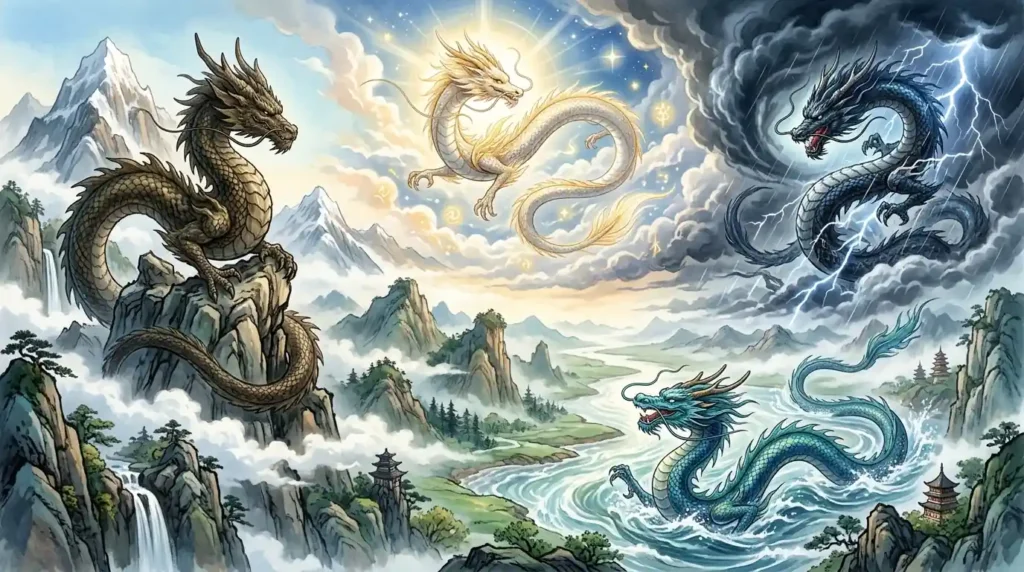
Water governance is the Eastern dragon’s defining characteristic. Eastern dragons control rain, rivers, and seas. That’s what they do.
Why This is Wrong
Several documented Eastern dragon types have no water governance function whatsoever.
The Zhulong, described in the Shanhaijing, creates day and night by opening and closing its eyes, and produces summer and winter through its breath. It’s associated with the world’s edge and cosmic time. Water plays no role in its function.
The Tianlong guards the celestial palaces and supports the heavenly realm’s architecture. Its domain is the sky, not water bodies.
The Yinglong is primarily a military figure in the oldest accounts, serving the Yellow Emperor in warfare against Chi You. Rain-summoning is one of its capabilities, but is not its defining characteristic in the earliest texts.
The Houtu dragon-related traditions in Chinese religion connect dragons to earth and soil rather than water specifically.
Water control is a common and important dragon function in Chinese mythology. Calling it the universal Eastern dragon function means ignoring multiple documented dragon types that govern completely different domains.
Myth 3: Eastern Dragons Never Breathe Fire
What People Believe
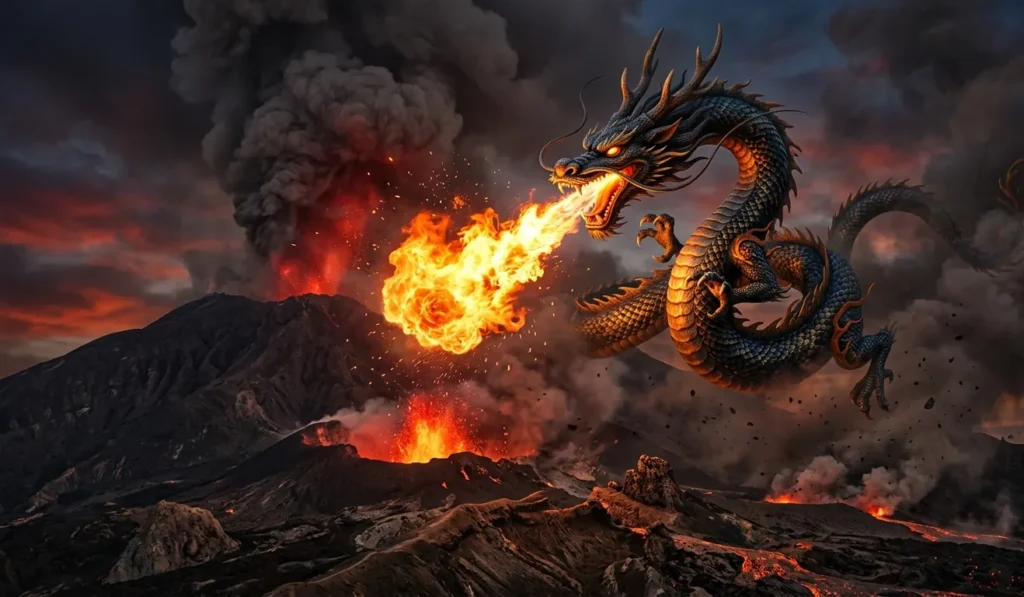
The cleanest version of the East versus West dragon comparison: Western dragons breathe fire, Eastern dragons don’t. Simple, memorable, and repeated everywhere.
Why this is more complicated
Classical Chinese texts do not describe the standard Chinese Long as breathing fire. That part is accurate.
The complete “Eastern dragons never breathe fire” claim is more problematic. The Zhulong is described as illuminating the world with its own light, which some texts characterize in terms consistent with fire emission. The description of its breath creating seasons involves qualities of heat and cold that several classical commentators have described in thermal terms.
More directly, fire-breathing is documented in Japanese dragon traditions. Specific regional variants of Japanese dragon mythology describe creatures with fire-related capabilities that exist alongside the more familiar water-associated types.
The Nagas of Buddhist-influenced traditions across Southeast Asia, which were incorporated into regional dragon mythologies, include fire-associated beings in several specific documented traditions.
The clean “Eastern dragons don’t breathe fire” distinction works reasonably well for classical Chinese Long mythology. Applied to Eastern dragon traditions as a whole, it’s an oversimplification that ignores documented diversity.
Myth 4: Eastern Dragons Don’t Have Wings
What People Believe
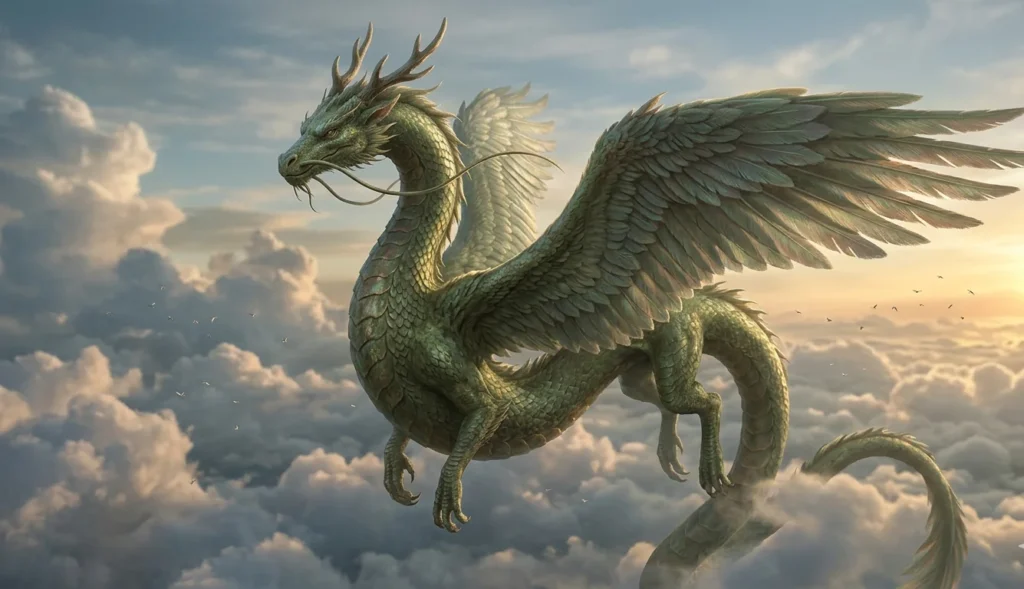
The visual contrast between Eastern and Western dragons consistently includes that Western dragons have wings, while Eastern dragons don’t. No wings is presented as a defining Eastern dragon characteristic.
Why This is Wrong
The Yinglong (Winged Dragon) has wings. This is not a modern reinterpretation or a fantasy elaboration. It is documented in the Shanhaijing and other classical texts as a specific dragon type distinguished precisely by its wings.
The Yinglong is described as having earned its wings through extreme age, specifically more than 2,000 years of existence according to the developmental timeline in Li Shizhen’s Bencao Gangmu. Classical Chinese art from multiple periods depicts the Yinglong with clearly visible wings.
The Yinglong is specifically the dragon that served the Yellow Emperor in his campaigns against Chi You and then settled in the south of China. Its winged status is part of its mythological identity, not an artistic option.
“Eastern dragons don’t have wings” is a statement that’s false according to Chinese mythology’s own classical texts. The wingless Long is the more common type. The winged Yinglong is a distinct type with a documented classical tradition.
Read: Why Eastern Dragons Don’t Have Wings Yet Can Fly [Real Myth]
Myth 5: The Chinese Dragon Was Always an Imperial Symbol
What People Believe
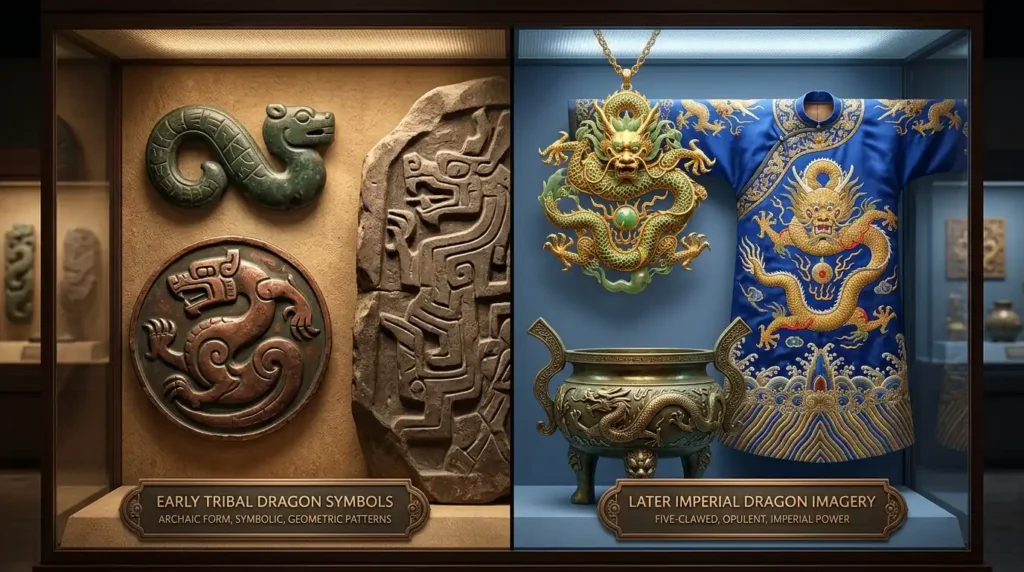
The five-clawed imperial dragon and the Chinese emperor’s connection to dragon symbolism are so thoroughly documented that many accounts present the dragon-emperor connection as fundamental and ancient, as if the dragon always meant imperial authority.
Why This is Wrong
The Chinese dragon’s imperial associations developed gradually. They were not always central to the tradition, and the specific regulations around imperial dragon imagery are historically recent relative to the tradition’s age.
The earliest Chinese dragon imagery, including Hongshan culture jade dragons dating to approximately 4700 BCE, predates any Chinese imperial state by thousands of years. These early dragons weren’t imperial symbols. They were ceremonial or cosmological objects whose relationship to specific political authority is unclear.
Dragon symbolism in the Shang Dynasty (1600 to 1046 BCE) was primarily divinatory and ritual rather than specifically imperial. Dragon imagery on Shang bronze vessels connected dragons to cosmological and ancestral functions rather than to a specific ruler’s authority.
The systematic regulation of dragon imagery as an imperial exclusive, including the specific prohibitions on unauthorized five-clawed dragon display, belongs to the Ming and Qing Dynasties. Before that, dragon imagery was more broadly available symbolically.
The dragon-emperor connection is ancient and genuine. The specific imperial monopoly on dragon symbolism is a relatively late development in a tradition spanning several thousand years.
Read: 11 Oldest Dragons in World Mythology: Sumeria to China
Myth 6: Eastern Dragons Are Immortal
What People Believe
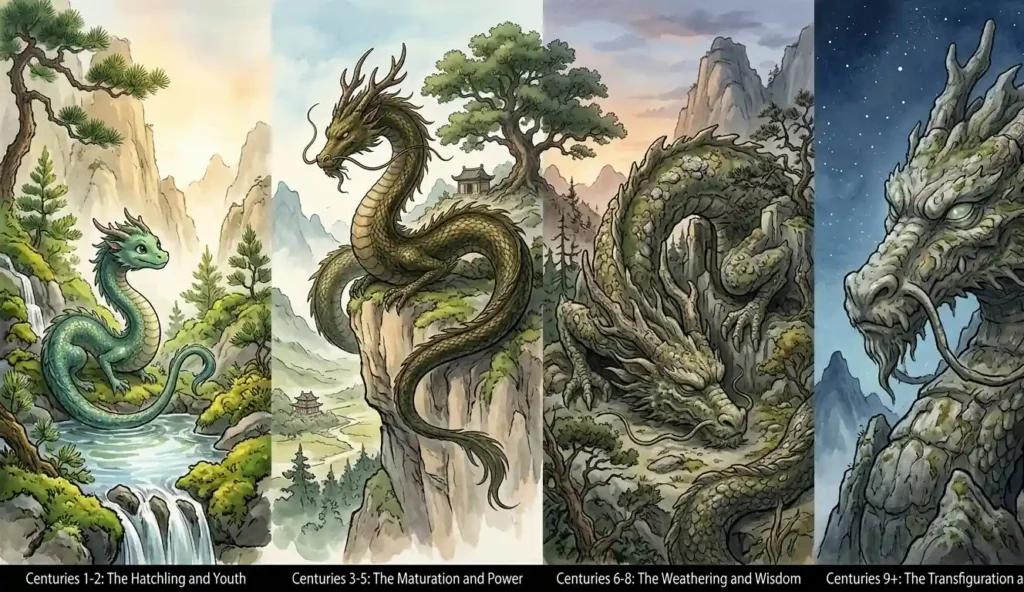
Divine beings, generally, and Eastern dragons specifically, are often assumed to be immortal by nature. They’re associated with immortality, they help produce immortality elixirs, and they seem to exist across vast timescales.
Why This is Wrong
Classical Chinese texts describe dragons dying, being killed, and aging in specific ways.
Yamata no Orochi was killed by Susanoo. This is explicitly stated in the Kojiki: Susanoo made the dragon drunk on sake and then killed it with his sword. The discovery of Kusanagi within one of the dragon’s tails confirms that the dragon died and was physically examined afterward.
The Shanhaijing describes dragons that can be harmed and killed. The Yinglong’s settlement in the south after the Yellow Emperor’s wars has been interpreted by some classical commentators as a kind of diminishment or constraint following its extreme exertions in battle.
Li Shizhen’s Bencao Gangmu discusses dragon body parts including bones and blood in a context that presupposes physical bodies that can die and decay. The existence of dragon-derived medicinal materials in traditional pharmacology implies that dragons do not simply vanish but leave physical remains.
The Chinese immortality tradition is connected to dragons, but does not make the dragons themselves immortal. A Dragon King can be killed. A dragon can die. The association with longevity and immortality substances doesn’t transfer to the dragon’s own permanent survival.
Myth 7: Eastern Dragons Are the Same Across Asian Cultures
What people believe
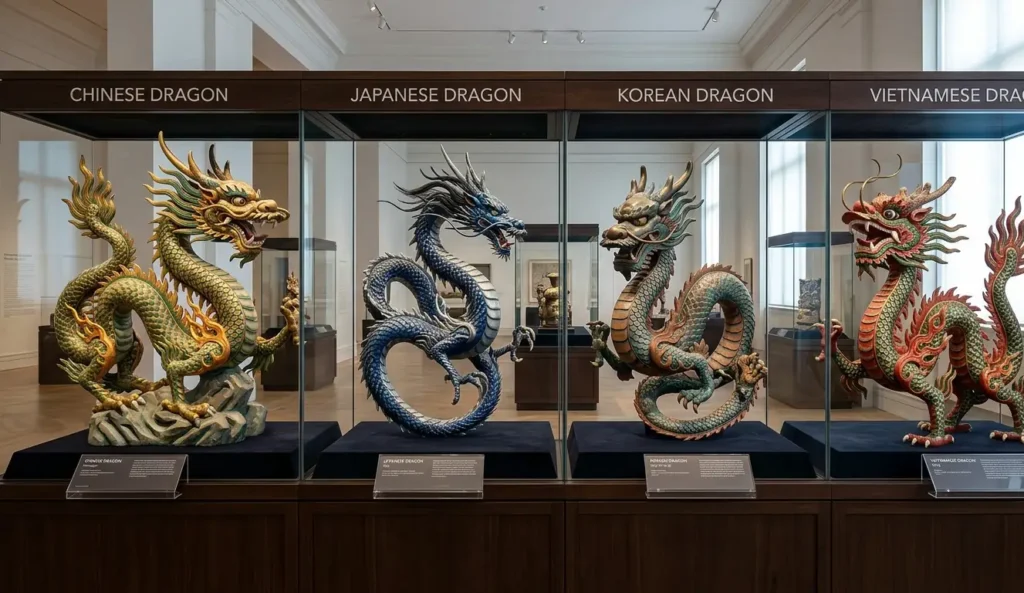
“The Eastern dragon” is often discussed as if it were a single coherent tradition shared across China, Japan, Korea, and Vietnam with minor regional variations.
Why this is wrong
The Chinese, Japanese, Korean, and Vietnamese dragon traditions are distinct in ways that matter for understanding each one properly.
Chinese Long mythology is cosmologically elaborate, administratively structured, and connected to the five-element system and the heavenly court hierarchy. The Dragon Kings are bureaucratic officials within a comprehensive divine administrative framework. This level of cosmic institutional structure is specifically Chinese.
Japanese dragon mythology shows much stronger influence from Indian Naga traditions transmitted through Buddhism, producing a tradition where water serpents and multi-headed beings play larger roles than in Chinese tradition. Yamata no Orochi has no Chinese equivalent. The Japanese Ryujin differs from Chinese Dragon Kings in specific ways that reflect distinct cultural development.
Korean dragon mythology developed its own concept of the Imugi as a specific intermediate category of being. This concept doesn’t exist in Chinese tradition. The Korean Yong’s four-toed form is a deliberate cultural marker distinguishing it from the five-toed Chinese imperial dragon.
Vietnamese dragon art changed traceable characteristics across dynasties in ways that reflect the specific political and cultural conditions of each period. The Ly Dynasty dragon (11th to 13th centuries) is visually distinct from the Le Dynasty dragon (15th century onward) in specific, documented ways that art historians can trace.
These aren’t minor variations. They’re distinct traditions with distinct characteristics shaped by distinct cultural, religious, and political histories. Treating them as one thing makes it impossible to understand any of them accurately.
Read: Chinese, Japanese & Korean Dragons: How They Actually Differ
Frequently Asked Questions
Where do these myths come from if the classical sources say otherwise?
Most originate from legitimate observations about the dominant types in each tradition presented as universal rules. The Chinese Long is indeed usually benevolent, usually associated with water, and usually wingless. When “usually” gets dropped and “always” gets inserted, the myth is born. The transition from dominant characteristic to universal rule happens easily in popular accounts.
Does getting these myths wrong actually matter?
It does if you want to understand the traditions themselves. Each myth flattens something that’s actually diverse and interesting. Thinking Eastern dragons are always benevolent means missing the genuine danger in Japanese dragon mythology. Thinking they all control water means missing the Zhulong’s genuinely strange cosmological function. The myths make the traditions seem simpler and more uniform than they actually are.
Which of these myths is most confidently stated in popular accounts?
The wingless dragon claim and the uniform benevolence claim are both stated with enormous confidence in popular comparative mythology accounts. Both are directly contradicted by classical sources. The wingless claim is the easiest to disprove since you only need to look up the Yinglong in any reliable classical Chinese mythology reference.
Are Eastern dragons based on real animals?
While dragons are mythical creatures, some scholars believe their legends may have been inspired by snakes, crocodiles, fossils, and powerful natural events such as floods and storms.
Why are Eastern dragons still important today?
Eastern dragons remain popular symbols of strength, wisdom, prosperity, and protection. They continue to appear in festivals, artwork, architecture, entertainment, and cultural celebrations across Asia.
Final Thought
Eastern dragon mythology is significantly richer, more diverse, and more internally complex than the popular summary suggests. Getting the myths right doesn’t make the traditions less impressive. It makes them considerably more interesting, because you stop seeing a single coherent “Eastern dragon” and start seeing a family of distinct traditions, each with its own specific character, its own range of types, and its own documented history.
The classical texts are specific. The popular accounts often aren’t. That gap is where the most interesting content lives.
Related Articles
- Dragon Mythology: How Dragons Are Depicted Across Cultures
- Western Dragon vs Eastern Dragon [Myth, Power & Origin]
- 11 Chinese Dragon Types & the Legends Behind Their Powers
- Loong: Chinese Dragon Myths, Symbolism & Sacred Power
- 9 Eastern Dragon Myths That Sound Too Strange to Be True
- 11 Eastern Dragon Legends Still Shaping Fantasy Today
References
- Yang, Lihui, Deming An & Jessica Anderson Turner. Handbook of Chinese Mythology. Oxford University Press, 2005.
- Birrell, Anne. Chinese Mythology: An Introduction. Johns Hopkins University Press, 1993.
- Journey to the West by Wu Cheng’en: Wu Cheng’en
- Kojiki: Translated with an Introduction and Notes by Donald L. Phillipi – Kojiki
- Nihongi: Chronicles of Japan from the Earliest of Times to A.D. 697
- Korea: A Religious History – James Huntley Grayson
- Shan Hai Jing – Chinese Text Project
- CHINESE DRAGON: THE FORMATION OF THE SYMBOL OF IMPERIAL AUTHORITY