
 By
By Quick Takeaways:
- The surface similarity between the Jade Emperor and Zeus (the supreme rulers of divine pantheons) conceals profound philosophical differences in how each tradition understood divine authority
- Jade Emperor vs Zeus – Zeus achieved his position through war. The Jade Emperor achieved his through 1,750 aeons of moral cultivation
- Zeus governs through personal will and power; the Jade Emperor governs through administrative structure and cosmic law
- Zeus’s personal life is full of affairs, rivalries, and emotional drama; the Jade Emperor’s mythology is almost entirely institutional
- The comparison illuminates what each civilization valued most deeply: Greek mythology emphasizes personal power and heroic contest, Chinese mythology emphasizes virtue, accountability, and structural order
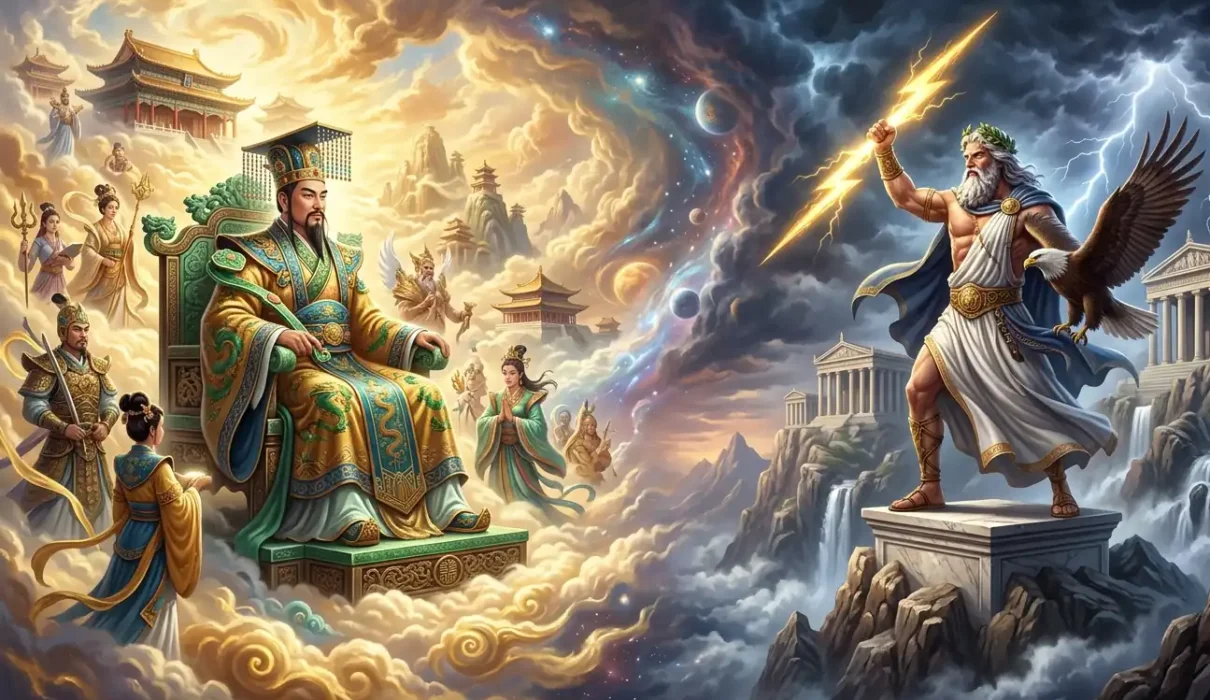
Both are supreme male rulers of their respective divine pantheons. Both govern from celestial thrones. Both have vast power over natural forces. On a quick glance, they look like the same archetype from different cultures.
They’re not. The deeper you go into the comparison, the clearer it becomes that these two figures express almost opposite ideas about what divine supremacy means and how legitimate authority actually works. That divergence reveals something fundamental about the civilizations that created them.
How They Got There: Origin Stories
Zeus: Supremacy Through Warfare
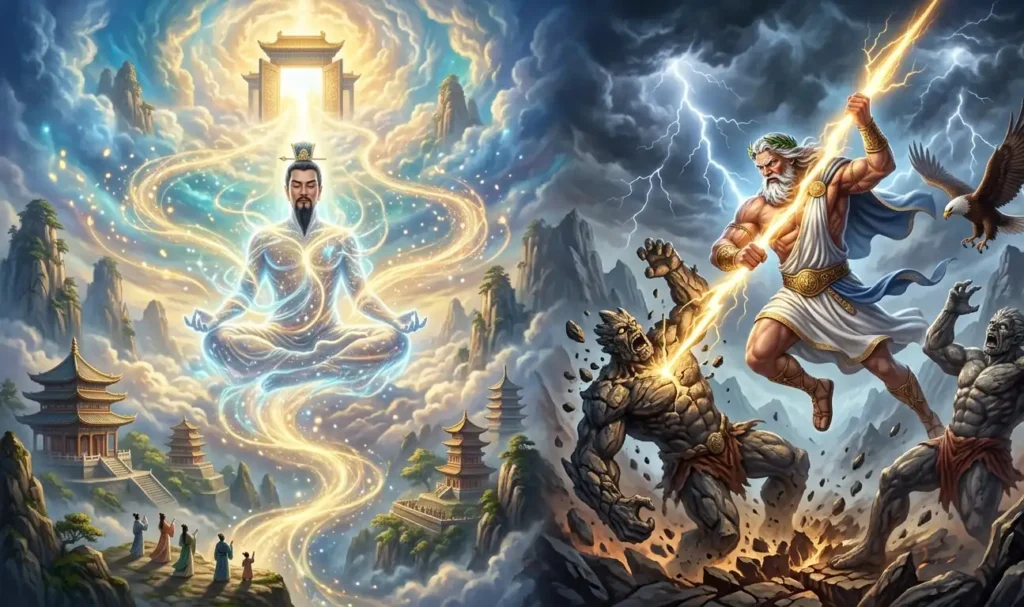
Zeus didn’t start at the top. He was born the youngest son of Cronus, who had overthrown his own father Uranus. Cronus, aware that a prophecy predicted his own children would depose him, swallowed each child at birth.
Zeus escaped this fate because his mother, Rhea, substituted a stone wrapped in cloth. He grew up in hiding, returned, forced Cronus to vomit up his siblings, and then led those siblings in the Titanomachy: a ten-year war between the Olympians and the Titans.
The Olympians won. Zeus received the sky and supreme authority as his portion of the victory division among his brothers. He also had to subsequently defeat the Giants and the monster Typhon in further challenges to his power.
Zeus’s supremacy is inseparable from his victory in divine warfare. He rules because he won. His power is the proof of his right, and his right is the proof of his power. The two are circular in a way that’s characteristic of how Greek mythology understands divine authority.
The Jade Emperor: Supremacy Through Cultivation
The Jade Emperor’s origin story is almost precisely the opposite. According to the Gaoshang Yuhuang Benyuan Jing (The Jade Emperor’s Origin Scripture, composed during the Song Dynasty), he was born as a prince of a divine kingdom who abdicated his throne to pursue the Dao.
He cultivated for 1,750 aeons of practice, moral development, and service to suffering beings. His elevation to supreme authority was the result of this cultivation reaching completion, not of any military victory. He didn’t defeat anyone to take his position. He became worthy of it through sustained moral and spiritual development.
The contrast is as stark as it gets in comparative mythology. One supreme god rules because he won the most important fight in divine history. The other rules because he did the moral and spiritual work across an incomprehensible timespan.
How They Rule: Governance Style
Zeus: Personal Authority
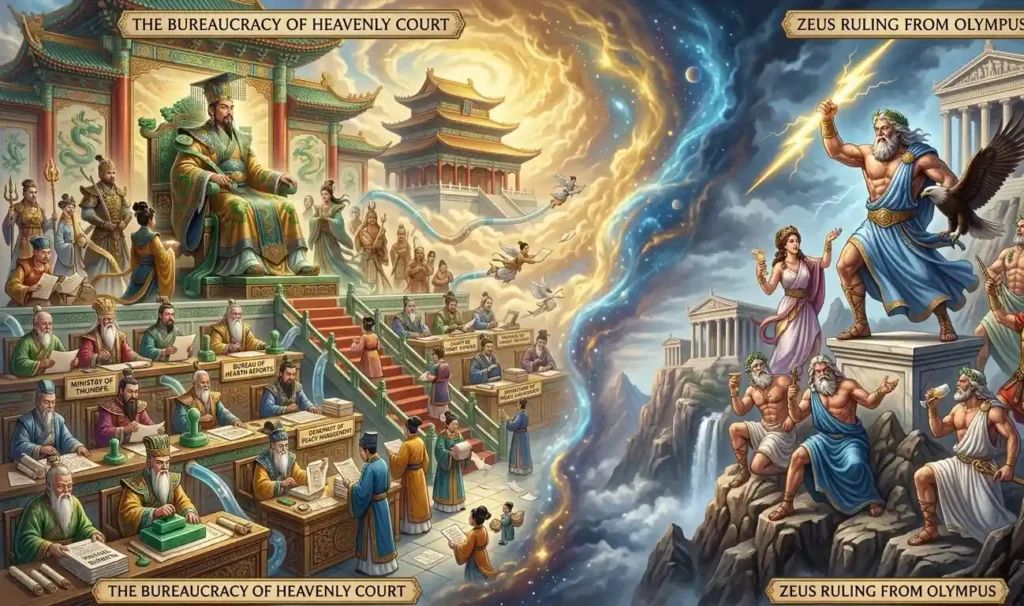
Zeus governs Olympus through his personal will, his relationships, and the implicit threat of his power. He holds court, he makes decisions, he issues commands. Other gods comply because he’s stronger than they are and because the structure of divine society requires a ruler.
His authority is frequently challenged, frequently circumvented, and frequently negotiated. Hera opposes him. Poseidon disputes his decisions. Apollo, Ares, and Athena all pursue their own agendas in ways that sometimes contradict Zeus’s intentions. The Iliad shows us a Zeus whose authority is real but constantly in dynamic tension with the independence of the other Olympians.
Zeus doesn’t have a divine bureaucracy. He doesn’t have ministries of thunder, rain, or lightning separate from himself. The natural forces he governs are governed directly and personally. Lightning belongs to Zeus in the sense that it is his weapon and expression, not in the sense that he manages a lightning department.
The Jade Emperor: Administrative Governance
The Jade Emperor governs through structure. His heavenly court is a comprehensive bureaucracy with specific ministries for every aspect of natural and human affairs. The Ministry of Thunder doesn’t report to the Jade Emperor in the way that a general reports to a king. It’s a functional department with defined responsibilities, operating under his ultimate authority but managing its own domain.
The Jade Emperor issues decrees rather than commands. He holds formal audiences rather than informal councils. His divine court keeps records, conducts annual audits of moral conduct through the Kitchen God system, and processes petitions through established procedures.
Where Zeus would personally decide whether a particular mortal deserved divine help, the Jade Emperor’s system processes that question through a multi-level administrative structure. The divine answer to a mortal’s drought might involve a Kitchen God report, a ministry review, and a specific allocation of rainfall by the relevant Dragon King, all operating within the framework of the Jade Emperor’s cosmic law without his personal involvement in each case.
Character and Personality
Zeus: Emotional, Powerful, Personal
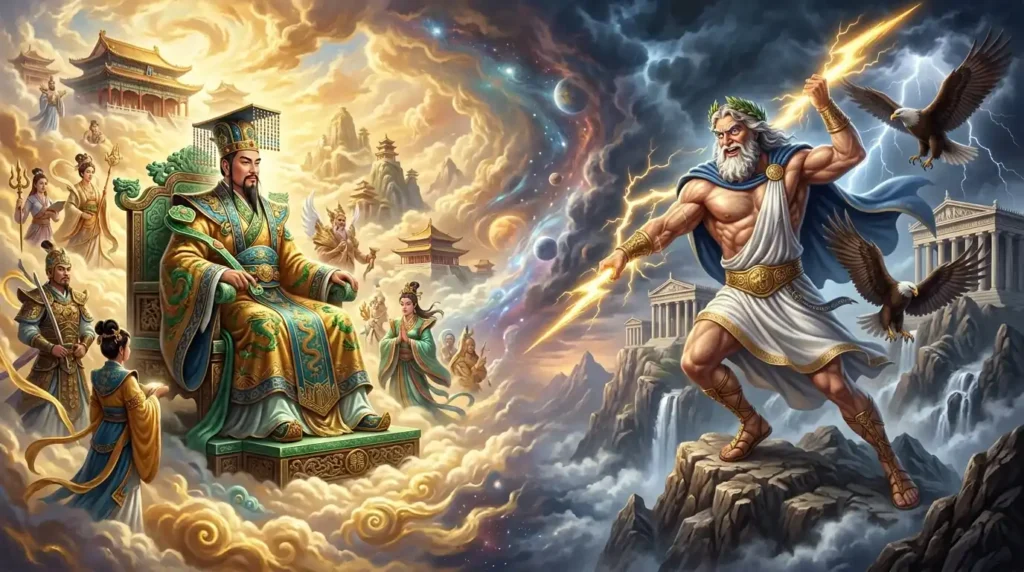
Zeus in Greek mythology is a fully realized personality with specific emotions, specific preferences, specific weaknesses, and specific strengths. He gets angry. He falls in love, repeatedly and with dramatic consequences. He plays favorites among mortals. He feels pride, jealousy, affection, and competitive satisfaction.
The list of Zeus’s affairs is famously long. Hera, Metis, Themis, Mnemosyne, and then a catalog of mortal women. The affairs produce divine children (Apollo, Artemis, Hermes, Dionysus, Persephone) and mortal heroes (Heracles, Perseus, Minos). The affairs also produce constant marital conflict with Hera, which becomes one of Greek mythology’s most persistent dramatic threads.
Zeus’s personality drives Greek mythology in direct and visible ways. His lust, his anger, his favoritism, his pride, and his occasional wisdom all create the situations that mortal heroes must navigate. He’s not a principle. He’s a person with a complicated inner life.
The Jade Emperor: Institutional, Formal, Restrained
The Jade Emperor’s personal emotional life is almost entirely absent from the mythology that surrounds him. He has a consort and children, but these relationships don’t generate the kind of dramatic personal narrative that Zeus’s family relationships produce.
He responds to challenges with institutional resources rather than personal emotion. When Sun Wukong disrupts the heavenly court, the Jade Emperor’s response is to call military assets and eventually request outside assistance, not to personally intervene in a rage. There’s no equivalent of Zeus in the grip of jealousy or desire, doing something dramatic and consequential.
This isn’t a limitation of the tradition. It reflects a deliberate understanding of what supreme divine authority should look like. The Jade Emperor is a model of institutional dignity rather than personal expressiveness. His effectiveness as a ruler is measured by how well the system works, not by the dramatic force of his personal interventions.
Relationship With Mortals
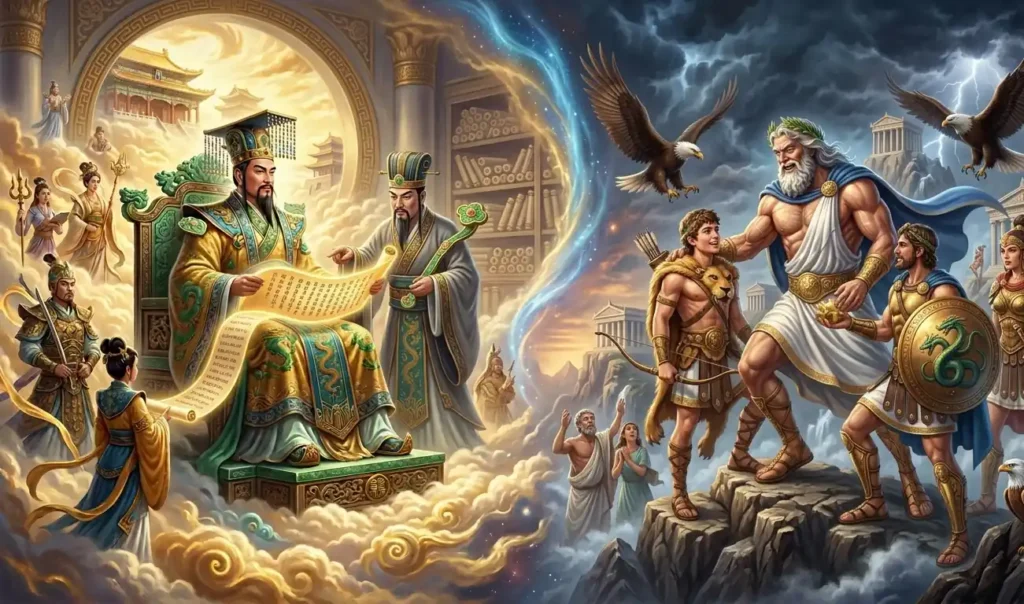
Zeus: Direct, Personal, Unpredictable
Zeus’s interactions with mortals are direct and deeply personal. He disguises himself to pursue mortal women. He personally grants or withholds help from heroes based on specific relationships and specific petitions. He watches the Trojan War from Olympus with the same emotional investment a sports fan might bring to a competition between favored teams.
Mortals in Greek mythology can be protected by Zeus, blessed by Zeus, punished by Zeus, and transformed by Zeus. The outcomes depend heavily on Zeus’s personal feelings about the individuals involved. Having Zeus’s favor is a specific and decisive advantage. Having his anger directed at you is potentially fatal.
The unpredictability is part of the mythology’s texture. Mortals in Greek mythology navigate a divine world where personal relationships with divine beings matter enormously and where those divine beings have real emotional lives that produce real consequences.
The Jade Emperor: Systematic, Procedural, Accountable
The Jade Emperor’s relationship with mortals is mediated by the divine bureaucratic system. A mortal’s prayer doesn’t go directly to the Jade Emperor. It enters a chain of divine officials, earth gods, city gods, and eventually the relevant divine ministry.
The annual Kitchen God audit is the most intimate point of contact between the Jade Emperor’s system and individual mortal households, and even that interaction is mediated through the Kitchen God as intermediary.
This doesn’t mean the Jade Emperor is distant or uncaring. It means his care for mortals is expressed through a comprehensive system designed to produce fair, consistent, accountable governance of all mortal affairs simultaneously, rather than through personal relationships with individuals.
The accountability dimension deserves particular attention. The Jade Emperor’s system can be petitioned against, including when divine officials fail their responsibilities. Communities could formally accuse the Dragon King of dereliction of duty during droughts. No such mechanism exists in Greek mythology for holding divine figures accountable through established procedures.
Handling Challenges to Authority
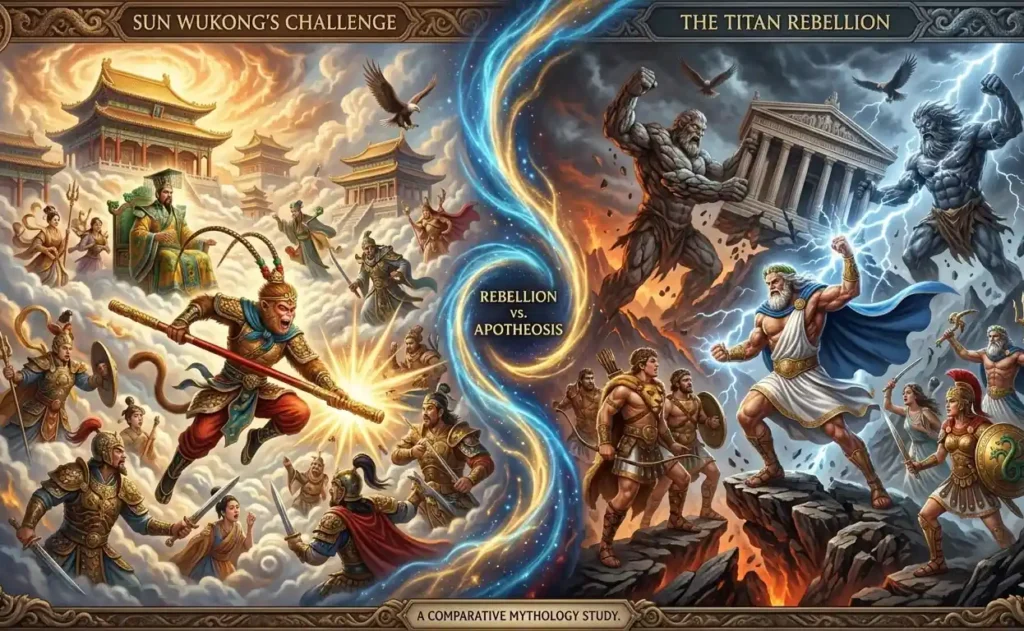
Zeus: Personal Confrontation and Overwhelming Force
When Zeus’s authority is challenged, he responds with personal power. The Titans were defeated in a ten-year war. The Giants required the combined effort of Olympians and the mortal Heracles to suppress. Typhon was defeated by Zeus personally in a combat that shook the earth.
Prometheus stealing fire was punished through Zeus’s personally directed torture. Mortals who defied divine order were punished by Zeus with floods, thunderbolts, or metamorphosis into animals or plants.
The pattern is consistent: challenge to Zeus’s authority produces direct confrontation between Zeus and the challenger. The resolution demonstrates Zeus’s superior power and reinforces his authority through demonstrated strength.
The Jade Emperor: Institutional Response and External Consultation
When Sun Wukong challenges the Jade Emperor’s authority, the response follows institutional procedures: send the divine armies, exhaust the available military options, then recognize that this specific problem requires a form of authority outside the divine court’s toolkit.
Calling in the Buddha isn’t a personal failure. It’s an accurate assessment of what kind of problem is being faced. Sun Wukong’s rebellion is ultimately a philosophical challenge (capability should determine authority) that military force can’t answer, because his military capability exceeds what the divine court can deploy.
The Buddha’s response, the palm demonstration, addresses the philosophical premise rather than the military challenge. This resolution would be inconceivable within Greek mythology’s framework, where divine conflicts are resolved through power rather than philosophical demonstration.
Position in the Cosmological Hierarchy
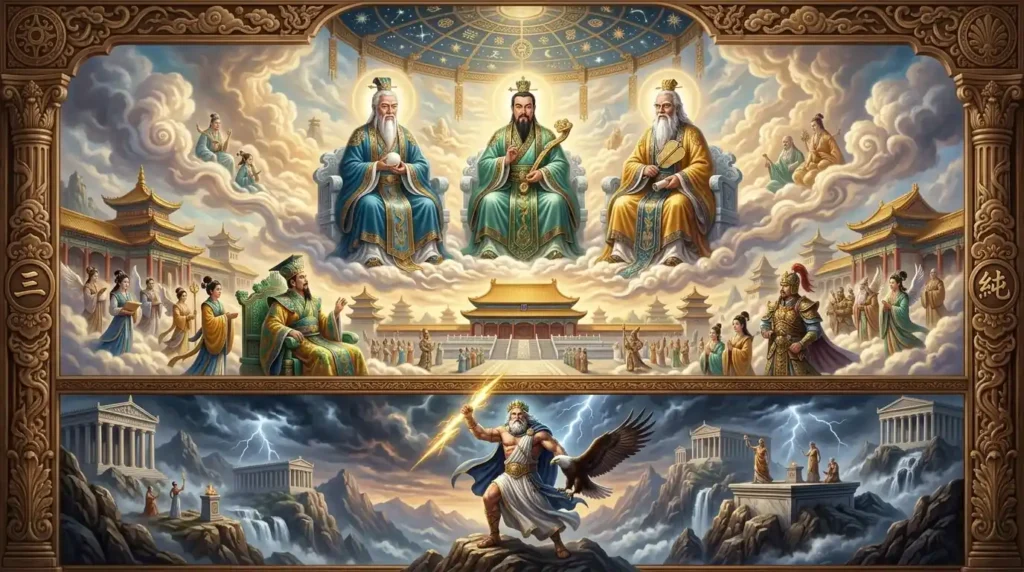
Zeus: The Top
Within Greek mythology’s cosmological framework, Zeus is effectively the highest authority that exists in practice. The Fates (Moirai) represent a principle of cosmic necessity that even Zeus acknowledges, but they’re not personal beings above him in a governing hierarchy.
The Titans and their generation existed before Zeus but were defeated and subordinated. The primordial beings (Chaos, Erebus, Night) preexist the Olympians but don’t govern them. Zeus is functionally supreme within the world as it operates.
The Jade Emperor: Not Quite the top
The Jade Emperor sits below the Three Pure Ones in Daoist theological hierarchy. Yuanshi Tianzun, Lingbao Tianzun, and Daode Tianzun represent transcendent metaphysical principles that the Jade Emperor’s governance operates within.
This means the Jade Emperor is the supreme administrator of conditioned existence, not the highest conceivable being in Chinese cosmology. The three-level structure (metaphysical principles, administrative supreme, operational governance) is a specifically Chinese theological sophistication that has no equivalent in Greek divine hierarchy.
What The Comparison Reveals
Different Ideas About Legitimate Authority
The most significant thing this comparison reveals is that Greek and Chinese mythology have fundamentally different answers to the question: what makes divine authority legitimate?
For Greek mythology, legitimacy comes from power demonstrated in a contest. Zeus rules because he won. His continued authority is backed by the constant awareness that he’s the most powerful being available.
For Chinese mythology, legitimacy comes from cultivated virtue expressed through effective governance. The Jade Emperor rules because he became worthy of ruling through moral development and because his system produces fair, accountable governance of the cosmos.
Different Ideas About What Divine Authority is For
Zeus’s authority exists to maintain a certain cosmic order, but it also exists to express Zeus’s own nature. His personal desires, his aesthetic preferences, his emotional responses to events all produce legitimate divine action. Zeus acts for reasons that include his own satisfaction.
The Jade Emperor’s authority exists to serve the cosmic system he administers. His personal preferences, to the extent they exist in the mythology, are irrelevant to his governance decisions. He acts to produce the best possible outcomes for all beings within the system, not to express himself.
These are genuinely different theories of what divine supreme authority is for.
Frequently Asked Questions
Which figure is more powerful?
This question doesn’t resolve cleanly because they measure power differently. Zeus’s power is personal force. The Jade Emperor’s power is institutional reach. Zeus could probably win a direct confrontation. The Jade Emperor’s system governs more comprehensively and more consistently. The comparison depends on what dimension of power you’re evaluating.
Do both figures have equivalent positions in their respective traditions?
Not quite. Zeus is the effective supreme being in Greek mythology. The Jade Emperor has the Three Pure Ones above him in Chinese theological hierarchy, making him supreme in an administrative sense but not metaphysically supreme. This asymmetry is itself one of the comparison’s most interesting points.
Is it fair to compare figures from traditions with such different structures?
It’s fair as long as the comparison illuminates rather than flattens the differences. The Jade Emperor and Zeus are genuinely the most appropriate comparison points between Chinese and Greek divine hierarchies. The comparison works best when it makes the differences visible rather than forcing the figures into a single evaluative framework.
Why is Zeus often seen as a warrior god?
Many Greek myths show Zeus using lightning bolts to defeat enemies, giants, and monsters, highlighting his martial power.
Why is the Jade Emperor viewed as a ruler rather than a fighter?
Stories usually focus on his role as Heaven’s sovereign, maintaining balance and overseeing divine affairs rather than engaging in combat.
Final Thought

Two supreme gods. Two completely different answers to the question of what supreme divinity means and what it’s for.
Zeus is divine personality at its maximum expression: powerful, emotional, personal, immediate. The Jade Emperor is divine governance at its most comprehensive: structural, accountable, systematic, patient.
Neither model is obviously superior. Each is internally coherent and profoundly expressive of the civilization that produced it. Greek mythology’s supreme god looks like the best possible version of a very powerful person. Chinese mythology’s supreme god looks like the best possible version of a very just administrator.
Those two visions of the highest authority reveal something genuinely deep about what their respective civilizations considered most important. I’ve been sitting with that comparison for twenty years, and I still find it one of the most illuminating things that comparative mythology offers.
Related Articles
- Jade Emperor vs Sun Wukong: Who Really Won the Rivalry?
- What Is the Heavenly Court? Chinese Myth’s Divine Authority
- Xiwangmu vs Jade Emperor: Who is More Powerful in Chinese Myth?
- Jade Emperor vs Buddha: Who Actually Outranks Whom?
References
- Birrell, Anne. Chinese Mythology: An Introduction.
- Kohn, Livia. Daoism and Chinese Culture.
- Daozang – Daoist Canon
- Investiture Of The Gods
- Journey To The West
- Jade Emperor Origin Scripture
- The Taoist Body – Kristofer Schipper
- Hesiod. Theogony. Translated by M. L. West. Oxford University Press, 1988.
- Homer. The Iliad. Translated by Robert Fagles.
- Burkert, Walter. Greek Religion. Harvard University Press, 1985.
- Hard, Robin. The Routledge Handbook of Greek Mythology. Routledge, 2004.
Written by Batin Khan | Mythology and philosophy reader across world cultures (20 years), Cultivation novels reader for the past 10 years | Specialist in Xianxia, Eastern and Western mythological traditions, and fantasy worldbuilding