
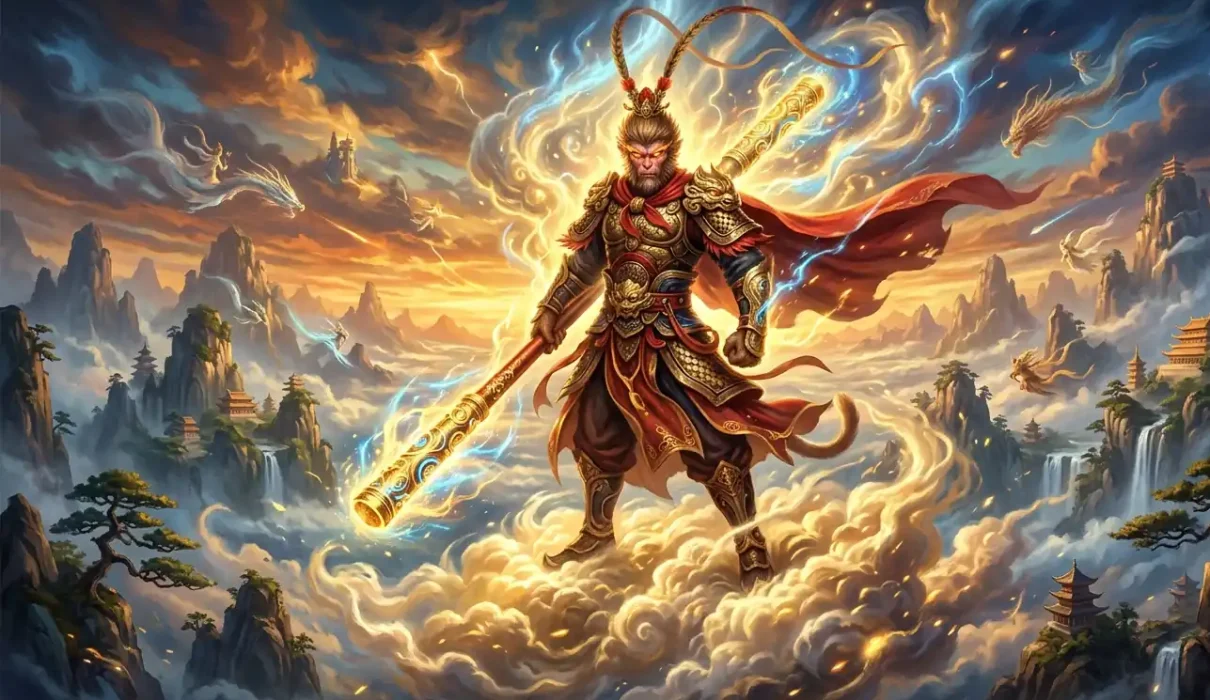
 By
By Quick Takeaways:
- Sun Wukong is the protagonist of Journey to the West and one of the most influential fictional characters in world literature. His symbolic meaning is considerably richer than his surface role as a powerful monkey suggests
- His name literally means “monkey awakened to emptiness,” encoding his entire character arc in a single phrase
- Every major element of his mythology encodes specific philosophical content: his stone birth, his staff, his 72 transformations, his golden headband, and his defeat by the Buddha
- He represents the fundamental human tension between raw capability and genuine wisdom, the question of what power is actually for
- His influence extends from Goku to Black Myth: Wukong, and his character structure underlies countless fictional protagonists worldwide
If I had to name the fictional character who’s had the most outsized influence on global storytelling relative to how well-known his source is, Sun Wukong would be my immediate answer. I would even go on to say he is the one who inspired many of the popular anime protagonists’ personalities.
He’s been shaping fiction for five centuries. His DNA is in Dragon Ball, in countless video game protagonists, in the specific archetype of the cocky, impossibly powerful figure who has to learn that wisdom matters more than strength. Most of the people shaped by him don’t know they’ve been shaped by him.
Every major element of his story is doing philosophical work. Let me show you what I mean.
The Name: A Character Arc in Three Syllables
What Sun Wukong Actually Means
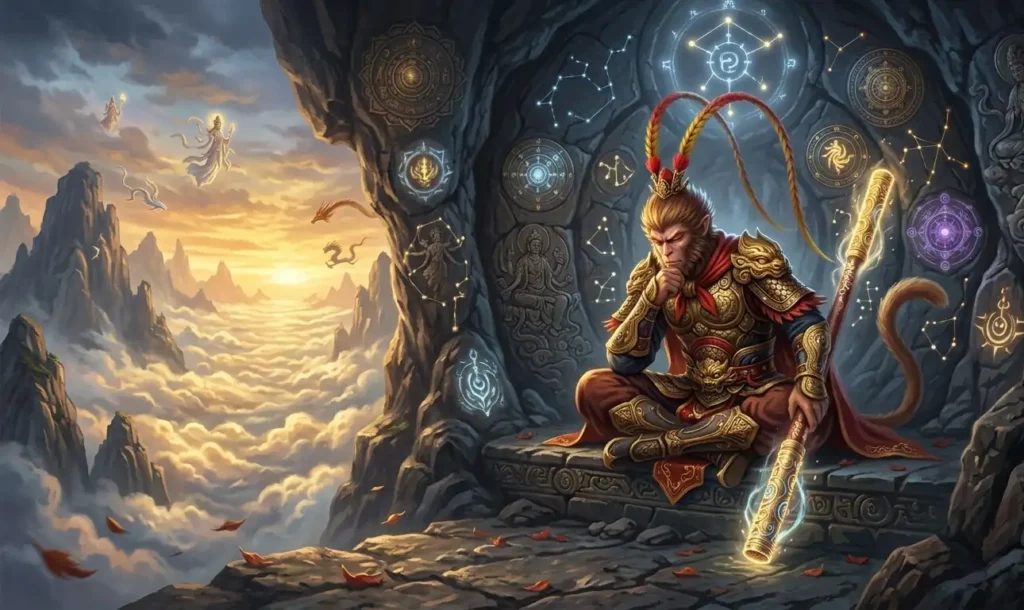
The name Sun Wukong breaks down into three characters, each doing specific work:
- Sun (孫): Monkey, but also a surname with connotations of speed and cleverness
- Wu (悟): Awakening, perception, enlightenment, the specific quality of coming to understand something that was previously obscured
- Kong (空): Emptiness, void, nothingness, the Buddhist concept of śūnyatā, the empty nature of all phenomena
Put together: the Monkey Awakened to Emptiness.
Mythology has made me pay close attention to character names in texts where the author was educated enough to choose them deliberately. Wu Cheng’en was a scholar. Sun Wukong’s name in Journey to the West isn’t decorative. It’s the novel’s thesis statement about its protagonist.
The character begins the story as far from “awakened to emptiness” as it’s possible to be. He’s defined by ego, by desire for recognition, by the absolute refusal to accept any limitation. His journey through the novel is the journey toward genuinely understanding emptiness toward the Buddhist and Daoist comprehension that the self’s demands are the primary obstacle to both power and peace.
The name tells you where he needs to go. The story shows you why the journey is so hard.
The Stone Birth: Origin Outside Ordinary Nature
Born From the Mountain’s Heart
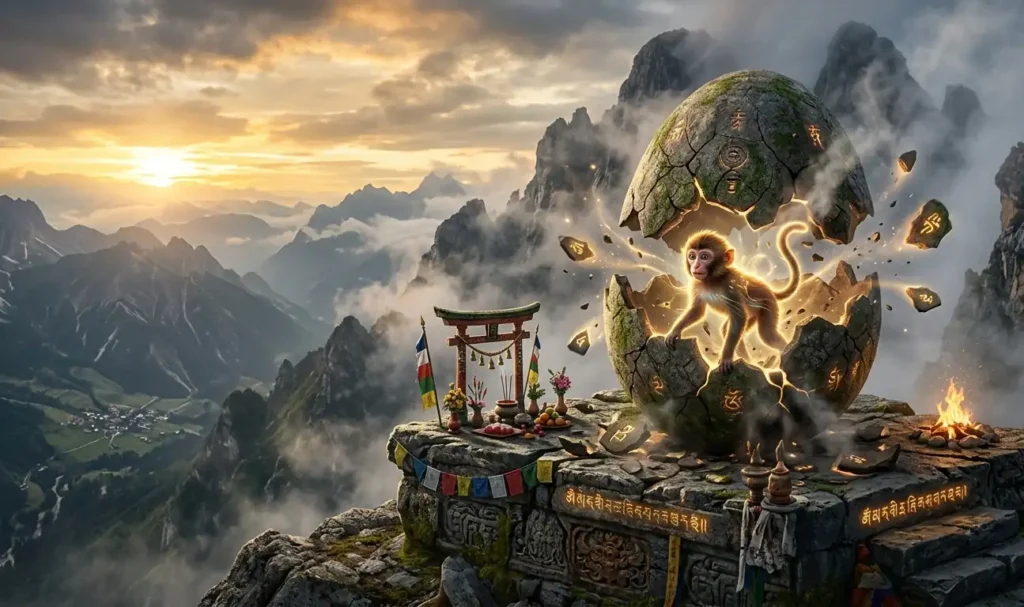
Sun Wukong wasn’t born from parents. He emerged from a stone, specifically a divine stone that had absorbed the essence of heaven and earth since the world’s creation, that had been quickened by sun and moon until a stone egg formed within it, and from that egg, in the wind, Sun Wukong hatched.
This origin is deliberate and philosophically loaded. By not having parents, Sun Wukong has no filial debt, no obligation that comes from being born to someone. He owes nothing to the ordinary social structures that Chinese culture organized around family lineage.
He enters the world without the karma of parentage, without the constraints of ordinary birth, outside the normal cycle of obligation. He’s free in a way that no ordinarily born being is free.
This freedom is both his greatest power and the source of his primary problem. Freedom from obligation means freedom from discipline too. Sun Wukong’s stone-born independence is what makes him magnificent. It’s also what makes him ungovernable, at least until he learns to govern himself.
The Weapons: What They Represent
The Ruyi Jingu Bang: Measuring Depth
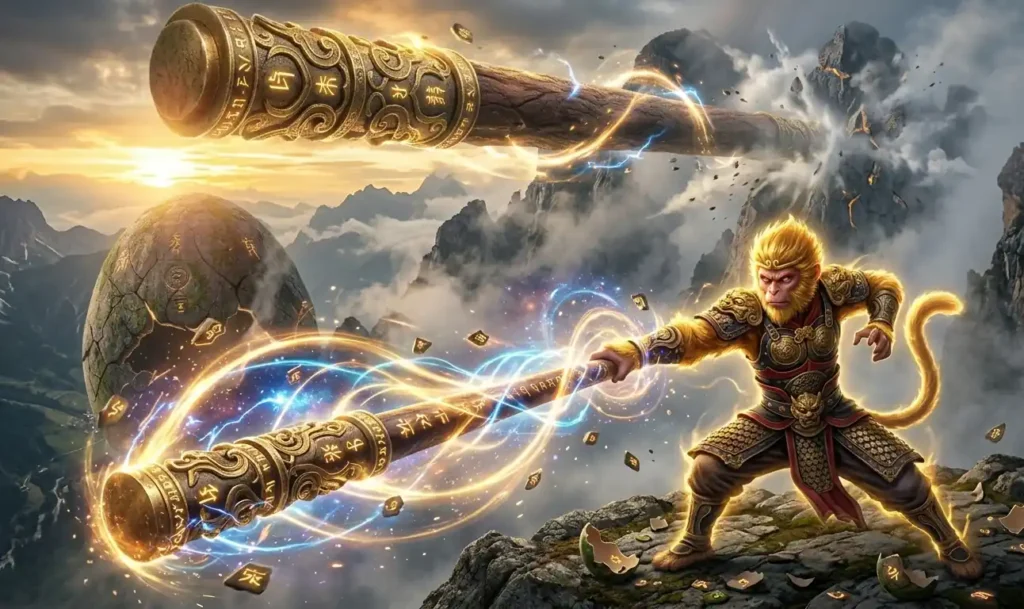
Sun Wukong’s staff, the Ruyi Jingu Bang (Compliant Golden-Banded Staff), is one of mythology’s most symbolically rich weapons, and most people who know about it don’t know what it was originally for.
The staff was a pillar that the Dragon King of the East Sea used to measure the depth of the ocean. It was a measuring instrument. When Sun Wukong found it in the Dragon King’s treasury, its light filled the entire underwater palace. He picked it up, and it resized instantly to fit his grip.
A staff that measures depth. Carried by a character whose entire arc is about learning to fathom the depth of things of reality, of the self, of wisdom, rather than simply asserting dominance over the surface.
The staff can shrink to the size of a needle and be stored behind Sun Wukong’s ear. It can expand to reach heaven and earth. Its magical property is the capacity for infinite contextual adaptation, becoming whatever size the situation requires, which is the same quality that Sun Wukong’s 72 transformations express at the personal level.
The Golden Headband: Discipline as Liberation
The golden headband (jīn gū er) that Guanyin places on Sun Wukong’s head, which Xuanzang can tighten with a spell to cause him pain when he behaves destructively, is typically read as a restraint device. A collar. A humiliation.
I want to argue for a different reading that I think the novel supports.
The headband doesn’t prevent Sun Wukong from acting. It provides immediate, physical feedback when his actions cross a specific line. It’s not eliminating his agency. It’s teaching him to notice when his power is being used in ways that damage rather than help.
The spell that activates the headband is called the Band-Tightening Spell (jǐngū zhòu). Crucially, Sun Wukong can remove the headband at the end of the journey when his wisdom has developed to the point where external feedback is no longer necessary because internal discernment has replaced it.
This is not a restraint that imprisons him. It’s a training tool that he eventually transcends. The discipline isn’t imposed forever. It’s scaffolding that he removes when he’s capable of standing without it.
The 72 Transformations: Protean Capability and its Limits
What The Transformations Represent
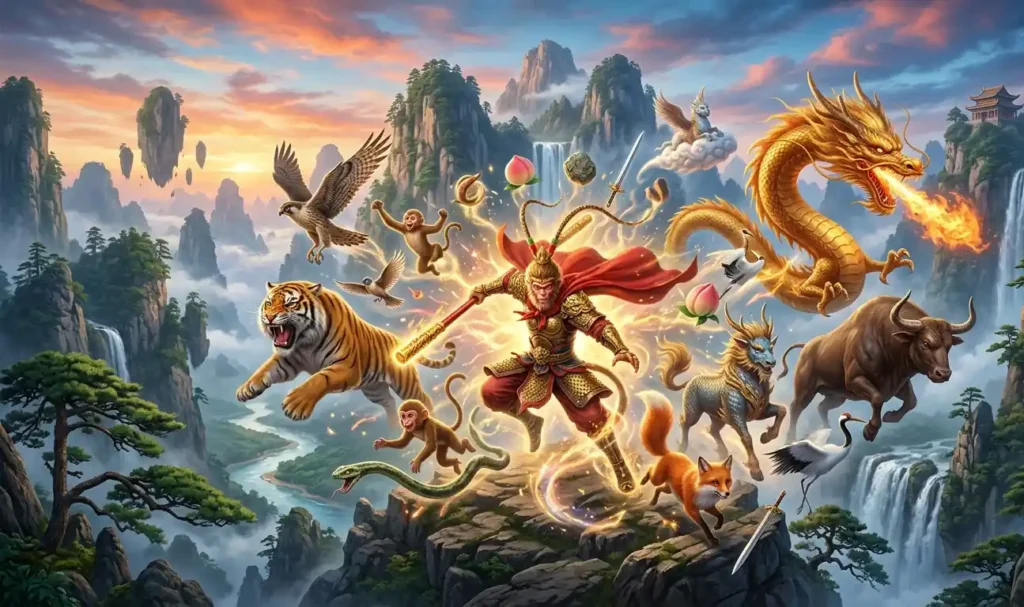
Sun Wukong learns 72 transformations (qīshíèr biàn), the ability to become any person, animal, object, or phenomenon he desires. He can become a fly, a mountain, a temple, or a human official. His transformative capability is essentially unlimited.
72 is a specific number in Chinese cosmological thinking. It appears in multiple classical contexts where it represents the complete range of something. 72 transformations means the complete range of possible forms. Sun Wukong can become anything.
But there’s a specific, famous limitation to his transformations that the novel deploys brilliantly in his battle with the demon king Zhu Bajie during the early sequences. Sun Wukong transforms into various creatures perfectly, but he can’t perfectly replicate a tail when he transforms into an animal that has one. The tail betrays him.
This limitation is symbolic. You can transform everything about your appearance. The things you’ve grown, the attachments, the ego’s specific formations are harder to transform than you think. Sun Wukong can look like anything. What he actually is keeps showing up in the detail he didn’t notice he needed to change.
The Battle with the Jade Emperor’s Forces
Sun Wukong’s extended battle against the heavenly armies is the novel’s most spectacular action sequence and simultaneously its most pointed satirical passage.
He defeats every general. He defeats every army. He defeats the combined forces of the Heavenly Court. The heavenly bureaucracy, for all its elaborate ranks and protocols, cannot handle a single sufficiently motivated individual.
This is specifically Ming Dynasty political satire: an elaborate official system that can’t actually solve the problem in front of it. But it’s also a statement about the limits of institutional power. The Jade Emperor’s court has legitimate authority. It has real power. It has everything that institutional power provides.
It doesn’t have what Sun Wukong has: the particular, undirectable force of individual will operating entirely outside the system’s logic.
The Buddha’s Defeat: The Most Important Scene
What Happens
The confrontation between Sun Wukong and the Buddha Tathagata is the novel’s philosophical centerpiece, the moment where everything Sun Wukong has been throughout his story is tested against something genuinely beyond his comprehension.
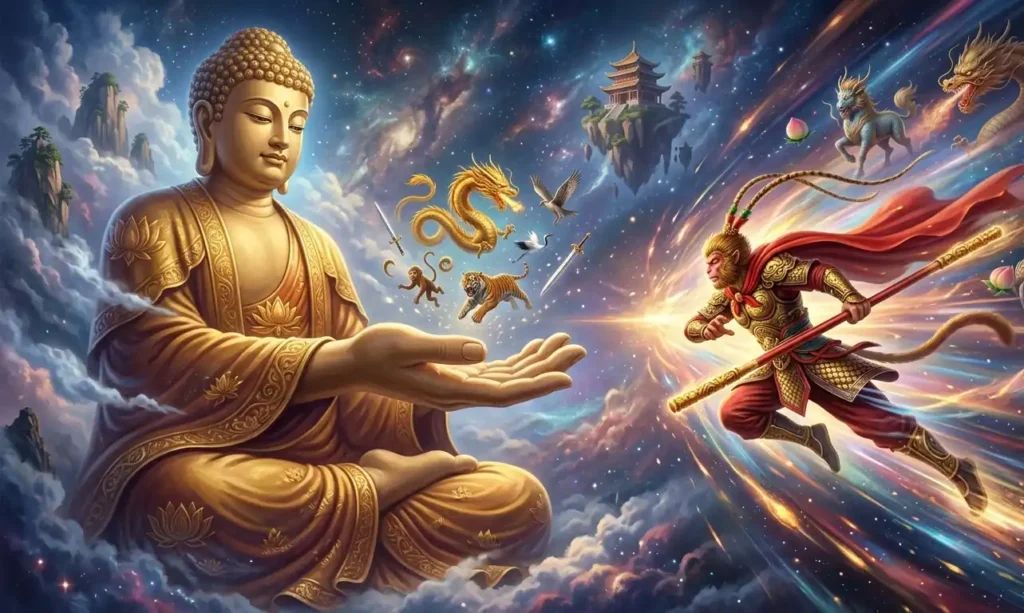
Sun Wukong claims he’s powerful enough to replace the Jade Emperor. The Buddha proposes a bet: if Sun Wukong can escape from the palm of the Buddha’s hand, he wins and the Jade Emperor must concede to him.
Sun Wukong leaps with his maximum speed, covering 108,000 li in a single somersault and arriving at the edge of existence, where five pillars mark the world’s end. He writes his name on one of them to prove he’s been there. He returns.
The Buddha shows him his hand. The writing is on his finger. The five pillars are the Buddha’s five fingers. Sun Wukong never left.
What This Means Philosophically
This scene has been making people uncomfortable for five centuries, and deliberately so.
Sun Wukong’s 72 transformations can produce any form. His somersault can travel 108,000 li. He has defeated every divine army. He has achieved, by every metric he values, the maximum possible capability.
And all of it fits within the palm of a hand he didn’t know he was standing on.
The scene isn’t a defeat of Sun Wukong’s power. It’s a demonstration that his power was never what he thought it was, not because it’s weak, but because it was always operating within a context he hadn’t understood.
This is the novel’s most direct Buddhist teaching. The ego’s capabilities are real. Its understanding of the context it operates in is radically incomplete. No amount of increasing the capabilities changes this. Only genuine change in understanding does.
Sun Wukong isn’t defeated because he’s weaker than the Buddha. He’s defeated because the category of competition he’s been operating in was never the right category. He didn’t know what game he was actually playing.
The Imprisonment: Five Centuries Under a Mountain
The Mountain of Five Elements
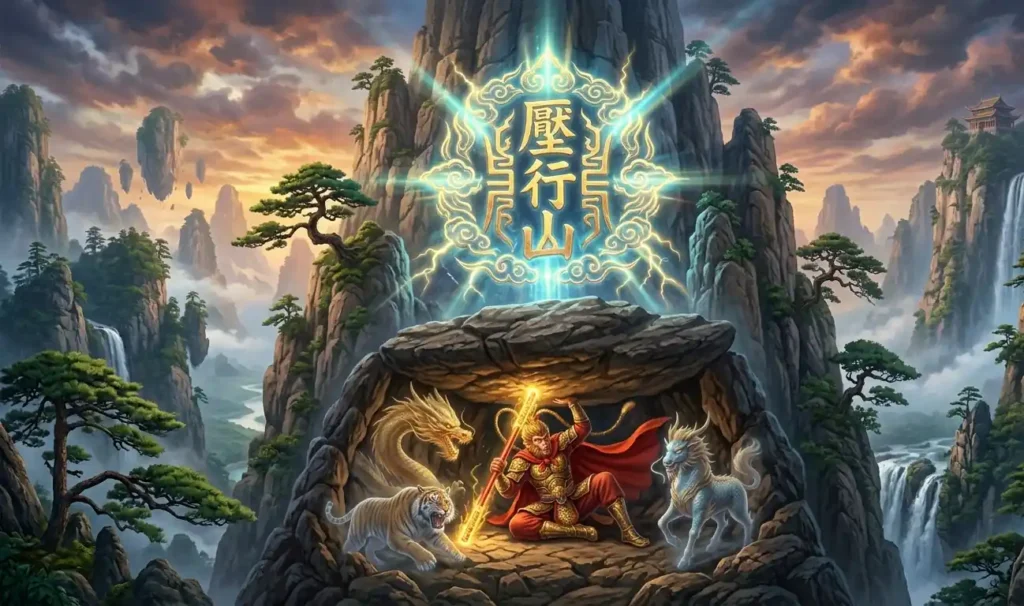
After his defeat, the Buddha imprisons Sun Wukong beneath the Mountain of Five Elements (Wǔxíng Shān), a mountain whose very name encodes the five-element cosmological framework that governs all-natural reality.
Sun Wukong spends five hundred years under this mountain. Not in a prison cell. Under a mountain. Compressed by the weight of natural law itself, fed occasionally by passing travelers, unable to leave.
Five hundred years is long enough to think. And thinking, under the Mountain of Five Elements under the full weight of natural reality pressing down on you, is presumably a specific kind of education.
The Seal
The seal on the mountain is a paper with six characters: Om Mani Padme Hum, the Buddhist mantra of compassion.
The thing that keeps the most powerful fighter in the novel imprisoned isn’t a greater military force. It’s a paper with a compassion mantra. The message is explicit: what restrained Sun Wukong isn’t power. Power couldn’t do it. What restrained him was something he didn’t yet have access to compassion, the understanding that power exists within a web of relationships and consequences rather than in isolation.
He can’t get free until he agrees to take on the pilgrimage to use his extraordinary capability in the service of something beyond his own advancement.
The Redemption Arc: What Wisdom Actually Looks Like
The Headband Stays On
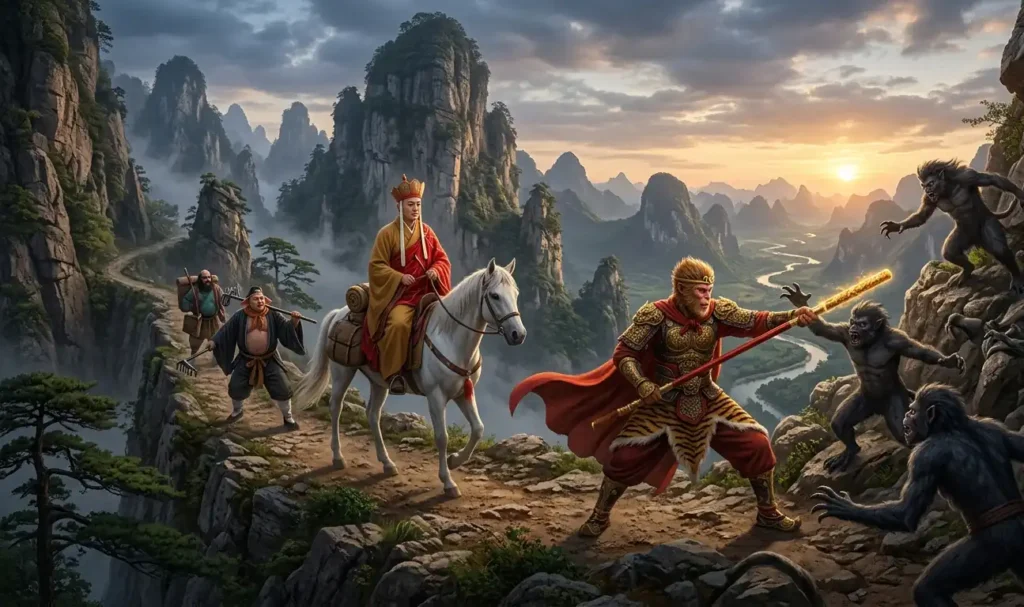
Throughout the pilgrimage, the golden headband remains on Sun Wukong’s head. He keeps trying to remove it. He can’t. This continues to grate on him.
What’s interesting is watching the gradual shift in when Xuanzang actually activates the spell. Early in the journey, it’s relatively frequent that Sun Wukong’s judgment about when violence is appropriate doesn’t match Xuanzang’s. As the journey continues, it becomes less frequent, not because Xuanzang is more permissive but because Sun Wukong’s judgment is genuinely developing.
The headband stays on. The relationship between Sun Wukong and the discipline it represents gradually transforms from adversarial to simply present to eventually transcended.
What He Gains
By the journey’s end, Sun Wukong is granted the title Victorious Fighting Buddha (Dòu Zhàn Shèng Fó), a title that encodes both the capability he’s always had (victorious in battle) and what the journey has added (Buddha, the awakened one).
He didn’t gain strength on the pilgrimage. He was already the strongest fighter in the novel at the beginning. What he gained was the wisdom to direct that strength toward something genuinely worth fighting for, which is, in the novel’s framework, the same as gaining everything that strength alone couldn’t give him.
Sun Wukong’s Sacred Power: The Specific Qualities
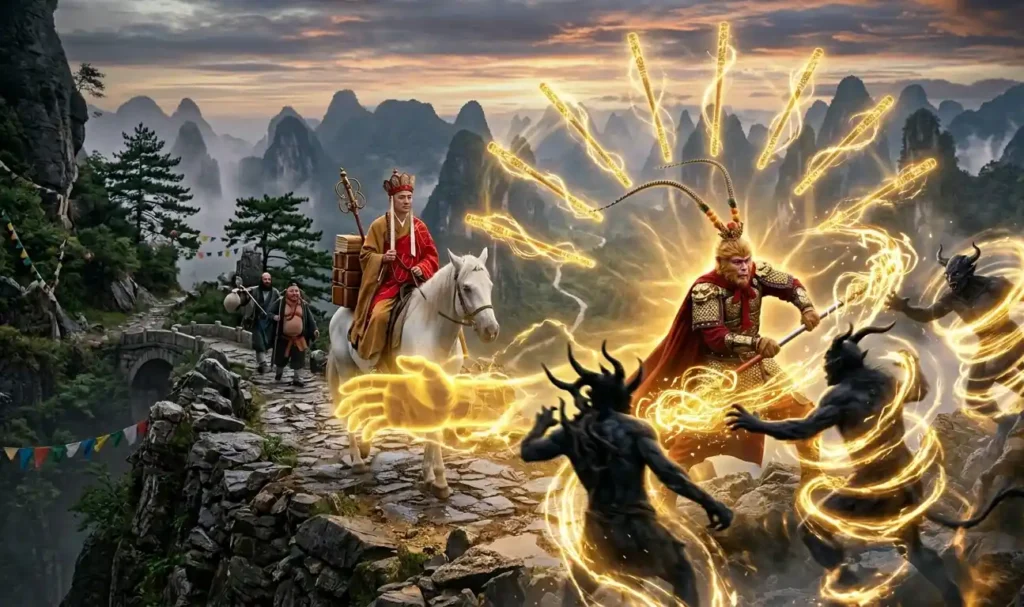
The tradition identifies several specific sacred powers that belong to Sun Wukong:
Physical capabilities:
- Seventy-two transformations into any form
- The cloud somersault covering 108,000 li per leap
- 84,000 hairs that can transform into copies of himself or other objects
- Extraordinary physical strength and near-invulnerability
Perceptual capabilities:
- Fiery Eyes and Golden Pupils (huǒ yǎn jīn jīng), the ability to see through all disguises and illusions, acquired when he was accidentally cooked in Laozi’s Eight Trigrams Furnace. His eyes were affected by the smoke, resulting in eyes that see truth rather than appearance.
Social/divine status:
- The self-declared title Great Sage Equal to Heaven
- The earned title Victorious Fighting Buddha at the journey’s end
- The unique position of having defeated the heavenly armies, cheated death, and then willingly submitted to a discipline that reoriented his power
The Fiery Eyes and Golden Pupils deserve special mention because they’re both the result of an attempted destruction and a genuine enhancement. Laozi tried to refine Sun Wukong into ashes in the Eight Trigrams Furnace. Instead, seventy-seven days of alchemical fire gave him eyes that can perceive demons through their disguises. The attempt to destroy him produced one of his most useful abilities.
The Global Influence: Why Sun Wukong Matters for Fiction
Dragon Ball and the Explicit Adaptation
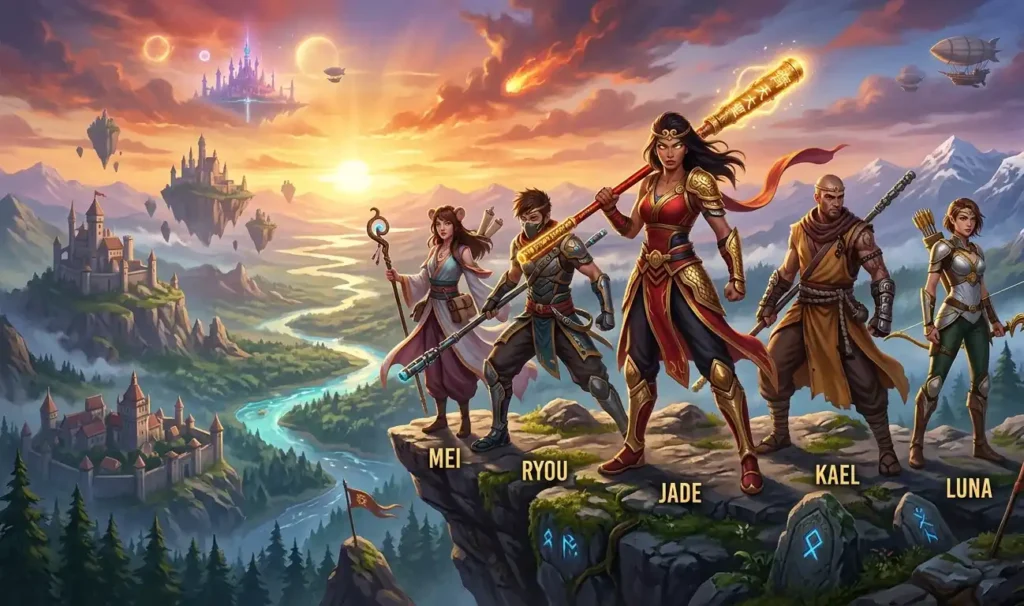
Akira Toriyama explicitly based Dragon Ball on Journey to the West. Goku is Sun Wukong, the power pole is the staff, the flying nimbus is the cloud, and the pilgrimage structure underlies the tournament arc structure. Dragon Ball became one of the most globally influential manga and anime series in history.
This means Sun Wukong’s character structure, the initially out-of-control, powerful protagonist who must develop wisdom to match his strength, mentored by a morally consistent elder, is baked into the DNA of action manga worldwide.
Black Myth: Wukong and the Current Moment
The 2024 game Black Myth: Wukong brought Sun Wukong to a new global gaming audience, generating significant interest in the source mythology among people who’d never encountered it directly.
The game’s success demonstrates that Sun Wukong’s appeal isn’t a historical curiosity. The character structure still works the extraordinary capability, the refusal to accept limitations, and the specific relationship with power that the mythology has always explored for audiences with no prior exposure to Chinese mythology.
The Underlying Archetype
What Sun Wukong ultimately represents, and why he keeps being reinvented across five centuries of adaptation, is a fundamental human question: what is extraordinary capability actually for?
The answer Journey to the West gives is specific and demanding. Capability is for something beyond the self. Power that serves only the ego, however spectacular, remains incomplete. The journey toward wisdom isn’t the abandonment of capability. It’s the discovery of what capability was always meant to become.
That’s a story that doesn’t run out of resonance.
Frequently Asked Questions
What does Sun Wukong’s name mean?
Sun Wukong literally means “monkey awakened to emptiness.” Sun means monkey, Wu means awakening or perception, and Kong means emptiness, the Buddhist concept of śūnyatā. The name encodes his entire character arc. the journey from ego-driven monkey to being awakened to the empty, interdependent nature of all phenomena.
Why can’t Sun Wukong escape the Buddha’s palm?
The scene represents the philosophical point that ego-based capability, however extraordinary, always operates within a context it hasn’t fully understood. Sun Wukong’s somersault can cover 108,000 li, but 108,000 li was always within the Buddha’s palm. The point isn’t that Sun Wukong is weak. It’s that his understanding of the context he operates in was radically incomplete.
What are Sun Wukong’s most important abilities?
His most significant abilities are the 72 transformations, the cloud somersault covering 108,000 li per leap, the infinitely resizable Ruyi Jingu Bang, 84,000 transformable hairs, and Fiery Eyes and Golden Pupils that see through all illusions, gained after 77 days in Laozi’s furnace.
Why does the golden headband matter philosophically?
The headband is not primarily a restraint but a feedback mechanism. It activates when Sun Wukong uses power destructively, providing immediate consequences. As his judgment develops, it is needed less often. By the journey’s end, he can remove it permanently because internal wisdom has replaced external control. Discipline becomes scaffolding that is eventually transcended.
What does Sun Wukong symbolize?
Sun Wukong symbolizes untamed potential, rebellion against limitations, and the transformative journey from impulsive power to disciplined wisdom.
Final Thoughts
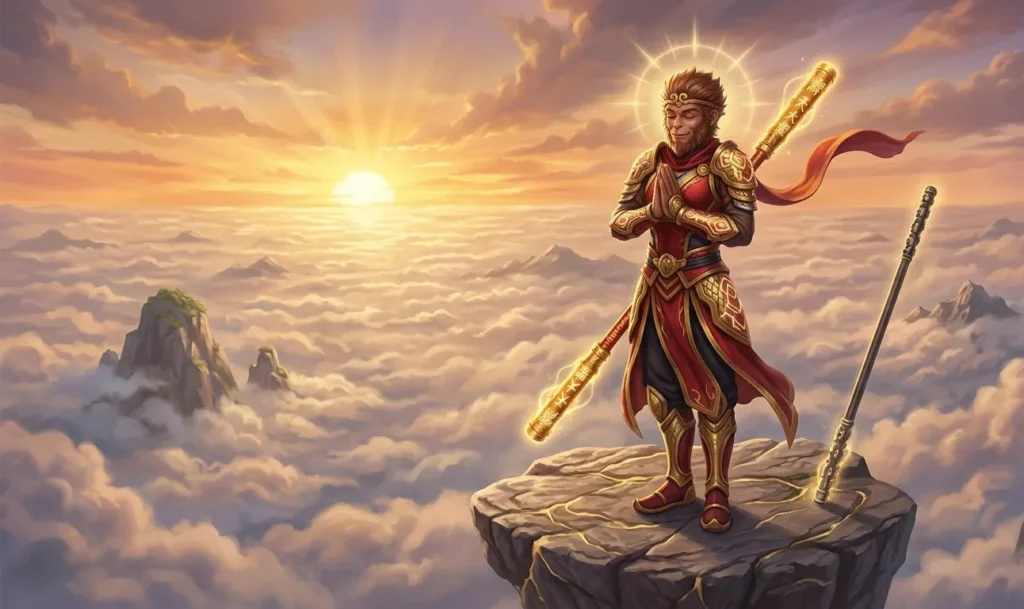
Sun Wukong has been one of my favorite mythological figures. Part of that is simple. He’s spectacular, entertaining, and endlessly creative in combat situations.
But the reason the character holds up, the reason he keeps being reinvented across five centuries of global culture, is the philosophical content underneath the spectacle.
The question Journey to the West asks through Sun Wukong is one that every person with any significant capability has to eventually face: what is this for? What am I doing with what I have?
His answer takes five hundred years under a mountain, a golden headband, 81 tribulations, and finally achieving a title that combines his original nature (victorious in fighting) with what the journey gave him (Buddha, the awakened one).
It’s a long way to travel for wisdom. The novel suggests it’s the right distance.
Related Articles
- Journey to the West: The Chinese Classic Behind Fiction
- Was the Jade Emperor Weak? The Answer Might Surprise You
- Jade Emperor vs Sun Wukong: Who Really Won the Rivalry?
- Pantao Banquet: Queen Mother of the West’s Heavenly Feast
- Sun Wukong Powers Ranked: From Weakest to Absolute
- The Three Pure Ones: Who Outranks the Jade Emperor
References
- Birrell, Anne. Chinese Mythology: An Introduction.
- Major, John. Heaven and Earth in Early Han Thought.
- Kohn, Livia. Daoism and Chinese Culture.
- Allan, Sarah. The Shape of the Turtle.Hanshu (Book of Han).
- Shiji (Records of the Grand Historian).
- Tao Te Ching – Translated by J. Legge
- Daozang – Daoist Canon
- Journey To The West
- Jade Emperor Origin Scripture
- The Taoist Body – Kristofer Schipper
- Andrew H. Plaks – The Four Masterworks of the Ming Novel
- Records of the Western Regions in the Great Tang Dynasty – Xuanzang
- Stephen Teiser – The Spirits of Chinese Religion
- Akira Toriyama Reveals Why How He Came Up With ‘Dragon Ball’