
 By
By Quick Takeaways:
- The Chinese phoenix, properly called the Fenghuang, is not the same creature as the Western resurrecting phoenix, and it’s also not the Vermilion Bird of the Four Holy Beasts, a distinction most popular accounts get wrong
- The dragon & phoenix pairing represents yin and yang made visible: masculine and feminine, sky and grace, power and virtue, joined into a single complete image
- The pairing became formally attached to the emperor and empress specifically during the later imperial dynasties, though dragon and phoenix imagery had appeared together for centuries before that political meaning solidified
- The phrase Longfeng Chengxiang, dragon and phoenix bring prosperity, is still used at Chinese weddings today, which is why you’ll see the pairing on everything from wedding invitations to bridal gowns
- Understanding the pairing properly requires understanding what each creature represents on its own before understanding what they mean together
Chinese mythology has given me a specific fondness for symbols that only reveal their full meaning once you understand both halves of the pair. The dragon and phoenix are the clearest example I know. Separately, each is already a complete and significant mythological figure. Together, they’re doing something neither can do alone.
You’ll find this pairing on imperial robes, temple architecture, wedding invitations, embroidered silk, and modern jewelry. Most people who see it recognize that it means something auspicious without knowing precisely what. Let me fill in the gap.
What the Fenghuang Actually Is
Not the Western Phoenix
The first thing worth clearing up is that the Chinese Fenghuang is not the same creature as the Greek phoenix that Western readers know, the bird that dies in flame and rises reborn from its own ashes.
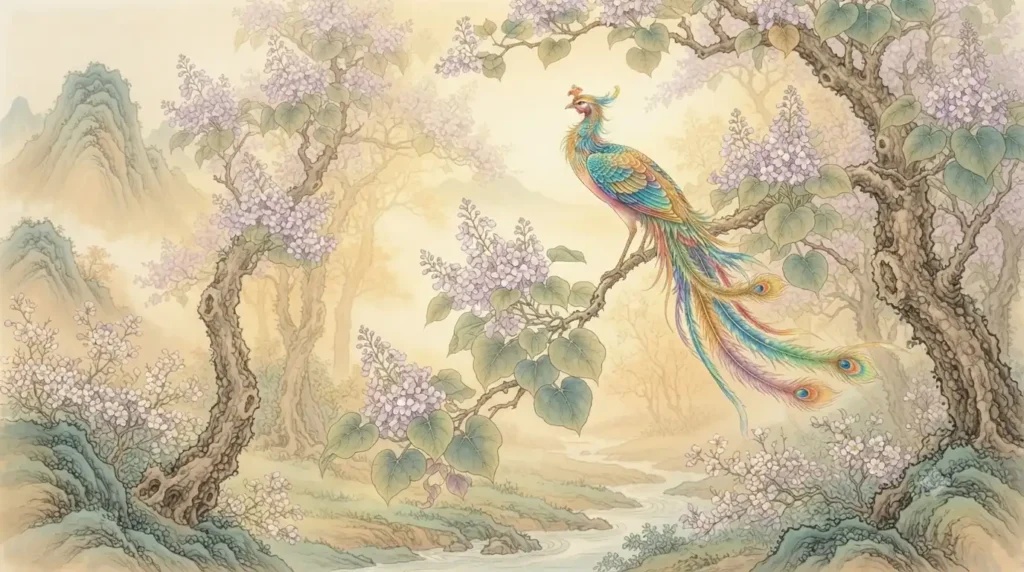
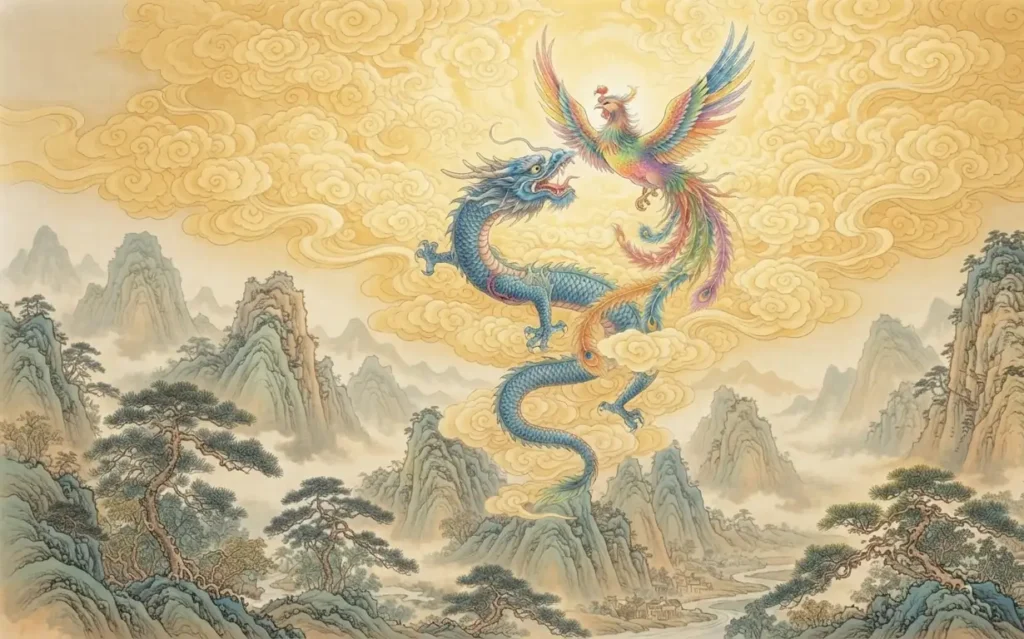
The Fenghuang doesn’t die and resurrect. It’s a composite mythological bird described across classical sources as combining features from multiple animals: the head of a pheasant or fowl, the body of a mandarin duck, the tail feathers of a peacock, the legs of a crane, and the general bearing of extraordinary grace and dignity. It’s closer in spirit to a magnificent, multicolored, semi-divine bird than to the specifically fire-and-rebirth creature of Greek mythology.
The English translation “phoenix” was chosen by early Western translators because the Fenghuang seemed like the closest available Western equivalent for an extraordinary mythical bird. The translation stuck, but it papers over real differences between the two traditions.
Not the Vermilion Bird Either
The second common confusion is mixing up the Fenghuang with Zhuque, the Vermilion Bird, one of the Four Holy Beasts that guards the southern direction alongside the Azure Dragon (east), White Tiger (west), and Black Tortoise (north).
These are genuinely different figures. Zhuque belongs to the four-directional cosmological system, tied specifically to the south, to fire, and to summer. The Fenghuang stands outside that system entirely. It’s a singular auspicious creature associated with virtue, harmony, and the appearance of a sage ruler rather than with a cardinal direction.
Popular accounts conflate the two constantly because both are magnificent mythical birds associated with fire imagery in some depictions. But when you see the dragon and phoenix paired in imperial or marital imagery, that’s the Fenghuang, not Zhuque.
An Ancient Figure
The Fenghuang’s imagery appears extremely early in Chinese art, with phoenix-like bird motifs documented on Shang Dynasty bronzes and oracle bones, predating much of the systematized dragon mythology that developed in later periods. This is a genuinely ancient creature, not a later invention paired decoratively with the dragon after the fact.
The Cosmological Argument: Yin and Yang Made Visible
Two Halves of a Complete System
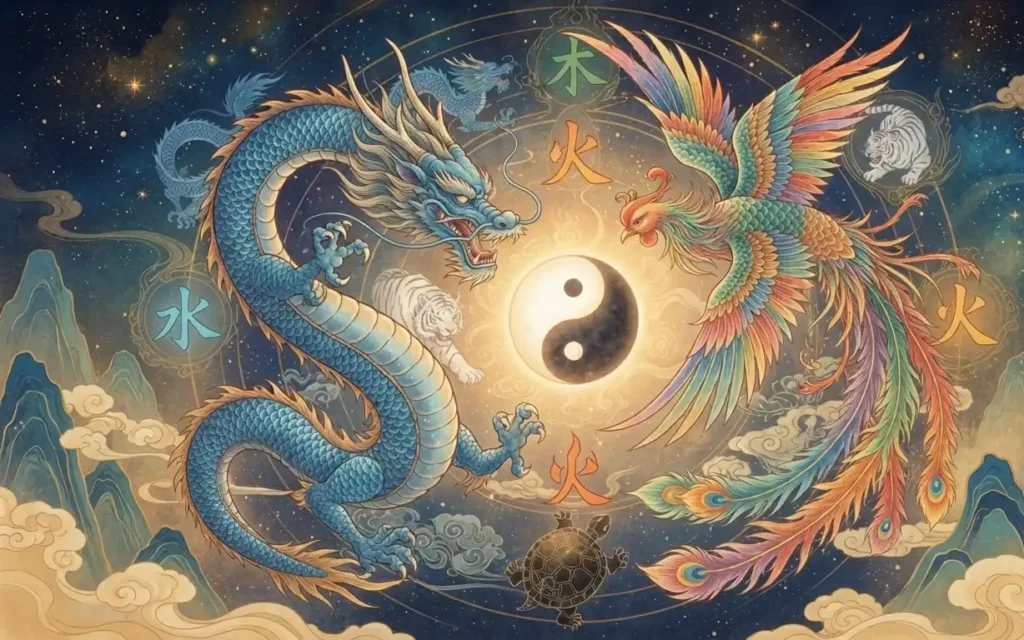
The deepest reason the dragon and Fenghuang are paired is cosmological. Chinese philosophical tradition organizes reality around the complementary principles of yin and yang, and the dragon and phoenix became the clearest visual embodiment of that complementarity available in the mythological vocabulary.
The dragon represents yang: masculine, active, associated with the sky, with water in motion, and with generative power moving outward into the world. The Fenghuang represents yin: feminine, receptive, associated with grace, harmony, and the kind of quiet dignity that doesn’t need to assert itself to be recognized.
Neither principle is complete without the other. Chinese cosmological thinking treats yin and yang not as opposites in conflict but as complementary halves that only produce genuine balance together. A dragon alone is power without grace. A phoenix alone is grace without the active force to accomplish anything. Together, the pairing is what a complete cosmos actually looks like.
The I Ching Connection
The Chinese dragon’s association with pure yang energy runs directly back to the I Ching, the Book of Changes, one of Chinese philosophy’s oldest and most foundational texts. The very first hexagram, Qian, representing pure yang and creative force, uses the dragon explicitly across its line statements: the hidden dragon, the dragon appearing in the field, the flying dragon in the heavens.
This gives the dragon’s yang association textual weight going back to the earliest layers of Chinese philosophical writing. The Fenghuang doesn’t appear in the I Ching in the same explicit way, but the broader yin-yang framework that the I Ching established is exactly what later tradition mapped onto the dragon and phoenix pairing as it developed.
The Political Pairing: Emperor and Empress
How the Symbolism Became Official
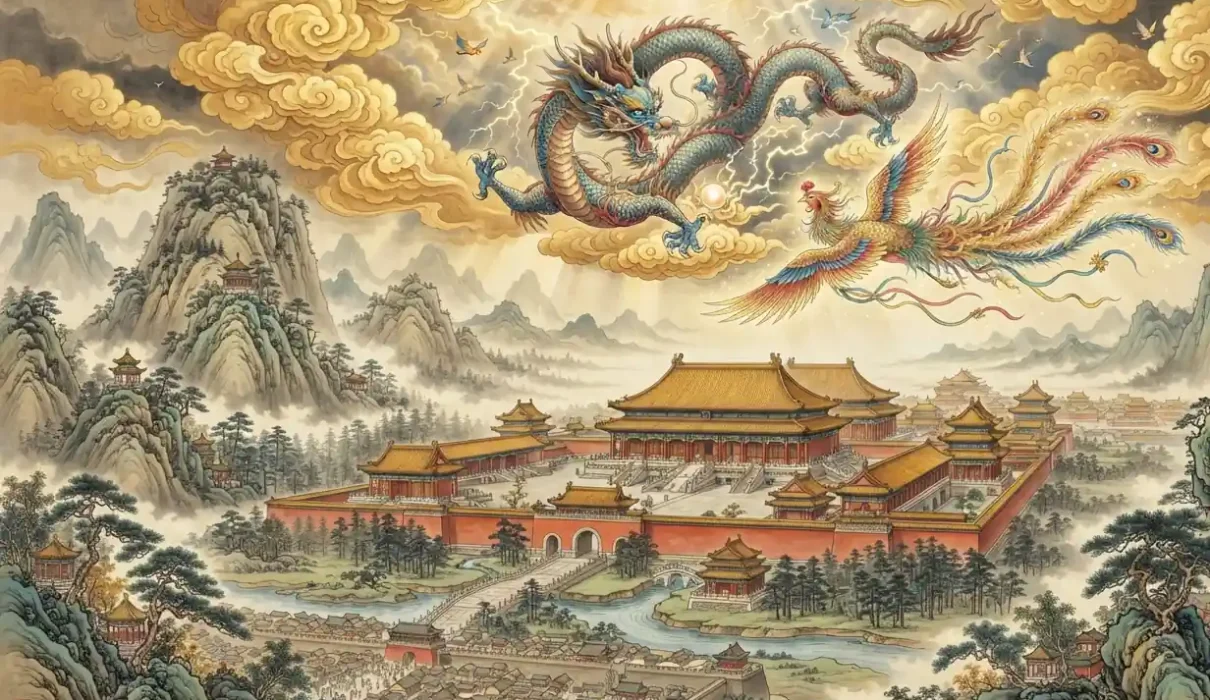
The Chinese dragon had long been associated with imperial authority by the time the pairing with the Fenghuang became formally attached to the empress specifically, primarily during the Ming and Qing Dynasties.
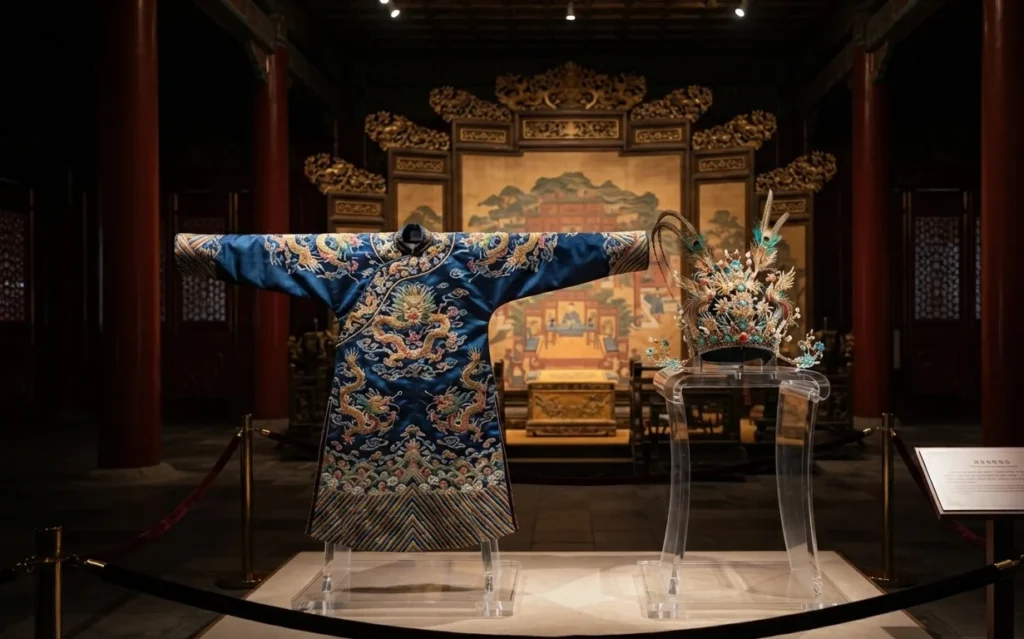
The five-clawed dragon was reserved by law for the emperor’s exclusive use during these later dynasties. The Fenghuang became the parallel symbol reserved for the empress, appearing on her formal robes, her ceremonial headdress, and her official seals.
The phoenix crown, fengguan, worn by empresses and high-ranking noblewomen, survives in museum collections and remains one of the most visually stunning artifacts of Chinese imperial material culture.
This formalized the dragon-phoenix pairing into an explicit statement about legitimate rule: the emperor’s yang authority and the empress’s yin authority together constituted the complete cosmic order that legitimate governance required. Neither alone was sufficient. The empire needed both principles represented at its head.
Before the Formal Pairing
It’s worth knowing that the strict emperor-empress gendered pairing wasn’t always fixed this precisely. Han Dynasty and Tang Dynasty art shows dragon and phoenix imagery together in contexts that are more fluid than the later, more rigidly gendered imperial symbolism.
Some scholarly accounts of the Fenghuang’s earlier history note it carried associations with the sun and with fire in certain early traditions, an association that sits somewhat in tension with its later yin classification. The specific gendered pairing we know today reflects centuries of gradual formalization rather than a single fixed meaning that existed from the beginning.
The Marriage Symbolism: Dragon and Phoenix Bring Prosperity
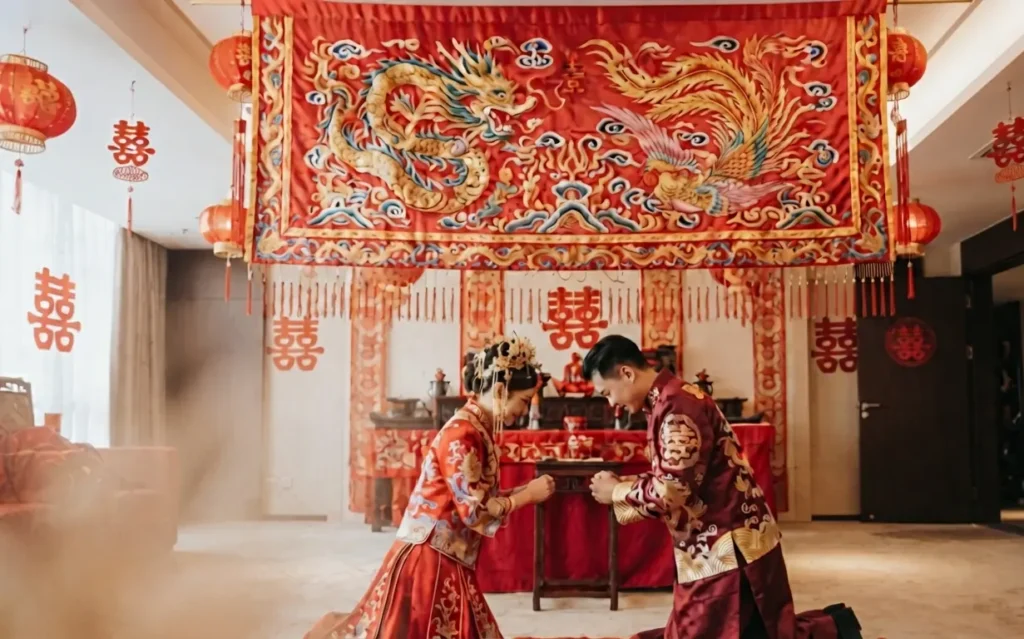
Longfeng Chengxiang
The phrase most directly connecting the dragon and phoenix to everyday Chinese cultural life is Longfeng Chengxiang, which translates roughly as “dragon and phoenix bring prosperity” or “dragon and phoenix present good fortune.”
This phrase and its accompanying imagery appear overwhelmingly in wedding contexts throughout Chinese culture, both historically and today. Wedding invitations, bridal gowns, decorative banners, and ceremonial objects frequently feature dragon and phoenix motifs together, invoking the same yin-yang complementarity that underlies the imperial symbolism but applied to an ordinary couple’s union.
Why Weddings Specifically
The logic connecting the dragon-phoenix pairing to marriage follows directly from the cosmological argument. A marriage, in traditional Chinese understanding, is meant to be the union of complementary yin and yang principles, producing a complete and harmonious household, exactly the same structural relationship the dragon and phoenix represent at the cosmic and imperial scale.
Invoking the dragon and phoenix at a wedding isn’t simply decorative. It’s calling on the same cosmic principle of complementary balance that governs the entire universe, asking that the couple’s union reflect that larger harmony.
This is why the pairing has survived so robustly in contemporary Chinese wedding culture even as the imperial system that formalized the emperor-empress version disappeared over a century ago.
The Virtue Dimension: Why the Phoenix Signals Good Governance
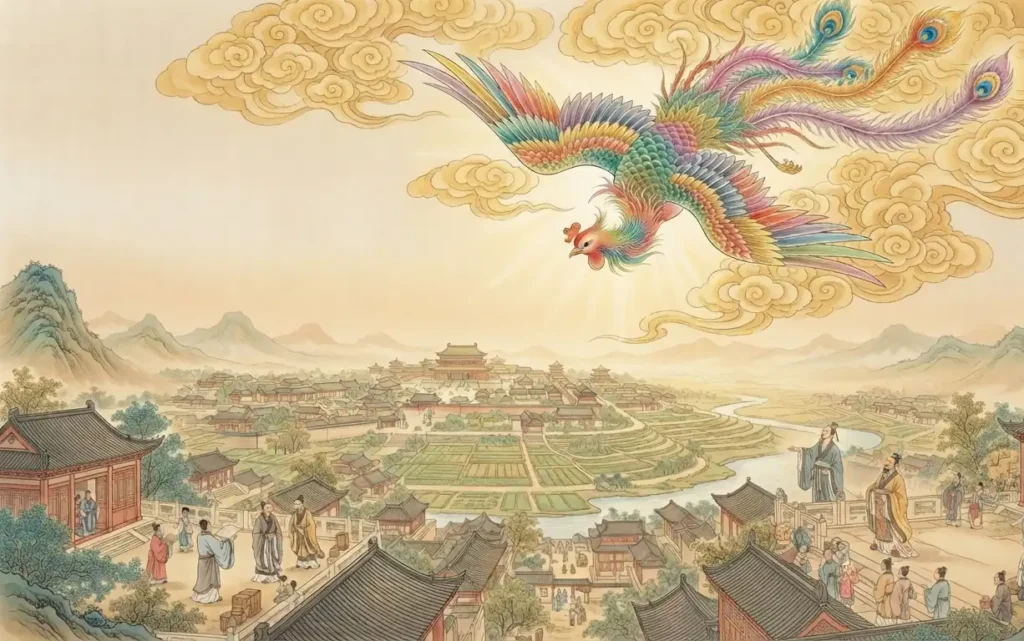
An Omen of Sage Rule
Beyond the cosmological and marital symbolism, the Fenghuang carries a specific political theology of its own: its appearance in the world was traditionally understood as a sign that a virtuous, sage ruler was governing, or about to govern.
Classical political thought held that the Fenghuang wouldn’t appear during periods of corrupt or chaotic governance. Its presence was a heavenly endorsement, a sign that the moral order of the cosmos and the political order of the state were properly aligned.
This connects the phoenix half of the pairing to a specifically Confucian understanding of legitimate rule as fundamentally a matter of virtue rather than simply of power.
The Five Virtues
Tradition associates the Fenghuang’s plumage, often described in five distinct colors, with the five Confucian virtues: benevolence, righteousness, propriety, wisdom, and sincerity. Whether this specific association is ancient or a later elaboration is genuinely debated among different textual traditions, but the general connection between the phoenix and virtuous character runs consistently through the mythology.
This gives the dragon-phoenix pairing an additional layer beyond simple gender complementarity: the dragon representing legitimate power, the phoenix representing the virtue that makes power legitimate. Neither power without virtue nor virtue without power constitutes complete and proper rule.
The Wutong Tree
Classical Chinese poetry, including passages in the ancient Book of Songs, describes the Fenghuang as perching only on the wutong tree (Firmiana simplex, the Chinese parasol tree) and eating only bamboo seeds.
This extreme selectivity reinforces the bird’s association with purity and discernment: a creature this discriminating in its habits only settles where genuine virtue and harmony already exist.
How the Pairing Evolved Over Time
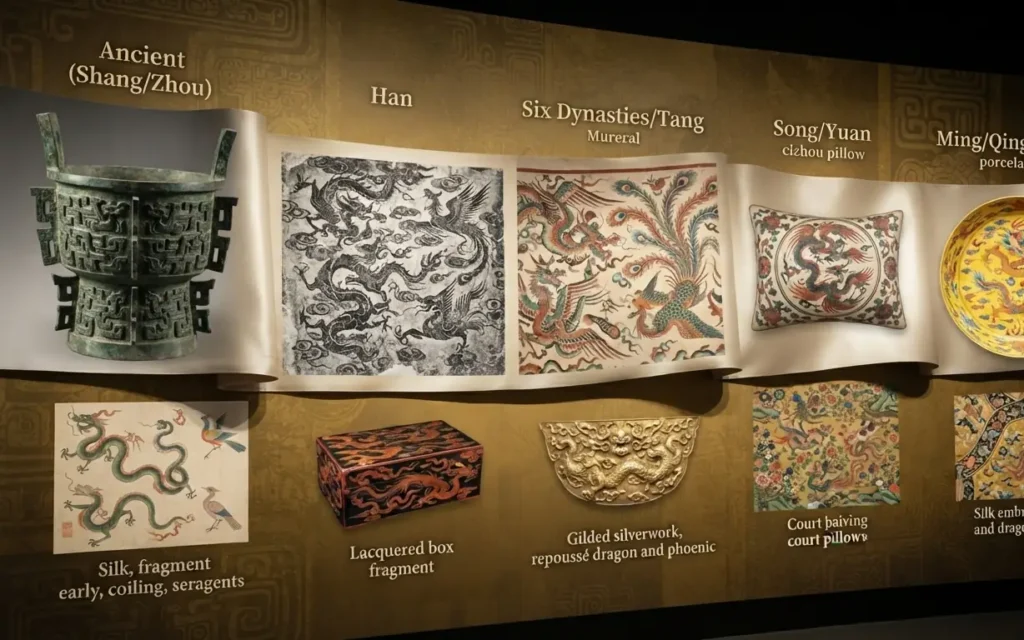
From Fluid Symbolism to Fixed Meaning
Understanding the dragon-phoenix pairing properly requires recognizing that its meaning wasn’t static across Chinese history. Earlier periods used the imagery more loosely, sometimes without the strict yin-yang gendered assignment that later became standard.
The formalization into the specific emperor-dragon, empress-phoenix relationship that most people associate with the pairing today developed gradually, becoming most rigid during the Ming and Qing Dynasties when imperial regulations around dragon imagery specifically became legally codified.
Folk tradition, meanwhile, preserved a broader and more flexible use of the pairing that never depended on imperial regulation, which is exactly why the marriage symbolism survived the fall of the imperial system entirely intact. The cosmological logic underneath the pairing didn’t need an emperor and empress to remain meaningful. It only needed the underlying yin-yang framework, which continued regardless of who governed China.
Where You Still See the Pairing Today
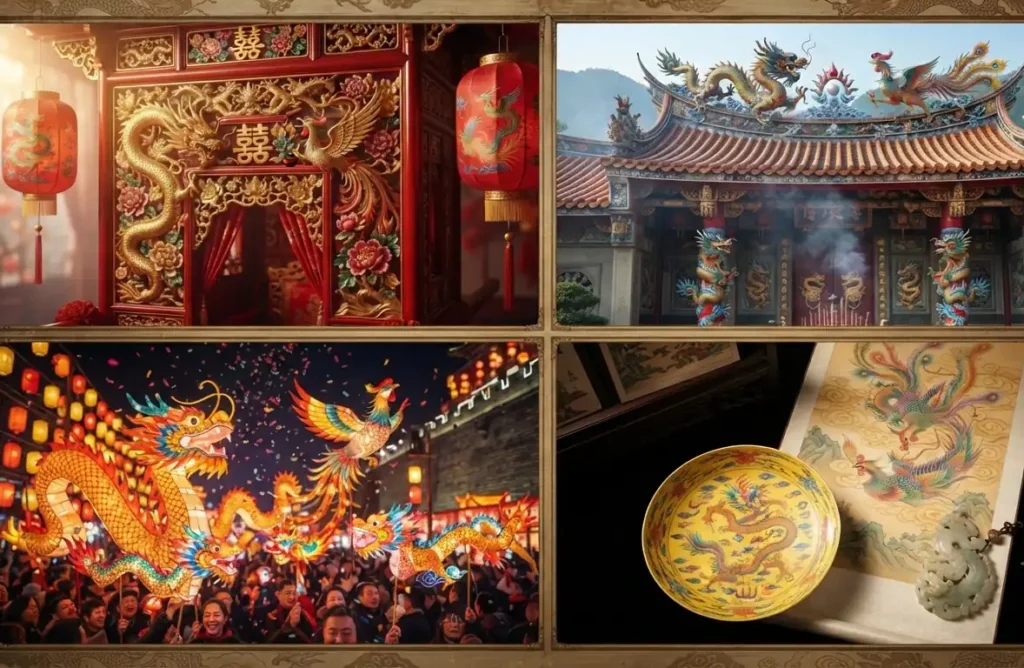
Living Tradition, Not Historical Curiosity
The dragon and phoenix pairing remains genuinely active in Chinese cultural life rather than existing only as historical or museum content.
Contemporary Chinese weddings across mainland China, Taiwan, Hong Kong, and diaspora communities globally continue to feature dragon and phoenix imagery on invitations, decorations, and bridal wear. Traditional Chinese architecture, particularly temple and palace complexes preserved as heritage sites, displays the pairing throughout decorative programs.
Chinese New Year celebrations, jewelry design, and textile arts all draw on the same symbolic vocabulary.
The pairing survived the end of the imperial system precisely because its deepest meaning was never really about the emperor and empress specifically. It was always about the underlying cosmological principle those two figures happened to embody for several centuries. The principle outlasted the political arrangement.
Frequently Asked Questions
Is the Chinese phoenix the same creature as the Egyptian or Greek phoenix?
No. The Fenghuang doesn’t die in flame and resurrect from ashes the way the Greek and Egyptian phoenix traditions describe. It’s a composite mythical bird associated with grace, virtue, and harmony rather than with death and rebirth. The shared English translation obscures genuine differences between these traditions.
What’s the difference between the Fenghuang and the Vermilion Bird?
The Vermilion Bird, Zhuque, is one of the Four Holy Beasts guarding the southern cardinal direction within a specific four-quadrant cosmological system. The Fenghuang is a separate, singular auspicious creature outside that system, associated with virtue and harmony rather than with a cardinal direction. They’re frequently confused but are distinct figures.
Why does the phrase Longfeng Chengxiang appear at Chinese weddings?
The phrase means “dragon and phoenix bring prosperity” and invokes the same yin-yang complementary principle that the dragon and phoenix represent cosmologically, applied to the union of a married couple. It calls on cosmic harmony as a blessing for the marriage, which is why the imagery remains standard in Chinese wedding culture today.
Was the dragon-phoenix pairing always associated specifically with the emperor and empress?
Not from the beginning. The strict imperial gendered association became formalized primarily during the Ming and Qing Dynasties, when dragon imagery was legally restricted to the emperor. Earlier periods, including the Han and Tang Dynasties, used dragon and phoenix imagery together more fluidly, without the same fixed political meaning.
Does the Fenghuang have a fixed gender in classical tradition?
Not originally. Some classical sources describe feng (鳳) as a male bird and huang (凰) as a distinct female bird, combined into the single term Fenghuang. Over centuries, the combined figure became associated primarily with femininity specifically to pair symbolically with the masculine dragon in imperial and marital contexts.
Final Thoughts
10 years of following Chinese mythology has taught me that the pairings a culture keeps returning to are usually doing more work than they first appear to do.
The dragon and Fenghuang aren’t simply two impressive mythical creatures that happen to look good together in decorative art. They’re a complete statement about what Chinese cosmological thinking considers a properly balanced world: active and receptive, power and grace, authority and the virtue that legitimizes it.
That’s why the pairing outlasted the empire that once formalized it into imperial regulation. It was never really about the throne. It was about a much older idea: that nothing is complete until its complementary half is standing beside it.
Further Reading
- Book of Changes (Yijing) – Chinese Texts Project
- Book of Songs (Shijing) – Chinese Texts Project
Metropolitan Museum – Dragon and Phoenix dish - Metropolitan Museum – Five Phoenixes
- Metropolitan Museum – Phoenix Robe
- Metropolitan Museum – Qing Imperial Robe
- Yang, Lihui, Deming An & Jessica Anderson Turner. Handbook of Chinese Mythology. Oxford University Press, 2005.
Related Articles
- Dragon Mythology: How Dragons Are Depicted Across Cultures
- 11 Chinese Dragon Types & the Legends Behind Their Powers
- Loong: Chinese Dragon Myths, Symbolism & Sacred Power
- 9 Chinese Dragon Colors & What Each One Means in Mythology
- 9 Rare Chinese Dragon Creatures Most People Never Encounter
- 7 Best Dragon Rings For Men That Look Premium
- 15 Most Iconic Fantasy Creatures: East & West Mythology
- Why Dragons Are Almost the Perfect Mythological Creature