
 By
By Quick Takeaways:
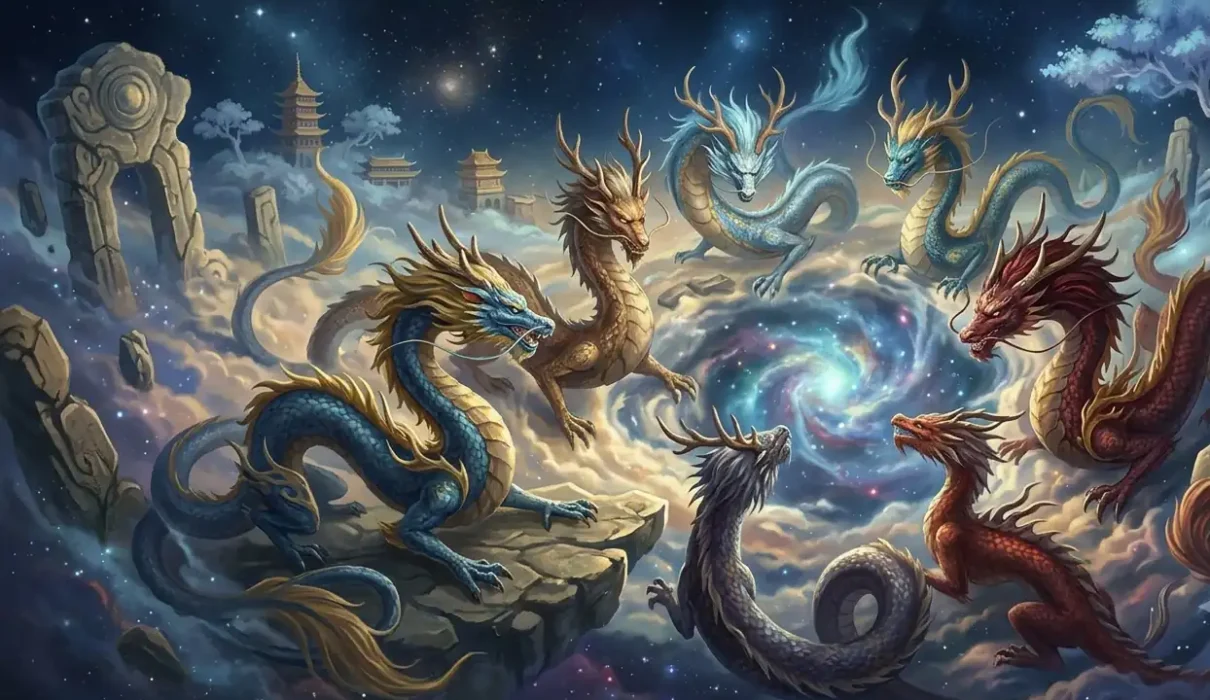
- Classical Chinese texts describe far more Chinese dragon creatures than the famous Dragon Kings and Azure Dragon that dominate popular accounts
- The Shanhaijing (Classic of Mountains and Seas) and related classical texts are the primary sources for most of these rare beings
- Several of these creatures were functionally distinct from the main Long dragon type, with different characteristics, different relationships to humans, and different mythological roles
- Some represent developmental stages in a dragon’s life rather than distinct species: young dragons, hornless variants, intermediate forms
- Understanding these creatures gives you a much richer picture of how Chinese mythological tradition thought about draconic nature as a broad category with many expressions
10 years of studying Chinese mythology has taught me that the famous figures are always the surface. The Dragon Kings, the Azure Dragon, the Yellow Dragon: these get all the attention because they’re cosmologically significant and artistically prominent.
Dig deeper into the Shanhaijing, the Bencao Gangmu, the Shuowen Jiezi, and the accumulated classical commentary tradition, and you’ll find a much richer taxonomy of dragon-type beings. Nine of them are worth knowing on their own terms.
1. Kui: The One-Legged Drum Dragon
What It Is
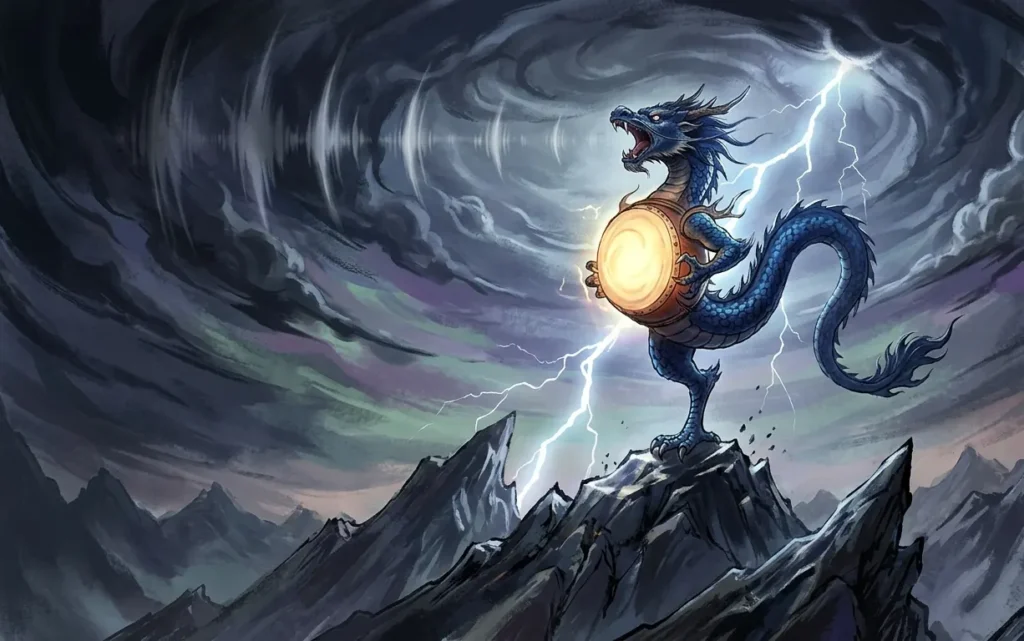
The Kui is one of the strangest creatures in the entire Shanhaijing, and one of the most memorable once you’ve encountered it. It’s described as resembling an ox but with a single leg, a blue-green body, no horns, and the remarkable ability to cause storms when it enters or exits the water of the Eastern Sea. Its call sounds like thunder.
The text explicitly classifies it as a type of dragon, though its ox-like body and single leg distinguish it dramatically from the composite Loong form.
The Legend
The Yellow Emperor (Huangdi) captured a Kui, killed it, and used its hide to make a war drum. When struck with a bone from the Thunder Beast, this drum could be heard five hundred li in every direction. Huangdi used this drum in his legendary campaigns against the rebel Chi You.
I find this myth genuinely remarkable because it positions the Kui as both a powerful cosmological being and a craftable material resource. The drum made from its hide isn’t just an instrument. It’s a captured cosmic power, the Kui’s thunder-causing nature domesticated into a military asset.
Symbolic Significance
The single leg has generated considerable classical commentary. Some sources interpret it as an artistic convention emphasizing the creature’s fundamental unity rather than literal anatomy. Others take it as a literal physical characteristic marking the Kui as a categorically different kind of being from the standard four-legged dragon variants.
The storm-causing quality when it enters or exits water connects it to the broader tradition of Chinese water dragons as weather-governing beings, even in this unusual form.
Read: 12 Best Dragon Books of 2026 [From the Hobbit to Seraphina]
2. Chi: The Hornless Mountain Dragon
What It Is
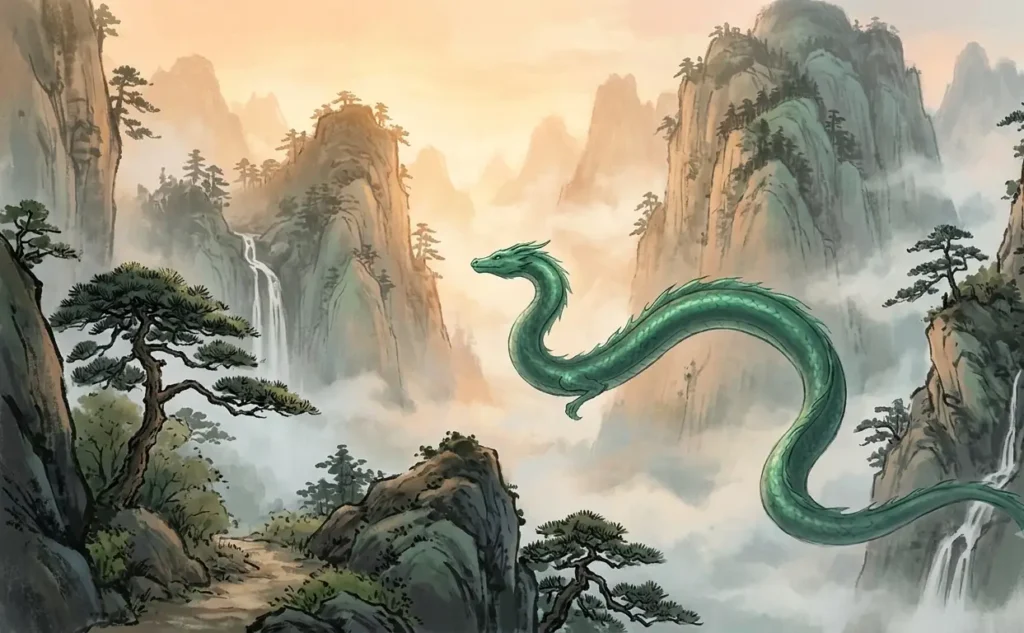
The Chi is specifically described in classical Chinese texts as a young dragon that has not yet grown its horns. It’s associated with mountains rather than water, which distinguishes it from the predominantly aquatic mainstream Long tradition.
The Shuowen Jiezi describes the Chi as a hornless dragon, placing it in the category of dragon-type beings defined by what they lack rather than what they have. The hornless status connects to the developmental timeline documented in the Bencao Gangmu: dragons grow horns at approximately 1,000 years old. A Chi is therefore an ancient but pre-horned dragon still in the mountain phase of its existence.
Artistic Presence
The Chi appears frequently in Chinese decorative art, often in contexts where the full five-clawed imperial Long would be inappropriate or unavailable. Chi imagery decorates architectural elements, bronze vessels, and carved objects across multiple dynasties.
The typical Chi depiction shows a serpentine body more compact than the Long’s elongated form, typically without the Long’s elaborate nine-animal composite features, and without horns. It tends to coil and curl in patterns that made it ideal for ornamental borders and architectural decoration.
The Mountain Connection
The Chi’s mountain association is worth understanding on its own terms. Mountains in Chinese cosmological tradition are places of accumulated earth energy, of intersection between the earthly and celestial realms, and of gathered mineral wealth.
A dragon type specifically associated with mountains rather than water governs a different domain of natural power than the standard water-associated Long. The Chi’s presence in mountain regions in classical texts connects it to the earth-element dimension of dragon nature rather than the water-element dimension that dominates mainstream dragon mythology.
3. Teng She: The Cloud-Riding Serpent
What It Is
The Teng She is a flying serpent that moves through clouds and mist without wings, distinguished from the main Long type by its specifically serpentine form (closer to a snake than to the composite-animal Long) and its specific association with cloud riding.
Some classical commentators treat the Teng She as a dragon variant. Others classify it separately as a distinct category of supernatural serpent. The ambiguity itself is interesting, reflecting the classical tradition’s recognition that the boundary between “dragon” and “supernatural serpent” was genuinely blurry at the edges of the taxonomy.
Powers and Character
The Teng She’s characteristic ability is movement through atmospheric phenomena rather than through air directly. It doesn’t fly in the way a bird flies. It inhabits the clouds, moving through them as easily as a fish moves through water.
Classical texts associate the Teng She with divination and with the passage of omens between celestial and earthly realms. A Teng She sighting in specific cloud formations was interpreted as carrying specific divinatory meaning about coming events. The cloud-riding serpent becomes a messenger in this interpretive tradition: not carrying explicit messages but marking the conditions in which specific predictions were appropriate.
4. Qiu Long: The Young Coiled Dragon
What It Is
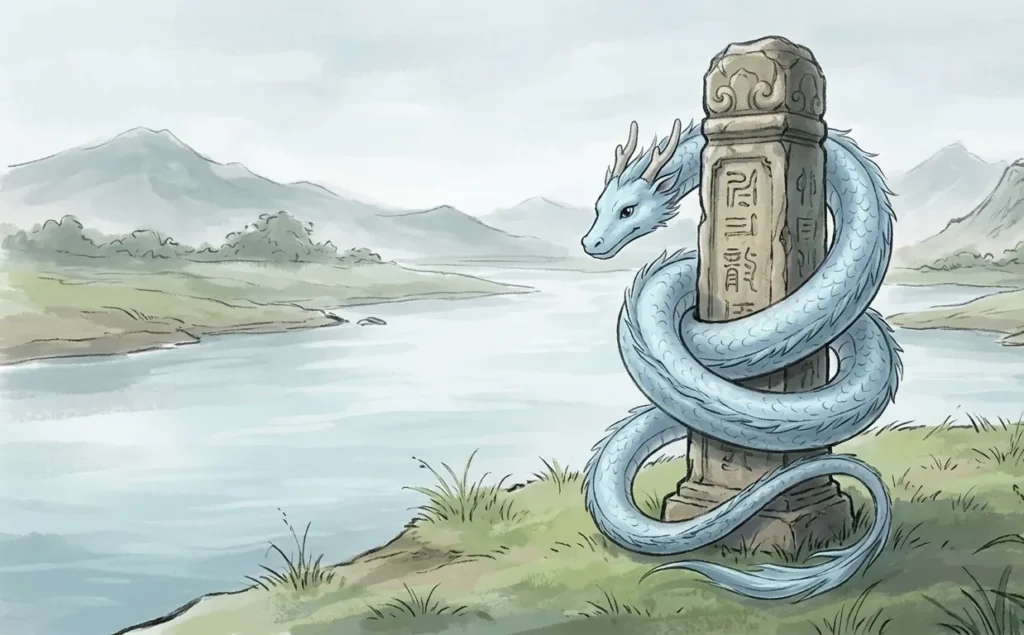
The Qiu Long is another developmental-stage dragon type, specifically identified as a young dragon in the period before it has grown both horns and wings. The name Qiu appears in classical poetry and texts as a descriptor for young, powerful, coiling dragon energy.
Different classical sources provide different technical specifications for exactly what distinguishes a Qiu Long from other developmental stages. The most consistent element is the coiling energy, a concentrated, inward, wound-spring quality that mature dragons don’t exhibit in the same way.
In Classical Literature
The Qiu Long appears more frequently in classical Chinese poetry than in mythological texts, which is itself interesting. Poets used Qiu Long imagery to convey concentrated power, youth combined with formidable capability, and the specific energy of something that hasn’t yet fully extended itself.
The coiling quality made Qiu Long imagery particularly useful for describing things that contain more than they appear to from the outside, situations where obvious display wasn’t matching the actual capability present.
This literary usage reflects something real about how the classical tradition understood this stage of dragon development: the Qiu Long’s coiling isn’t weakness or limitation but a specific expression of gathered potential not yet released.
5. Li Long: The River Scale Dragon
What It Is
The Li is among the most difficult dragon-type beings to pin down precisely, partly because different classical texts use the term somewhat differently. The most consistent usage describes a small-scale dragon being specifically associated with river environments, distinguished from the Jiaolong (which tends toward larger and more destructive forms) by its smaller size and less catastrophically powerful nature.
I want to be honest about the interpretive complexity here. The Li dragon category involves some genuine scholarly disagreement about what exactly is being described in classical texts. What’s consistent is a class of smaller, river-associated dragon-type beings that form the lower end of the draconic hierarchy in specific water environments.
Role in River Ecology Mythology
The Li tradition, however precisely defined, reflects an important aspect of how Chinese mythology organized its understanding of river environments. Not every river supernatural being was a Dragon King level entity. Rivers had their own ecosystems of supernatural beings at multiple scales and power levels.
The smaller river-associated dragon creatures like the Li governed the day-to-day supernatural ecology of river environments in ways that the Dragon Kings, with their more cosmic responsibilities, weren’t directly involved in. They’re the local officials in the divine bureaucracy of Chinese rivers, managing specific reaches and pools with local rather than cosmic authority.
6. Hanba: The Drought Creature of Dragon Origin
What It Is
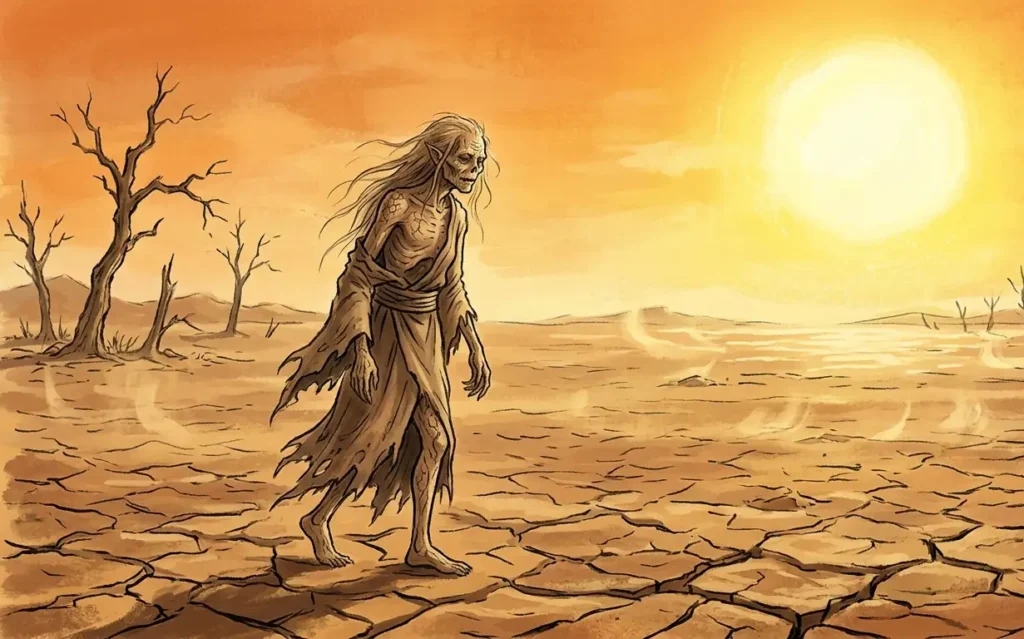
The Hanba (also called Nüba) is a drought-causing being whose classical descriptions give her characteristics that connect her to the broader dragon-adjacent tradition. She’s described in the Shanhaijing as a divine being associated specifically with drought, her presence causing rainfall to cease wherever she goes.
Her connection to dragon mythology comes through her role in the Yellow Emperor’s campaigns against Chi You. After participating in these cosmic battles, she found herself unable to return to heaven and settled in the mortal world, causing persistent drought wherever she resided.
The Drought Connection
What makes the Hanba relevant to a discussion of dragon creatures is her role as a deliberate counterpart to the rain-bringing Dragon King tradition. Where Dragon Kings bring water, the Hanba removes it. Where Dragon King worship was aimed at summoning rain, specific folk religious traditions developed ritual responses to Hanba’s presence aimed at driving away drought.
The tradition that drought could be caused by a specific supernatural being, rather than simply being the absence of rain, gave communities a more actionable mythological framework. You couldn’t negotiate with absent rain. You could potentially address the entity causing its absence.
Read: The Forgotten Female Dragons of Chinese Mythology
7. Ying Long Remnants: Earth-Shaping Dragon Lineages
What It Is
This entry requires some explanation because it’s not a single creature type but a specific mythological tradition about what happened to the Yinglong after its famous service in the Yellow Emperor’s wars.
After helping Huangdi defeat Chi You by using water-based tactics, the Yinglong (Winged Dragon) settled in the south of China rather than returning to the celestial realm. This settlement was understood to have consequences: the Yinglong’s presence in a region influenced its weather, its water patterns, and its landscape features.
The local dragon lineages that developed in regions where the Yinglong was said to have settled are a specific category of regional dragon creatures: beings that inherited partial Yinglong nature and governed local weather patterns as a consequence.
Regional Dragon Traditions
Different southern Chinese regions developed specific local dragon traditions that they traced to the Yinglong’s settlement in their area. These regional dragon beings were understood as direct descendants or transformations of Yinglong energy that had taken local form.
These regional beings are among the most genuinely obscure in Chinese dragon mythology because they’re by definition local. They weren’t part of the standardized cosmological framework that the Dragon Kings represent. They were specific to particular valleys, rivers, and mountains in southern China.
The tradition of the Yinglong’s descendants as local guardian dragons is one of the aspects of Chinese dragon mythology that didn’t survive into the mainstream literary and imperial traditions but persisted in regional folk practice.
8. Zhu Long Regional Variants: Local Torch Serpents
What It Is
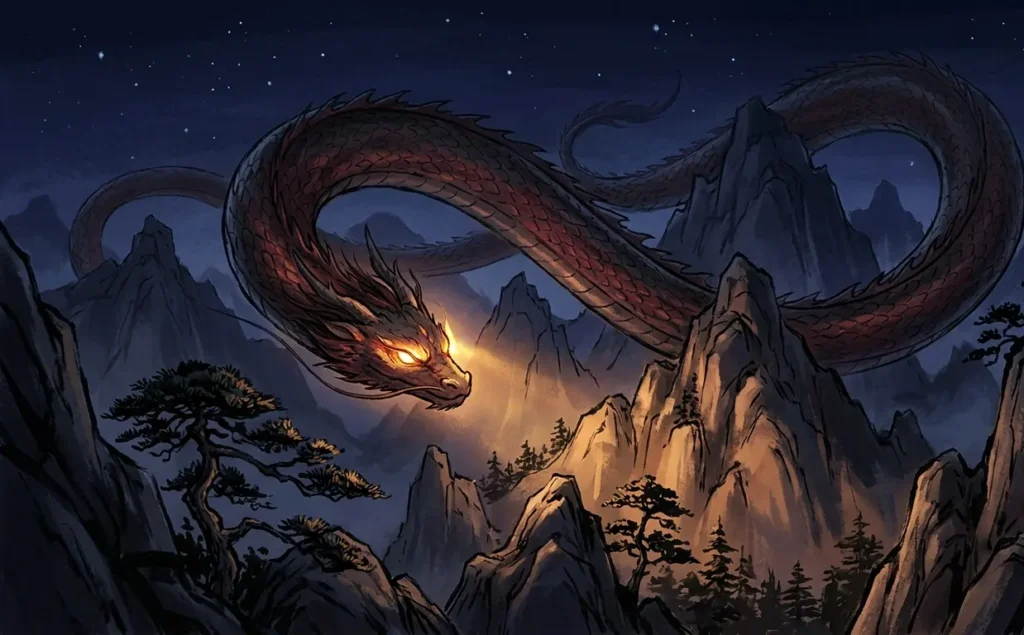
The Zhulong, the great Torch Dragon of the Shanhaijing whose opening and closing eyes create day and night, is described in that text as residing at a specific location at the world’s edge. But classical regional mythology also describes smaller-scale torch serpent beings whose luminous properties are similar but whose cosmic scale is local rather than universal.
These regional torch serpents are described in various texts as inhabiting specific mountain caves or deep gorges, their natural luminosity illuminating underground spaces, their presence associated with both danger and the discovery of mineral deposits.
The connection to the great Zhulong is one of quality rather than identity: these local luminous serpents share the torch dragon’s light-producing characteristic without sharing its cosmological function of creating day and night.
Cultural Significance
The local torch serpent tradition explains several Chinese folk beliefs about glowing phenomena in dark places. Caves that seemed to emit light, underground spaces where luminosity appeared without obvious source, phosphorescent phenomena in specific geological contexts: all of these were potentially explained by the presence of torch serpent beings inhabiting those locations.
This is one of the clearest examples of how a cosmologically significant dragon being (the Zhulong) generated a whole family of smaller-scale folk beliefs about luminous creatures in dark places, the cosmic principle expressed at local scale in ways that connected everyday experience to the great mythological tradition.
9. Fang Long: The Directional Dragon Variants
What It Is
The concept of directional-specific dragon variants, beyond the standard Four Holy Beasts framework, appears in specific Daoist ritual and cosmological texts that describe the different qualities of dragon energy in each of the four quadrants of the sky and the center.
The Fang Long tradition describes how the general Long principle manifests differently in each direction, producing dragon-type energy with specific elemental and directional qualities depending on which quadrant it occupies. A dragon energy concentrated in the northern quadrant has a different character from the same energy in the southern quadrant, even if the creature is not cosmologically distinct from the mainstream Long.
I want to be specific about the nature of this entry: the Fang Long tradition is more of a cosmological system than a specific creature taxonomy. It’s the classification of dragon-type beings by their directional character as recorded in specific ritual texts.
Practical Application in Ritual
Daoist ritual practice that works with directional energy, including specific feng shui applications and ceremonial practices, draws on the Fang Long framework. The idea that summoning or working with dragon energy in different directions requires attention to the specific character that dragon energy takes in each direction reflects this tradition.
It’s one of the aspects of Chinese dragon mythology that’s most difficult to access from the outside because it exists primarily in specialized ritual texts rather than in the narrative literature that translation efforts have focused on.
Frequently Asked Questions
Where can I find these rare dragon creatures in classical sources?
The Shanhaijing (Classic of Mountains and Seas) is the primary source for Kui, Hanba, and several others. Anne Birrell’s English translation is the most accessible. The Shuowen Jiezi and Bencao Gangmu cover the developmental-stage types including Chi and Qiu.
Are these creatures worshipped in Chinese folk religion?
Rarely in standardized forms. These are primarily mythological and literary creatures rather than devotional figures. The Dragon Kings and local dragon deities receive active worship. The obscure creatures in this article appear in classical texts rather than temple traditions.
How confident are scholars about the exact characteristics of these creatures?
Confidence varies significantly. Kui is well-documented with consistent descriptions across multiple sources. Others, like the Li river dragon variants, involve genuine scholarly ambiguity about what exactly classical texts are describing. This article acknowledges that uncertainty where it exists.
Why aren’t these creatures better known if they appear in classical sources?
The mainstream dragon mythology (Dragon Kings, Qinglong, Huanglong) received sustained artistic, religious, and literary attention across centuries. These rarer types appear in specific texts but weren’t picked up by the imperial and devotional traditions that transmitted the famous types.
Do any of these creatures appear in Chinese art?
The Chi appears extensively in decorative art. The Qiu Long appears in classical poetry’s visual conventions. The Kui appears rarely, usually in academic illustration rather than mainstream decorative tradition. Most others are almost entirely textual rather than visual presences..
Final Thoughts
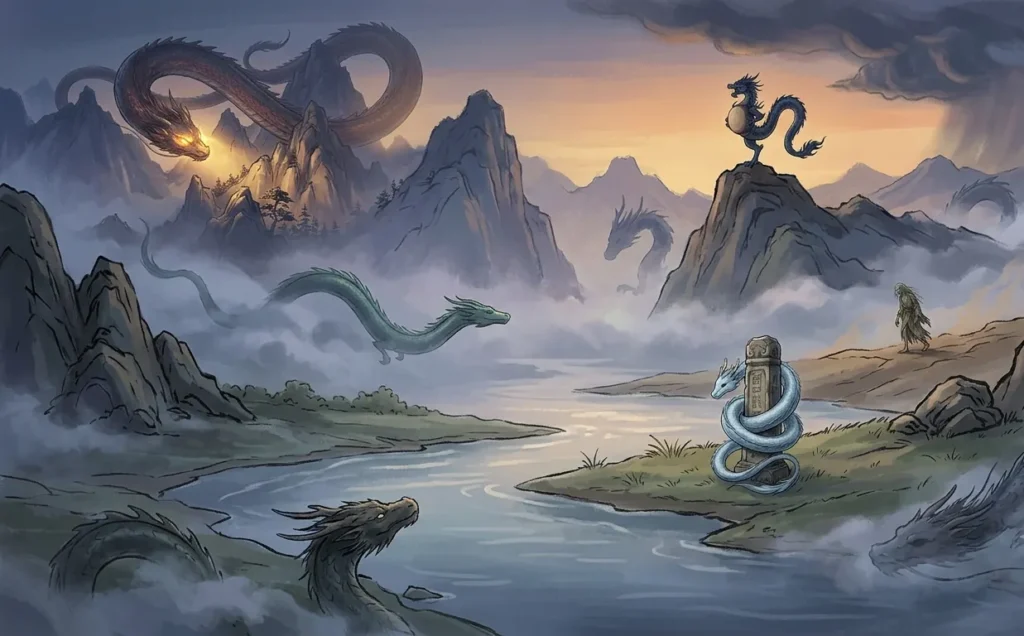
Nine creatures. Most of them will be genuinely new to readers who know Chinese dragon mythology from popular accounts.
The Shanhaijing alone contains enough strange and specific material to keep a serious mythology reader occupied for years. The developmental-stage types (Chi, Qiu), the single-legged storm drum (Kui), the drought being (Hanba), the cloud-riding serpent (Teng She): all of these exist in classical sources with enough consistency across multiple texts to confirm they’re genuine parts of the tradition rather than scribal errors or regional fabrications.
Mythology study has taught me that the edge of what’s commonly known is where the tradition gets most interesting. These nine creatures are at that edge.
References
- Allan, Sarah. The Shape of the Turtle: Myth, Art, and Cosmos in Early China. SUNY Press, 1991.
- Yang, Lihui, Deming An & Jessica Anderson Turner. Handbook of Chinese Mythology. Oxford University Press, 2005.
- Birrell, Anne. Chinese Mythology: An Introduction. Johns Hopkins University Press, 1993.
- The Huainanzi: A Guide to the Theory and Practice of Government in Early Han – An Liu
- Shan Hai Jing – Chinese Text Project
- The Flood Myths of Early China – Mark Edward Lewis
- Xu Shen. Shuowen Jiezi
- Compendium of Materia Medica: Bencao Gangmu
- The Taoist Body – Kristofer Schipper
Related Articles
- Dragon Mythology: How Dragons Are Depicted Across Cultures
- 11 Chinese Dragon Types & the Legends Behind Their Powers
- Loong: Chinese Dragon Myths, Symbolism & Sacred Power
- 9 Chinese Dragon Colors & What Each One Means in Mythology
- Four Dragon Kings: Guardians of China’s Seas & Weather
- Chinese, Japanese & Korean Dragons: How They Actually Differ
- Dragon & Phoenix: Chinese Myth’s Most Sacred Bond
- Zhulong: The Chinese Dragon Who Ruled Time Itself
Written by Batin Khan, a curious free spirit who loves reading and exploring the worlds of fantasy, mythology, and ancient stories. Through this blog, Batin hopes to share that sense of wonder with readers while building an exciting future along the way.