
 By
By Long before meteorology explained rainfall patterns or ocean currents, ancient Chinese civilization had a more vivid explanation: four dragon sovereigns ruled the seas, controlled the rains, and decided whether your crops would survive the season. These were the Four Dragon Kings, and for thousands of years, they were among the most actively worshipped divine figures in all of Chinese religion.
Understanding them requires setting aside everything Western mythology has taught you about dragons. What you’ll find instead is something far more interesting: a group of divine beings whose authority over water made them simultaneously the most feared and the most prayed-to figures in Chinese folk religion.
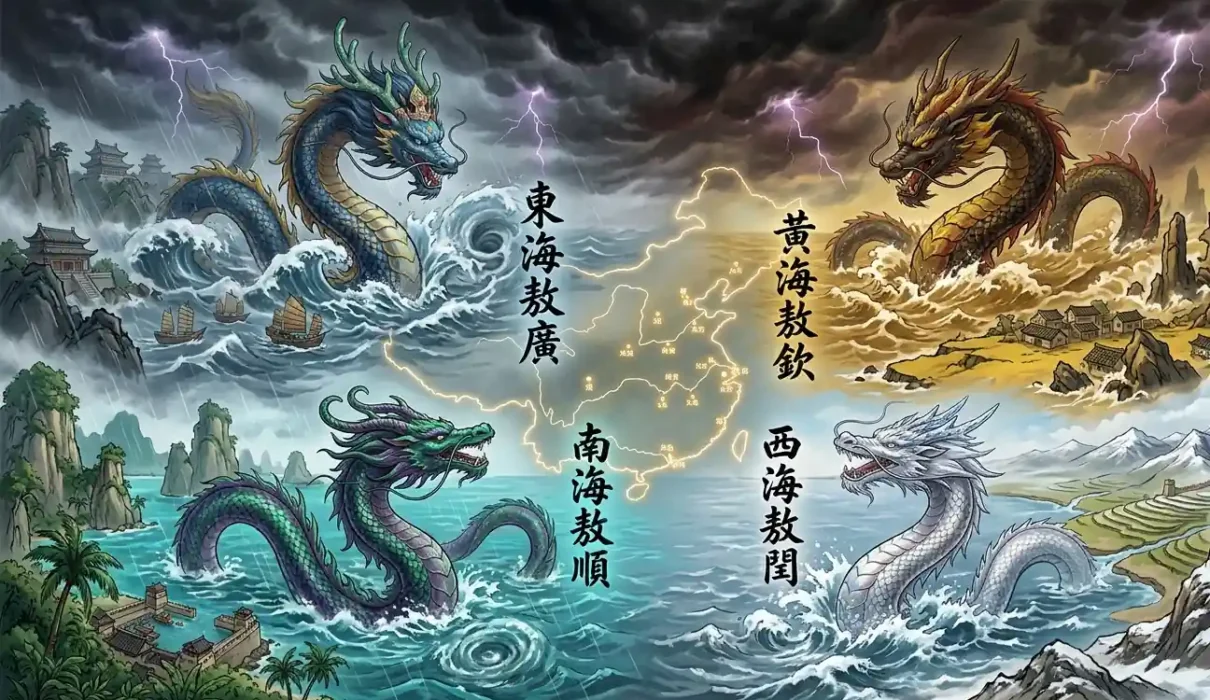
Who are the Four Dragon Kings?
Origins in Chinese Mythology
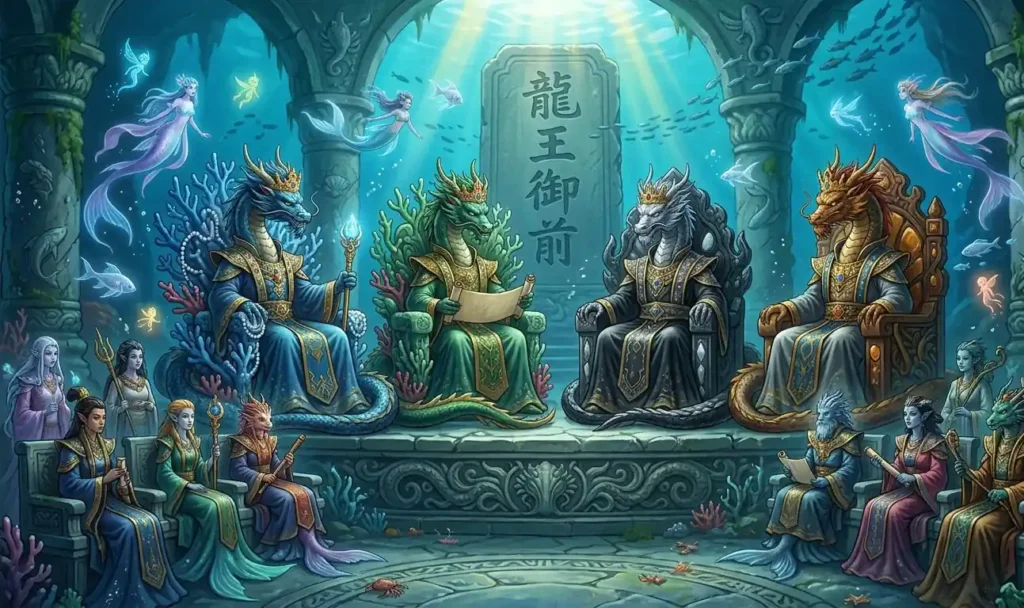
The Four Dragon Kings emerged from the intersection of ancient Chinese cosmology, agricultural need, and the tradition of the Loong (龍), the divine Chinese dragon.
Unlike their fire-breathing counterparts in European mythology, the Chinese Loong was understood as a fundamentally benevolent cosmic being. Water was its domain. Rain was its gift. The Dragon King tradition formalised this into a governing structure: four divine sovereigns, one for each of the four cardinal seas, responsible for all water-related phenomena within their jurisdiction.
The Dragon King tradition appears in texts from the Han Dynasty onward and becomes fully elaborated during the Tang and Song Dynasties, when Chinese folk religion organised its divine hierarchy into the comprehensive bureaucratic structure it maintains today.
Different from Western Dragons Entirely
This is worth stating clearly. The Four Dragon Kings don’t hoard gold, terrorize villages, or breathe fire. They govern water, control rainfall, and operate within the divine court’s administrative system as responsible officials of cosmic governance.
They have palaces beneath the sea. They command courts of marine beings. They can be prayed to, petitioned, and in drought situations, formally accused of negligence. The relationship between Chinese communities and their Dragon Kings was genuinely interactive, not merely reverential.
The Four Dragon Kings and Their Realms

The four kings are identified by the seas they govern and the cardinal directions those seas represent. Their names all share the prefix Ao (敖), a specific dragon name element that marks their family and divine lineage.
Ao Guang: Dragon King of the East Sea
Ao Guang governs the East Sea and commands the largest and most significant jurisdiction among the four. The East Sea carries specific cosmological weight in Chinese tradition because the east is the direction of spring, new beginnings, and the Azure Dragon of the four holy beasts.
Ao Guang’s responsibilities include:
- Governing the rainfall patterns of eastern China
- Managing the rivers that flow eastward into his sea
- Overseeing a vast court of marine creatures serving as his officials and soldiers
- Reporting water conditions to the Jade Emperor through the divine court hierarchy
Ao Guang is the Dragon King with the most mythological narrative attached to him. He appears prominently in Journey to the West as the reluctant donor of Sun Wukong’s staff. The Ruyi Jingu Bang had been used as a measuring instrument in Ao Guang’s palace for millennia. When Sun Wukong demanded it, the palace shook from the pillar’s removal.
The story reveals something specific about Ao Guang’s character: powerful enough to govern an ocean, but unable to refuse a visitor with enough audacity and strength to simply take what he wanted.
His other famous appearance involves Nezha, the divine marshal whose origin story includes killing Ao Guang’s son during a confrontation in the sea. The Dragon King’s subsequent attempt to seek imperial justice from the Jade Emperor became a narrative about the limits of divine legal process when faced with figures of exceptional power.
Ao Qin: Dragon King of the South Sea
Ao Qin governs the South Sea, which in the Chinese cosmological framework corresponds to the direction of summer, fire, and maximum yang energy.
The South Sea’s particular character is warmth. Ao Qin’s domain is the most abundant and life-giving of the four, receiving the most direct solar energy and producing the rainfall that feeds the agricultural heartlands of southern China. His responsibilities include governing the monsoon patterns that made rice cultivation possible across southeastern China.
Ao Qin’s court is described in classical texts as particularly magnificent, reflecting the abundance of his domain. The southern seas’ richness meant his treasury was the most extensive of the four Dragon Kings.
Regional worship of Ao Qin was particularly strong in southeastern China and among Chinese maritime communities whose fishing and trading depended on the South Sea’s conditions. Fishermen prayed to him before voyages, and returning sailors made offerings of thanks.
Ao Run: Dragon King of the West Sea
Ao Run governs the West Sea, associated with the direction of autumn, the Metal element, and the contracting, harvesting quality that the western direction represents in Chinese cosmological thinking.
The West Sea jurisdiction includes the waters and weather systems of western China, a geographically harsh region where water was precious and rain genuinely scarce. Ao Run’s governance of this domain gave him a specific character in the tradition: the Dragon King of a difficult territory, whose rain-bringing was more urgent and more precarious than his eastern and southern counterparts.
Ao Run receives less individual mythological attention than Ao Guang but maintains significant presence in the collective ritual traditions involving all four Dragon Kings. Western Chinese communities with limited water access maintained particularly devoted Dragon King worship traditions.
Ao Shun: Dragon King of the North Sea
Ao Shun governs the North Sea, associated with winter, the Water element, and the maximum yin energy of the northern direction.
The North Sea’s character is depth and stillness. Ao Shun’s domain is the coldest, the most inward, the furthest from the warm abundance of the south. His rainfall governance covers the northern regions of China where cold, dry conditions made agricultural water management a constant concern.
Of the four Dragon Kings, Ao Shun appears most in the context of extreme weather: the fierce winter storms and the spring floods that came when northern waters moved. His governance tradition emphasises not just rain provision but the management of water in its most forceful and potentially destructive expressions.
Why Ancient China Revered the Dragon Kings

Agriculture’s Absolute Water Dependency
Modern readers can underestimate how completely early Chinese civilization’s survival depended on rainfall arriving in the right quantity at the right time.
Rice cultivation in southern China required monsoon rainfall calibrated to specific seasonal windows. Grain cultivation in the north was equally sensitive to precipitation. A season of drought meant crop failure. Consecutive seasons meant famine. The beings responsible for rainfall weren’t objects of curiosity or philosophical interest. They were objects of genuine necessity.
Praying to the Dragon Kings wasn’t a ritual performed out of tradition. It was a practical response to the most urgent question every agricultural community faced every year: will the water come?
Drought Rituals and Extreme Measures
When rain failed, communities didn’t simply pray. They escalated through a specific ritual progression that demonstrates how seriously the Dragon Kings were taken as genuine administrative figures.
First came standard petitionary prayer with offerings. If that failed, the Dragon King’s image might be removed from its temple and exposed to direct sunlight, so it experienced the drought conditions its negligence was causing. If that failed, formal written accusations could be filed through the divine court system, treating the Dragon King’s rainfall failure as an official dereliction of duty requiring divine administrative correction.
This escalation structure reveals something important about Chinese folk religion’s relationship with its divine figures. The Dragon Kings weren’t owed deference regardless of performance. They had responsibilities, and failure to meet those responsibilities had consequences, even for cosmic beings.
Dragon King Temples
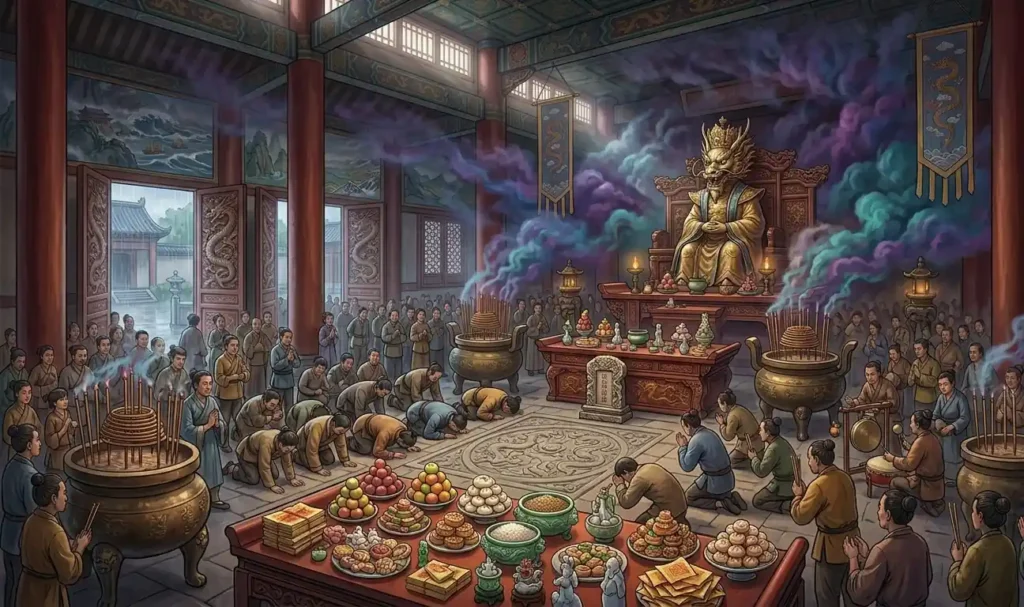
Dragon King temples (Lóng Wáng Miào) were among the most common religious sites in traditional China, found in virtually every community that depended on specific water sources.
A coastal fishing village had its Dragon King temple for safe voyages. An inland agricultural community had its temple for rainfall. River communities had temples for flood prevention. The specific Dragon King honoured varied by location and need, but the presence of a Dragon King temple was a near-universal feature of Chinese community religious geography.
Temple festivals, seasonal offerings, and community prayers maintained the relationship between local populations and their divine water governors throughout the agricultural year.
Dragon Kings in Chinese Folklore and Religion
Connections to Daoism and Buddhism
The Dragon King tradition sits at the intersection of multiple religious streams that converged in Chinese folk religion.
Daoist tradition incorporated the Dragon Kings into its divine court hierarchy, giving them specific ranks and responsibilities within the cosmological administrative system. Daoist practitioners who worked with water energy and weather ritual operated with the Dragon Kings as the relevant divine authorities.
Buddhist tradition brought its own Naga serpent-deity tradition into dialogue with the Chinese Dragon King mythology. Buddhist cosmology described dragon kings (naga-rajas) as powerful beings who inhabited water realms and could be propitiated for rain. The convergence of these traditions deepened and complicated the Dragon King mythology while expanding its ritual vocabulary.
Popular Legend and Folklore
Beyond the formal religious traditions, the Dragon Kings generated an extensive popular folklore.
Stories of Dragon King daughters who married human heroes are a recurring narrative pattern. The mortal who wins a Dragon King’s gratitude through some act of service or courage, then receives permission to marry into the dragon family, appears across multiple Chinese regional traditions.
Dragon King palace visits by human heroes are another persistent narrative category. The underwater palace, with its crystal halls, treasure vaults, and courtly marine beings, became a standard setting for adventure stories involving mortals who had earned the right to visit.
The Dragon Kings’ role in the Journey to the West narrative gave them their most widely known fictional characterizations, presenting them as powerful but fallible divine beings navigating the same bureaucratic constraints as every other figure in the Jade Emperor’s court.
Symbolism of the Four Dragon Kings
Water as Life’s Foundation
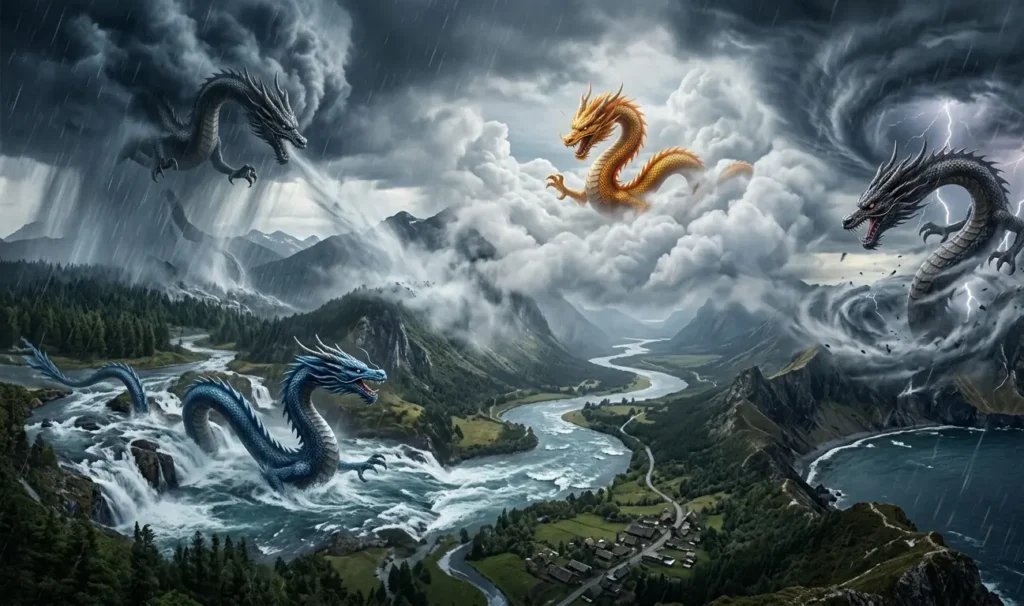
The Dragon Kings’ most fundamental symbolic role is as embodiments of water’s life-giving character.
Water in Chinese philosophical tradition carries the qualities of the northern direction and the Water element in Wu Xing cosmology: depth, stillness, patient persistence, hidden potential, and the paradoxical strength of yielding. The Dragon Kings aren’t just rain-bringers. They’re the cosmic expression of what water actually is in this tradition: the most fundamental sustaining force, the thing that makes everything else possible.
Balance and the Four Directions
Four Dragon Kings for four seas and four directions reflect the Chinese cosmological tradition’s commitment to organizational completeness. The four directions, the four seasons, the four guardian beasts (Si Xiang), and now the four sea sovereigns all work together to describe a complete, balanced cosmic geography.
No direction is ungoverned. No sea is without its divine authority. The four kings together constitute a complete system of water governance that covers the entire known world.
Heaven, Earth, and Humanity in Alignment
The Dragon Kings’ bureaucratic structure, operating within the Jade Emperor’s divine court and responsive to human petition, embodies the Chinese religious tradition’s characteristic vision of a well-ordered cosmos.
Heaven governs. Earth responds. Humanity aligns itself with both through an appropriate ritual relationship. The Dragon Kings are part of the mechanism through which this three-level alignment actually functions, turning cosmic principle into specific, practical weather outcomes.
Legacy and Cultural Influence
Modern Festivals and Living Traditions
The Dragon Kings remain genuinely present in contemporary Chinese religious practice.
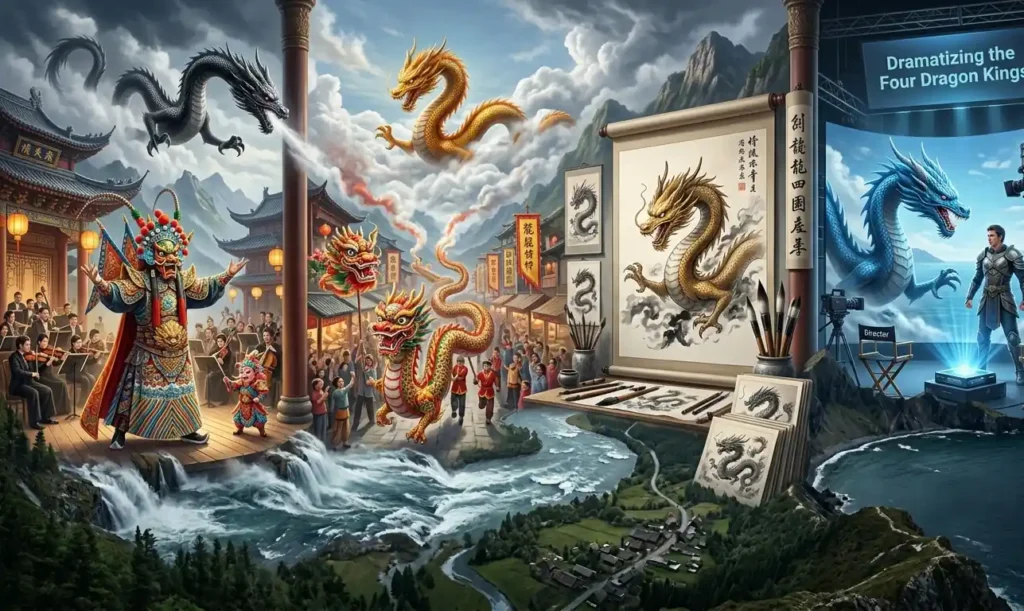
Dragon King temple festivals continue throughout China, Taiwan, and Chinese diaspora communities globally. The Dragon Boat Festival, which has spread to international recognition, carries Dragon King associations in some of its origin traditions. Fishing communities across Southeast Asia maintain active Dragon King worship as a practical preparation for each new fishing season.
Specific communities in coastal China celebrate Dragon King birthdays with elaborate ceremonial events that draw significant participation. These aren’t heritage performances staged for tourists. They’re functioning religious events that communities consider genuinely important.
Art, Literature, and Popular Culture
The Four Dragon Kings have been a continuous subject of Chinese visual and literary art across centuries.
Classical paintings depicting underwater Dragon King palaces constitute a distinct genre of Chinese art. Temple murals show the kings in their courts receiving petitions and governing their watery domains. Dragon King imagery appears on ceramics, textiles, architectural decoration, and the full range of Chinese decorative arts.
The late-Ming novel Investiture of the Gods features the Dragon Kings prominently in its narrative of divine warfare and cosmic conflict. Their characterizations there influenced how subsequent Chinese literature and drama treated the figures.
Contemporary Chinese film and television regularly draws on Dragon King mythology, finding new audiences for stories that have been told for a thousand years.
Frequently Asked Questions
Who are the Four Dragon Kings in Chinese mythology?
The Four Dragon Kings are powerful dragon deities who rule the four seas surrounding the world in Chinese mythology. They are responsible for controlling rain, storms, rivers, and other water related forces that were essential to daily life.
What does each Dragon King rule?
Each Dragon King governs a specific sea and direction. Ao Guang rules the East Sea, Ao Qin the South Sea, Ao Run the West Sea, and Ao Shun the North Sea. Together, they oversee water and weather across the world.
Are the Four Dragon Kings considered gods?
Yes, they are often regarded as divine rulers of water and weather. In traditional beliefs, people viewed them as powerful supernatural beings capable of bringing rain, calming storms, or causing floods when angered.
Do people still visit Dragon King temples today?
Yes. Many historic Dragon King temples still attract visitors, worshippers, and tourists. Some communities continue traditional ceremonies that honor the Dragon Kings and seek blessings for rain, prosperity, and good fortune.
Are the Four Dragon Kings related to the Chinese zodiac dragon?
They share dragon symbolism but serve different roles. The zodiac dragon represents personality traits and fortune, while the Four Dragon Kings are mythological rulers responsible for governing seas, rainfall, and weather.
Final Thoughts – The Dragon Kings Today
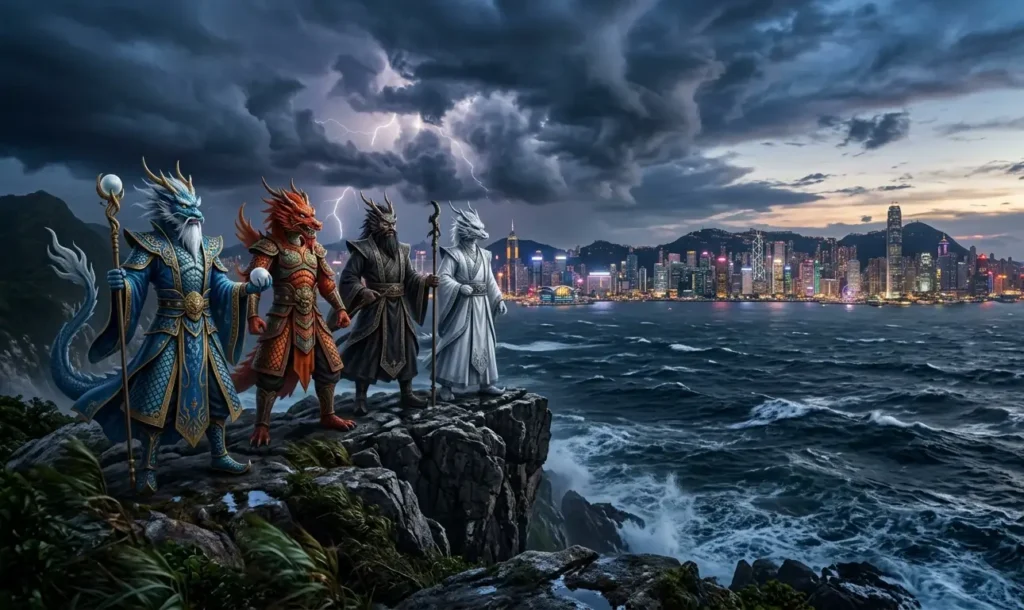
Dragon Kings survived cultural transformation precisely because the needs they address are permanent.
Water anxiety is not a historical curiosity. Concern about rainfall, about floods, about the ocean’s safety for those who work it, these are as immediate today as they were for Tang Dynasty farmers. The specific ritual forms through which communities address that anxiety have changed, but the underlying relationship between human beings and the water systems they depend on has not.
The Four Dragon Kings are guardians of the seas and weather because seas and weather need guardians. Not because we can’t explain meteorologically what they do, but because explanation and reverence aren’t mutually exclusive. A fishing community that understands weather systems can still find meaning in the tradition that names a sovereign behind those systems and provides a ritual language for living alongside the ocean’s power.
That’s why these four ancient figures still have temples. Still receive offerings. Still appear in art made today by artists who grew up with these stories. The seas they guard are still there. The rain they send is still essential.
Some guardians don’t retire.
Sources and Further Reading
- Birrell, Anne. Chinese Mythology: An Introduction.
- Kohn, Livia. Daoism and Chinese Culture.
- Allan, Sarah. The Shape of the Turtle.Hanshu (Book of Han).
- Shanhaijing (Classic of Mountains and Seas).
- Shiji (Records of the Grand Historian).
- Investiture Of The Gods
- Journey To The West
- The Book of Rites
- Book of Changes: Yi Jing
- Dragon Kings and Thunder Gods: Rainmaking, Magic, and Ritual in Medieval – Joshua Capitanio, Anna Roszkowski
Related Articles
- Dragon Mythology: How Dragons Are Depicted Across Cultures
- 11 Chinese Dragon Types & the Legends Behind Their Powers
- Loong: Chinese Dragon Myths, Symbolism & Sacred Power
- 9 Sons of the Dragon: What Each One Guards in Chinese Myth
- The Forgotten Female Dragons of Chinese Mythology
- 11 Eastern Dragon Legends Still Shaping Fantasy Today
- 9 Chinese Dragon Myths Born From Real Natural Disasters