
 By
By Quick Takeaways:
- Several of modern fantasy’s most recognizable tropes trace directly to Eastern dragon legends rather than European sources, which most readers assume
- The size-changing weapon, the undersea palace, the dragon pearl, the weapon hidden inside the monster, and the transformation-through-ordeal structure all have specific Eastern dragon mythological origins
- The influence often came through Japanese popular culture, which absorbed Chinese dragon mythology and transmitted it globally
- Understanding the specific source legends makes both the mythology and the fantasy traditions that drew on them considerably more interesting
- Every legend in this article comes from documented classical sources, not from modern reinterpretations of those sources
Modern fantasy is built on more Eastern mythology than most Western readers realize. The genre’s European medieval aesthetic is the surface. Underneath it, especially in the past forty years, a significant amount of dragon mythology has arrived from Chinese, Japanese, and Korean classical traditions.
Some of this influence is direct. Some came through intermediary traditions. Some arrived so gradually and through so many filters that even the authors using these concepts may not have consciously connected them to specific Eastern legends. But the connections are there, and tracing them back to their classical sources reveals some genuinely satisfying things about where modern fantasy’s most beloved tropes actually came from.
Here are eleven Eastern dragon legends with traceable influence on how fantasy treats dragons, weapons, transformations, and the relationship between the divine and the natural world.
1. The Dragon Gate Legend and Transformation Through Ordeal
The Legend
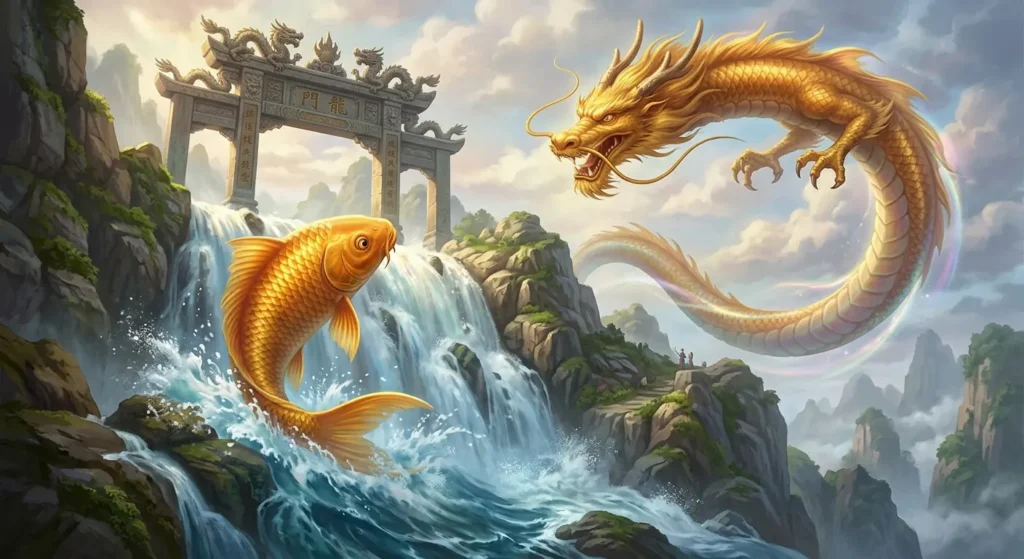
The Longmen (Dragon Gate) legend describes a waterfall on the Yellow River where carp swim upstream each spring to attempt the leap through the falls. Those who succeed transform into dragons. Those who fail return downstream unchanged.
The transformation is immediate, total, and earned. The carp doesn’t gradually become more dragon-like. It’s a fish, it makes the leap, it becomes a dragon. The effort is the qualifier, and the moment of success produces a categorical change in nature rather than a quantitative improvement.
The Fantasy Influence
The “ordeal that transforms rather than merely strengthens” is one of fantasy’s most fundamental narrative structures, and the Dragon Gate legend is the clearest classical precedent for its specific form: the single moment of challenge that separates what you were from what you become.
This isn’t the same as the Western hero’s trial, which typically produces the hero’s recognition or the completion of a quest. The Dragon Gate transformation produces a change in fundamental nature. The carp that crosses is not a better carp. It’s no longer a carp at all.
Fantasy uses this structure constantly: the protagonist who completes the right ordeal doesn’t just gain power but becomes something different in kind. The Dragon Gate is the mythological origin of that narrative beat.
2. Yamata no Orochi and the Sword Inside the Monster
The Legend
The Kojiki describes Yamata no Orochi, the eight-headed serpent whose defeat by Susanoo produced the divine sword Kusanagi from within one of the creature’s tails. The sword was inside the dragon. Killing the dragon revealed the weapon.
Kusanagi subsequently became one of Japan’s three imperial treasures. The sword hidden inside the adversary is one of Japanese mythology’s most significant narrative revelations.
The Fantasy Influence
The concept of the weapon hidden inside the monster is a direct inheritance from this tradition. Fantasy regularly places its most powerful or most significant items inside the creatures that must be defeated to find them.
The specific structure of the Yamata no Orochi legend, where the monster isn’t guarding the treasure in an accessible hoard but literally contains it, producing the item through the act of defeating the monster, shows up across fantasy in forms ranging from dragon drops in tabletop gaming to literary narratives where what you seek is only accessible through what you must overcome.
Read: 12 Best Dragon Books of 2026 [From the Hobbit to Seraphina]
3. Sun Wukong’s Staff and the Weapon From the Dragon’s Palace
The Legend
In Journey to the West, Sun Wukong visits the Dragon King’s underwater palace and demands a weapon. The weapon he eventually chooses is the Ruyi Jingu Bang, a pillar that had been used to measure the depth of the sea. It was so heavy that the Dragon King’s warriors couldn’t lift it to bring it out. Sun Wukong simply picks it up.
The weapon chooses its wielder through the fact that only the right person can handle it. The dragon’s palace is the storage location for weapons that exceed ordinary human capacity.
The Fantasy Influence
The “weapon that can only be lifted or wielded by the right person” is now a fantasy staple. The dragon or dragon-adjacent divine figure as the original keeper of weapons that ordinary beings can’t handle is a direct Eastern mythology contribution to how fantasy thinks about special weapons and their relationships to specific heroes.
4. The Ruyi Jingu Bang and the Size-Changing Weapon
The Legend
The Ruyi Jingu Bang can shrink to the size of a needle and be stored behind Sun Wukong’s ear. It can expand to reach from earth to heaven. The weapon’s size adapts to its wielder’s need at any moment.
This adaptive sizing isn’t a magical add-on. It’s the weapon’s fundamental nature, described as a specific property in the classical text.
The Fantasy Influence
The weapon that changes size on command has become a recognized fantasy mechanic across multiple media traditions. The specific combination of tiny-to-enormous range, owner-responsive adjustment, and the carrying method (too small to be visible when not needed) is directly traceable to the Ruyi Jingu Bang’s classical description.
The needle-behind-the-ear storage method in particular is so specific and so visually distinctive that its appearances in fantasy contexts can usually be traced back, through whatever intermediary tradition, to this specific mythological origin.
Read: Journey to the West: The Chinese Classic Behind Fiction
5. The Dragon King’s Underwater Palace as a Fantasy Setting
The Legend
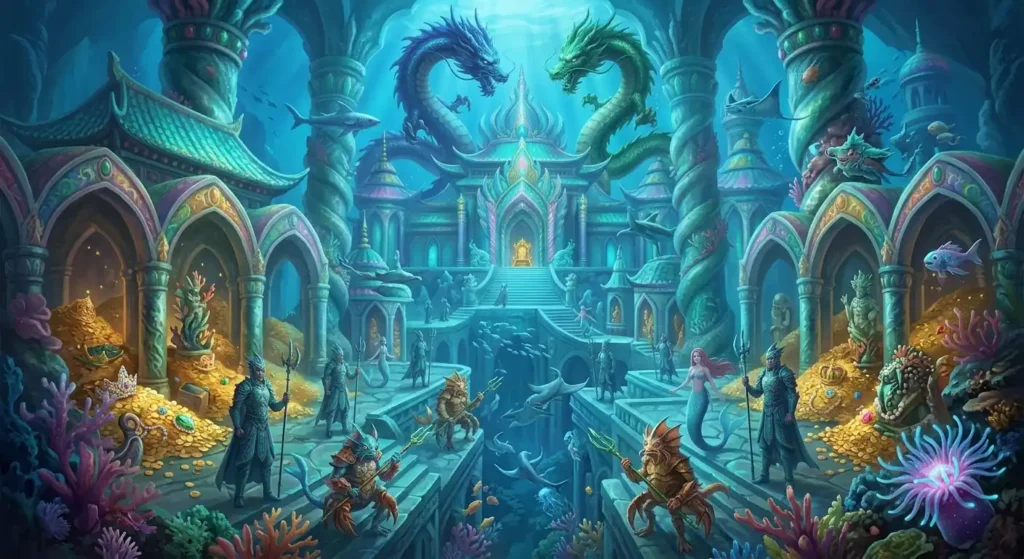
Classical Chinese texts describe the Dragon Kings’ palaces beneath their respective seas in specific architectural detail: crystal halls, jade pillars, treasuries of supernatural objects, courts of marine beings serving as officials and soldiers, underwater light sources that didn’t require sunlight.
These descriptions appear across multiple classical sources and were elaborated in literary traditions over centuries. The underwater palace became a recognized mythological setting with specific expected features.
The Fantasy Influence
The undersea kingdom as a complete civilization rather than a simply aquatic environment is a concept with multiple sources, but the Dragon King’s palace tradition contributed specifically to the idea that undersea kingdoms are bureaucratically organized, hierarchically sophisticated, and contain treasuries of objects not available on the surface.
The magical objects kept in the undersea palace, accessible only to those who can make the journey there, is a specific Eastern dragon mythology contribution to how fantasy imagines the relationship between surface and undersea worlds.
6. The Imugi and the Dragon Pearl That Triggers Transformation
The Legend
Korean dragon mythology describes the Imugi as a serpentine being that must catch a heavenly pearl (Yeouiju) falling from the sky to complete its transformation into a full Yong dragon. The pearl is the catalyst. Without it, the Imugi remains an Imugi regardless of its age or development.
The specific object that enables the final transformation, arriving from outside the being that needs it, is distinct from the Dragon Gate’s self-earned transformation. Here, external circumstances must align with internal readiness.
The Fantasy Influence
The “final catalyst” structure, where a being that has developed to its maximum inherent capacity still requires a specific external element to complete its transformation, is a recognized fantasy narrative structure. The catalyst arriving from outside, requiring both preparation and the right moment, gives fantasy protagonists something to seek and a reason why full transformation can’t be self-generated alone.
The Imugi’s thousand-year wait for the pearl that may or may not fall when expected is the specific mythological expression of this structure.
7. Liu Yi and the Dragon Bride Tradition
The Legend
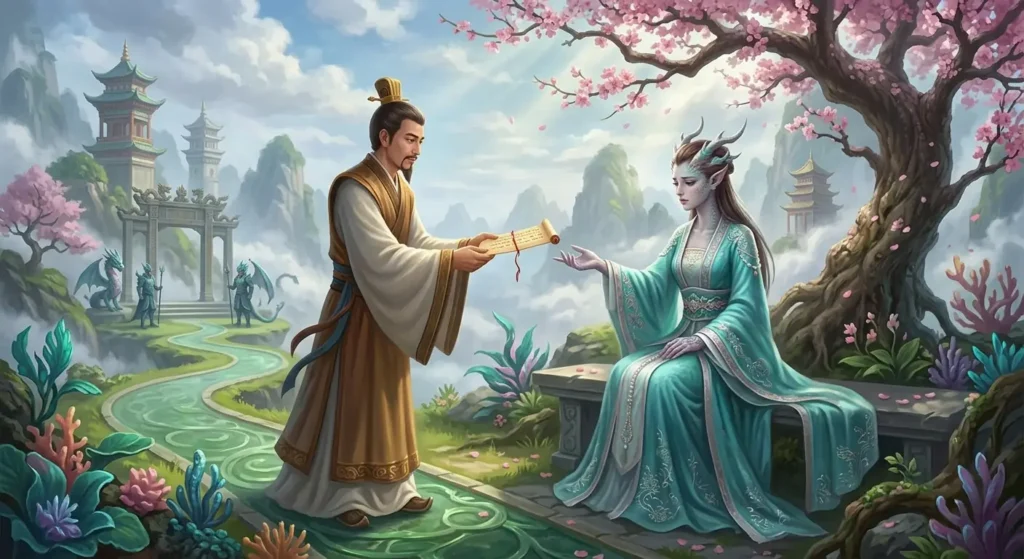
The Tang Dynasty story of Liu Yi describes a mortal scholar’s encounter with a Dragon King’s daughter in distress, his delivery of her message, and the subsequent development of a relationship between the mortal and the dragon family. In literary elaborations, the Dragon King’s daughter eventually reveals her full divine nature and marries the human who helped her.
The pattern of the human gaining access to the dragon family through an act of assistance, developing a relationship with a dragon figure in disguised or reduced form, and eventually meeting the full divine truth of that figure, became one of Chinese literature’s recurring narrative templates.
The Fantasy Influence
The dragon who takes human form to interact with mortals, the romance between human and disguised dragon, and the revelation of dragon nature as the climax of a relationship rather than as an initial threat, are all fantasy staples that the Liu Yi tradition and related Chinese dragon daughter stories contributed to the genre.
The specific structure where the human earns the dragon family’s respect through virtuous action and is rewarded with access to the dragon’s true world appears across fantasy in various forms.
Read: Chinese, Japanese & Korean Dragons: How They Actually Differ
8. Nüwa as Serpentine Creator and the God-Beast Who Builds
The Legend
Classical Chinese texts describe Nüwa with a human head on a serpentine body, credited with creating humanity from yellow clay and with repairing the sky after Gonggong broke one of the pillars of heaven. She uses five-colored stones melted down and applied to the hole in the sky.
The serpentine divine being as creator rather than destroyer, as builder rather than hoarder, represents a fundamentally different relationship between dragon-adjacent beings and the world they inhabit.
The Fantasy Influence
Fantasy’s “good dragons” and dragon figures associated with creation, healing, or the restoration of natural order have a closer relationship to this tradition than to anything in European mythology, where dragons are consistently adversarial. The specific concept of the serpentine divine being who repairs rather than damages draws on this Chinese tradition’s most fundamental image of the divine female serpent who fixed what was broken.
Fantasy’s world-building dragons, dragons who created landscapes or maintain cosmic order, reflect this creator-serpent tradition far more than they reflect the treasure-guarding adversary of European mythology.
9. Zhulong and the Dragon as Cosmic Mechanism
The Legend
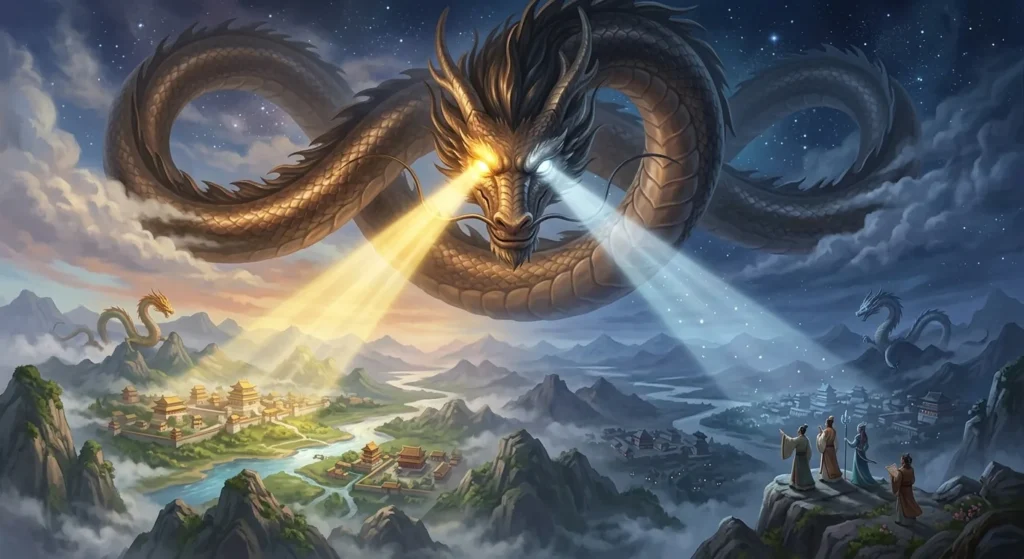
The Shanhaijing describes Zhulong as a being whose biology is indistinguishable from natural cycles: its eyes open to create day and close to create night, its breath produces summer and winter. The dragon isn’t controlling these forces from outside. The forces are expressions of its body’s normal functioning.
A dragon so large and so integrated with the natural world that day and night are its eyelids is a qualitatively different kind of being from any other dragon type in world mythology.
The Fantasy Influence
The concept of a dragon or dragon-adjacent being so ancient and so integrated with the natural world that it has become indistinguishable from it, that its existence and the world’s cycles are the same thing, is a specific contribution to how high fantasy thinks about the oldest and most powerful beings in a world.
Fantasy’s “world dragons” or “primal dragons” whose existence maintains natural balance rather than threatens it carry this specific concept. The Zhulong is the oldest and clearest classical precedent for the idea that some dragons don’t live in the world but are the world.
Read: 11 Chinese Dragon Types & the Legends Behind Their Powers
10. Ryujin’s Tide Jewels and Control Through Possession
The Legend
Japanese mythology describes Ryujin, the Dragon King of the Sea, as possessing tide jewels (kanju and manju) that control the tides. Whoever holds the jewels controls the sea’s movement. The jewels’ power is transferable, which is why their possession becomes a diplomatic and military object in the mythological narratives where they appear.
The magical object that gives its holder control over a natural force, kept by the dragon but capable of being given or taken, is a specific mythological structure.
The Fantasy Influence
The concept of controlling vast natural forces through possession of a specific object, an object that the dragon holds not as personal power but as a kind of key to a mechanism that exists separately from the dragon itself, is present throughout fantasy in multiple variations.
The dragon as keeper of a key rather than simply as a powerful being gives the fantasy dragon a different narrative role: the treasure matters not because of its value but because of what it unlocks.
Read: The 9 Darkest Japanese Dragon Legends You Have Never Heard
11. The Nine Dragon Sons and the World They Inhabit
The Legend
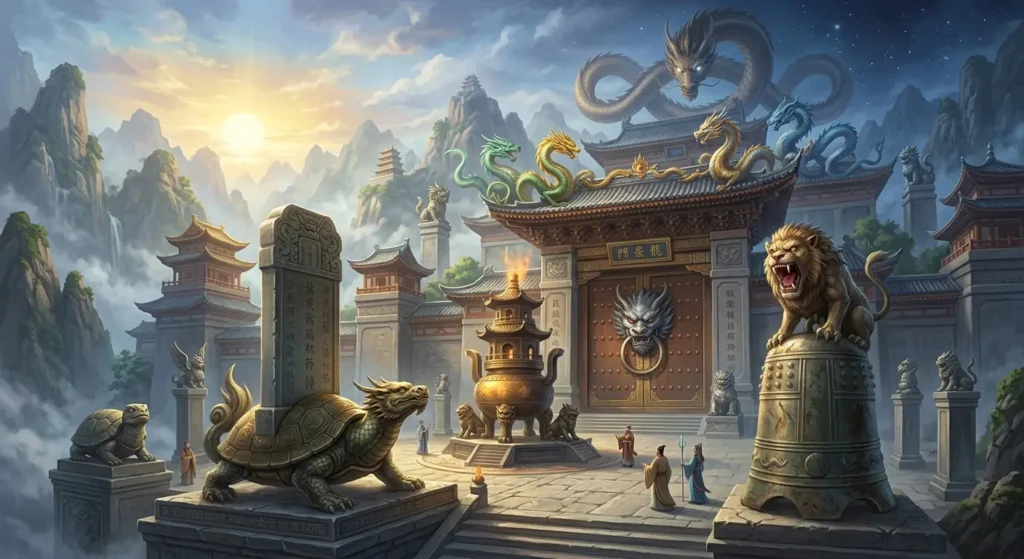
Classical Chinese tradition, codified in the Ming Dynasty, describes nine sons born to the dragon, each with distinct characteristics and each naturally suited to a specific function: one carries heavy loads, one devours fire, one amplifies sound, one guards prisons, one inhabits incense smoke. The sons’ natural characters match their functions so precisely that each one is placed where its nature is most useful.
The dragon’s offspring inherit partial dragon nature in ways that manifest as specific specializations rather than as diminished versions of the parent.
The Fantasy Influence
The concept that powerful beings leave functional traces on the world through their offspring, each offspring embodying one specific aspect of the parent’s nature, is present throughout fantasy world-building. The idea that a dragon’s children are not simply smaller dragons but distinct beings whose partial dragon nature expresses differently in each one gives fantasy a way to populate worlds with dragon-adjacent beings without reducing them to copies of the parent.
Fantasy’s varied dragon subspecies, half-dragons, and dragon-adjacent species can all be traced to traditions that include the nine sons concept. The children of great beings as functionally distinct, not merely powerful, is a specifically Eastern dragon mythology contribution to how fantasy thinks about powerful lineages.
Frequently Asked Questions
Did fantasy authors consciously draw from these specific legends?
Sometimes directly, more often through intermediary traditions. Japanese popular culture absorbed Chinese dragon mythology and transmitted specific concepts globally. Western fantasy writers who encountered those intermediary traditions may not have known the classical Chinese origins of the concepts they were working with. The influence is real regardless of whether individual authors were consciously aware of the specific source legends.
Are there other Eastern dragon legends with significant fantasy influence not on this list?
Yes. The phoenix and dragon pairing in East Asian traditions influenced how fantasy thinks about divine animal companionship. The Naga traditions of South and Southeast Asia contributed extensively to how fantasy imagines aquatic serpentine beings. This list focuses on eleven of the most traceable and most specific influences rather than attempting to be comprehensive.
How do I learn more about these legends in their original forms?
The Kojiki (compiled 712 CE) is available in multiple English translations for the Japanese legends. Anthony C. Yu’s four-volume translation of Journey to the West (University of Chicago Press) is the most complete English version of Sun Wukong’s legends. Anne Birrell’s Chinese Mythology: An Introduction (Johns Hopkins University Press) covers the Chinese traditions, including Nüwa, Zhulong, and the Dragon Gate legend with scholarly depth.
Which Eastern dragon legend influenced fantasy the most?
The Dragon Gate legend is one of the most influential. Its theme of transformation and personal growth has inspired countless fantasy stories, games, and anime characters.
Are Eastern dragons considered gods?
Some are. Figures like Ryūjin and the Dragon Kings are often treated as divine or semi-divine beings with control over natural forces such as oceans, rain, and storms.
Final Thoughts
Eastern dragon mythology was always more varied, more interesting, and more narratively generative than its popular reputation suggested. Modern fantasy owes dragon myths considerably more than it usually acknowledges.
The specific concepts, the transformation through ordeal, the weapon inside the monster, the object that enables final change, the creator-serpent who repairs rather than destroys, the being so old it has become the world’s own mechanism, are not generic fantasy inventions. They’re classical mythological structures with specific documented origins.
Knowing the origins doesn’t diminish the fantasy. It makes both the myths and their descendants more interesting to inhabit.
Related Articles
- Dragon Mythology: How Dragons Are Depicted Across Cultures
- 7 Eastern Dragon Facts Most People Believe But Are Wrong
- 9 Eastern Dragon Myths That Sound Too Strange to Be True
- 9 Lesser-Known Facts About Eastern Dragons [Real Mythology]
- Why Eastern Dragons Don’t Have Wings Yet Can Fly [Real Myth]
- 7 Best Dragon Rings For Men That Look Premium
- 15 Japanese Dragon Legends Hollywood Has Been Ignoring
- 11 Oldest Dragons in World Mythology: Sumeria to China
References
- Allan, Sarah. The Shape of the Turtle: Myth, Art, and Cosmos in Early China. SUNY Press, 1991.
- Yang, Lihui, Deming An & Jessica Anderson Turner. Handbook of Chinese Mythology. Oxford University Press, 2005.
- Birrell, Anne. Chinese Mythology: An Introduction. Johns Hopkins University Press, 1993.
- Journey to the West by Wu Cheng’en: Wu Cheng’en
- Kojiki: Translated with an Introduction and Notes by Donald L. Phillipi – Kojiki
- Nihongi: Chronicles of Japan from the Earliest of Times to A.D. 697
- Korea: A Religious History – James Huntley Grayson
- Samguk Yusa: Legends and History of the Three Kingdoms of Ancient Korea
- Shan Hai Jing – Chinese Text Project
- The Dragon King’s Daughter: Ten Tang Dynasty Stories
- The Flood Myths of Early China – Mark Edward Lewis