
 By
By Quick Takeaways:
- Journey to the West (Xī Yóu Jì) is a 16th-century Chinese novel by Wu Cheng’en, one of the four great classical novels of Chinese literature and one of the most influential texts in world fiction
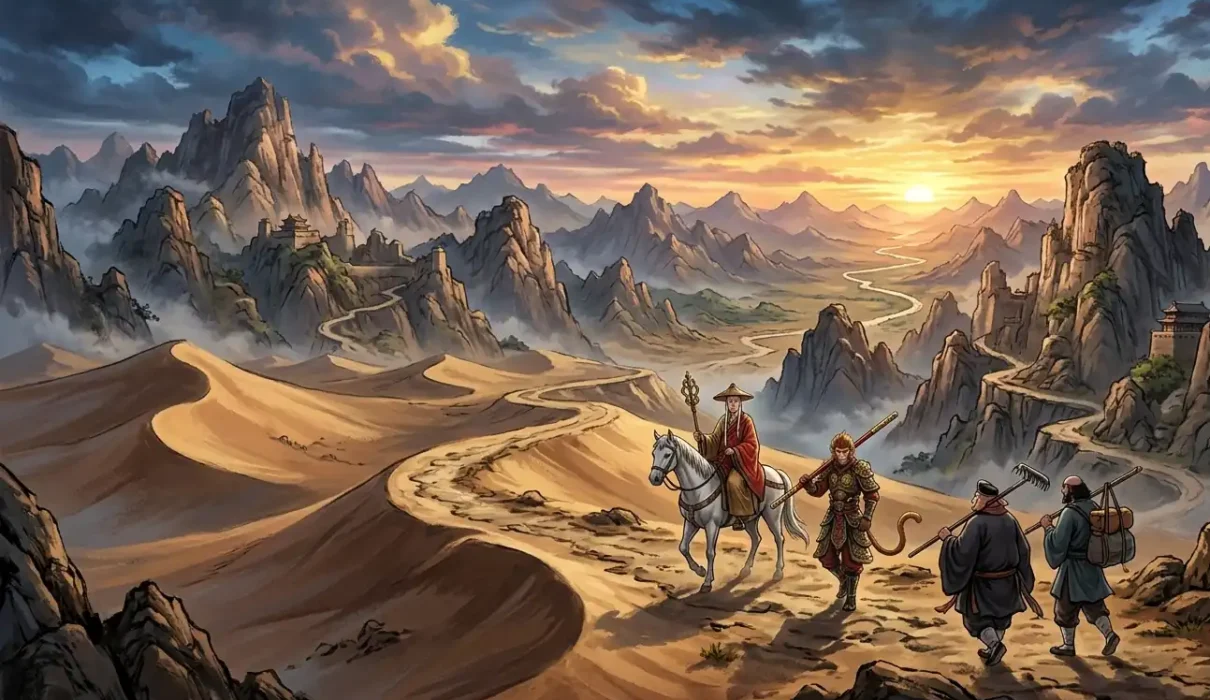
- It follows the Buddhist monk Xuanzang and his three disciples, Sun Wukong (the Monkey King), Zhu Bajie (Pigsy), and Sha Wujing (Sandy) on a pilgrimage from Tang Dynasty China to India to retrieve Buddhist scriptures
- Sun Wukong is one of the most influential fictional characters in world literature. His DNA runs through Dragon Ball Z’s Goku, countless video game protagonists, and the entire genre of Chinese cultivation fiction
- The novel operates simultaneously as adventure story, Buddhist allegory, Daoist satire of bureaucracy, and character study
- Understanding it changes how you read Chinese mythology, Chinese popular culture, and a significant portion of global fantasy fiction
I came to Journey to the West backwards.
I encountered Sun Wukong first through games and anime, the character’s combat ability, his magical staff, his transformations, his fundamental refusal to accept limitations imposed on him by forces he didn’t consent to. I thought I was encountering a genre character. I was actually encountering one of the oldest and most influential fictional figures in world literature, filtered through decades of adaptations.
Having actually read the source novel, I can tell you: the original is considerably more interesting than any single adaptation manages to capture. And as I mentioned it many times in my previous post and will be doing so in the future, I thought, why not create a beginner-friendly introduction to Journey to the West? So, let’s get on with it.
What Journey to the West actually is
The Basic Framework
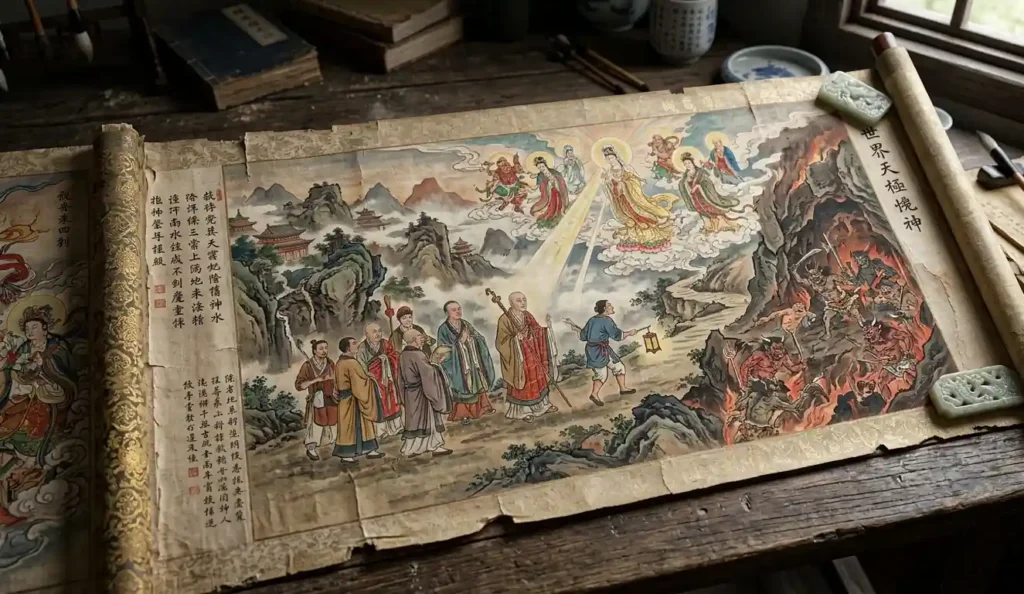
Journey to the West was written by Wu Cheng’en and published around 1592 CE during the Ming Dynasty. It runs to one hundred chapters and approximately five hundred thousand Chinese characters, a substantial novel by any standard.
The surface plot is a road trip. The Buddhist monk Xuanzang (called Tripitaka or Tang Sanzang in different translations) is tasked by the Tang Emperor to travel to the Western Paradise (India) and return with Buddhist scriptures. The journey is roughly 108,000 li, a cosmological distance that functions more as mythological vastness than geographical precision.
Xuanzang doesn’t make the journey alone. He acquires three disciples along the way:
- Sun Wukong (Monkey King) – a divine monkey of extraordinary power who has been imprisoned under a mountain for five centuries as punishment for his heavenly rebellion
- Zhu Bajie (Pigsy) – a pig spirit and former heavenly marshal, banished for misconduct and now working off his karma
- Sha Wujing (Sandy) – a former heavenly general, banished for an accident involving a jade cup at a celestial feast
These four travel together, encountering eighty-one tribulations, specifically eighty-one, because this number is cosmologically precise, before completing the pilgrimage.
The Historical Basis
The novel isn’t entirely invented. It’s based on the real historical pilgrimage of the monk Xuanzang (602–664 CE), who actually did travel from Tang Dynasty China to India and back, acquiring Buddhist texts that he then spent the rest of his life translating.
The historical Xuanzang was an extraordinary figure, a genuinely brave, intellectually committed Buddhist scholar who undertook a genuinely dangerous journey. He wrote his own account of the journey (Great Tang Records on the Western Regions) that remained historically valuable for centuries.
Wu Cheng’en took this historical skeleton and built something fantastical over it, replacing the real journey’s hardships with supernatural adversaries, replacing the historical monk’s companions with mythological figures, and surrounding the whole thing with the Chinese divine court, Buddhist cosmology, and Daoist philosophy.
Sun Wukong: The Character Who Changed Everything
Who He is
Before he was a disciple of Xuanzang, Sun Wukong was a cosmic-scale problem for the Jade Emperor’s heavenly court.
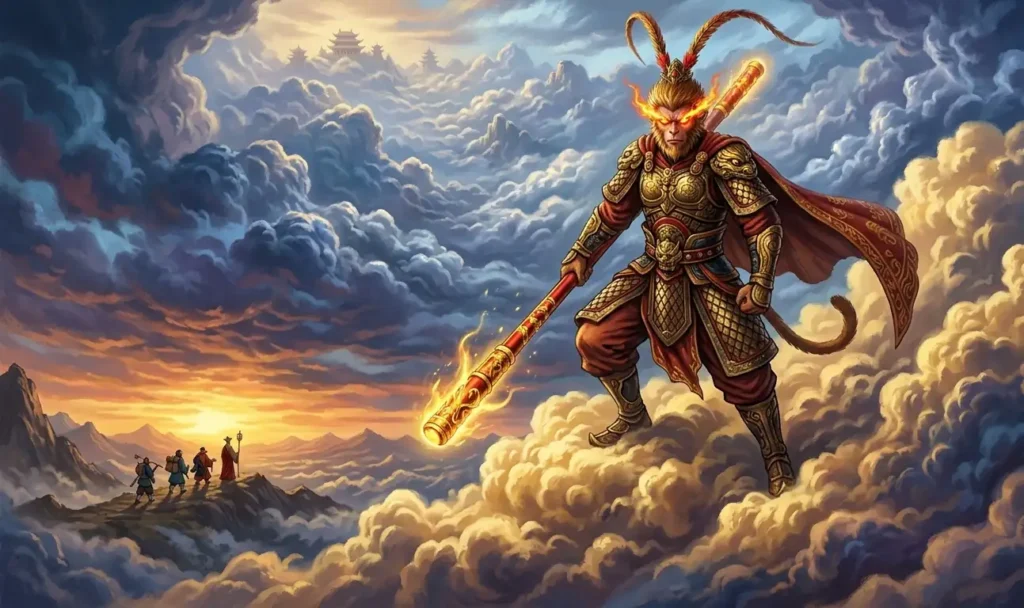
Born from a stone on the Mountain of Flowers and Fruit, Sun Wukong achieved immortality through cultivation, acquired a magical staff (the Ruyi Jingu Bang – a pillar used to measure sea depths that he takes from the Dragon King’s underwater palace), caused chaos in the underworld by deleting his name from the Book of Life and Death, and eventually was granted a position in the heavenly court to keep him placated.
He wasn’t placated. He demanded a title equal to the greatest divine figures. When denied, he declared himself the Great Sage Equal to Heaven (Qí Tiān Dà Shèng), which is the specific kind of audacity that mythology was built for.
His subsequent rampage through heaven, his defeat of every divine army sent against him, and his temporary suppression under a mountain by the Buddha. This opening sequence is one of the most entertaining stretches in all of classical literature.
What Makes Him Genuinely Interesting
The obvious reading of Sun Wukong is as a power fantasy, the impossible protagonist who defeats everything. That reading is correct but incomplete.
What I find most interesting about the character, after engaging with him seriously through my readings, is the specific nature of his journey in the novel.
Sun Wukong begins the story as maximum capability with minimum wisdom. He’s the most powerful being in the novel in terms of martial ability. He’s also fundamentally limited by his own pride, his reactive anger, and his inability to distinguish genuine threats from situations where restraint would be more effective.
His journey with Xuanzang isn’t a power gain story. It’s a wisdom gain story. The headband the goddess Guanyin places on him, which Xuanzang can tighten with a specific spell to cause him pain when he misbehaves, is not a humiliation device. It’s a teaching device. The novel is interested in what happens when infinite capability is directed by genuine wisdom rather than ego. That’s a considerably more sophisticated narrative than the “strong person gets stronger” structure.
The Other Pilgrims: The Overlooked Characters
Zhu Bajie: The Most Human of the Four
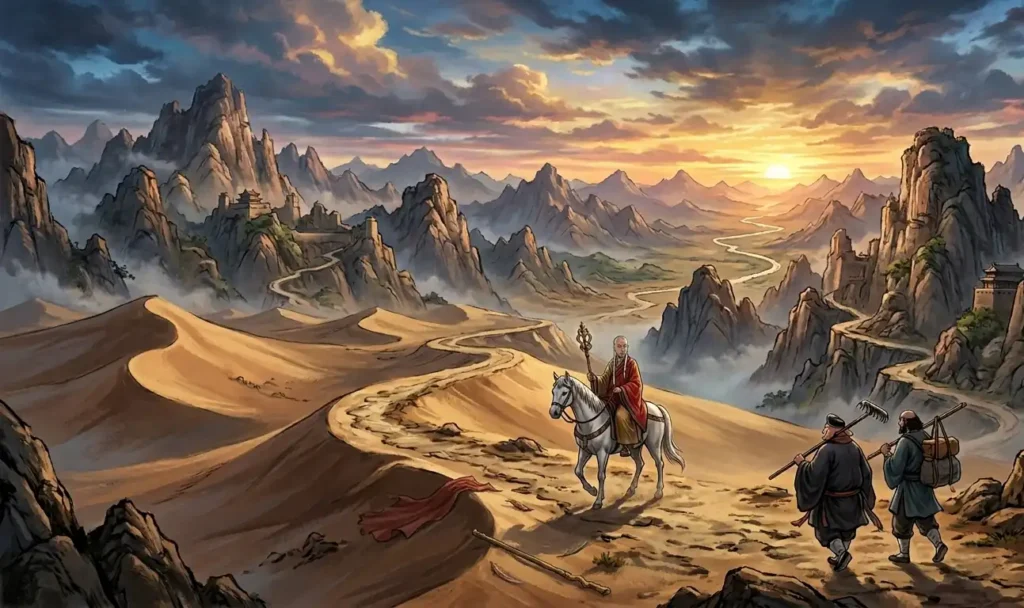
Zhu Bajie gets less attention than Sun Wukong and deserves considerably more.
He’s lazy, greedy, lustful, cowardly, and frequently trying to convince the group to abandon the mission and go home. He complains. He thinks primarily about food and comfort. He’s often more obstacle than help.
He’s also the most human figure in the novel. Every reader who’s ever wanted to quit something difficult, every person who’s ever let short-term comfort win over long-term purpose, Zhu Bajie is that impulse given form and sent on a pilgrimage anyway.
The novel’s treatment of him is warm rather than condemnatory. He’s not a villain. He’s a being with genuine weaknesses who shows up and keeps going despite those weaknesses. His humanity, for all its pettiness, is presented as part of the complete picture of beings undertaking a genuine spiritual journey.
Sha Wujing: Reliability as a Character
Sha Wujing is arguably the least dramatically interesting of the four steady, reliable, competent, and not given to the theatrical failures of Zhu Bajie or the spectacular excesses of Sun Wukong.
What’s interesting about Sha Wujing is what his presence says about the journey’s structure. Not everyone on a long, difficult journey is going to have a dramatic character arc. Some people are just the person who keeps doing their job. His reliability is itself a character statement.
Xuanzang: More Complex than he Looks
Xuanzang is frequently read as passive and even irritating, the monk who constantly has to be rescued, who occasionally misjudges situations and punishes Sun Wukong unfairly, who seems less capable than his disciples.
This reading is missing the novel’s point.
Xuanzang is morally consistent in an environment where moral consistency is genuinely difficult. His compassion is sometimes exploited by villains who disguise themselves as victims. His commitment to non-violence is sometimes an obstacle. But his character never wavers, and his unwavering character is ultimately why the pilgrimage can be completed.
Sun Wukong’s power makes him the most capable figure in the novel. Xuanzang’s constancy makes him the pilgrimage’s actual heart.
The Novel’s Multiple Layers
Buddhist Allegory
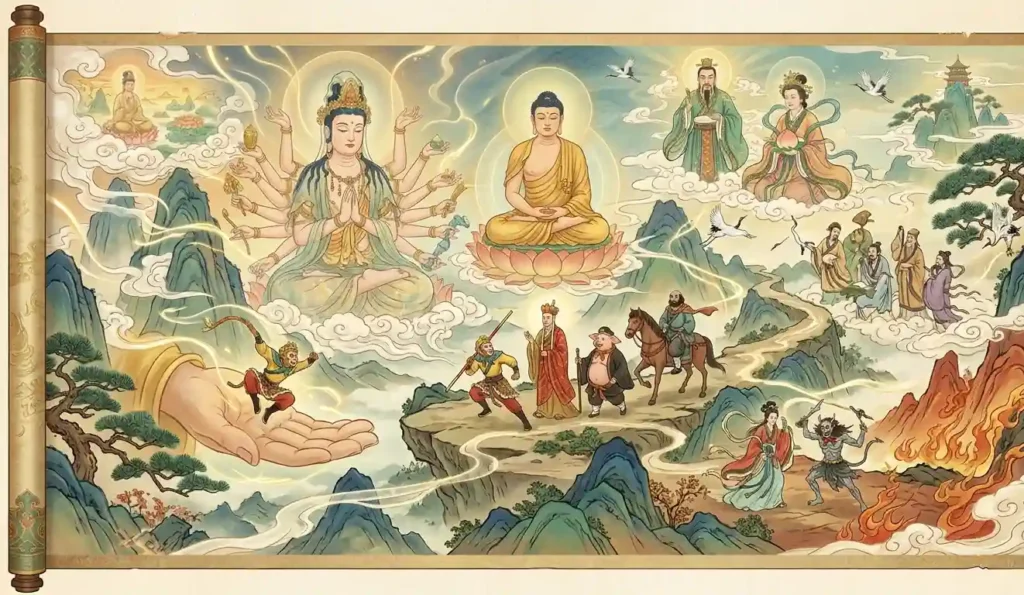
The most straightforward second reading is Buddhist: the pilgrimage is the spiritual journey, the eighty-one tribulations are the obstacles that genuine spiritual practice encounters, and the disciples’ various failings represent different kinds of attachment and ego that the practitioner must work through.
The scriptures they’re retrieving are, in this reading, the genuine dharma the understanding that makes liberation possible. The journey to find them is the practice.
Daoist Satire
The heavenly court scenes,, particularly Sun Wukong’s initial rampage function as biting satire of bureaucratic governance.
The Jade Emperor’s court can’t handle Sun Wukong. Every divine army fails. The divine departments are paralyzed by their own protocols. The supreme ruler of heaven has to call in outside help to manage a single troublemaking monkey.
Wu Cheng’en was writing during the Ming Dynasty, whose bureaucratic dysfunction was well-known to educated readers. The heavenly bureaucracy that can’t solve its own problems is the earthly bureaucracy seen from a specific satirical angle.
The Influence: Why it Matters for Fiction

Dragon Ball and Global Cultural Spread
The most famous Western encounter with Sun Wukong is through Dragon Ball, Akira Toriyama’s manga series explicitly based on Journey to the West, with Goku as Sun Wukong, the power pole as the staff, and the cloud as the flying nimbus.
Dragon Ball Z became a global phenomenon, meaning Sun Wukong’s DNA is present in the action animation vocabulary of an entire generation worldwide including everyone who grew up watching it without knowing what they were watching.
What it gave Chinese Fiction
For Chinese fiction specifically, Journey to the West provided:
- The template for the cosmic power journey – a protagonist who starts from unusual origins, gains extreme power, and must develop wisdom to match
- The heavenly court as a narrative space – the complete divine bureaucracy as a setting that subsequent authors could populate with their own characters
- Sun Wukong as an archetype – the figure who refuses to accept limitations that others consider absolute, who earns his own identity through defiance and growth
- The eighty-one tribulations structure – a journey organized around discrete challenges rather than a continuous narrative, which maps onto serialized fiction naturally
The influence on Chinese cultivation fiction specifically is so direct that it barely needs tracing. The protagonist who starts at the bottom, gains power through cultivation, challenges a divine hierarchy that initially dismisses them, and eventually earns genuine cosmic standing. That’s Journey to the West’s structure applied to a cultivation framework.
Frequently Asked Questions
How long is Journey to the West and where can I read it?
The full novel is one hundred chapters, making it a significant commitment. You can read the English translation here for free
Is Journey to the West a religious text?
It’s a novel with religious dimensions rather than a religious text in the doctrinal sense. It uses Buddhist cosmology and Buddhist concepts seriously and with genuine engagement, and the allegorical Buddhist reading is legitimate and rewarding. But it’s also clearly a satirical entertainment and an adventure story. Wu Cheng’en was a scholar writing for an educated readership who could appreciate all these dimensions simultaneously.
How does it relate to the Monkey King in modern Chinese pop culture?
Sun Wukong remains one of the most active figures in contemporary Chinese pop culture, appearing across films, games, animation, and online fiction. The 2024 game Black Myth: Wukong introduced him to a global gaming audience and renewed international interest in the source novel. Each generation finds its own way into the character.
Is Journey to the West based on a real story?
Yes. The novel is inspired by the real seventh century journey of the Buddhist monk Xuanzang, though it transforms his pilgrimage into a fantastical adventure filled with demons, gods, and magic.
Why does Journey to the West remain influential today?
Its themes of self improvement, perseverance, friendship, and spiritual growth continue to resonate with audiences. The novel also provides rich source material for films, television, animation, games, and modern fiction.
Final Thoughts
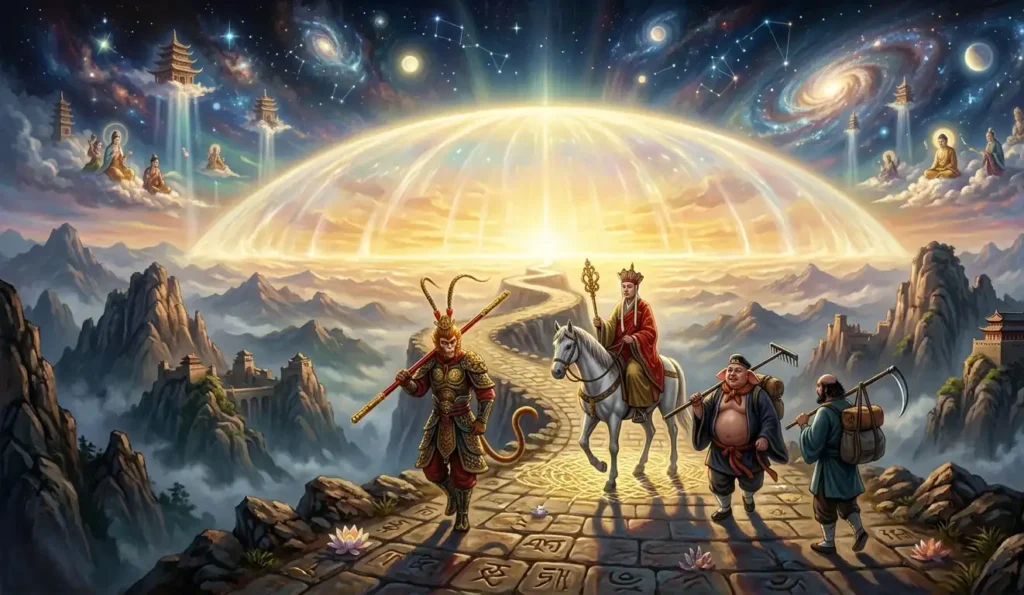
Journey to the West is one of those texts that’s everywhere in culture and nowhere in most readers’ direct awareness.
If you’ve ever enjoyed Dragon Ball, you’ve been shaped by it. If you’ve played games with a staff-wielding monkey protagonist, you’ve been shaped by it. If you’ve read Chinese cultivation fiction and found the divine court setting coherent and richly detailed, you’ve been shaped by it. The novel’s presence in global fiction is enormous and largely unacknowledged.
Reading the source is worth it not just for completeness or cultural literacy, but because Wu Cheng’en’s novel is genuinely funny, genuinely moving in places, and more philosophically sophisticated than any summary makes it sound.
Sun Wukong refuses to accept limitations. The novel about him refuses to be only one thing. That’s the characteristic that makes both the character and the book inexhaustible.
Related Articles
- Was the Jade Emperor Weak? The Answer Might Surprise You
- Sun Wukong: Monkey King Symbolism, Myths & Sacred Power
- Jade Emperor vs Sun Wukong: Who Really Won the Rivalry?
- Jade Emperor vs Buddha: Who Actually Outranks Whom?
- Sun Wukong Powers Ranked: From Weakest to Absolute
- The Three Pure Ones: Who Outranks the Jade Emperor
References
- Andrew H. Plaks – The Four Masterworks of the Ming Novel
- Journey To The West
- Wilt L. Idema – Chinese Vernacular Fiction
- Victor H. Mair – The Columbia History of Chinese Literature
- C. T. Hsia – The Classic Chinese Novel
- Crazy Ji: Chinese Religion and Popular Literature – Meir Shahar
- Stephen Teiser – The Spirits of Chinese Religion
- Records of the Western Regions in the Great Tang Dynasty – Xuanzang