
 By
By Quick Takeaways:
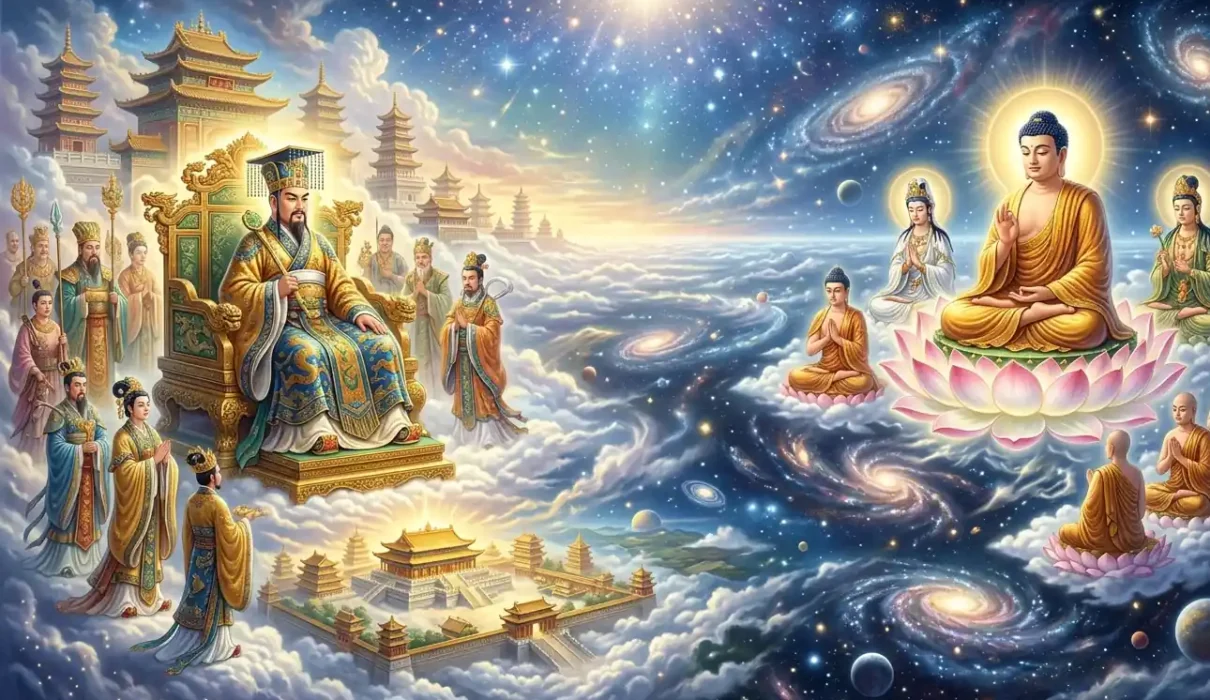
- Jade Emperor vs Buddha? – The Jade Emperor and the Buddha don’t occupy the same type of authority, which is why the “who rules” question is more interesting than it first appears
- The Jade Emperor governs conditioned existence: the administrative management of heaven, earth, and the underworld as they currently operate
- The Buddha represents liberation from conditioned existence: the transcendence of the cycle of birth, death, and rebirth that even divine beings are subject to
- The famous Journey to the West episode where the Buddha handles what the Jade Emperor cannot is not evidence of simple hierarchy. It’s evidence that different problems require different kinds of authority
- Chinese cosmology’s most sophisticated answer is that these two figures rule different dimensions of reality simultaneously, and neither makes the other irrelevant
This question sounds simple. It isn’t.
Most people who encounter the Jade Emperor and the Buddha in Chinese mythology arrive at the question through Journey to the West: the Jade Emperor’s armies can’t stop Sun Wukong, the Buddha traps him under a mountain with five fingers, and the obvious conclusion seems to be that the Buddha is simply more powerful. The Jade Emperor needed help. Therefore, the Buddha outranks him.
I held that reading for years before I understood why it was wrong. After years of studying Chinese religious tradition, the relationship between these two figures is one of the things I find most genuinely illuminating about how Chinese cosmology actually works. The real answer requires understanding not just who is stronger, but what each figure is actually for.
Setting Up the Question Properly
Two Traditions, One Religious Culture
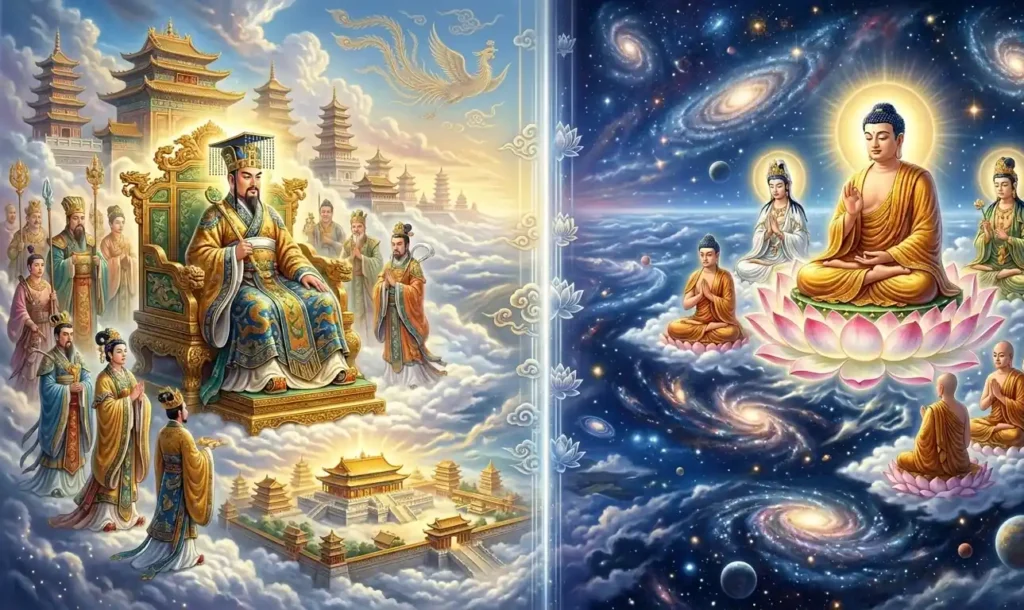
The Jade Emperor comes from the Daoist tradition. He’s the supreme administrator of the divine court, governing the three realms through the elaborate bureaucratic system that the Chinese religious tradition developed across centuries.
The Buddha, specifically Tathagata Buddha (Rúlái Fó) as depicted in Chinese religious texts and in Journey to the West, comes from the Buddhist tradition. Buddhism arrived in China from India around the 1st century CE and spent several centuries negotiating its relationship with the existing Daoist and Confucian frameworks.
Chinese folk religion absorbed both traditions into a single syncretistic whole. Temples hold deities from Daoist, Buddhist, and folk traditions side by side. Practitioners pray to figures from multiple traditions without experiencing this as a contradiction. The two traditions share a cultural space rather than competing for exclusive loyalty.
This shared space is exactly what makes the Jade Emperor versus Buddha question so interesting. They coexist in the same cosmological system, but they don’t hold the same type of authority within it.
What the Jade Emperor Actually Governs
The Administrator of Conditioned Existence
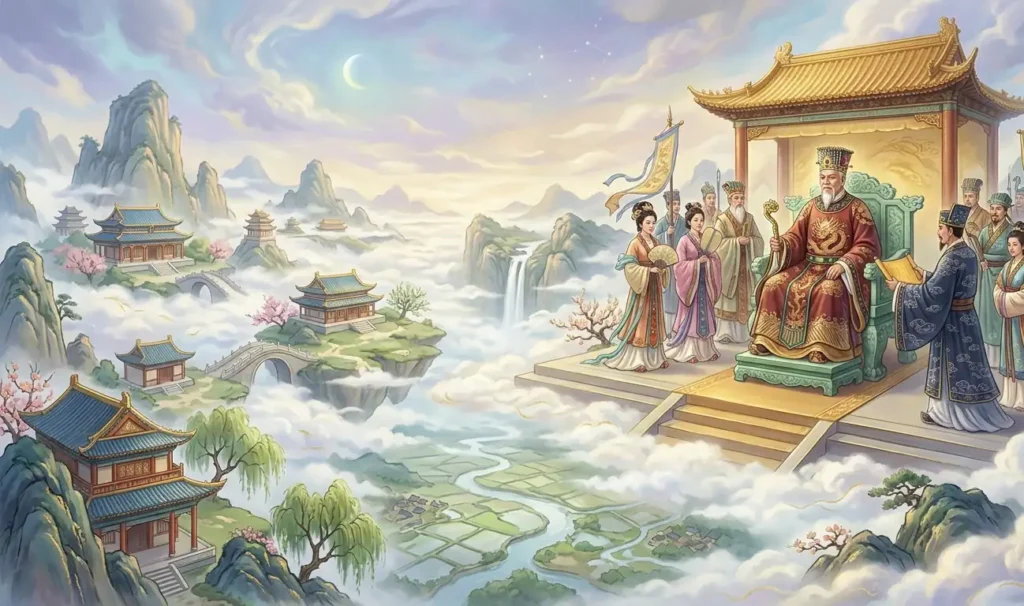
The Jade Emperor (Yùhuáng Dàdì) governs everything within what Buddhist philosophy would call conditioned existence: the universe as it currently operates, with its cycles of birth and death, its karma, its natural forces, its divine hierarchy, and its moral accounting system.
His authority includes:
- Heaven and all the divine beings who inhabit it
- Earth and all the living beings who populate it
- The underworld and all the processes of posthumous judgment and rebirth
- The heavenly court’s administrative machinery, including every ministry and every divine official
- The annual moral audit of human conduct through the Kitchen God reporting system
This is genuine, comprehensive, universal authority. There’s no corner of conditioned existence that falls outside the Jade Emperor’s jurisdiction. He governs through legitimate authority earned through 1,750 aeons of moral cultivation, not through raw power alone.
The key phrase is conditioned existence. The Jade Emperor governs the universe as it is, with all its cycles, structures, and limitations intact. His authority is the authority of the best possible administrator of reality as it currently functions.
What the Buddha Actually Represents
Liberation, Not Administration
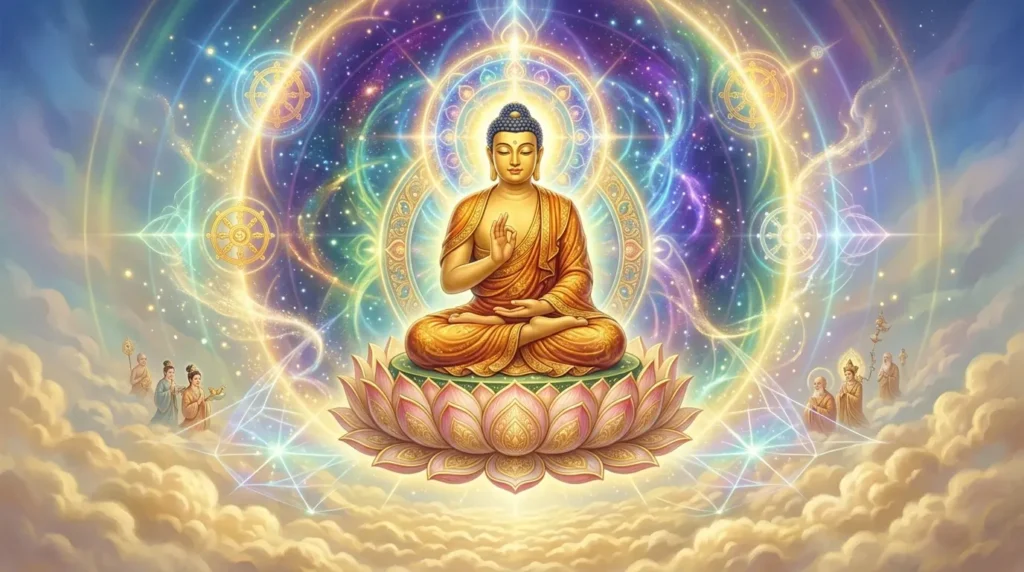
The Buddha, in the Chinese religious tradition that absorbed and adapted Indian Buddhism, represents something categorically different from administrative authority over conditioned existence.
Buddhist cosmology understands all conditioned existence, including heavenly realms and even divine status, as ultimately subject to impermanence and the cycle of rebirth. Even the gods in heaven will eventually exhaust their merit and descend. Even the Jade Emperor’s position, however vast, exists within a cosmos that Buddhist thought views as ultimately not the final reality.
The Buddha’s enlightenment represents transcendence of this entire cycle. Not governance of it. Transcendence of it.
This is the distinction that makes the Jade Emperor versus Buddha comparison so philosophically precise. The Jade Emperor is the best possible version of someone who operates within conditioned existence. The Buddha has stepped outside it. They’re not competing for the same territory.
The Journey to the West Episode: What it Actually Means
What Most People Read into It
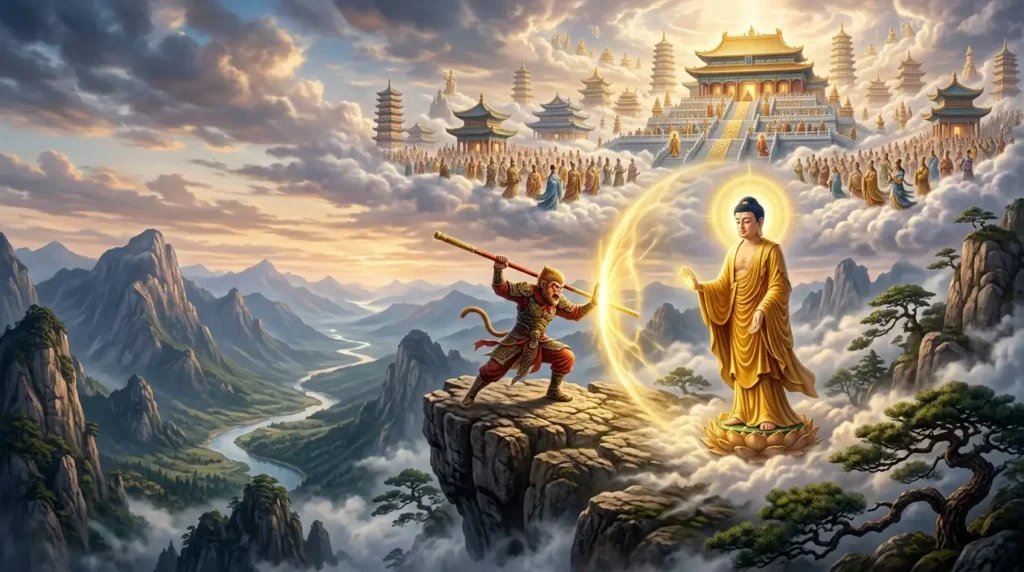
The Sun Wukong rebellion sequence in Journey to the West is the primary source for most readers’ understanding of the Jade Emperor and Buddha’s relative authority. Sun Wukong defeats every divine army. The Jade Emperor calls in the Buddha. The Buddha traps Sun Wukong under Five Elements Mountain.
The obvious reading: the Buddha is more powerful than the Jade Emperor. The Jade Emperor needed the Buddha’s help, which means the Buddha outranks him.
This reading is understandable and not entirely wrong about the specific power dynamics. But it mistakes a specific case for a general principle.
What’s Actually Happening
Sun Wukong’s rebellion isn’t primarily a military problem. It’s a philosophical problem.
His claim is that supreme capability entitles supreme cosmic standing. He calls himself the Great Sage Equal to Heaven because he can defeat every divine army in existence, and his argument is that his power should translate directly into authority.
The Jade Emperor’s military force can’t answer this argument, because military force is exactly the category of power that Sun Wukong has mastered. Sending more armies proves nothing except that he’s stronger than the armies.
The Buddha’s response addresses the actual problem. The palm scene demonstrates something that armies cannot: Sun Wukong’s understanding of his own cosmic situation is radically incomplete. He jumps to the edge of the universe and returns triumphant, and the Buddha shows him that he never left the palm. The pillars at the world’s edge are fingers.
This isn’t a military defeat. It’s a philosophical demonstration that the premise of Sun Wukong’s rebellion was based on a misunderstanding of what the cosmos actually is. The Buddha has the authority to make this demonstration because he has transcended the limits that Sun Wukong doesn’t yet know he’s operating within.
Wu Cheng’en’s Satirical Dimension
The novel was written in the 16th century during the Ming Dynasty, and its Jade Emperor has a deliberate satirical quality. The helpless bureaucrat who can’t solve his own problems without outside assistance mirrors the Ming Dynasty’s bureaucratic dysfunction.
This satirical portrait exaggerates the Jade Emperor’s limitations for literary and political purposes. It’s not a theological statement about the Jade Emperor’s actual power level within Chinese religious tradition. Reading the novel’s satirical Jade Emperor as the definitive theological account produces a distorted picture of both the figure and his actual role.
The Theological Hierarchy Above the Jade Emperor
The Three Pure Ones
Before deciding whether the Buddha outranks the Jade Emperor, it’s worth knowing that the Jade Emperor already has figures above him in the Daoist theological framework.
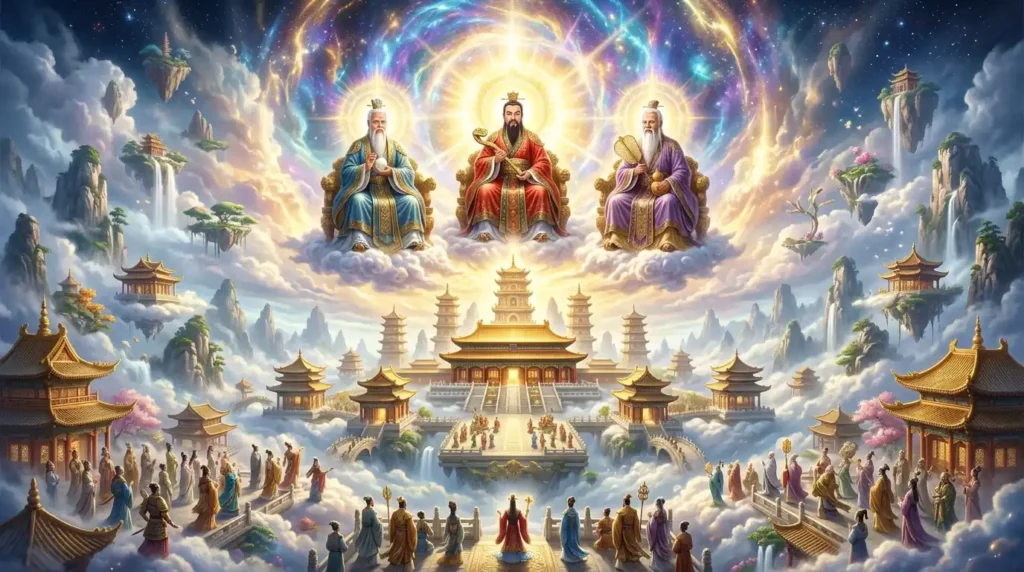
The Three Pure Ones (Sanqing) sit above the Jade Emperor as transcendent metaphysical principles rather than administrative figures. Yuanshi Tianzun, Lingbao Tianzun, and Daode Tianzun (the deified Laozi) represent the cosmic ground from which the Jade Emperor’s governance emerges. They’re not competing administrators. They’re the principles that make any administration possible.
The Jade Emperor governs. The Three Pure Ones are the philosophical foundation of governance itself.
This matters for the Buddha comparison because it shows that the Jade Emperor’s position was always understood as supreme administrative authority rather than metaphysical supremacy. He was never the highest possible being in Chinese cosmology. He was always the supreme practical administrator within a larger framework.
Placing the Buddha in that larger framework is therefore not a category error. Buddhist transcendence and Daoist metaphysical principles both represent dimensions of reality that the Jade Emperor’s governance operates within rather than above.
Where the Buddha Fits in Chinese Religious Cosmology
In Chinese folk religion, which integrates Daoist and Buddhist traditions pragmatically rather than systematically, the Buddha typically occupies a position of transcendent authority that parallels rather than subordinates the Jade Emperor.
He isn’t the Jade Emperor’s boss. He governs a different dimension of reality. Beings who want liberation from the cycle of existence approach the Buddha. Beings who want good governance of their conditions within that cycle approach the Jade Emperor. Both needs are real. Both figures address genuine human concerns. Neither makes the other unnecessary.
Two Different Dimensions of Authority
The Governance Dimension
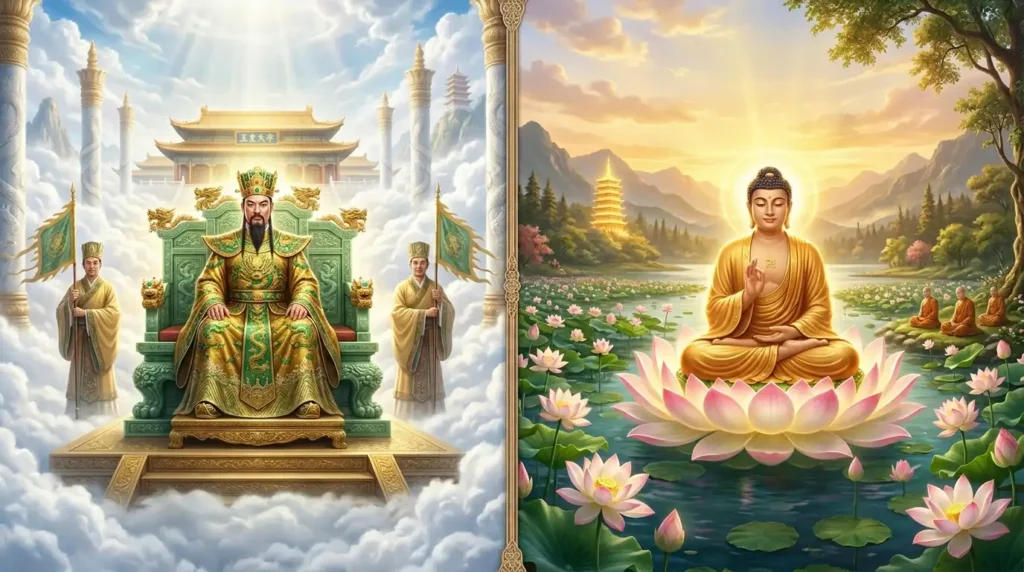
The Jade Emperor’s authority is structural and administrative. He answers the question: given that conditioned existence operates as it does, how should it be governed to produce the best possible outcomes for all beings within it?
His answer is the divine court system: a comprehensive bureaucracy of divine officials, nature ministries, moral auditing mechanisms, and karmic accounting systems that attempt to govern conditioned existence in alignment with cosmic moral principles.
This is an immensely sophisticated answer to a genuine question. The Jade Emperor’s authority is legitimate, comprehensive, and genuinely beneficial for beings operating within the cycles of conditioned existence.
The Liberation Dimension
The Buddha’s authority is transcendent and transformative. He answers a different question: given that conditioned existence operates as it does, how can beings escape its fundamental limitations and achieve liberation from its cycles entirely?
His answer is the dharma: the teaching that enables beings to understand the nature of conditioned existence clearly enough to step outside it. This authority doesn’t compete with the Jade Emperor’s governance. It addresses a question the governance framework cannot answer, because governance of conditioned existence cannot by definition offer liberation from conditioned existence.
Which One Rules Chinese Cosmology?
The Honest Answer
After years of sitting with this question, my honest answer is that the framing creates a false choice.
Chinese cosmology as practiced in the living tradition doesn’t require a single supreme ruler who outranks all others in every possible dimension. It’s comfortable holding multiple types of authority in multiple dimensions simultaneously, each appropriate to its own domain.
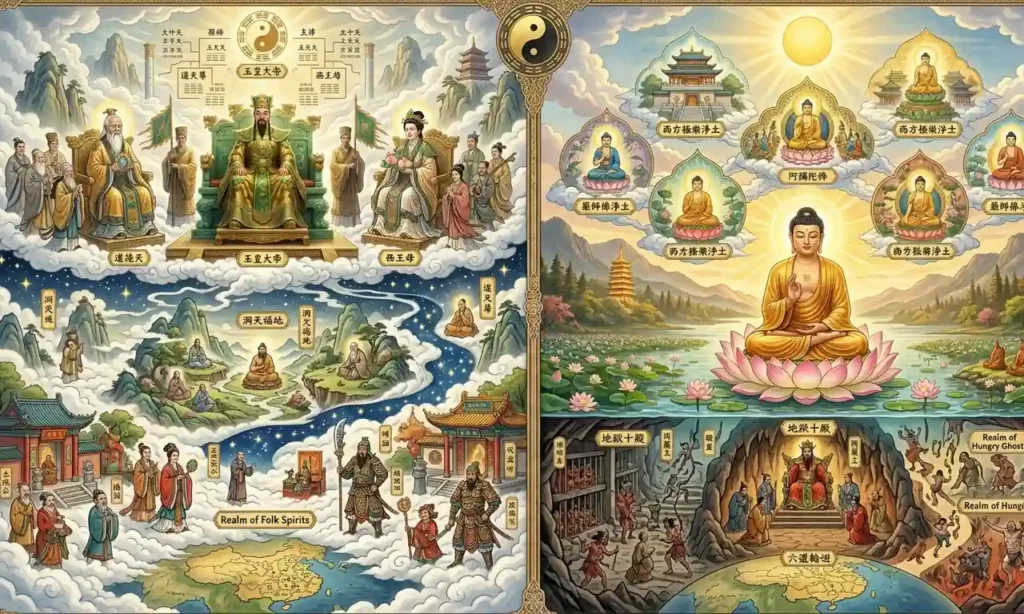
The Jade Emperor rules conditioned existence as its supreme administrator. The Buddha represents the transcendence of conditioned existence. The Three Pure Ones embody the metaphysical principles that underlie all of it. All three operate simultaneously in Chinese religious understanding without mutual contradiction.
If forced to identify which type of authority is more fundamental, I’d say that transcendence is philosophically deeper than governance, because governance operates within the framework that transcendence steps outside. The Buddha’s authority, in that sense, represents something the Jade Emperor’s system cannot contain.
But the Jade Emperor’s governance remains the most practically relevant authority for beings who are still within conditioned existence, which includes almost everyone. Most prayers, most rituals, and most human religious needs are addressed to the Jade Emperor’s system, not to the Buddha’s transcendent dimension, because most human needs are needs within conditioned existence rather than needs for liberation from it.
What Journey to the West Actually Concludes
The novel’s ending is worth looking at for what it says about this question. Xuanzang and his disciples complete the pilgrimage. They receive titles from the Buddha’s assembly in the Western Paradise. Then the Jade Emperor hosts a celebration in their honor in the heavenly court.
Both authorities participate in the completion of the same great task. The Buddha recognizes the achievement within his transcendent framework. The Jade Emperor celebrates it within his governance framework. Neither authority is absent. Neither is subordinate to the other in a simple sense. They operate on different registers of the same completed journey.
Frequently Asked Questions
Does the Buddha replace the Jade Emperor in Chinese folk worship?
No. Both figures receive active devotion in Chinese folk religion, but they receive it for different reasons. Jade Emperor worship addresses concerns about governance, fortune, weather, and the conditions of life. Buddhist practice addresses the deeper existential questions about the nature of existence, suffering, and liberation. Most practitioners engage with both traditions for different purposes.
Is Guan Yin related to this discussion?
Yes, significantly. Guan Yin (Bodhisattva Avalokiteshvara) represents Buddhist compassion working within the world rather than apart from it. She remains accessible to beings within conditioned existence, making her the Buddhist figure most closely connected to the Jade Emperor’s governance tradition. In Chinese folk religion, she often receives as much or more veneration than the Jade Emperor or the Buddha.
Did the Jade Emperor and the Buddha coexist peacefully in historical Chinese religion?
Generally yes. Chinese religious history includes periods of sectarian tension, but the dominant pattern is syncretism rather than conflict. Daoist and Buddhist traditions sometimes competed for imperial patronage, yet ordinary practitioners often honored both without seeing a contradiction. The distinction between governing conditioned existence and transcending it helped both traditions maintain distinct identities while sharing cultural space.
Why do some Chinese temples honor both the Jade Emperor and the Buddha?
Chinese religion is highly syncretic. Many worshippers draw from Daoist, Buddhist, and folk traditions simultaneously, seeing them as complementary rather than mutually exclusive.
Do all Chinese people believe in the Jade Emperor and the Buddha?
No. Beliefs vary widely across regions, families, and religious communities. Some people venerate both, some follow only one tradition, and many view them primarily as cultural figures.
Final Thought
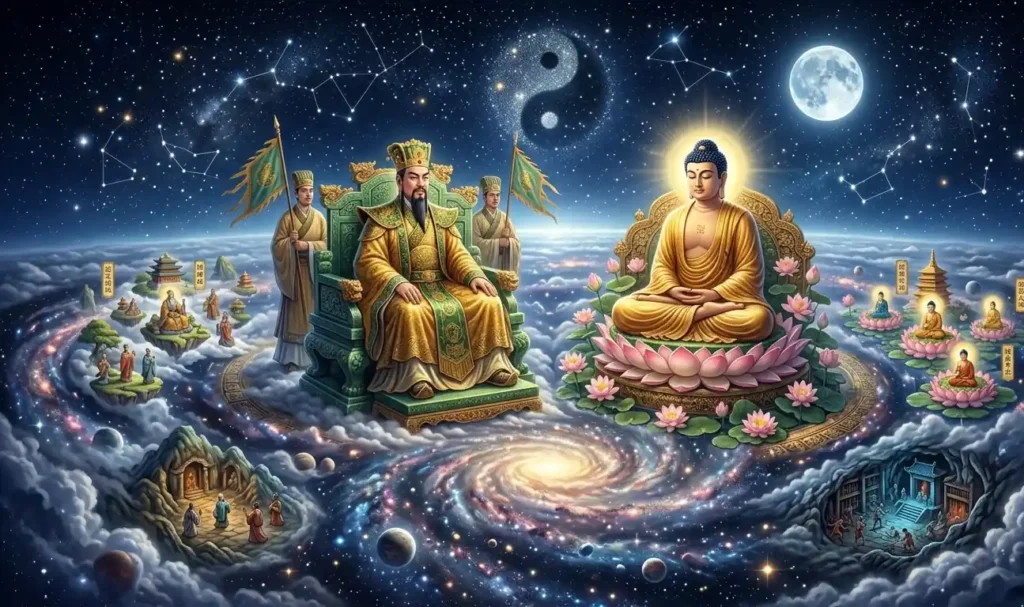
The question “who really rules Chinese cosmology” assumes that cosmological authority works the same way political authority does, with one figure at the top and everyone else subordinate to them.
Chinese religious tradition is more interesting than that assumption allows. It holds multiple types of authority simultaneously, each appropriate to its domain, without requiring them to be ranked in a single hierarchy.
The Jade Emperor administers everything within existence. The Buddha represents the possibility of stepping outside existence entirely. The Three Pure Ones embody the metaphysical ground that existence rests on.
You could spend a lifetime exploring any one of these figures and not exhaust what’s there. The fact that all three coexist in the same tradition isn’t theological confusion. It’s theological sophistication, holding genuine complexity without forcing it into a simpler shape than it actually has.
Related Articles
- Journey to the West: The Chinese Classic Behind Fiction
- Jade Emperor vs Sun Wukong: Who Really Won the Rivalry?
- What Is the Heavenly Court? Chinese Myth’s Divine Authority
- Xiwangmu vs Jade Emperor: Who is More Powerful in Chinese Myth?
- Yu Emperor vs Zeus: Same Power, Different World
References
- Birrell, Anne. Chinese Mythology: An Introduction.
- Kohn, Livia. Daoism and Chinese Culture.
- Tao Te Ching – Translated by J. Legge
- Daozang – Daoist Canon
- Journey To The West
- Jade Emperor Origin Scripture
- The Taoist Body – Kristofer Schipper
- The Diamond Sutra
- Lotus Sutra
- Yun Ji Qi Qian – Chinese Text Project
- Kenneth Ch’en – Buddhism in China
Written by Batin Khan | Mythology and philosophy reader across world cultures (20 years), Cultivation novels reader for the past 10 years | Specialist in Xianxia, Eastern and Western mythological traditions, and fantasy worldbuilding