
 By
By Quick Takeaways:
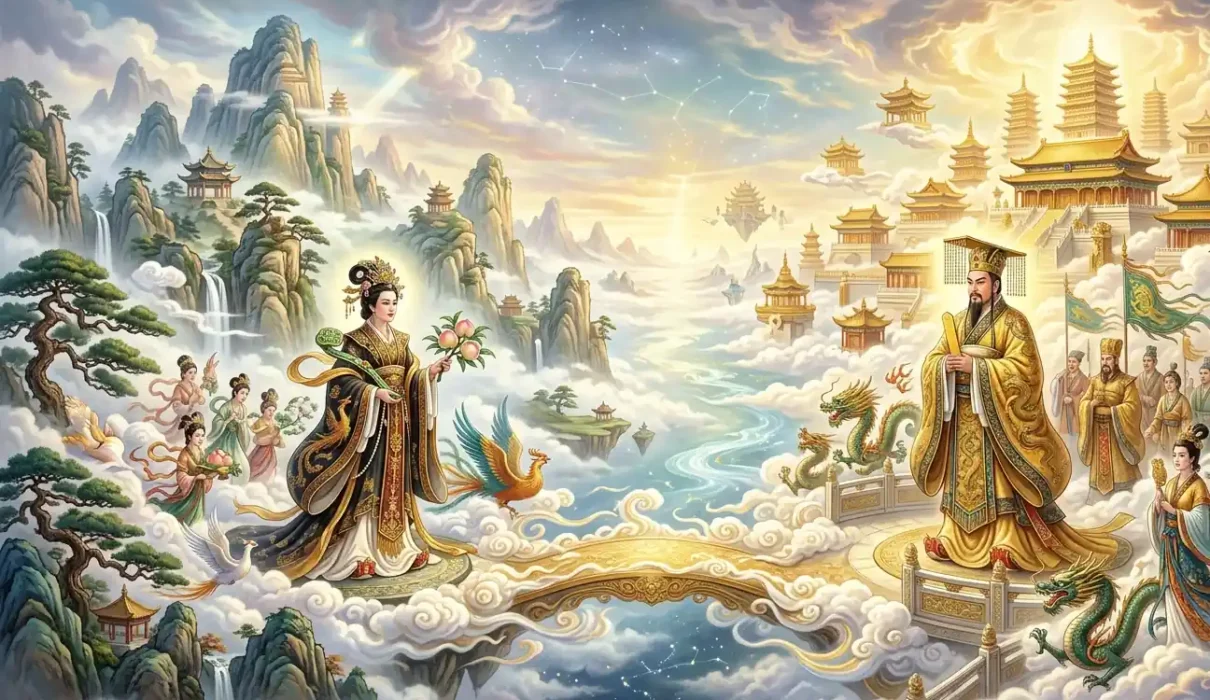
- Xiwangmu vs Jade Emperor: The Jade Emperor holds supreme administrative power. He governs heaven, earth, and the underworld as the operational head of the divine court
- Xiwangmu holds supreme immortality power. She controls the peach garden, the Jade Pool, and access to the substances that sustain the divine beings who govern the cosmos
- Their powers don’t reduce to a simple hierarchy because they govern genuinely different domains with different kinds of authority
- Xiwangmu’s origins significantly predate the Jade Emperor’s mythology. She was a major divine figure before his tradition developed
- My honest position after twenty years: Xiwangmu holds more philosophically fundamental power, because she governs what sustains the governors themselves
Let me give you the direct answer first, then the interesting argument underneath it.
Direct answer: In the administrative scope, the Jade Emperor is supreme. In the specific domain of immortality, which is what sustains the divine beings who run everything else, Xiwangmu holds authority that the Jade Emperor depends on rather than commands.
Which kind of power you consider more fundamental determines your answer. I’ll tell you mine at the end, but let me walk you through the comparison properly first.
Xiwangmu Vs Jade Emperor: Setting Up the Comparison Fairly

Why This is a Genuinely Interesting Question
Most power comparisons in mythology are straightforward: who can defeat whom, who holds the higher throne, whose name comes first in the ritual invocations. This one is more interesting because Xiwangmu and the Jade Emperor hold genuinely different kinds of power that don’t reduce to a simple stronger-weaker ranking.
A comparison that just says “the Jade Emperor is supreme administrator, therefore he wins” misses something real about what Xiwangmu’s authority actually is.
A comparison that says “Xiwangmu is more ancient, therefore she wins” misses something real about the scope of the Jade Emperor’s governance.
The honest comparison requires looking at what each figure actually controls and then making a genuine judgment about which kind of control is more fundamental.
The Key Dimensions
I’ll compare them across five dimensions:
- Age and independence of authority
- Scope of governance
- The immortality domain
- Dependence and interdependence
- Active religious power today
Dimension 1: Age and Independence of Authority

Xiwangmu’s Ancient Origins
Xiwangmu’s origins significantly predate the Jade Emperor mythology. She appears in Shang Dynasty oracle bone inscriptions among the earliest written records of Chinese religious practice, dating to approximately 1600–1046 BCE.
Her early form in the Shanhaijing (Classic of Mountains and Seas) describes a wild, independent divine figure with tiger’s teeth and leopard’s tail who controls plague and punishment. This isn’t a figure defined by any relationship with a male deity. She exists on her own authority, in her own domain, with her own independently established power.
The Jade Emperor mythology, in its fully developed form, appears primarily in texts from the Song Dynasty (960–1279 CE) and later, approximately two thousand years after Xiwangmu’s earliest documented presence.
Edge: Xiwangmu, clearly and significantly.
The Jade Emperor’s Cultivated Authority
The Jade Emperor’s authority comes from 1,750 aeons of moral cultivation earned rather than inherited or ancient. His position is legitimately his through achievement rather than seniority.
This is worth acknowledging because it reframes the age comparison. Xiwangmu is older as a documented divine figure. The Jade Emperor’s authority derives from a different kind of foundation from cultivation so vast that it makes ordinary time-consciousness inadequate.
Neither origin is superior in an obvious way. They’re simply different foundations for divine authority.
Dimension 2: Scope of Governance

The Jade Emperor’s Comprehensive Scope
The Jade Emperor governs all three realms: heaven, earth, and the underworld simultaneously. His administrative reach encompasses:
- Every divine official in the Heavenly Court
- Every living being’s moral audit through the Kitchen God system
- All natural forces through the ministry structure
- Fate governance through the Books of Life and Death
- Cosmic decree authority
This is comprehensive power at the maximum possible scope. The Jade Emperor doesn’t govern a specific domain. He governs everything within conditioned existence.
Edge: Jade Emperor, his scope is genuinely universal.
Xiwangmu’s Specific Domain
Xiwangmu’s governance is domain-specific rather than universal:
- The western paradise on Kunlun Mountain
- The Pantao Garden and its immortality peaches
- Yao Chi and its sacred waters
- The immortality tradition and access to its substances
- The three blue birds as her messenger network
Her domain is smaller in geographic and administrative scope. But its control over the substances that maintain immortal existence is uniquely significant.
Dimension 3: The Immortality Domain
Why This Dimension Matters Most
Here’s the argument I find most compelling after 10 years of studying this tradition in my 20-year-long journey.
The Jade Emperor governs everything within conditioned existence. The divine officials who implement that governance are immortal beings whose sustained existence makes continued governance possible.
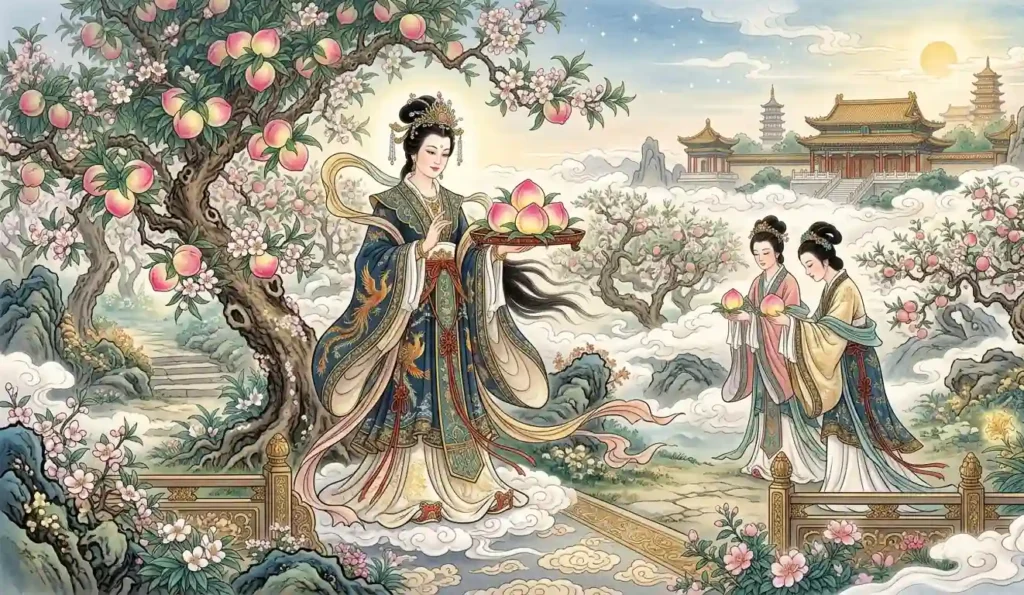
Where does their sustained existence come from? The Pantao Banquet. Xiwangmu’s peaches.
The Jade Emperor can appoint every divine minister. He can issue cosmic decrees. He can oversee the moral audit of every household. But the ministers he appoints, the beings who implement his decrees, the divine officials who run his ministries, all of them attend Xiwangmu’s Pantao Banquet for the periodic renewal of their immortal vitality.
The governor of everything depends, for the continued existence of every being who implements his governance, on the keeper of the immortality domain.
The Structural Dependency
This creates a specific structural relationship between their powers that isn’t a simple hierarchy.
The Jade Emperor is administratively superior. He convenes and hosts the Pantao Banquet, using his authority to organize the event. But the event’s substance, the peaches that actually renew the divine beings in attendance, comes from Xiwangmu’s garden, over which she has independent authority.
She can’t convene the heavenly court without his authority. He can’t renew the divine court without her peaches. They’re mutually dependent in ways that make a simple hierarchy inadequate.
Dimension 4: Dependence and Interdependence
What the Jade Emperor Needs from Xiwangmu
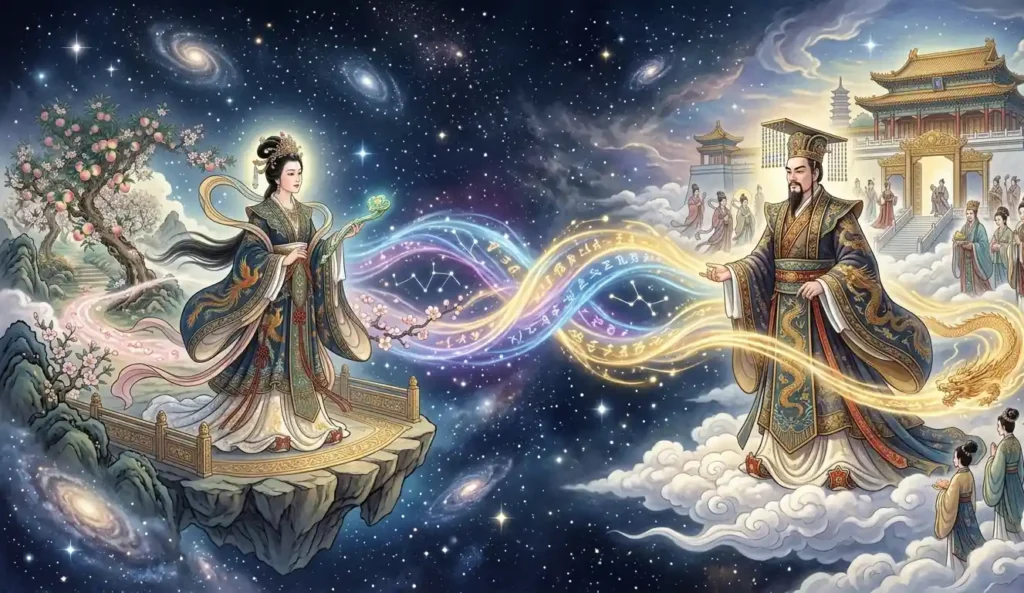
The clearest evidence of the Jade Emperor’s dependence on Xiwangmu is the Pantao Banquet itself. He hosts it. Her garden makes it possible. This isn’t a transaction where he commands resources from a subordinate. she has independent authority over the peach garden that predates the divine court’s current structure.
When the Jade Emperor wants the Pantao Banquet to occur, he works with Xiwangmu rather than directing her. The banquet is hosted in her domain (Kunlun’s Yao Chi), using her peaches of immortality, on a schedule she doesn’t control, but the Jade Emperor doesn’t control either. The peaches ripen when they ripen.
This is not the relationship between a supreme administrator and a subordinate official. It’s the relationship between two figures with different but complementary domains who need each other for different things.
What Xiwangmu Needs from the Jade Emperor
Xiwangmu’s independent authority on Kunlun is real, but the broader mythological tradition suggests she operates within the overall cosmic framework the Jade Emperor presides over.
She receives divine guests through protocols consistent with the divine court’s hierarchy. The Pantao Banquet’s guest list reflects the divine court’s ranking structure. Her authority is independent within her domain but not entirely separate from the cosmic order the Jade Emperor maintains.
Both figures have genuine dependencies on the other. The interdependence is real and specific.
Dimension 5: Active Religious Power Today
Who Receives More Active Veneration
This is the dimension most power comparisons ignore, and I think it reveals something important about which figure’s power has proven more enduring in practice.
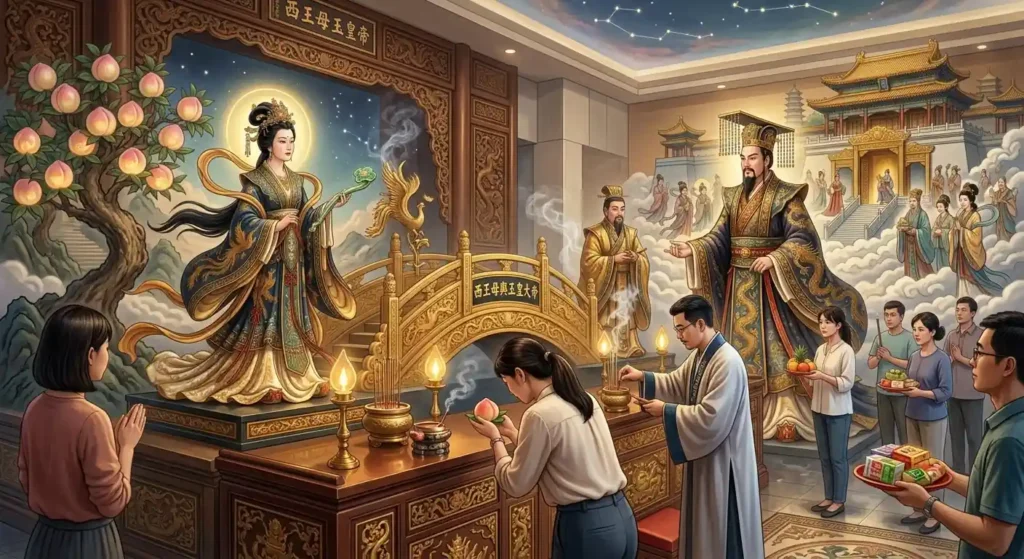
The Jade Emperor receives significant religious veneration. His birthday celebration on the ninth day of the first lunar month is one of Chinese folk religion’s most important annual events.
Xiwangmu receives dedicated temple veneration across China and the Chinese diaspora. Her birthday (seventh day of the third lunar month) has its own celebration. Women’s religious communities in particular maintain active Xiwangmu devotion that has continuous documented history.
More interesting is the everyday cultural presence: birthday peach buns at celebrations, longevity peach imagery, peach wood protective objects, the Yao Chi symbolism in Chinese poetry and art. Xiwangmu’s immortality symbolism permeates Chinese daily life in ways that the Jade Emperor’s administrative authority doesn’t quite match.
Edge: roughly equal, with Xiwangmu having broader daily cultural presence.
The Verdict: My Position After Twenty Years
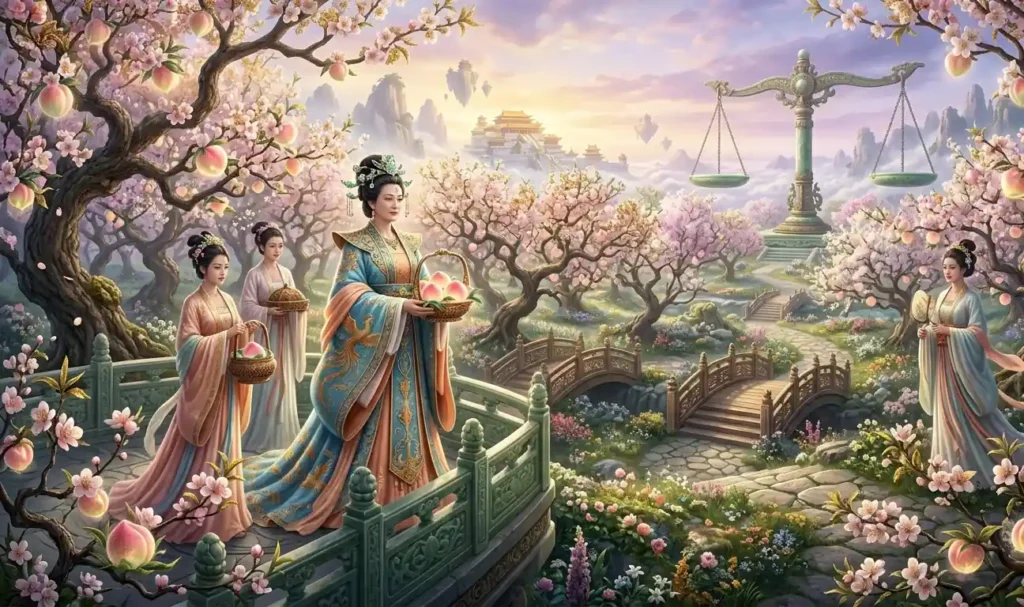
Here’s my honest assessment, and I’ll defend it specifically.
Xiwangmu holds more philosophically fundamental power.
The argument:
The Jade Emperor governs the structure within which everything operates. He administers the cosmos, maintains order, issues decrees, appoints ministers, and manages the moral accounting of all beings.
Xiwangmu controls what sustains the beings who make all of that possible. The immortality peaches don’t just serve the divine beings. They’re what keep the divine governance structure populated with beings capable of fulfilling their roles. Without continued divine immortality, the court can’t function. Without Xiwangmu’s peaches, continued divine immortality isn’t available.
The Jade Emperor governs the system. Xiwangmu maintains what makes the system possible. In engineering terms, she controls the power supply, not just the administration.
There’s also the independence argument. The Jade Emperor’s authority is, in some respects, structurally dependent on legitimacy within the framework of cultivation and cosmic law that makes governance authority valid. Xiwangmu’s authority over the immortality domain doesn’t derive from any external framework’s validation. It’s simply hers, by virtue of who she is and what she controls.
The thing that sustains the governors is ultimately more fundamental than the governance.
That’s my position. But I acknowledge the strongest counter-argument: governance power that organizes everything, including the use of Xiwangmu’s resources, is itself a form of supremacy. The Jade Emperor doesn’t just benefit from the peaches. He convenes the banquet, determines the guest list, and frames how the immortality renewal occurs within the divine social structure.
Both positions are defensible. I find mine more interesting.
Read: Are the Jade Emperor & Queen Mother of the West Married?
Frequently Asked Questions
Is Xiwangmu subordinate to the Jade Emperor in classical texts?
It depends on the text and period. Earlier classical sources present Xiwangmu as independent; the Shanhaijing describes her without reference to any male divine authority. Later traditions, especially from the Song Dynasty onward, place her within a divine court presided over by the Jade Emperor. This reflects theological development rather than a fixed relationship.
Do the Jade Emperor and Xiwangmu ever conflict in mythology?
Direct conflict between them is not a common mythological narrative. They are more often depicted as complementary cosmic authorities than as rivals. The closest thing to tension involves control of the Pantao Banquet, but even there, the texts emphasize collaboration. Their domains of authority are generally presented as complementary rather than competitive.
Why is Xiwangmu sometimes described as the Jade Emperor’s wife?
Popular folk tradition and later texts sometimes pair them as the supreme divine couple. This reflects a desire to connect the highest male and female divine figures, and confusion is reinforced by the similarity between Xiwangmu and the Jade Emperor’s consort, Wangmu Niangniang. In classical sources, however, they are distinct figures with independent authority rather than a married pair.
Could either of them function without the other?
The mythology suggests they need each other for certain functions while remaining independently powerful in their own domains. Xiwangmu’s Kunlun realm operates regardless of the divine court’s administration, and the Jade Emperor’s authority persists regardless of the Pantao Banquet. Yet the cosmic order is most complete when both are active: his governance and her provision of immortality working in tandem.
Why are Xiwangmu and Wangmu Niangniang often confused?
The similarity of their names has led to overlap in popular imagination, even though they originated as distinct figures in the tradition.
Final Thoughts
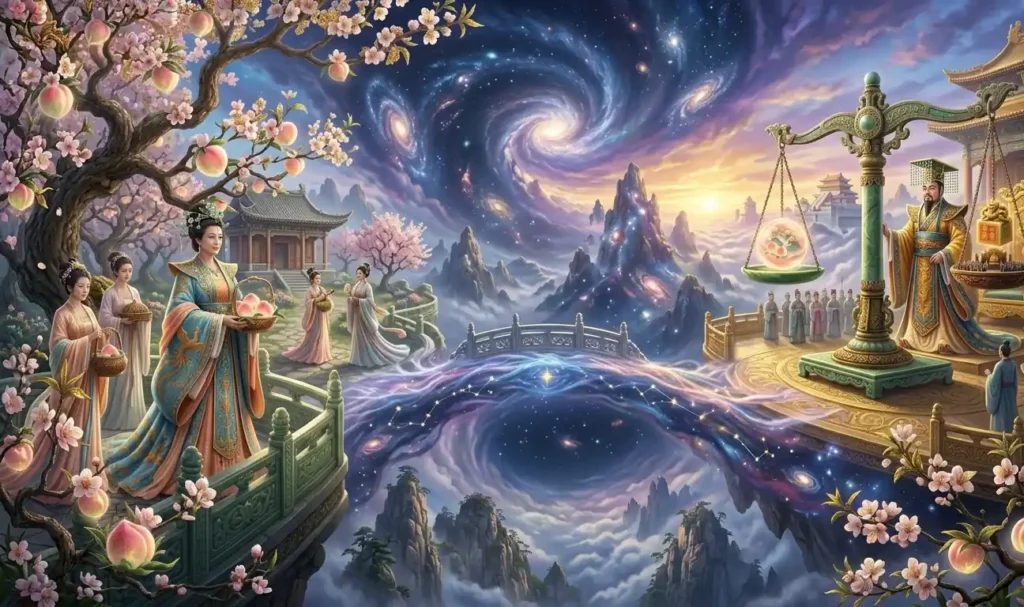
Twenty years of mythology has taught me that the most interesting power comparisons are the ones where neither figure wins cleanly, where the comparison reveals something about what power actually is and what different kinds of authority are actually for.
Xiwangmu and the Jade Emperor are genuinely complementary cosmic authorities whose power relationship can’t be collapsed into a simple stronger-weaker ranking without losing the most interesting content.
The Jade Emperor administers everything. Xiwangmu sustains what makes administration possible. Both are necessary. Neither is simply superior.
But if you push me to choose and the title of this article requires that I do, I’ll say Xiwangmu. Because the one who controls what keeps the governors alive has a kind of leverage that transcends the governors’ authority to direct anything else.
The power supply matters more than the administration. And the power supply is in her garden, on her mountain, at her pool.
Related Articles
- Jade Emperor: Origin, Powers & Sacred Meaning in Mythology
- What Is the Heavenly Court? Chinese Myth’s Divine Authority
- Queen Mother of the West: Myths, Symbolism & Sacred Power
- Jade Emperor and the Chinese Zodiac: The Great Race Story
- Are the Jade Emperor & Queen Mother of the West Married?
- Jade Emperor vs Sun Wukong: Who Really Won the Rivalry?
- 9 Divine Powers of the Jade Emperor [Ranked by Strength]
Written by Batin Khan | Mythology and philosophy reader across world cultures (20 years), Cultivation novels reader for the past 10 years | Specialist in Xianxia, Eastern and Western mythological traditions, and fantasy worldbuilding