
 By
By Quick Takeaways:
- The Chinese Heavenly Court is a divine bureaucracy modelled directly on the Chinese imperial administration, complete with ministries, ranks, audits, promotions, and demotions
- Above the Jade Emperor (the court’s operational head) sits a transcendent metaphysical tier, the Three Pure Ones, that most popular accounts of Chinese mythology overlook entirely
- The court is organised into specific departments governing every aspect of natural and human life: thunder, fire, water, plague, wealth, medicine, examinations, and more
- The divine audit system, where lesser deities report annually to higher authorities and can be promoted or demoted based on performance, is perhaps the most distinctively Chinese feature of any divine court in world mythology
- Understanding the court’s structure illuminates Chinese religion, folk practice, mythology, and literature simultaneously
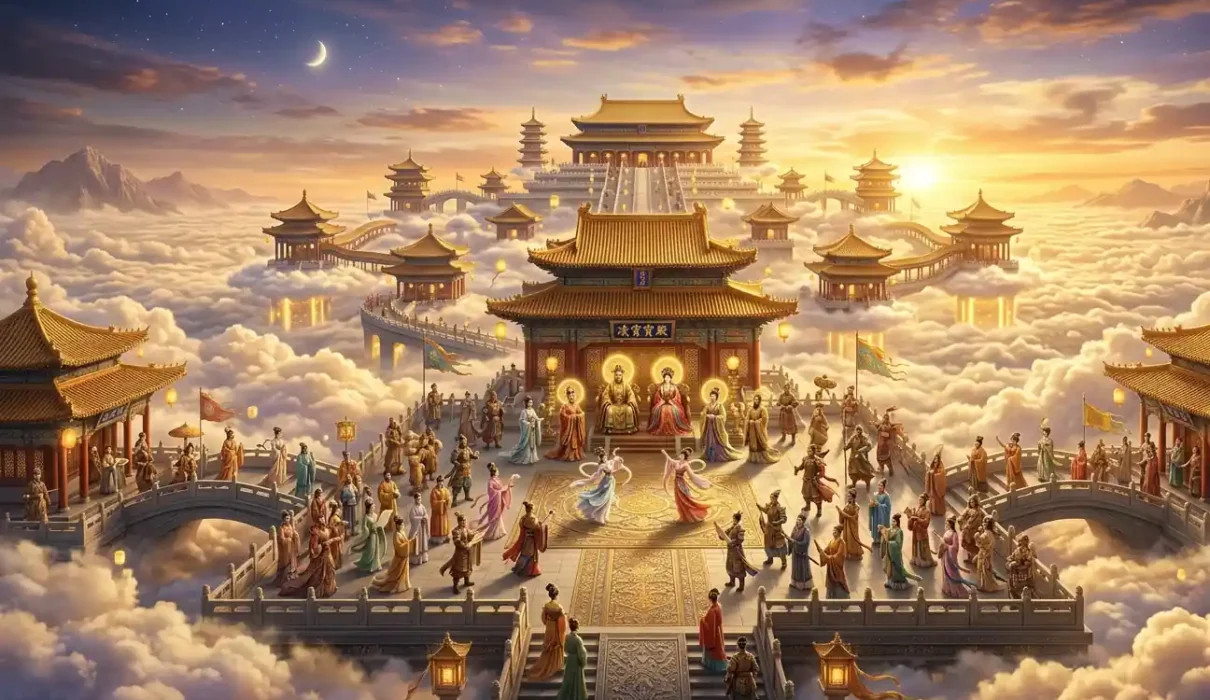
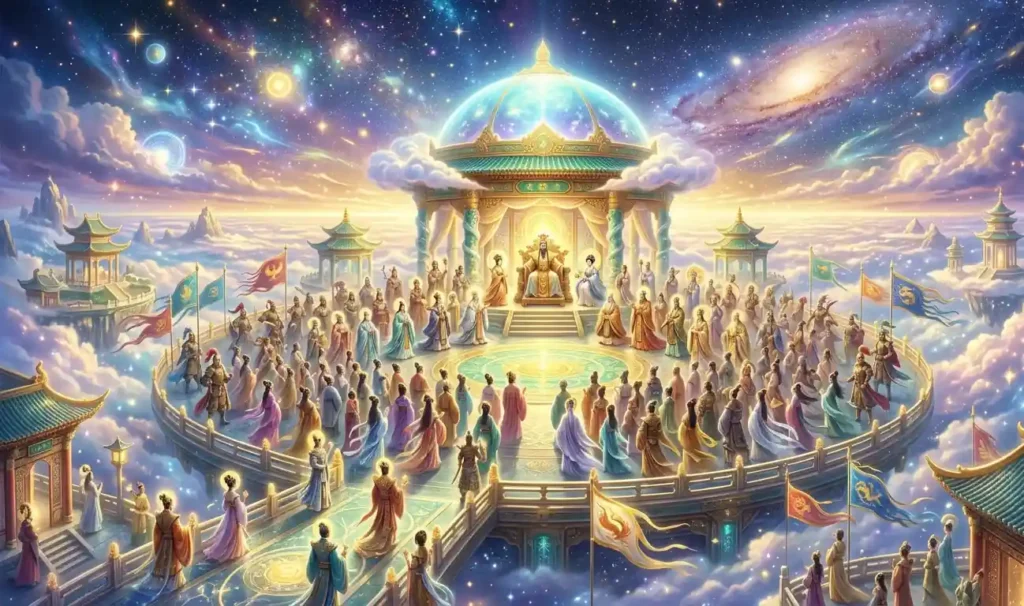
The Chinese Heavenly Court isn’t just a collection of interesting divine figures. It’s a complete bureaucratic system.
And I mean that in the most specific, administrative sense. It has departments. It has ranks. It has performance reviews. It has a minister of personnel who handles divine appointments. It has a system for filing complaints and appeals. It has a records office. The gods don’t just exist. they have job descriptions.
Butting my head into following world mythology, I still find this fascinating. almost no other world mythology has produced a divine court this elaborate, this specifically administrative, or this directly modelled on the actual governance system of the culture that created it.
This article is the complete guide. The full structure, from the transcendent metaphysical tier at the top through the operational court hierarchy to the local divine officials at the bottom, with the major figures, their roles, their stories, and the historical and philosophical context that produced all of it.
Why the Heavenly Court Looks Like an Imperial Government
The Bureaucratic Mirror
The most important thing to understand about the Chinese Heavenly Court before diving into its structure is why it looks the way it does.
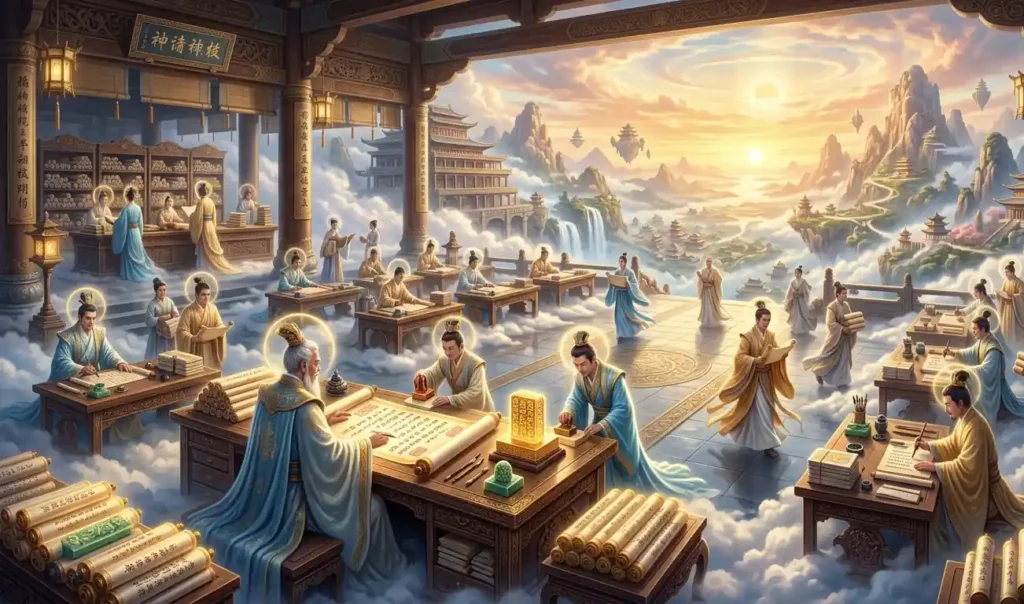
The court developed its current elaborate form primarily during the Tang, Song, and Ming dynasties, periods of sophisticated, highly bureaucratized imperial administration. Chinese imperial governance organized the empire into departments (ministries), ranks (from the emperor down through nine grades of officials), regular audits and performance evaluations, and a complex system of promotion and demotion based on merit and conduct.
The divine court mirrors all of this exactly. Not approximately, exactly. The same nine-rank system. The same ministerial structure. The same audit calendar. The same promotion and demotion mechanisms.
Why The Mirroring Happened
This isn’t a coincidence and it isn’t merely descriptive. It reflects a deep Chinese cultural assumption: that legitimate power operates through hierarchy, specialisation, and accountability.
The emperor’s mandate to rule came from heaven. He was the Son of Heaven (天子, tiānzǐ), the intermediary between the human and divine orders. For the divine order to be legitimate, it had to operate by the same principles that made human governance legitimate. A chaotic, arbitrary, or personal-whim-driven divine court would have been, within this cultural framework, a mark against the gods rather than evidence of their power.
This is genuinely different from most world mythologies. Greek gods operate through personal passion and political maneuvering. Norse gods are essentially a warrior aristocracy. The Chinese heavenly court is a professional administration. The difference reveals something important about what each culture values in its model of cosmic order.
The Historical Development
The court we know today wasn’t invented all at once. It developed through layers of religious and mythological tradition:
- Pre-dynastic shamanic traditions contributed the earliest divine figures
- Daoist religious thought developed the theological framework (the Three Pure Ones, the Five Emperors of the Directions)
- Buddhist integration from the Han Dynasty onward added new figures and cosmological concepts
- Folk religion accumulated local deities into the expanding bureaucratic framework
- Popular literature, particularly Journey to the West (16th century), crystallised the court’s structure in the popular imagination
The court that appears in Ming Dynasty literature and that continues to be the reference point for Chinese folk religion today is a product of all of these layers simultaneously.
The Transcendent Tier: Beyond The Court
Why Most Accounts Miss This
Every popular account of the Chinese Heavenly Court that leads with the Jade Emperor is, in a sense, starting on the second floor.
Above the operational court, above the Jade Emperor, above the administrative machinery of divine governance sits a tier of figures so transcendent that they’re beyond the kind of governance the court represents. These are not gods who run ministries. These are metaphysical principles that underlie all of existence.
This tier is primarily Daoist in origin, and understanding it requires engaging with Daoist cosmological philosophy rather than mythology in the narrative sense. But it’s essential for understanding what the Heavenly Court actually is, because it shows that the court, magnificent as it is, is understood within the tradition as a provisional arrangement operating within something much larger.
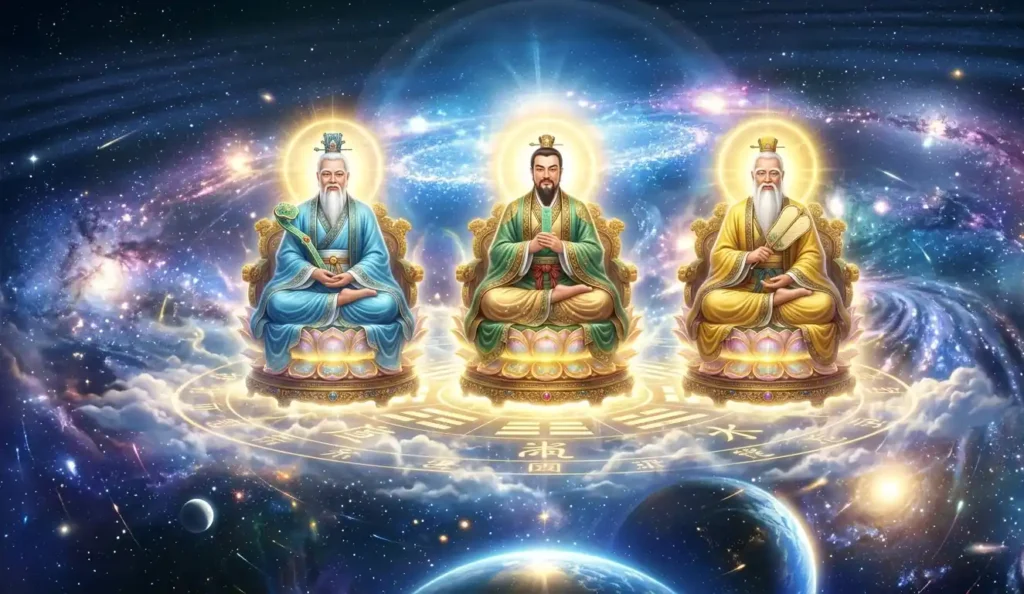
The Three Pure Ones (Sanqing)
The Three Pure Ones are the supreme deities of Daoist religious thought, three manifestations of the primordial Dao, each governing a different aspect of cosmic reality.
Yuanshi Tianzun: the Primordial Celestial Worthy
The first and highest of the Three Pure Ones. Yuanshi Tianzun embodies the beginning of all things, not a beginning in time but the primordial principle from which time and existence emerge. He inhabits the Jade Pure Heaven, the highest of the three pure heavenly realms.
His name means “the Celestial Worthy of Original Beginning” and the “original beginning” he represents isn’t the universe’s first moment so much as the timeless ground of origination from which all moments emerge.
In iconography, he’s typically depicted holding a pearl or circular object representing the undivided totality from which existence differentiates.
Lingbao Tianzun: the Numinous Treasure
The second of the Three Pure Ones, governing the transition from primordial unity to the differentiated world. Lingbao Tianzun embodies the cosmic laws and principles, the fundamental patterns that govern how existence unfolds from the primordial ground.
He inhabits the Highest Pure Heaven and is associated with the sacred Lingbao texts that encode the cosmic laws in writing. His governance is the governance of cosmic principles, the laws that run the universe, rather than the administration that implements those laws.
Daode Tianzun: the Moral Way
The third of the Three Pure Ones, most directly associated with the Daoist philosophical tradition through his identification with Laozi, the historical sage and author of the Tao Te Ching, who was apotheosized within religious Daoism as a divine figure.
He inhabits the Grand Pure Heaven and embodies the Dao as it expresses itself in human experience and moral cultivation the Dao accessible to human understanding and practice. His position as the lowest of the Three Pure Ones reflects the tradition’s ordering of transcendence: pure being at the top, cosmic law in the middle, the Dao made humanly accessible at the bottom.
The Five August Emperors of the Five Directions
Below the Three Pure Ones but above the operational court sit the Five August Emperors (Wǔ Dì) cosmic emperors governing the five cardinal directions (East, South, Centre, West, North) in alignment with the five-element framework.
These figures bridge the metaphysical tier and the operational court, representing the cosmic order at the level of differentiated directional and elemental governance rather than pure transcendence. The Jade Emperor is sometimes identified with the Yellow August Emperor of the Centre, the most important of the five, governing the central direction (Earth element) that holds the entire system together.
The Jade Emperor: The Court’s Operational Head
Who the Jade Emperor Actually is
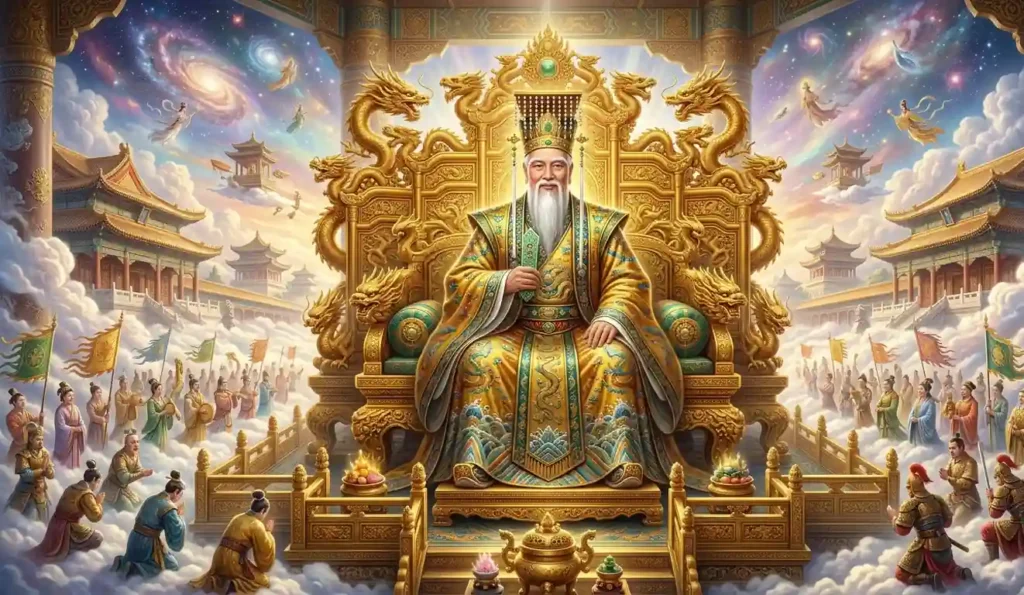
The Jade Emperor (Yùhuáng Dàdì or Yùdì) is the supreme ruler of the Heavenly Court’s operational tier, the divine emperor who heads the administrative machinery of the cosmos
His full title is impressively elaborate: Xuanling High Perfected Jade Emperor of the Mysterious and Numinous, the Awe-inspiring One of the August Heaven, the Father-King of the Golden Watchtower, the Jade Emperor (Can give mother of dragons a run for the money xD), which tells you something about both his status and the Chinese tradition’s love of comprehensive official titles.
His origin story varies across sources. The most popular account, preserved in folk tradition, has him beginning as a mortal who underwent 1,750 aeons of cultivation and passed through numerous trials before achieving his current position. This origin story is theologically significant: the Jade Emperor’s authority isn’t based on inherent divine nature but on earned cultivation and accumulated merit. The divine emperor, like the human emperor, achieves and maintains authority through demonstrated virtue and capability.
The Jade Emperor’s Court: Layout and Structure
The Jade Emperor’s court is modelled precisely on the imperial court of the Chinese emperor. It includes:
- The Hall of Divine Mists: The throne room where the Jade Emperor holds audience
- The celestial ministers: Divine officials arranged by rank and department
- The divine generals: Military commanders of the heavenly armies
- The Record Office: Where the Book of Life and Death is maintained
- The divine kitchen: Where the divine peaches and other celestial substances are prepared
The court holds regular audiences at which divine officials report, petitions are heard, and the Jade Emperor issues decrees. This is not a mythological invention. It directly mirrors the actual operational structure of the Chinese imperial court.
The Divine Ministries: Governing Everything
The operational machinery of the Heavenly Court is organised into specialised ministries, each governing a specific domain of natural or human affairs. This is where the bureaucratic model becomes most elaborate and most specifically Chinese.
The Ministry of Thunder
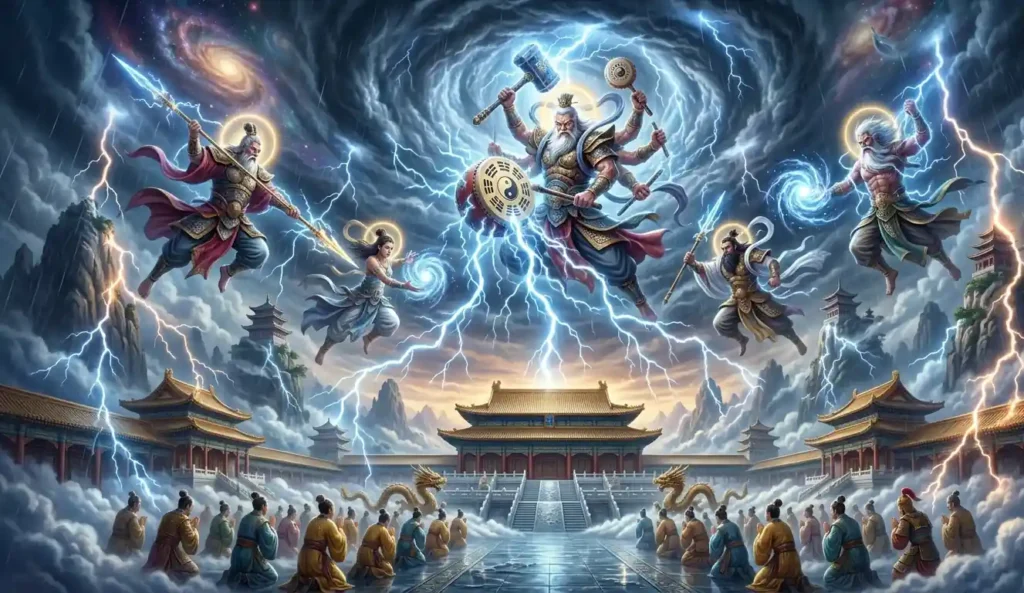
Head: Lei Gong (Duke of Thunder) and Dian Mu (Mother of Lightning)
The Ministry of Thunder is responsible for delivering divine retribution, executing the heavenly punishments decreed against humans who have committed sufficiently serious offences against the cosmic moral order.
Lei Gong is depicted with a bird’s beak, bat wings, and clawed feet, wielding a drum and mallet. He produces thunder by striking the drum. Dian Mu produces lightning by flashing mirrors she carries.
The pairing of Lei Gong (male, thunder) and Dian Mu (female, lightning) is one of the court’s most striking yin-yang symbolic pairings, masculine and feminine principles working together to deliver divine judgment.
The Ministry of Fire
Head: Huo De Xing Guan (Fire Virtue Star Official)
Notable members: Zhu Rong – the ancient fire deity
The Ministry of Fire governs all aspects of fire in the natural and human worlds, including the management of droughts, the protection of fire-users, and the punishment of arson.
The great fire deity Zhu Rong has roots in Chinese mythology that predate the Heavenly Court framework by centuries. He’s one of the most ancient Chinese divine figures, associated with the south and the summer in the earliest cosmological frameworks.
The Ministry of Water
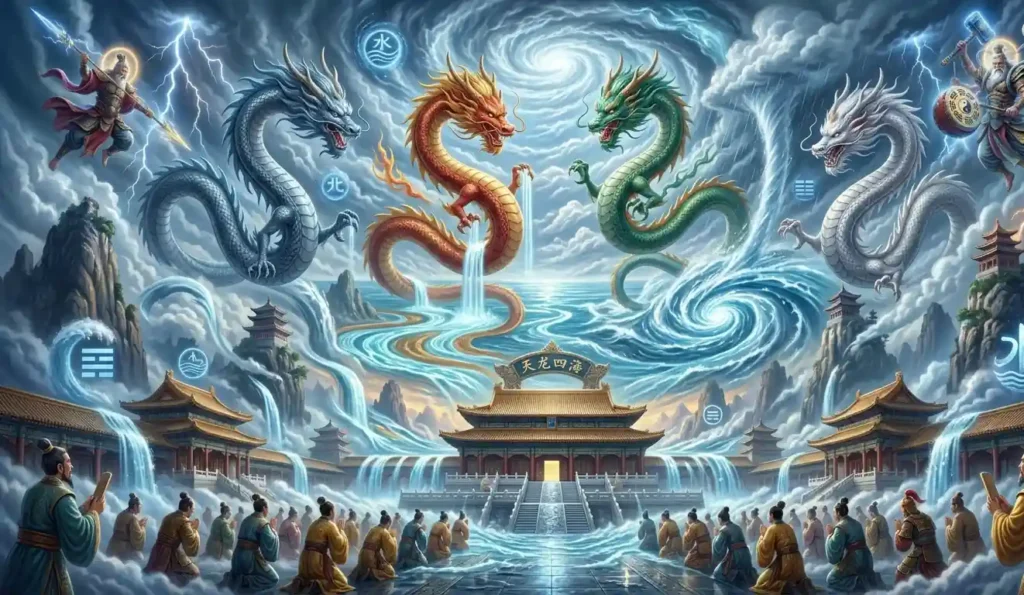
Head: Governed collectively by the Dragon Kings of the Four Seas
The Ministry of Water is one of the court’s most populated and most practically important departments. Water governance in an agricultural civilisation dependent on rainfall and river management has real urgency.
The Four Dragon Kings of the East, South, West, and North seas are the most important water officials, governing the major ocean domains. Below them sit river gods, lake gods, and local water deities covering every significant body of water in the empire.
The Dragon Kings have an interesting relationship with the Jade Emperor. They’re powerful, independently established divine figures who operate within the court’s framework but retain considerable autonomy. Their stories in Chinese mythology often involve conflicts with the Jade Emperor that have to be negotiated rather than simply commanded.
The Ministry of Wind
Head: Feng Bo (Wind Master)
Feng Bo governs the winds and is responsible for ensuring they’re deployed appropriately, bringing the spring winds at the right time, moderating storm winds to prevent excessive destruction, and executing weather punishments when decreed.
He’s often depicted as an old man carrying a sack from which wind emerges when the mouth is opened.
The Ministry of Plague
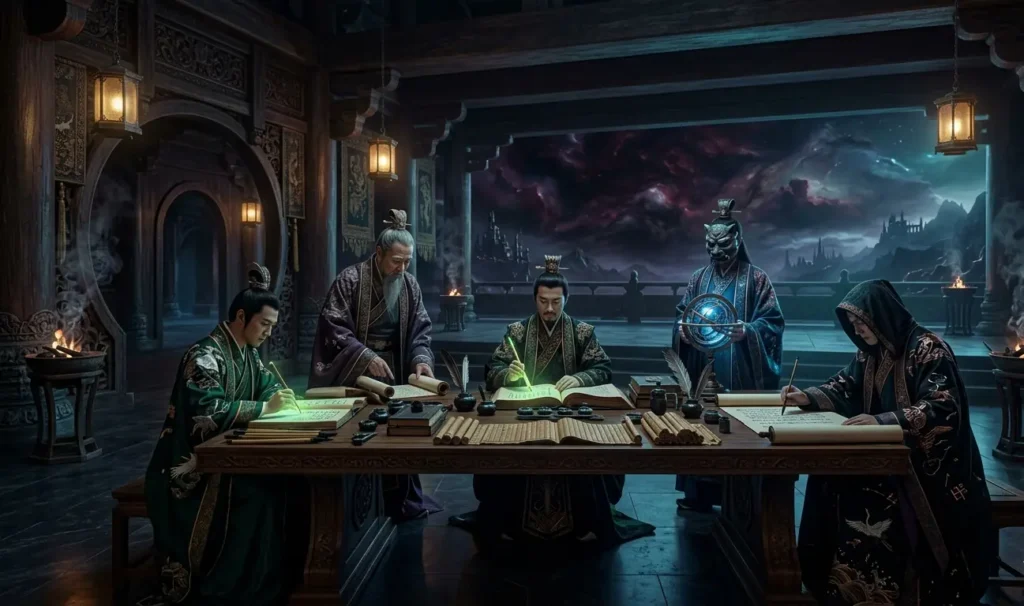
Head: The Five Plague Gods
The Ministry of Plague is one of the most feared of the divine departments the officials responsible for delivering epidemics as divine punishment for collective moral failings.
The Five Plague Gods are associated with the five seasons and five elements, making epidemic disease a cosmologically grounded phenomenon rather than random misfortune. When a community fell ill, the folk religious interpretation was that the Plague Gods had been sent, which meant moral remediation and ritual propitiation, not just physical treatment.
The Ministry of Plague’s existence in the divine bureaucracy reflects the premodern understanding that large-scale suffering was divinely administered and that understanding had real effects on how communities responded to epidemic disease.
The Ministry of Wealth
Head: Cai Shen – the God of Wealth
Notable figure: Bi Gan – the historical figure who was apotheosized as a Wealth God
The Ministry of Wealth governs the distribution of prosperity and manages the cosmic economy. Cai Shen is the most popularly worshipped deity in Chinese folk practice. Images of the Wealth God appear in virtually every Chinese business and many Chinese homes.
The Wealth God tradition actually encompasses several distinct figures who have been grouped under the same function:
- Civil Wealth Gods: Bi Gan and Fan Li, both historical figures associated with wealth management
- Military Wealth Gods: Zhao Gongming, a more martial-looking Wealth God who commands supernatural power alongside financial patronage
- The Five Wealth Gods: Associated with the five directions, each bringing prosperity from their respective domain
The proliferation of Wealth God figures reflects both the practical importance of prosperity in folk religion and the diversity of communities that developed their own specific patronage relationships with divine financial figures.
The Ministry of Medicine
Head: Shennong (the Divine Farmer) and Sun Simiao
Associated figure: Hua Tuo
The Ministry of Medicine governs healing and the administration of medicinal knowledge. Shennong, the legendary Divine Farmer who tasted hundreds of herbs to identify their medicinal properties, is the foundational medical deity, the original source of Chinese medical knowledge in the mythological framework.
Sun Simiao is a historically real Tang Dynasty physician who was apotheosized after his death for his medical contributions. His Thousand Golden Prescriptions remains a significant classical medical text.
The Medicine Ministry is interesting because it demonstrates the court’s incorporation of both mythological figures (Shennong) and deified historical figures (Sun Simiao) within the same administrative framework.
The Ministry of Literature and Examinations
Head: Wen Chang Di Jun (Emperor Lord of Literature)
Key figure: Kui Xing – the Star of Literary Excellence
For a civilization that selected its administrative class through competitive examinations, the divine governance of those examinations was extremely important. The Ministry of Literature oversaw intellectual excellence, the cultivation of writing and scholarship, and most critically, the divine influence over examination outcomes.
Wen Chang Di Jun was the supreme patron of scholars and examination candidates. His temple in Chengdu is one of the most significant of any deity in the Chinese divine court centuries, scholars and officials made pilgrimage there for his blessing.
Kui Xing, depicted as a divine official holding a writing brush and the Big Dipper (whose stars his name references), is the direct arbiter of examination success. His divine pen determines whose name appears on the register of successful candidates. Scholars placed images of Kui Xing on their desks during examination preparation.
The Divine Generals and Celestial Armies
Why The Court Needs Military Force
The Heavenly Court isn’t just an administrative body. It governs a cosmos that contains active challenges to its order. Demonic forces, rebel deities, and beings that require martial subjugation rather than administrative management.
The court’s military wing is extensive and includes some of Chinese mythology’s most vivid figures.
Nezha: The Divine Marshal
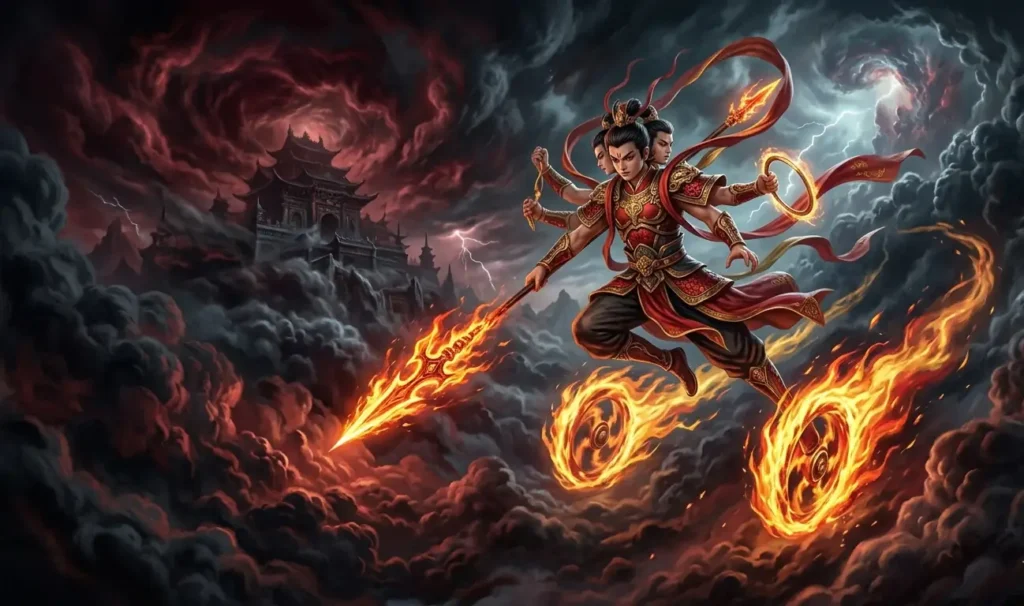
Nezha is one of the most beloved figures in Chinese mythology, a divine child of enormous power who rides on Wind Fire Wheels, wields a Universe Ring and Red Armillary Sash, and can transform into a multi-armed combat form of overwhelming power.
His origin story is one of Chinese mythology’s most psychologically complex. Born from his mother’s womb as a divine child after a three-and-a-half-year pregnancy, he immediately caused chaos, accidentally killing the Dragon King’s son in a moment of childish play, then killing himself to spare his father from divine retribution, then being resurrected by his teacher Taiyi Zhenren from lotus petals into a new body.
The lotus resurrection creates a new Nezha, one who owes nothing to his father and serves only his divine teacher and the Jade Emperor’s court. His eventual role as Third Prince and Marshal of the Central Altar places him as one of the court’s most powerful military officials.
Erlang Shen: The Finest Warrior
Erlang Shen, the “Second Son” is considered by many classical sources to be the finest individual warrior in the Heavenly Court, a distinction that famously put him in a contest with Sun Wukong in Journey to the West.
He’s depicted with three eyes (the third being a vertical eye in his forehead that can see through all deceptions) and accompanied by a divine dog that assists in battle. He wields a three-pointed, double-edged spear.
His origin story is complex and varies across sources. Some identify him as Yang Jian, nephew of the Jade Emperor, born of a divine father and a mortal woman. This semi-divine origin gives him powers that differ from either pure gods or pure mortals.
His position in the court is unusual. He governs from Guanjiang Mouth in Sichuan and is famously willing to act independently of the Jade Emperor’s direct orders. He’s a marshal who serves the court’s interests while maintaining his own judgment about how best to serve them.
The Four Heavenly Kings
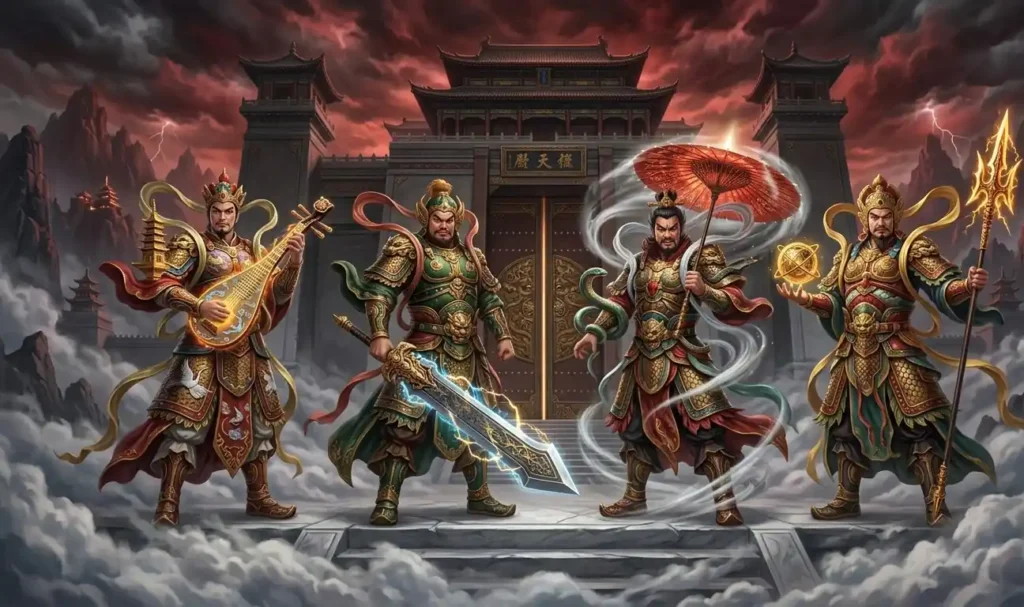
The Four Heavenly Kings are the court’s directional military governors, divine generals who command the heavenly armies in each of the four cardinal directions.
As discussed in the Four Heavenly Kings article, they’re Buddhist in origin but fully integrated into the Chinese divine court framework:
- Mo Li Qing: East, commands the wind
- Mo Li Hong: South, commands fire
- Mo Li Hai: West, commands the sea (carries a four-stringed guitar)
- Mo Li Shou: North, commands the sword
They appear as enormous, armored warriors, guardians of the cosmic directions and primary defenders of the court’s military perimeter.
The Twenty-Eight Constellations
The Twenty-Eight Constellations are divine figures corresponding to the twenty-eight Chinese lunar mansions, the astronomical divisions of the sky that underlie the Four Holy Beasts system.
In military terms, they serve as the divine army’s most powerful unit, twenty-eight supernatural warriors of immense individual power who can be deployed against threats beyond what ordinary divine armies can handle.
Their appearance in Journey to the West as part of the force assembled against Sun Wukong gives them their most famous narrative context, but they appear throughout Chinese mythology as a collective military force of supreme capability.
The Divine Audit System: Heaven’s Annual Review
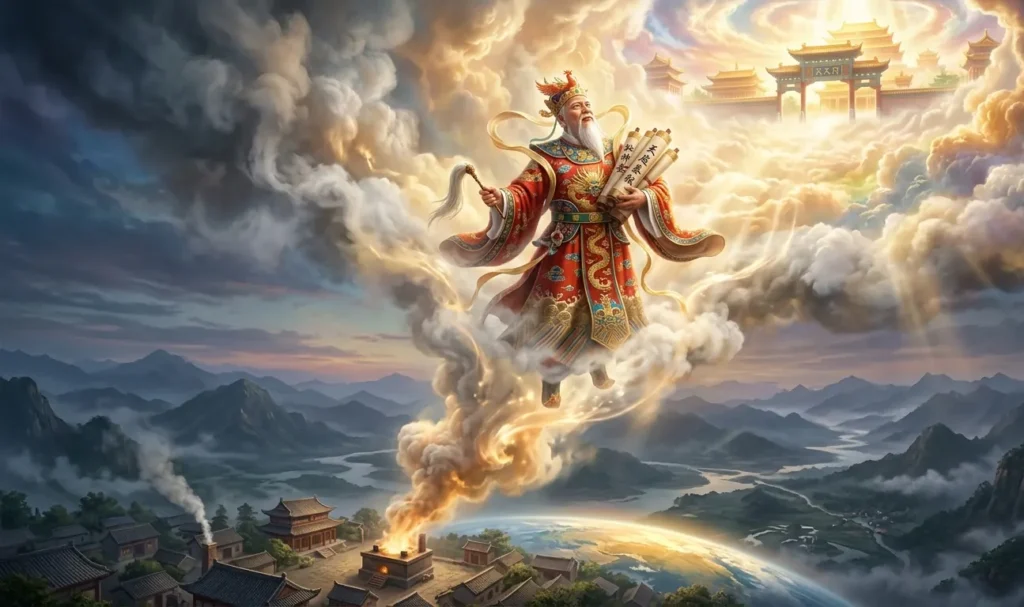
The Kitchen God and the Reporting Mechanism
If there’s one aspect of the Chinese Heavenly Court that I find most specifically and wonderfully Chinese, it’s the divine audit system, the mechanism by which lower divine officials regularly report to higher authorities on the moral state of their jurisdictions.
The most familiar expression of this system involves the Kitchen God (Zào Shén or Zào Wáng Yé), the divine official who resides in every household’s kitchen and observes the family’s behavior throughout the year.
On the twenty-third day of the twelfth lunar month, approximately a week before the Lunar New Year, the Kitchen God ascends to the Heavenly Court to present his annual report on the household’s moral conduct to the Jade Emperor. Based on this report, the household’s fortune for the coming year is determined.
Families traditionally offered the Kitchen God sticky sweet foods (particularly a sticky candy called Tang Gua) before his departure to stick his mouth shut so he couldn’t speak of the household’s failings, or to sweeten his words so he’d speak only good things.
The Broader Reporting Structure
The Kitchen God is the most intimate example of a pervasive divine reporting structure:
- Household-level: Kitchen God reports on family moral conduct
- Village level: Local earth gods (Tǔ Dì Shén) report on village moral conditions
- County and prefectural level: City gods (Chénghuáng Shén) report on urban communities
- Provincial level: Higher divine officials report on regional conditions
- National level: Major divine ministries report to the Jade Emperor
This creates a complete divine governance structure parallel to the human administrative hierarchy, with information flowing upward through the system and directives flowing downward.
The City God: Divine Magistrate
The City God (Chénghuáng) is one of the most practically important figures in the divine bureaucracy, the divine equivalent of the human city magistrate, governing the spiritual and moral conditions of urban communities.
City Gods have individual identities and histories many are deified humans, former magistrates or officials who were particularly virtuous in their human lives and were posthumously appointed to divine administrative positions. Each major city has its own specific City God with its own name, its own temple, and its own civic identity.
The City God’s jurisdiction mirrors the human magistrate’s: he governs the living, manages the dying, and maintains order in the local divine ecology. His temple served as the divine court where spiritual cases were tried and divine judgments issued.
The Underworld Administration: Yama and the Ten Courts
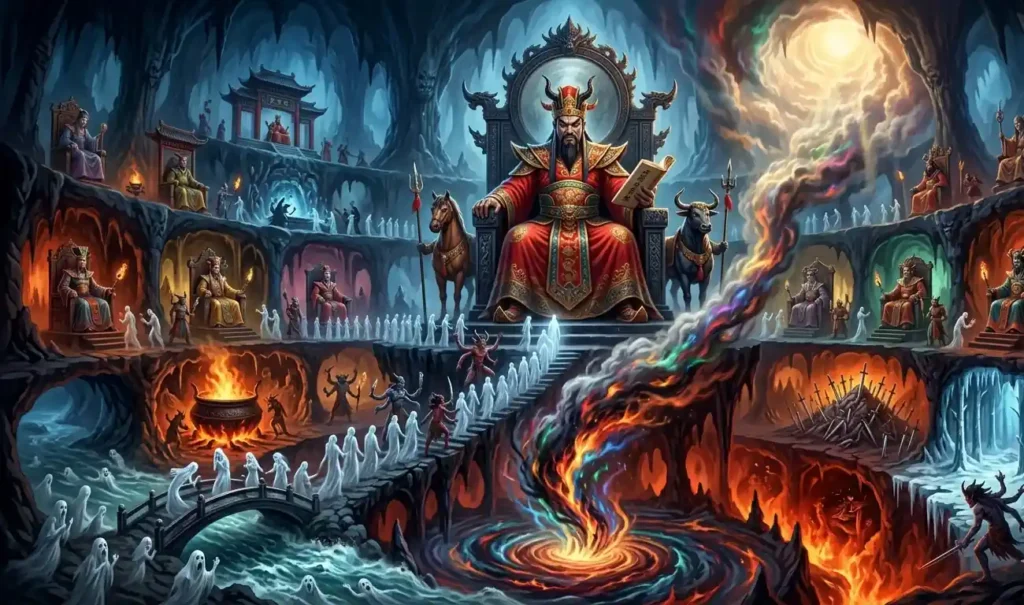
The Heavenly Court’s Underworld Extension
The divine bureaucracy doesn’t end at death. The underworld (Dìfǔ) is governed by its own administrative structure, ten courts of judgment, each governed by its own King of Hell, through which souls pass after death and before their next incarnation.
This structure blends Chinese folk religion, Buddhist cosmology (particularly the concept of hell realms and karmic judgment), and the bureaucratic principles of the Heavenly Court.
Yama: The Supreme Underworld Judge
Yama (Yánluó Wáng) is the king of the underworld and the supreme judge of the dead. He’s derived from the Hindu/Buddhist deity of death (Yama in Sanskrit) but has been thoroughly Sinicized into a robed judge presiding over a divine court of judgment.
Yama oversees the process by which souls’ deeds are recorded, weighed, and used to determine their next existence. His court functions like a divine courthouse: souls are brought before the judge, their earthly deeds are read from the Book of Life and Death, and their next experience (heaven, hell, or rebirth as a specific type of being) is determined by divine judgment.
The Book of Life and Death
The Book of Life and Death (Shēngsǐ Bù), also called the Register of the Living and Dead, is maintained in the underworld and contains the complete life record and predetermined lifespan of every being.
This book’s existence creates one of Chinese mythology’s most productive narrative tensions. If your lifespan is recorded in the Book, can it be changed? Journey to the West‘s Sun Wukong famously broke into the underworld and modified his own entry, effectively cheating death, an act that both demonstrates the system’s theoretical integrity and the possibilities available to those powerful enough to circumvent it.
The Bodhisattvas: The Buddhist integration
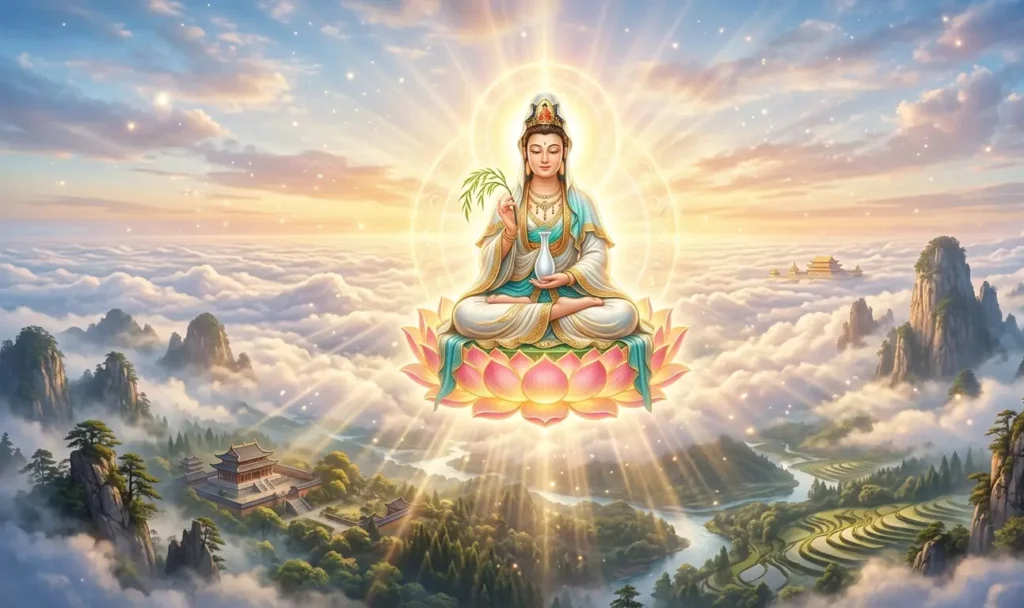
Guanyin and the Celestial Compassionate Presence
The integration of Buddhist figures into the Chinese divine court is one of the most successful cross-religious syntheses in world religious history. Buddhist Bodhisattvas beings who have achieved enlightenment but remain available to help all sentient beings rather than passing into nirvana were incorporated into the court’s structure as benevolent divine presences who operate somewhat outside the strictly hierarchical administrative framework.
Guanyin (also Guān Shìyīn, Bodhisattva of Compassion) is the most beloved divine figure in Chinese religious practice, more widely venerated than any figure in the Heavenly Court itself. She represents compassion and mercy, responding to the sincere calls of suffering beings regardless of their formal religious affiliation.
Guanyin’s integration into Chinese folk religion is so complete that her origins as the male Indian Bodhisattva Avalokiteshvara have been almost entirely replaced by a distinctly Chinese feminine figure, the White-Robed Guanyin, often depicted with a child or standing on a lotus above the sea.
The Complete Hierarchy: A Reference Structure
| Level | Figures | Function |
|---|---|---|
| Metaphysical supreme | Three Pure Ones | Cosmic principle, transcendent ground |
| Five Directional Emperors | Five August Emperors | Directional cosmic governance |
| Operational supreme | Jade Emperor | Administrative head of the divine court |
| Major ministries | Ministry heads (Thunder, Fire, Water, etc.) | Governing specific natural domains |
| Divine generals | Nezha, Erlang Shen, Four Heavenly Kings | Military enforcement and defence |
| Celestial armies | Twenty-Eight Constellations, divine soldiers | Military force |
| Regional divine officials | City Gods, Mountain Gods | Provincial and local governance |
| Community divine officials | Earth Gods, Kitchen God | Village and household level |
| Underworld | Yama, Ten Kings of Hell | Post-death administration |
Frequently Asked Questions
Who is the highest god in Chinese mythology?
In the operational divine court, the Jade Emperor rules supreme. In Daoist theology, the Three Pure Ones stand above him as transcendent principles rather than administrators. In lived Chinese folk religion, Guanyin is often the most widely venerated figure. These overlapping answers reflect the tradition’s internal complexity rather than contradiction.
How does the Jade Emperor relate to the Jade Emperor in Journey to the West?
, the classic novel by Wu Cheng’en, is the most influential popular depiction of the Heavenly Court and its bureaucracy. Its Jade Emperor follows the standard divine ruler archetype but is also treated satirically, often appearing indecisive and dependent on both Sun Wukong and Buddha to resolve crises. The portrayal reflects the novel’s broader critique of bureaucracy and authority.
Is the Chinese Heavenly Court a religious belief or mythology?
Both, depending on context. For practitioners of Chinese folk religion, which remains a living tradition with hundreds of millions of followers worldwide, the divine court is a real cosmic order whose figures actively respond to prayer and ritual. For scholars, it is a mythological system with a traceable historical evolution. For cultural audiences, it functions as a rich narrative framework across Chinese art, literature, and popular culture. These categories often overlap rather than exclude one another.
What’s the relationship between the Heavenly Court and Buddhism?
The Chinese Heavenly Court is a syncretic system that blends Daoist theology, Buddhist cosmology, and indigenous Chinese folk religion. Buddhist figures, especially Bodhisattvas such as Guanyin and the Four Heavenly Kings, became integrated into its structure, while the underworld reflects Buddhist ideas of karma and rebirth. The result is a divine court shaped by multiple religious traditions rather than belonging exclusively to one.
How did ordinary Chinese people interact with the Heavenly Court?
People engaged with the Heavenly Court through everyday folk religious practice: praying at temples dedicated to specific divine officials, making offerings to the Kitchen God before his annual report, consulting City God temples on moral and legal matters, seeking the Wealth God’s blessing for business, and appealing to the Literature God before examinations. The divine court was not merely abstract theology but a practical cosmic administration woven into daily life.
Where can I learn more about specific figures in the Chinese Heavenly Court?
Key classical sources include Journey to the West for the Heavenly Court’s narrative framework, Investiture of the Gods for the mythology surrounding the court’s establishment, and historical works such as Records of the Three Kingdoms for the later deification of historical figures. Important English-language scholarship includes Anne Birrell’s Chinese Mythology, Anthony Christie’s Chinese Mythology, and C.K. Yang’s Religion in Chinese Society, especially for understanding the folk religious dimension.
Final Thoughts
The Greek Olympians. The Norse Aesir. The Hindu devas. The Mesopotamian divine assembly. All of them are fascinating.
None of them is anything like the Chinese Heavenly Court.
The level of structural elaboration of the ministries, the ranks, the audit system, the parallel to human governance, and the incorporation of deified historical figures into an expanding administrative framework is simply unmatched in any other world mythology. It reflects something deep and specific about Chinese culture. The belief that legitimate cosmic order works through the same principles as legitimate human order, and that those principles involve hierarchy, specialization, accountability, and regular performance review.
I find this genuinely admirable in its way. The Heavenly Court doesn’t promise an arbitrary cosmic order governed by divine passions and whims. It promises a rational, accountable cosmic administration, one that can be appealed to, one that has rules, one where merit matters, and bad performance has consequences.
Whether that promise is realized is the question every tradition’s believers and skeptics debate. But the aspiration encoded in the structure of an orderly, accountable cosmos governed by principle rather than caprice is itself a philosophical achievement worth taking seriously.
Related Articles
- Eight Immortals: symbols, sacred roles and Daoist meaning
- Jade Emperor: Origin, Powers & Sacred Meaning in Mythology
- Queen Mother of the West: Myths, Symbolism & Sacred Power
- What Was the Jade Emperor Origin Before He Became a Ruler?
- Jade Emperor Family: The Divine Family of Chinese Mythology
- Are the Jade Emperor & Queen Mother of the West Married?
References
- Birrell, Anne. Chinese Mythology: An Introduction.
- Major, John. Heaven and Earth in Early Han Thought.
- Kohn, Livia. Daoism and Chinese Culture.
- Allan, Sarah. The Shape of the Turtle.Hanshu (Book of Han).
- Shiji (Records of the Grand Historian).
- Tao Te Ching – Translated by J. Legge
- Daozang – Daoist Canon
- Zhuangzi – Chinese Text Project
- Taipingjing – Chinese Text Project
- Investiture Of The Gods
- Journey To The West
- The book of Rites