
 By
By Quick Takeaways:
- For practical purposes, Japanese dragon traditions can be understood through three major layers: indigenous Shinto tradition in the Kojiki and Nihon Shoki, Buddhist Naga traditions transmitted through China and Korea, and regional folk legends attached to specific landscapes
- The Kojiki (712) and Nihon Shoki (720) are among the earliest surviving Japanese written sources for dragon- and serpent-like beings, and this article treats them as such
- Japanese dragons range from the genuinely terrifying (Yamata no Orochi) to the cosmically benevolent (Ryujin) to the tragically human (Kiyohime)
- Several of the most significant Japanese dragon legends involve transformation, particularly the transformation of women into dragon form, which is a recurring and philosophically interesting pattern
- Understanding these figures enriches your engagement with Japanese religious sites, classical literature, and artistic tradition simultaneously
East Asian mythology has taught me that Japanese dragon tradition is frequently undersold. The popular shorthand, “Japanese dragons are basically like Chinese dragons but with three toes,” misses how genuinely distinct, how varied, and how emotionally complex the Japanese tradition actually is.
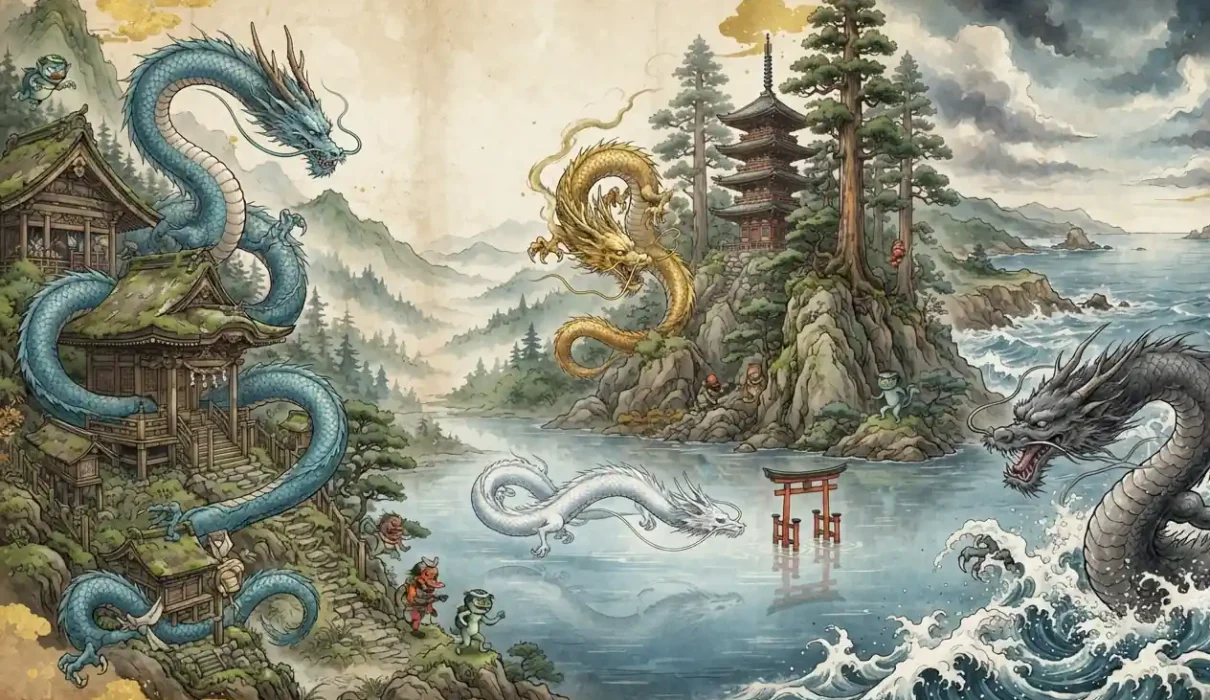
Japanese dragons come from genuinely different places. Some come from Shinto texts that predate significant Chinese influence. Some came through Buddhist transmission with Indian Naga concepts already layered over the Chinese Long tradition. Some are purely regional, attached to specific lakes, mountains, and temples with no clear textual pedigree beyond folk memory.
Here are 10 of the most significant, with the legends that made them famous.
1. Yamata no Orochi: The Eight-Headed Serpent
The Most Famous Japanese Dragon
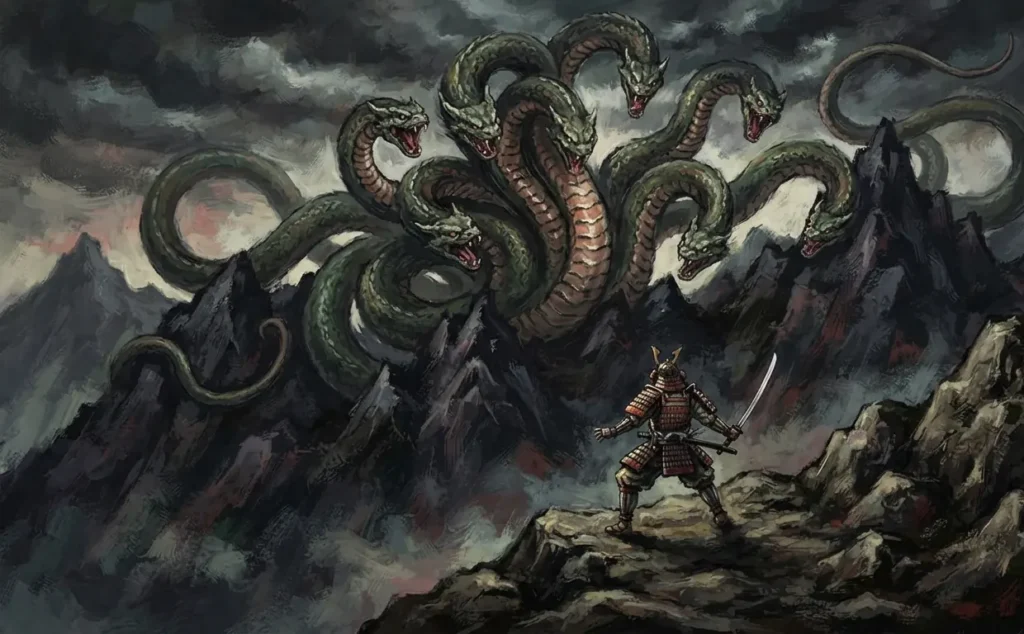
Yamata no Orochi is a gigantic eight-headed serpent often described as Japan’s closest equivalent to a dragon in popular retellings, documented in both the Kojiki (712 CE) and the Nihon Shoki (720 CE). The surviving Japanese versions are deeply rooted in the Izumo mythological tradition and differ significantly from the classical Chinese dragon tradition.
The name means “eight-branching great serpent.” The creature has eight heads and eight tails, a body so vast that eight valleys and eight peaks fit within it, and eyes described as red as winter cherries. It descends annually to a region of Izumo province to claim one of a family’s daughters, having already killed seven.
The Legend
Susanoo, the storm god, had been banished from the heavenly realm for causing chaos during his grief over his mother. He encountered the family whose last daughter was about to be taken. His solution was distinctly pragmatic: he instructed the family to brew eight vats of sake, placed them out for the serpent, and waited.
Yamata no Orochi drank from all eight vats, one head per vat, and fell into a deep stupor. Susanoo then killed it with his sword.
When he cut through one of the tails, his blade struck something inside and chipped. Within the tail, he found the divine sword Kusanagi-no-Tsurugi, which became one of Japan’s three imperial treasures, and tradition holds that it is enshrined at Atsuta Jingū in Nagoya.
Why This Legend Matters
Yamata no Orochi is not a benevolent rain-bringer or a cosmological guardian. It’s a threat that demands tribute, that kills without cosmic justification, and that is defeated through cleverness rather than divine power. This adversarial character distinguishes it from most East Asian dragon traditions and gives Japanese mythology a dragon figure with no precise equivalent in Chinese or Korean tradition.
2. Ryujin: The Dragon King of the Sea
The Most Powerful Japanese Sea Deity
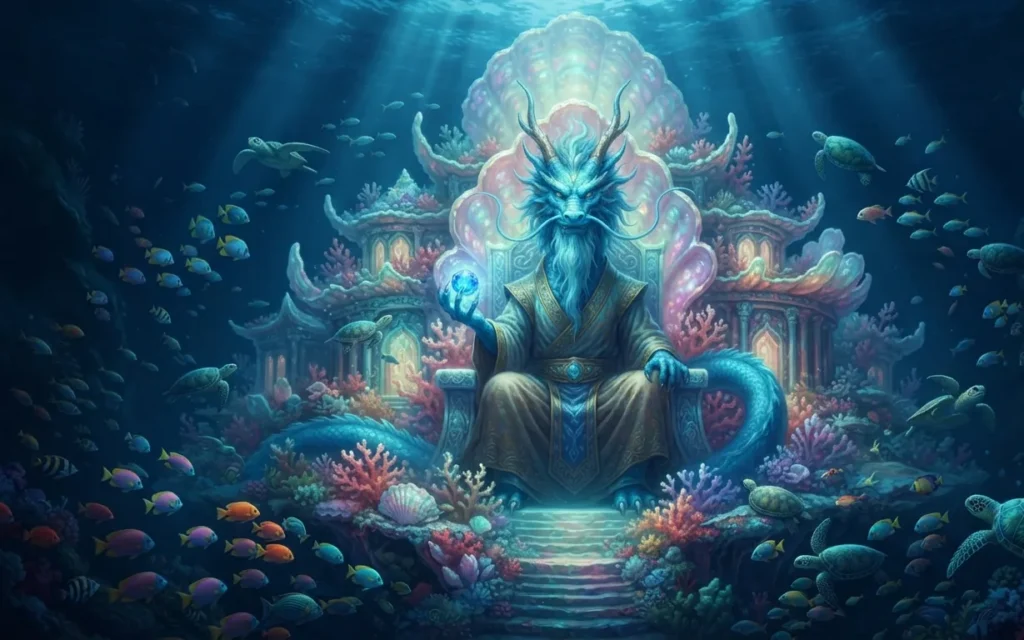
Ryūjin is the Japanese Dragon King associated with the sea. His tradition overlaps with the older Watatsumi sea-deity tradition preserved in the classical chronicles.
Watatsumi is the name/title of a sea deity in the early classical texts, while Ryūjin is the later Japanese Dragon King conception that became increasingly prominent under continental Buddhist and Chinese influence.
He possesses two tide jewels: Kanju (the tide-ebbing jewel) and Manju (the tide-flowing jewel). These jewels give him control over the ocean’s movement. Whoever possesses them controls the sea’s expansion and withdrawal, making them objects of enormous political and military significance in the legends surrounding them.
The Legend of the Lost Hook
The most extensive Ryujin legend involves the hero Hoori (also called Yamasachi-hiko), who borrowed his brother’s fishing hook, lost it in the sea, and descended to Ryujin’s palace to find it.
Ryujin received him hospitably. Hoori spent three years in the palace, married Ryujin’s daughter Toyotama-hime, and eventually found the lost hook. When he returned to the surface with the tide jewels, he used them to humble his brother.
The legend is documented in both the Kojiki and the Nihon Shoki with enough specificity to establish Ryujin’s palace as a fully realized mythological setting complete with its own court, its own time flow (three years passed while Hoori perceived only a short visit), and its own supernatural materials that could be brought to the surface world.
3. Toyotama-hime: The Dragon Princess Who Could Not Stay
The Most Emotionally Complex Dragon Figure
Toyotama-hime (Abundant Jewel Princess) is Ryujin’s daughter and the wife of the mortal hero Hoori. Her story is the Japanese dragon tradition’s most humanly affecting legend, and the one I find most worth understanding in depth.
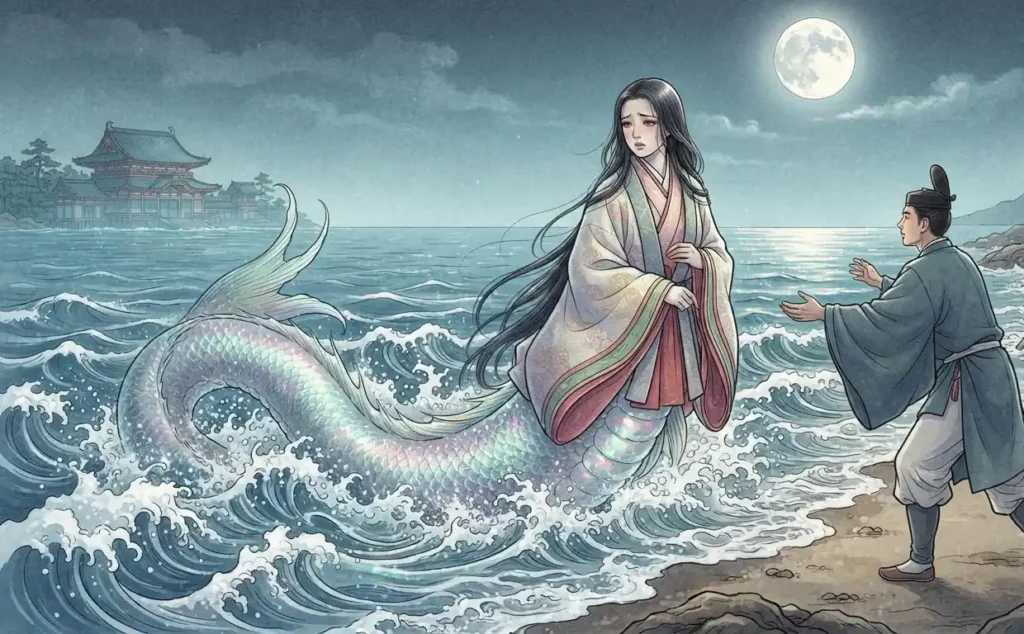
When Toyotama-hime became pregnant, she came to the surface world to give birth. She made one request of her husband: do not look at her during the birth.
He looked.
She had returned to her true form during the birth, the form of a crocodile-like creature (some translations say a great serpent or dragon). Seeing that she had been observed, she completed the birth, entrusted the child to her younger sister, and returned to the sea permanently.
What This Legend Is Actually About
The story of the supernatural bride who cannot remain after her true nature is witnessed is a recognizable folk tale pattern across world mythology. What gives Toyotama-hime’s version its particular weight is the specific nature of what is revealed.
She wasn’t hiding something shameful. She was in her true form, the form natural to what she actually is, performing an act (childbirth) that is fundamentally about being rather than performing. The observation violates something more fundamental than a promise. It witnesses something she wasn’t ready to show.
The child she leaves behind is an ancestor of the imperial line. The dragon princess who couldn’t stay became the grandmother of Japan’s first emperor, making her absence from subsequent history the condition that made imperial history possible.
4. Kiyohime: The Woman Who Became a Dragon
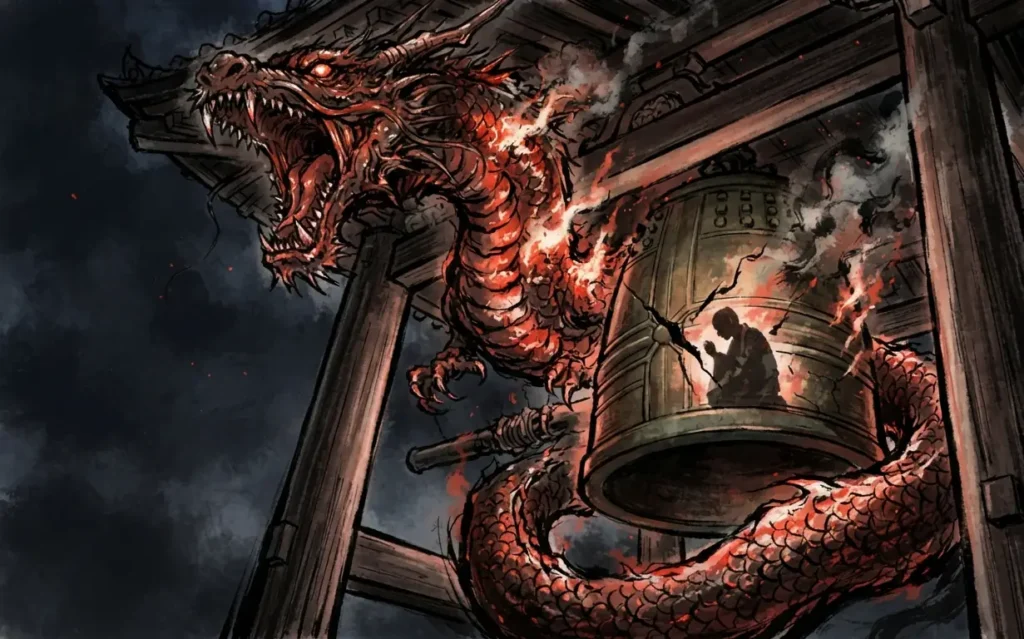
Transformation Through Betrayal
Kiyohime’s legend isn’t from the Kojiki. It appears in the Dojoji Engi (Dojoji Temple Origin Story) tradition and in the Yamato Monogatari, dating to the Heian period. It’s one of Japanese mythology’s most enduring and most emotionally powerful stories.
Kiyohime was a young woman who fell deeply in love with a traveling Buddhist monk named Anchin. He had stopped at her family’s inn and may or may not have encouraged her attachment (versions vary). When he tried to escape her feelings by fleeing across the Hidaka River, she pursued him. Her intensity of emotion was so extreme that she transformed into a dragon while crossing the river.
The Legend
Anchin hid under a large bronze bell at Dojoji Temple. Kiyohime, now fully in dragon form, found him, coiled around the bell, and breathed fire so intense that it melted the bell with Anchin inside it.
The legend is documented with enough consistency across multiple sources to be taken seriously as a genuine piece of Heian period cultural mythology. It was subsequently adapted into Noh and Kabuki theatrical traditions, which gave it extraordinary cultural longevity.
What makes Kiyohime interesting for dragon mythology is the specific mechanism of transformation: genuine, overwhelming human emotion producing a physical change into dragon nature. The dragon isn’t a being she transforms into from outside. It’s something she becomes because of what she feels.
5. Watatsumi: The Original Sea Dragon
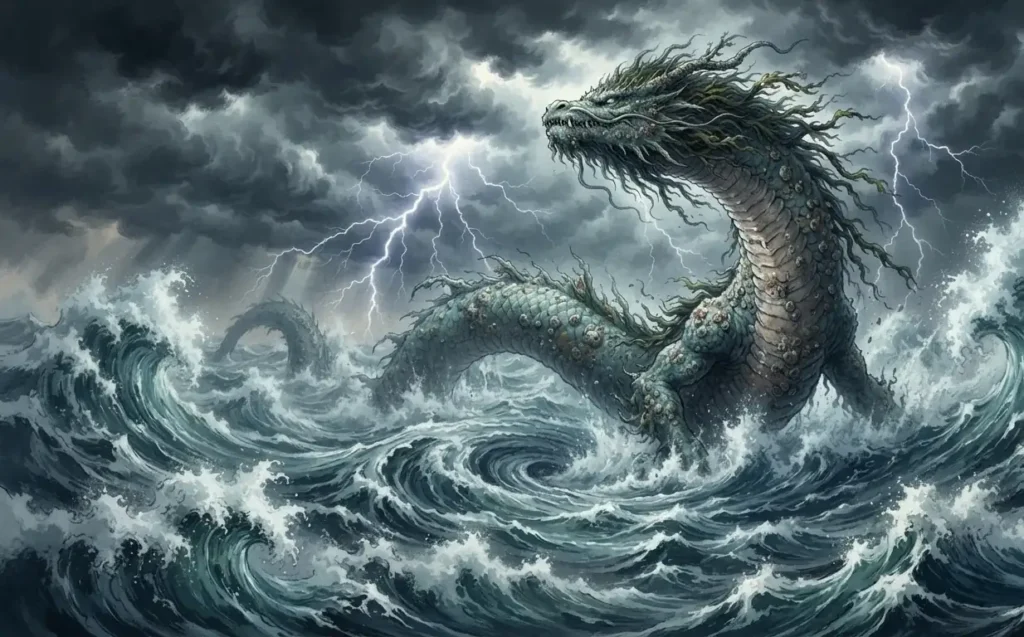
Before Ryujin Had a Name
The Kojiki and Nihon Shoki use Watatsumi (Sea God) as a name or title for the sea dragon deity, sometimes identifying it with Ryujin and sometimes treating it as a distinct older figure.
Watatsumi represents the Japanese sea deity tradition before it was fully elaborated with the specific Dragon King court imagery that Buddhist and Chinese cultural influence subsequently added. In its oldest form, Watatsumi is simply the overwhelming divine presence of the sea: powerful, potentially generous or dangerous, and requiring specific ritual attention from anyone whose life depended on the ocean.
The Watatsumi tradition is worth knowing separately from Ryujin because it preserves the oldest stratum of Japanese sea dragon mythology, before the underwater palace, before the tide jewels, before the Naga-influenced elaboration. At its oldest, the Japanese sea dragon was simply what lived in the sea and governed its power.
6. The Wani: Dragon Ancestors of the Kojiki
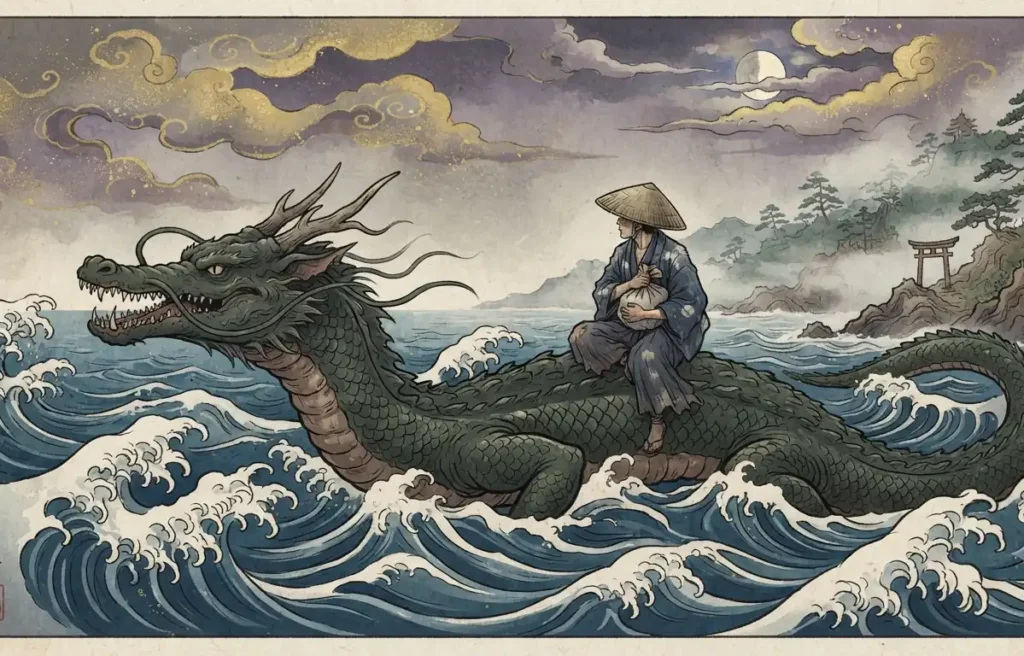
The Sea Creatures Who Carry Divine Travelers
Honest Flag: The word wani presents a translation problem: depending on the passage and scholarly interpretation, it can refer to a shark, crocodilian creature, or supernatural sea being. That ambiguity makes it particularly useful for understanding how modern categories such as ‘dragon’ can distort ancient Japanese mythology.
In one of the Kojiki’s most interesting narrative sequences, Hoori’s brother Umisachi-hiko is described in terms that connect him to Wani, and the contest between the brothers involves sea power that Wani represent.
The Wani serve as carriers in some narratives, transporting divine or significant human figures across the sea in ways that establish their nature as beings of intermediate status between the sea’s divine power and the human world that needs to cross it.
The Wani’s identity (what exactly these creatures are) has generated significant scholarly discussion. They’re not simply sharks or crocodiles. They carry some of the same ambiguous boundary-crossing quality that characterizes dragon figures across East Asian mythology: creatures that belong to the water but interact meaningfully with the land.
7. Zennyo Ryuo: The Buddhist Rain Dragon
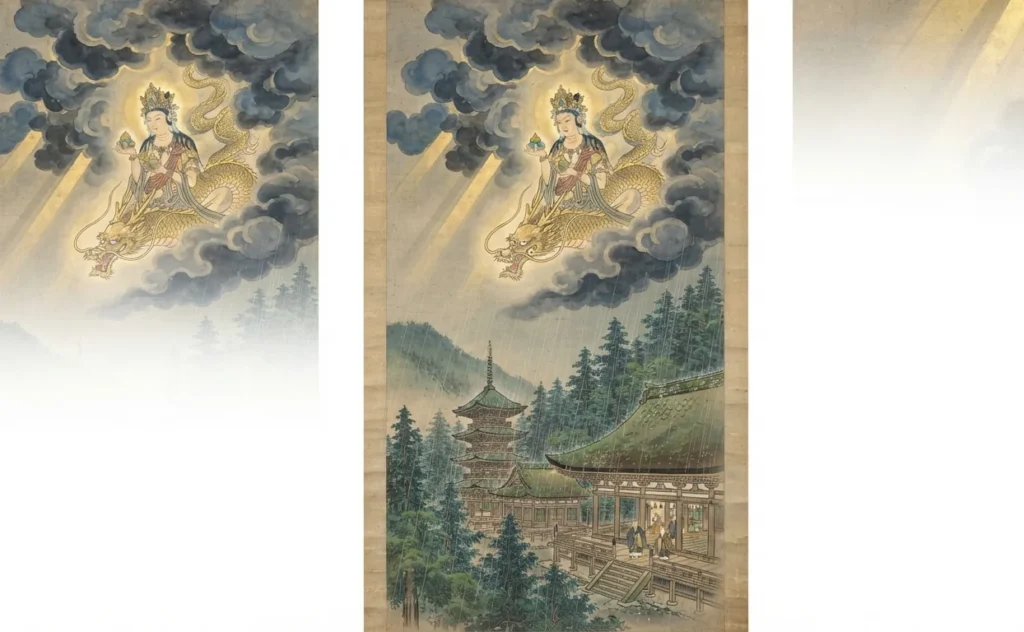
The Dragon That Answered a Monk’s Prayer
Zennyo Ryuo (Virtuous Dragon King) is one of the most important dragon figures in Japanese Buddhism, associated specifically with rain and with the efficacy of Buddhist prayer in summoning beneficial weather.
The founding legend involves the monk Kukai (774 to 835 CE), also known as Kobo Daishi, who is said to have summoned Zennyo Ryuo through Buddhist ritual during a drought. The dragon appeared in a specific pond (Shinjike, or Divine Pond) in what is now the precincts of Jingoji Temple in Kyoto, and rain subsequently fell.
The Buddhist Dragon Tradition
Zennyo Ryuo represents the Japanese Buddhist dragon tradition, which is distinct from both the indigenous Shinto dragon mythology of the Kojiki and the Chinese folk religion Dragon King tradition.
Buddhist dragons in Japan carry specific Naga associations from Indian Buddhism, including the rain-bringing function, but these are filtered through Chinese Buddhist elaboration and then adapted to Japanese religious contexts. Zennyo Ryuo is a Japanese Buddhist dragon: its function, its iconography, and its connection to specific sacred sites all reflect this particular hybrid tradition.
The pond at Jingoji became associated with the Zennyo Ryūō legend and became a significant pilgrimage site. The legend persists partly because the physical site persists.
8. The Eight Dragon Kings of Japanese Buddhism
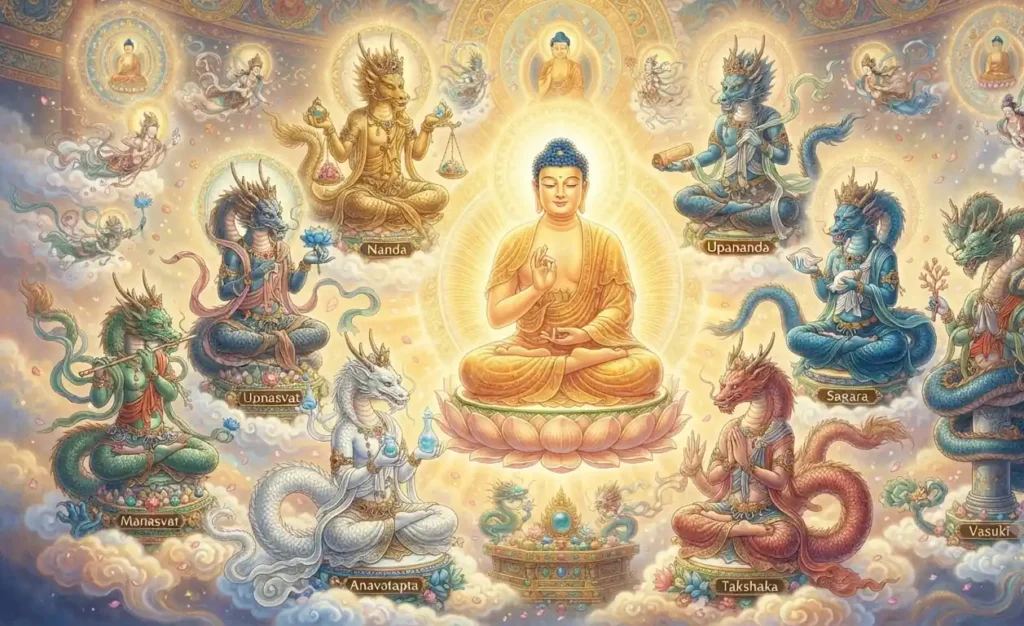
The Naga Kings of the Lotus Sutra
The Eight Dragon Kings (Hachidai Ryuo) are Buddhist Naga figures from the Lotus Sutra who play a specific role in Japanese Buddhist tradition. When the Lotus Sutra was transmitted to Japan through Chinese Buddhism, these dragon figures came with it.
The Eight Dragon Kings include Nanda, Upananda, Sagara, Vasuki, Takshaka, Anavatapta, Manasvin, and Utpalaka. They appear in the Lotus Sutra’s assembly as protective dragon beings who hear the Buddha’s teaching and commit to defending it.
In Japanese Buddhist visual tradition, particularly in temple paintings and sculptures, these dragon kings are depicted with specific identifying characteristics. Sagara is particularly important in Japanese tradition because his daughter, Sagara’s daughter, achieved enlightenment in the Lotus Sutra narrative, making the dragon lineage directly relevant to Buddhist soteriological discussions.
9. The Dragon of Chikubu Island
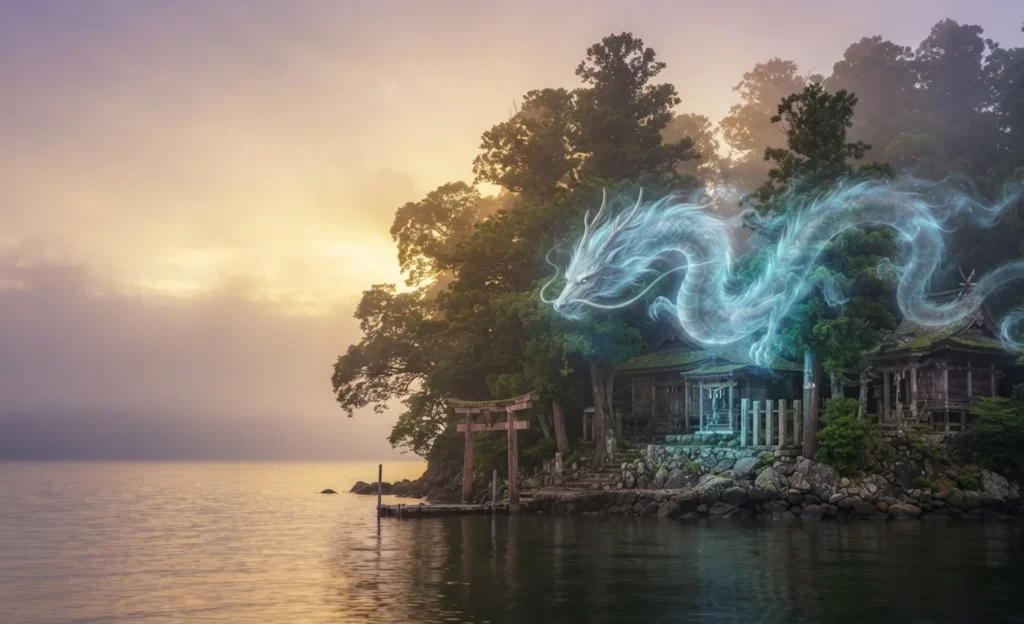
Benten’s Serpent and the Lake’s Sacred Island
Chikubu Island in Lake Biwa, Japan’s largest lake, is a Shinto and Buddhist sacred site associated with Benzaiten (also called Benten), one of Japan’s Seven Gods of Fortune and a deity with specific serpent and dragon associations.
The island’s dragon tradition connects the water dragon inhabiting Lake Biwa to Benzaiten’s sacred presence on the island. Benzaiten herself has complex iconographic associations with serpents and dragons in Japanese tradition, and the Lake Biwa water dragon becomes part of the sacred geography centered on her primary shrine.
Pilgrims who visit Chikubu Island are visiting a site where Buddhist, Shinto, and dragon traditions are so completely intertwined that separating them is impossible without losing what makes the location significant. Whether understood literally or symbolically, the dragon remains part of the island’s living religious tradition; it’s a presence that practitioners acknowledge and that shapes how the sacred site is understood and approached.
10. The Dragon of the Hidaka River

The River That Became Sacred Through a Legend
The Hidaka River in Wakayama prefecture is the river that Kiyohime crossed during her transformation into a dragon. The river’s connection to that legend gave it a specific sacred and mythological character that persisted through the Heian period and beyond.
Rivers associated with significant transformations acquire mythological weight in Japanese tradition that they wouldn’t otherwise have. The Hidaka River isn’t particularly large or historically important for political or economic reasons. Its significance is entirely mythological: this is where the woman who loved too absolutely crossed the boundary into dragon nature.
The river’s legend reflects something important about how Japanese mythology treats landscape. Significant events don’t just happen in places. They transform places. The river where Kiyohime changed is forever the river where transformation of that specific kind is possible.
That’s a form of sacred geography that’s specifically Japanese in character: not cosmological significance imposed from above but human experience sedimenting into landscape and making it mean something it didn’t mean before.
Frequently Asked Questions
What is the oldest documented Japanese dragon?
Yamata no Orochi, documented in the Kojiki (712 CE), is one of the earliest surviving Japanese dragon-like figures with a fully narrated legend. The Watatsumi/Ryujin sea deity appears in the same text. Both predate significant Chinese Dragon King influence on Japanese dragon tradition.
Are Japanese dragons always associated with water?
Predominantly yes, but not universally. Yamata no Orochi is associated with mountains and valleys in Izumo province rather than primarily with water. Most Japanese dragon traditions are water-associated, but the Kojiki’s earliest dragon figure is explicitly a mountain-dwelling creature.
What distinguishes Japanese dragons from Chinese dragons visually?
Toe count is sometimes used as a visual distinction in East Asian dragon art, but it isn’t a universal rule. Japanese dragons are often depicted with three claws, while five-clawed dragons became strongly associated with imperial authority in China. Japanese dragons also show stronger visual influence from the Indian Naga tradition in certain Buddhist contexts, sometimes appearing more serpentine and occasionally multi-headed in ways that the Chinese Long tradition doesn’t typically favor.
Is Benzaiten actually a dragon deity?
Benzaiten (Benten) has complex associations with serpents and dragons in Japanese tradition, derived partly from her Indian origins as the goddess Saraswati and partly from her association with water and the musical arts. She’s depicted with a white serpent as her messenger and her sacred sites often have dragon associations, but she’s not classified as a dragon deity in the same way Ryujin is.
Where can I encounter Japanese dragon traditions at actual religious sites today?
Ryujin’s palace tradition is honored at coastal Shinto shrines. The Dojoji Temple in Wakayama preserves the Kiyohime legend in its physical space. Jingoji Temple in Kyoto has the Dragon Pond associated with Zennyo Ryuo. Chikubu Island in Lake Biwa and the Suwa Grand Shrine in Nagano both maintain active dragon-related sacred traditions. Atsuta Shrine in Nagoya enshrines Kusanagi, the sword found within Yamata no Orochi.
Final Thoughts
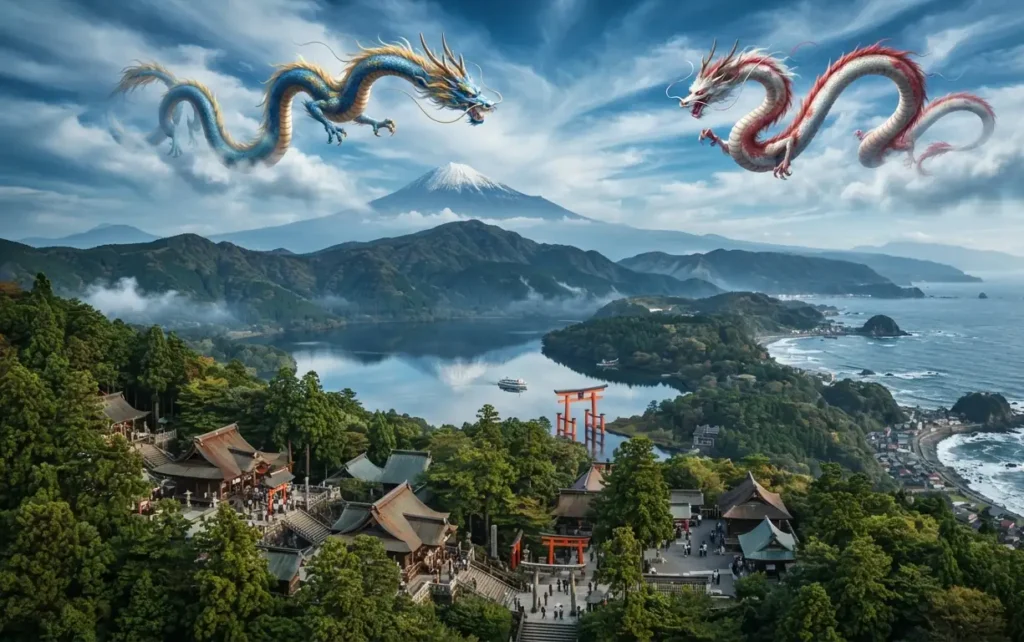
Ten Japanese dragons. Three source traditions: Shinto mythology from Japan’s oldest classical texts, Buddhist Naga tradition transmitted through the continent, and regional folk legends attached to specific sacred landscapes.
The range is wider than the popular summary suggests. From Yamata no Orochi’s demanding annual tribute to Toyotama-hime’s impossible marriage to Kiyohime’s transformation through grief: Japanese dragon mythology covers territory that no other East Asian tradition maps in quite the same way.
That range is the tradition’s genuine contribution to world mythology. It’s worth knowing on its own terms.
Related Articles
- Dragon Mythology: How Dragons Are Depicted Across Cultures
- Western Dragon vs Eastern Dragon [Myth, Power & Origin]
- Chinese, Japanese & Korean Dragons: How They Actually Differ
- 12 Best Dragon Books Ever Written [Updated 2026]
- 15 Most Iconic Fantasy Creatures: East & West Mythology
- 14 Most Iconic Anime Dragons You Should Recognize