
 By
By Quick Takeaways:
- Chinese dragon types are very diverse, it has a rich taxonomy of dragon types, each with distinct domains, powers, and legendary traditions
- The most commonly known dragon (the rain-bringing, cosmologically significant Long) is actually one of several distinct types, each with its own character
- Some types are primarily cosmic (governing weather, earth movement, or time itself), others are primarily elemental, and others represent stages of the dragon’s own development
- The most obscure types on this list, particularly Zhulong and Yinglong, are among the most philosophically interesting and most chronologically ancient
- Understanding the full taxonomy changes how you read Chinese mythology, Chinese art, and Chinese cosmological thinking simultaneously
Here’s something that took me years to properly appreciate: when classical Chinese texts talk about dragons, they’re not always talking about the same kind of being.
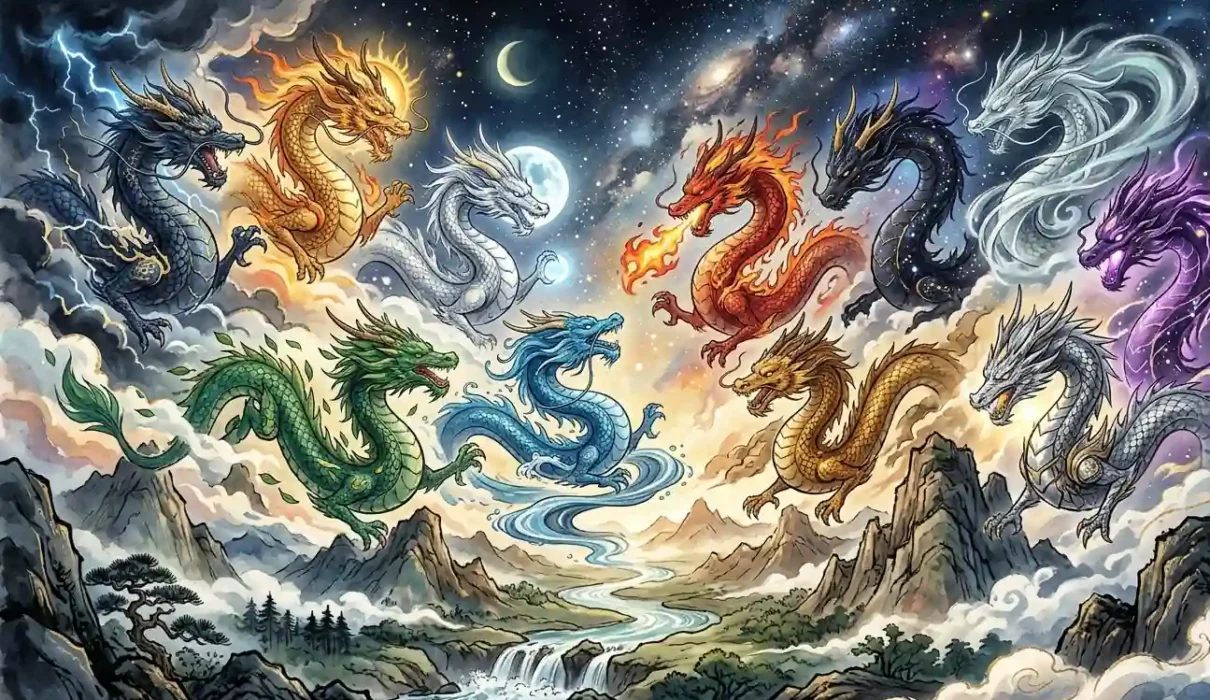
Western mythology essentially has one dragon type (with regional variations). Chinese mythology has a taxonomy. Different classes of dragon with different domains, different powers, different relationships to humanity, and different places in the cosmological hierarchy. The rain-bringer Dragon King and the cosmic Torch Dragon that creates day and night are both called Loong, but they’re as different as a civil servant and a geological force.
10 years of Chinese mythology study has given me a genuine appreciation for this taxonomic richness. Here are the eleven types worth knowing.
1. Tianlong: The Celestial Dragon
What it is
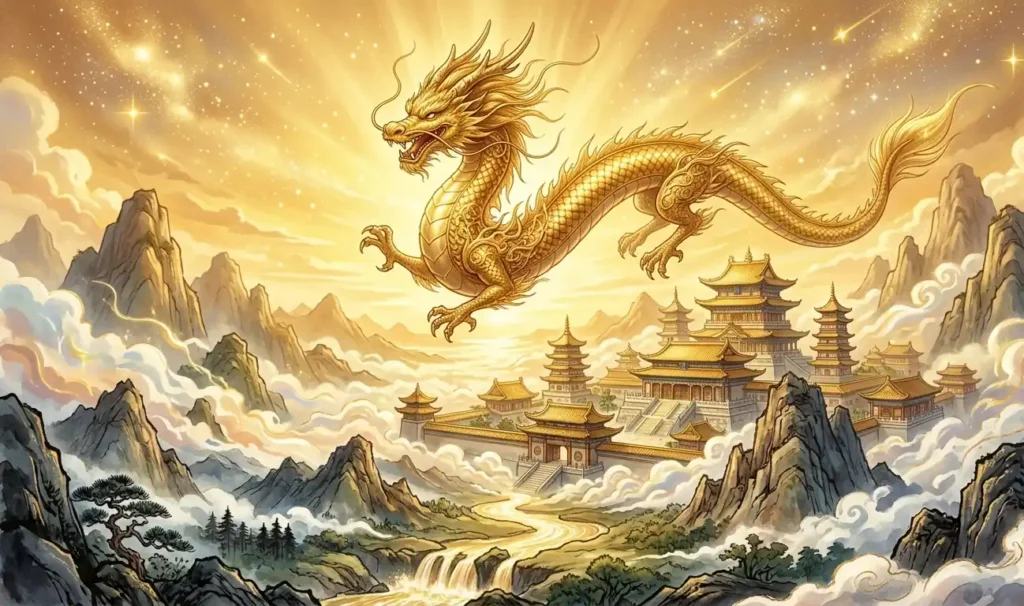
Tianlong (literally Heaven Dragon) is the dragon that guards the celestial realm, the divine being whose specific function is to support and protect the heavenly palaces, carry the divine beings across the sky, and maintain the structural integrity of the cosmic heavenly architecture.
Tianlong doesn’t descend to earth as a general matter. Its domain is the celestial sphere, and its powers are specifically directed toward maintaining that sphere’s order.
Its Powers and Legends
Classical texts describe the Tianlong’s specific capabilities:
- The ability to support the weight of divine palaces without tiring
- A body that illuminates the celestial sphere with its natural luminosity
- The power to transport divine beings across vast celestial distances
- Scales that are impervious to any celestial weapon
The Tianlong’s significance in Buddhist-influenced Chinese mythology is particularly notable. Buddhist cosmology that entered China described celestial dragon guardians (naga-derived) in terms that Chinese tradition absorbed and integrated, giving the Tianlong a cross-traditional significance that purely Daoist dragon types don’t have.
What makes it interesting: The Tianlong is the dragon as celestial infrastructure, less a being with personal mythology than a cosmic functional presence. It’s what the heavenly realm is built on top of.
2. Shenlong: The Spirit Dragon
What it is
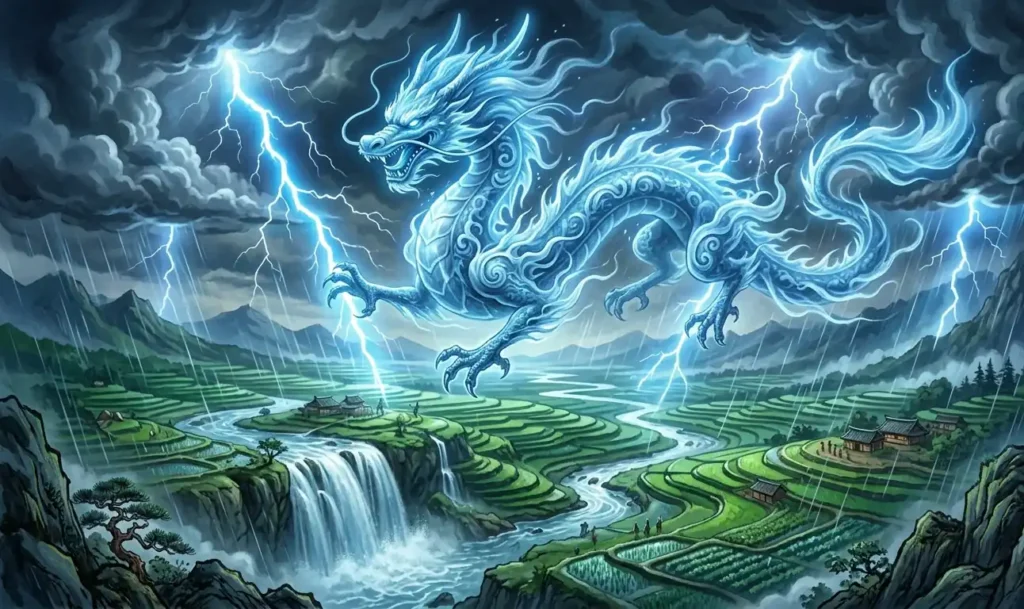
Shenlong (Spirit Dragon or Divine Dragon) is perhaps the closest to the popular conception of the Chinese dragon, the being that controls wind, rain, and storms. It’s the dragon most directly responsible for weather governance, and in Chinese agricultural civilization, that made it the most practically relevant dragon type.
Its Powers and Legends
The Shenlong’s domain is the atmosphere. Its specific powers:
- Direct control over rainfall, summoning rain or withholding it
- Command of winds and storm systems
- The ability to call lightning and thunder
- Movement through clouds without being visible to ordinary human sight
The Shenlong’s color changes with its mood and intent. A dark Shenlong signals coming storms, a golden or light-colored one signals beneficial rain. This color-reading tradition is preserved in Chinese folk meteorological observation.
The most important Shenlong legend involves the consequences of disrespecting the spirit dragon. Classical texts record numerous accounts of droughts attributed to communities that failed to properly propitiate the Shenlong and of floods attributed to Shenlong’s anger at serious violations of the moral order.
What makes it interesting: The Shenlong is the dragon as a moral force. It doesn’t just control the weather. It responds to human moral conditions. Drought is a punishment. Beneficial rain is a reward. The weather itself becomes a continuous moral communication.
Read: Chinese, Japanese & Korean Dragons: How They Actually Differ
3. Fucanglong: The Hidden Treasure Dragon
What it is
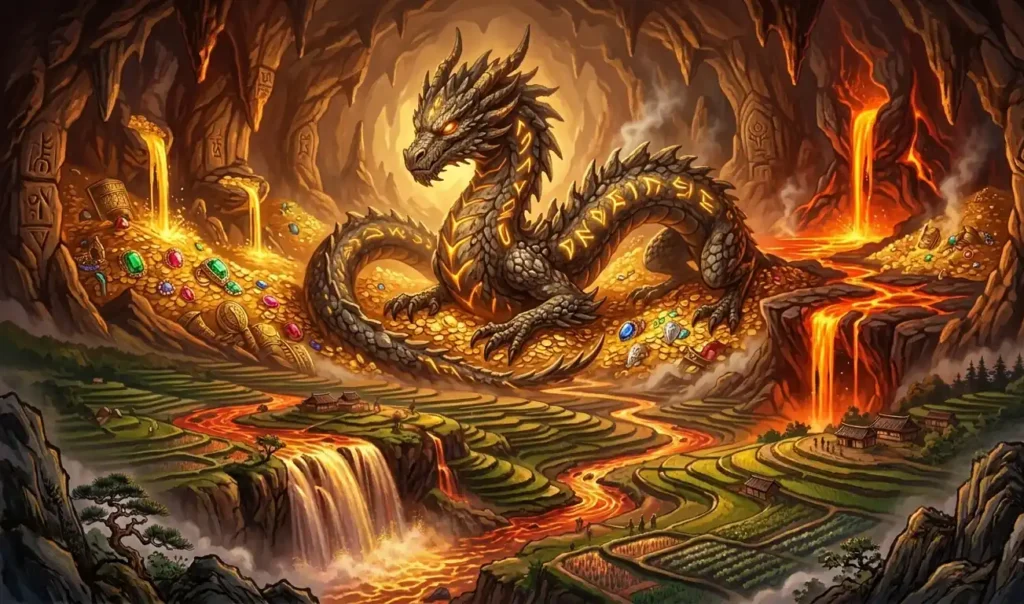
Fucanglong (Hidden Treasure Dragon) lives underground, specifically guarding the vast deposits of precious metals, gems, and other natural treasures that the earth contains. It’s the dragon that waits beneath the surface rather than soaring through the sky.
Its Powers and Legends
The Fucanglong’s powers are earthward rather than atmospheric:
- The ability to locate any precious deposit anywhere in the earth
- Perfect knowledge of where all natural treasure is found
- The power to move through solid earth as easily as water
- The ability to create new mineral deposits through its own presence
The Fucanglong legend tradition includes an important detail: when a Fucanglong finally erupts from the earth after guarding its hoard for sufficient time, the emergence is accompanied by volcanic or seismic activity. The guardian’s ascent reshapes the landscape.
This connection between underground dragons and geological events is one of Chinese mythology’s most interesting geological explanations. Earthquakes, volcanic eruptions, and the sudden appearance of springs were understood as Fucanglong activity, the treasure guardian moving through its domain.
What makes it interesting: The Fucanglong is the dragon as a geological force connecting the mythological tradition to real observations about the earth’s behavior.
4. Dilong: The Earth Dragon
What it is
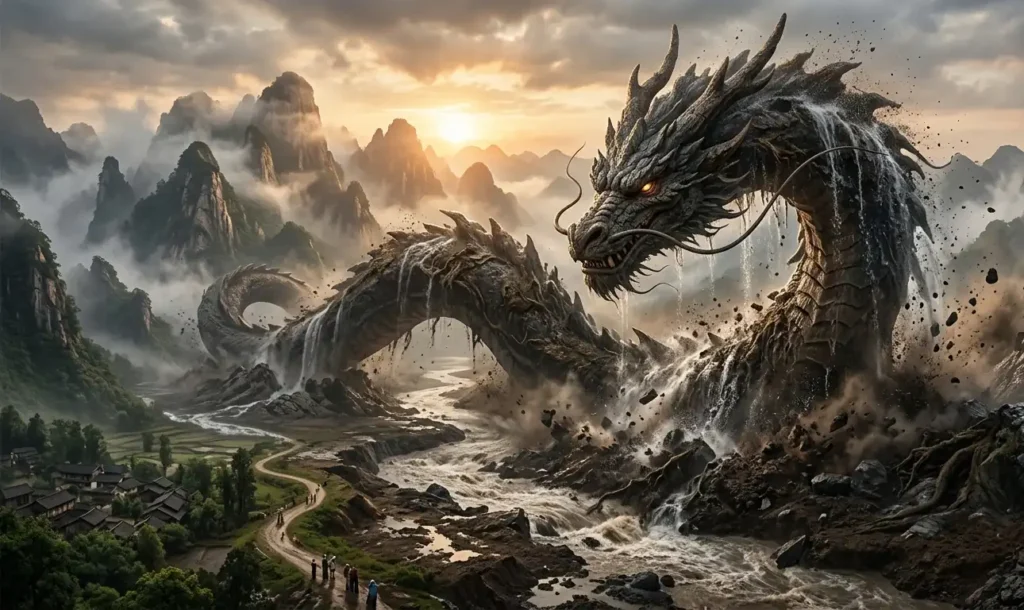
Dilong (Earth Dragon) governs rivers and the patterns of the earth’s surface rather than its underground contents. Where the Fucanglong is below the surface, the Dilong governs the earth’s surface water systems and the patterns of topography.
Its Powers and Legends
The Dilong’s specific domains:
- Governance of rivers, streams, and surface water flow
- Control over the seasonal patterns of rivers, floods and droughts at the surface level
- The ability to change the course of rivers
- Responsiveness to the moral conditions of communities living along waterways
A specific Dilong legend tradition involves the dragon’s responses to community behavior. Villages that maintained proper practices along riverbanks experienced stable, beneficial river behavior. Communities that violated specific prohibitions, improper disposal of certain items in rivers, disrespect toward river deities, experienced flooding, course changes, or drying.
In traditional Chinese geomancy (feng shui), Dilong is a specific technical term for the pattern of energetic veins that run through a landscape, the “dragon veins” that feng shui practitioners trace to determine auspicious site selection. This technical usage connects the mythological tradition directly to living practice.
What makes it interesting: The Dilong bridges mythology and living practice more directly than any other dragon type through the feng shui dragon vein tradition.
5. Yinglong: The Winged Dragon
What it is
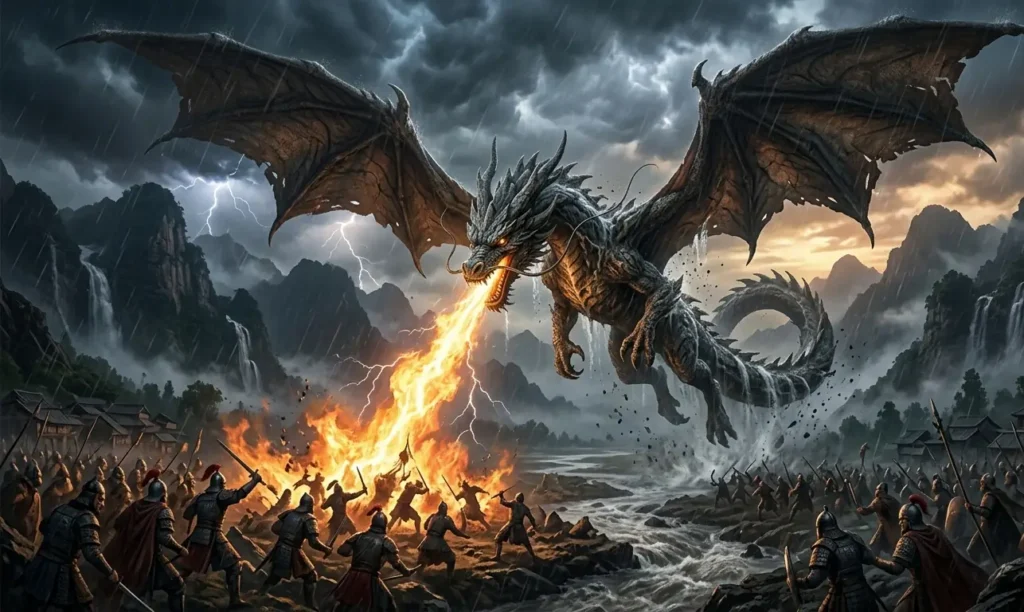
Yinglong (Responding Dragon or Winged Dragon) is unique among Chinese dragon types for having wings, a physical characteristic that most Long dragon types don’t possess. It’s also one of the oldest dragon figures in Chinese mythology, appearing in texts that significantly predate most other dragon type classifications.
Its Powers and Legends
Yinglong’s powers include:
- Flight through wings rather than cloud-riding (which distinguishes it from other dragon types)
- Extraordinary rain-summoning capabilities – considered the most powerful rain-bringer in the dragon taxonomy
- The ability to store water in its wings and release it as rain
- Powers of transformation that exceed most other dragon types
The most important Yinglong legend involves its service to the Yellow Emperor (Huangdi) against the rebel Chi You. Yinglong is described as serving as a divine general in Huangdi’s army using its rain-summoning power as a weapon, creating floods that overwhelmed Chi You’s forces.
After this battle, Yinglong settled in the south of China and became responsible for the rainfall of that region. But here’s the tragic element: the drought legends associated with Yinglong are specifically about what happens when this most powerful rain-bringer is absent or occupied elsewhere. The south’s fertility became dependent on Yinglong’s presence in a way that made its occasional absences meteorologically significant.
The Yinglong’s wings also mark it as a dragon that has undergone the most extreme transformation.
What makes it interesting: Yinglong is the dragon at the apex of a transformation sequence, the oldest, most transformed dragon type, the one that has become something beyond the ordinary Long through pure accumulated time.
6. Jiaolong: The Sea Dragon
What it is
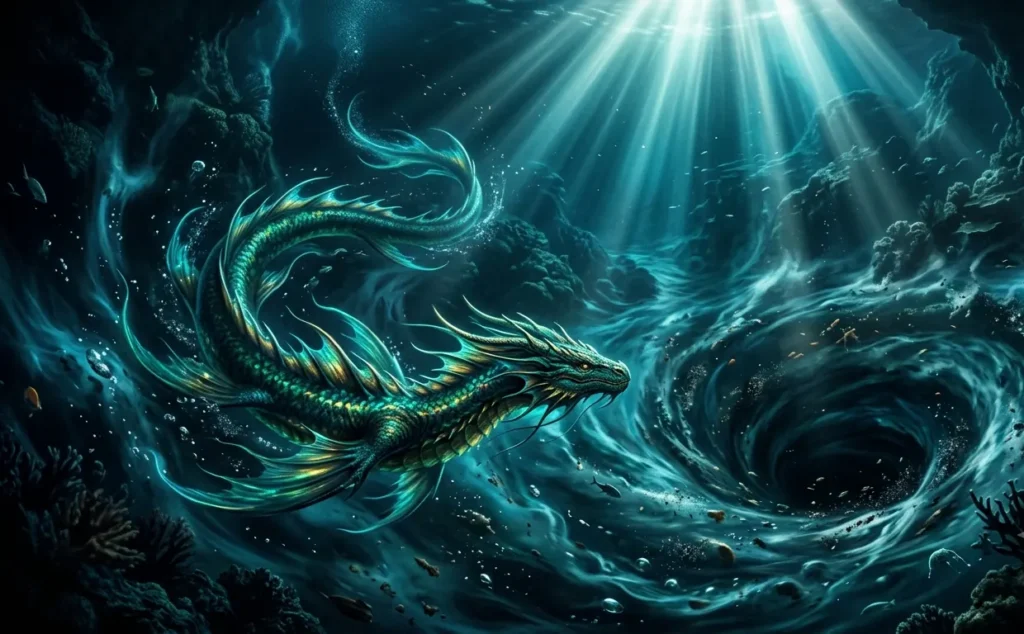
Jiaolong (literally Crocodile Dragon or Flood Dragon) is the dragon most closely associated with deep water rivers, seas, and the terrifying potential of waterways in flood. It’s also the dragon most frequently associated with transformation, specifically in the famous legend of the carp that crosses the Dragon Gate to become a Jiaolong.
Its Powers and Legends
Jiaolong’s specific powers:
- Absolute mastery of water environments – it can be in any water and is completely at home in any aquatic condition
- The ability to summon floods of devastating scale
- Camouflage in water – it’s nearly impossible to detect until it acts
- Transformation abilities that allow it to appear as other aquatic creatures
The most famous Jiaolong legend is the Dragon Gate (Longmen) story. Carp that swim upstream to the Dragon Gate waterfall on the Yellow River and successfully leap through the falls are transformed into Jiaolong, the transformation from ordinary fish to water dragon being the mythological basis for the idiom “crossing the Dragon Gate” to mean achieving dramatic social transformation.
What makes it interesting: The Jiaolong is the dragon of transformation and potential, the being you become rather than are born as. The carp-to-dragon transformation is one of Chinese mythology’s most powerful statements about merit and fundamental change.
7. Panlong: The Coiled Dragon
What it is
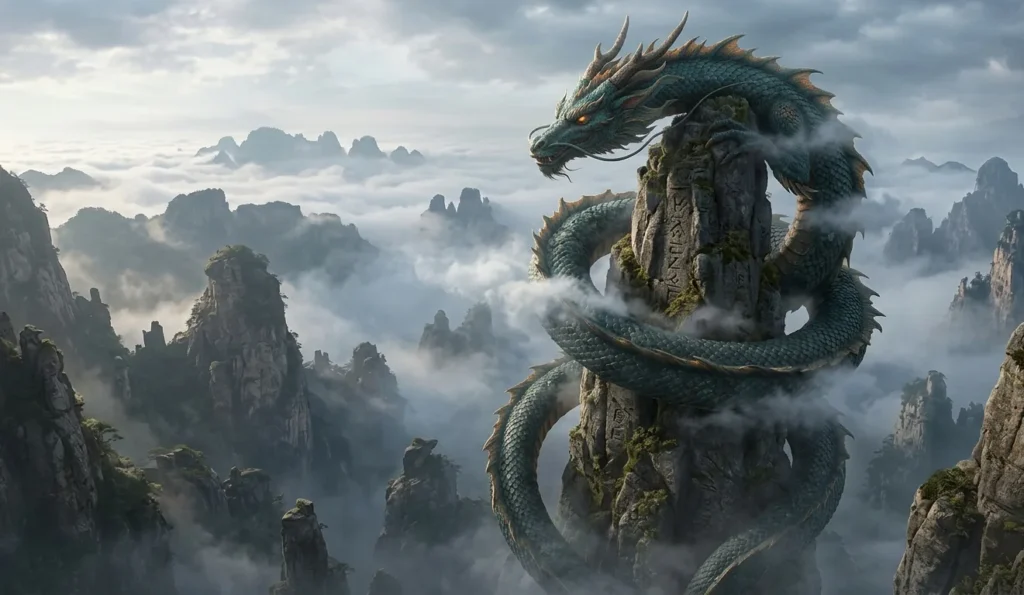
Panlong (Coiled Dragon) is a specific dragon type defined by its earthbound status. It has not yet ascended to the sky. It’s the dragon that remains coiled in water or on earth, possessing all the power of a Long but having not yet completed the transformation that would allow it to ascend.
Its Powers and Legends
The Panlong’s powers are the full Long power set but directed downward rather than upward:
- Immense strength applied to earthly domains
- Deep water mastery
- The ability to coil around and protect specific locations – making it a natural guardian figure
- Potential for eventual ascent when the right conditions are achieved
The Panlong’s most significant characteristic isn’t a specific power but a specific state: it’s the dragon in potential. Classical texts describe how Panlong eventually achieves ascent through specific conditions, most commonly the falling of rain during a thunderstorm of sufficient cosmic significance.
The Panlong appears most frequently in Chinese art on the pillars of imperial buildings. The coiled dragon around the pillar is specifically the Panlong, whose earthbound coiling makes it the appropriate architectural guardian figure.
What makes it interesting: The Panlong is the dragon that hasn’t become everything it will be, which makes it philosophically interesting as a figure of unfulfilled potential and patient waiting.
8. Feilong: The Flying Dragon
What it is
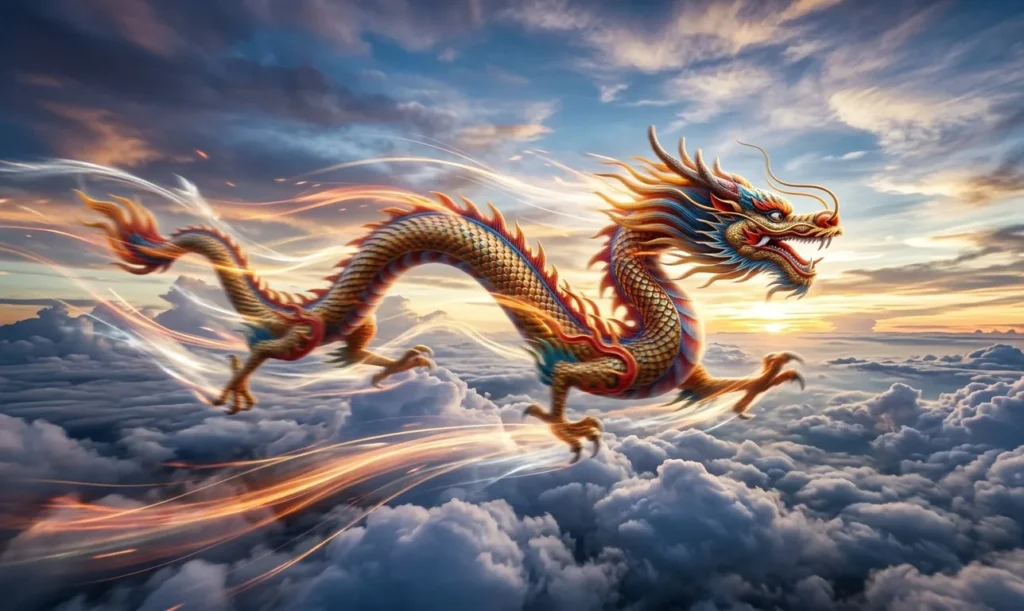
Feilong (Flying Dragon) rides clouds and mist through the sky, its movement specifically associated with being carried by atmospheric phenomena rather than self-powered flight. It’s the dragon most closely associated with the visual imagery of dragons among clouds that characterizes so much Chinese dragon art.
Its Powers and Legends
The Feilong’s specific associations:
- Movement through clouds and mist rather than open sky
- The ability to generate and move through cloud cover
- Association with specific auspicious appearances – seeing a Feilong among clouds was considered a sign of exceptional good fortune
- The power to appear and disappear in mist
The Feilong appears in classical Chinese texts in the context of divination. Its appearance in specific cloud formations was read as divine communication. A Feilong sighting on a specific day of the agricultural calendar carried specific meanings about the coming growing season.
The visual tradition of Chinese dragon art, with long, sinuous bodies moving through cloud formations, primarily depicts the Feilong rather than other dragon types. The dragon-and-clouds motif that appears on imperial robes, porcelain, and architectural decoration is specifically Feilong’s visual signature.
What makes it interesting: The Feilong is the dragon as aesthetic and auspicious presence, less concerned with specific functional powers than with the meaning of its appearance.
9. Zhulong: The Torch Dragon
What it is
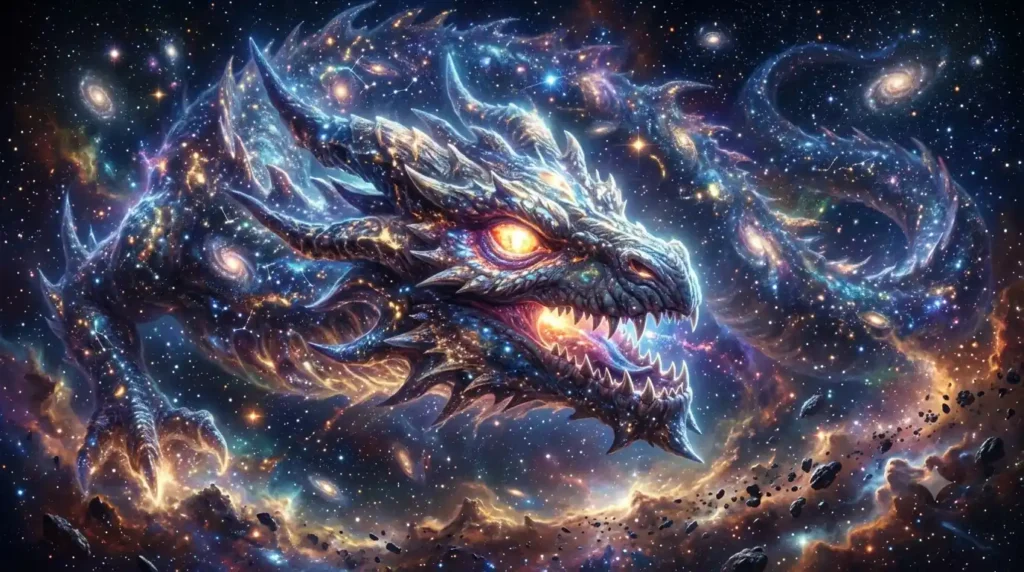
Zhulong (Torch Dragon) is the most cosmologically powerful and most ancient dragon type on this list, and the least discussed in popular mythology accounts. It’s described in the Shanhaijing (Classic of Mountains and Seas) as a being of such vast scale that its very existence creates day and night.
This is not a dragon that guards treasure or brings rain. This is a dragon that is time itself.
Its Powers and Legends
The Shanhaijing describes the Zhulong with extraordinary specificity:
- When it opens its eyes, it creates daylight across the world
- When it closes its eyes, it creates night
- When it exhales, it creates winter
- When it inhales, it creates summer
- It never eats, never drinks, never breathes in rest
- Its body illuminates the nine darknesses – the parts of the world that ordinary sunlight never reaches
The Zhulong lives in the northern mountain range called Zhangwei at the world’s edge, coiled in perpetual existence, its biological processes being the mechanisms of cosmic time.
This is a creation mythology using a dragon as its vehicle. Day and night aren’t the sun’s movement. They’re the Zhulong’s eyelids. Seasons aren’t the earth’s tilt, they’re the Zhulong’s breath. The cosmological dragon and the cosmos are barely distinguishable.
What makes it interesting: The Zhulong is the most philosophically extreme dragon type, a being whose very existence is indistinguishable from the passage of cosmic time. It’s not in the world. The world’s rhythms are its biology.
10. Qinglong: The Azure Dragon
What it is
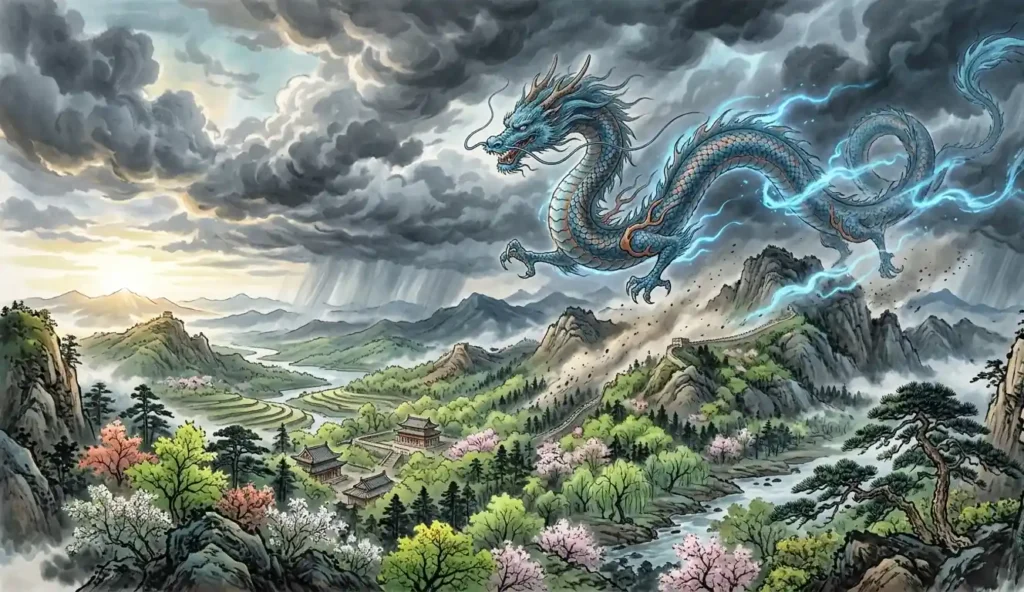
Qinglong (Azure Dragon) is the celestial guardian of the East, one of the Four Holy Beasts (Si Xiang), and the animating intelligence of the eastern sky’s seven lunar mansions. As the dragon most embedded in Chinese cosmological astronomy, the Qinglong holds a specific structural role in the Chinese understanding of how the cosmos is organized.
Its Powers and Legends
Qinglong’s specific domain:
- Governance of the East, spring, and the Wood element
- The animating intelligence of seven specific constellations
- Symbol of the emperor’s cosmic mandate and imperial virtue
- Protective function for the eastern direction in architectural and tomb orientation
The Qinglong differs from other dragon types in being simultaneously a mythological figure and an astronomical reality. Its form is traceable in the star positions of the eastern sky, making it a being that exists in the night sky rather than simply in mythological narrative.
As a symbol of imperial power, the Qinglong appeared on imperial regalia, military banners, and ceremonial objects specifically as an endorsement of the emperor’s legitimate cosmic mandate.
What makes it interesting: Qinglong is the dragon as cosmic architecture, the animating intelligence of a specific quarter of the sky rather than a being that exists within the sky.
11. Huanglong: The Yellow Dragon
What it is
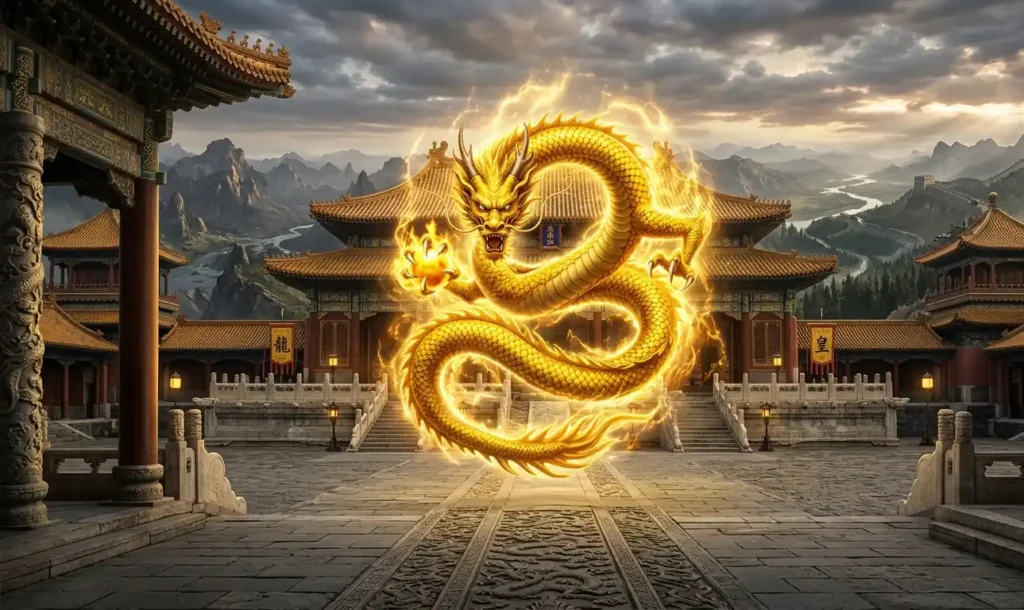
Huanglong (Yellow Dragon) is the forgotten fifth guardian, the cosmic dragon that governs the Centre, the Earth element, and the transitional periods between seasons. Where the Four Holy Beasts govern four cardinal directions, Huanglong governs the axis around which those directions are organized.
Its Powers and Legends
Huanglong’s specific domains:
- Governance of the Center direction and Earth element
- The transitional periods between seasons – the eighteen days before each seasonal shift
- Imperial authority – as the dragon of the Earth element and the Center, it’s the most direct dragon symbol of the emperor’s cosmic mandate
- The stable axis of the cosmic system
The most significant Huanglong legend involves its appearance to the Yellow Emperor Huangdi, bearing the He Tu, a cosmic diagram of profound significance, on its back from the Luo River. This transmission of cosmic knowledge from the Yellow Dragon to the Yellow Emperor established the connection between the Earth element’s dragon and the foundational moments of Chinese civilization.
The Huanglong’s five-colored scales, incorporating all five elemental colors, make it unique among dragon types in embodying the complete five-element system rather than any single element.
What makes it interesting: Huanglong is the dragon as cosmic center, the stable point that all the other dragon types orbit around. Its forgotten status relative to the four directional dragons makes finding it one of Chinese mythology’s most satisfying discoveries.
The Chinese Dragon Taxonomy at a Glance
| Type | Domain | Key power | Most famous for |
|---|---|---|---|
| Tianlong | Heaven | Celestial support | Guarding the divine realm |
| Shenlong | Atmosphere | Weather control | Moral weather governance |
| Fucanglong | Underground | Treasure guarding | Geological activity on ascent |
| Dilong | Earth surface | River governance | Feng shui dragon veins |
| Yinglong | Sky (winged) | Supreme rain-summoning | Service in the Yellow Emperor’s wars |
| Jiaolong | Deep water | Flood power, transformation | The Dragon Gate carp legend |
| Panlong | Earth/water | Full Long power, earthbound | Architectural guardian columns |
| Feilong | Clouds | Cloud movement, appearance | Imperial robe dragon iconography |
| Zhulong | World’s edge | Creates day, night, seasons | Cosmic time as dragon biology |
| Qinglong | Eastern sky | Elemental and directional governance | Imperial cosmic mandate symbol |
| Huanglong | Centre | Five-element integration | Transmission of the He Tu to Huangdi |
Frequently Asked Questions
Are all these dragon types worshipped in Chinese religion?
Several are actively worshipped, including Shenlong through rain prayer traditions, the Dragon Kings as regional dragon deities, Qinglong in directional ritual, and Huanglong in some Daoist traditions linked to Wudang Mountain. Others, such as Zhulong and Fucanglong, remain primarily mythological figures from classical texts.
What’s the difference between a Jiaolong and a regular Long?
A Jiaolong is specifically associated with water and transformation, while Long is a broader term encompassing many dragon types. In some traditions, Jiaolong serves as an intermediate stage between fish dragons, such as the Dragon Gate carp, and higher forms like Yinglong, developing into dragons with broader cosmic associations
Do Chinese dragons have a single physical form?
No. Different dragon types have distinct physical characteristics. Most Long share the composite nine-animal form, but Yinglong has wings, Zhulong is described as human-faced, and Jiaolong appears more serpentine or crocodilian in early accounts. Their visual differences reflect their classification as separate dragon types.
Is the Zhulong related to the creation dragon Tiamat from Babylonian mythology?
The similarity is notable from a comparative mythology perspective. Both are cosmogonic dragons whose existence is tied to fundamental natural processes and the functioning of the world. Whether this reflects ancient cultural exchange or the independent development of similar cosmological ideas remains a subject of scholarly debate.
What are the Dragon Kings?
The Dragon Kings are divine rulers of the seas and major bodies of water, traditionally worshipped for rain and protection. You can read my post about the four dragon kings here.
Final Thoughts
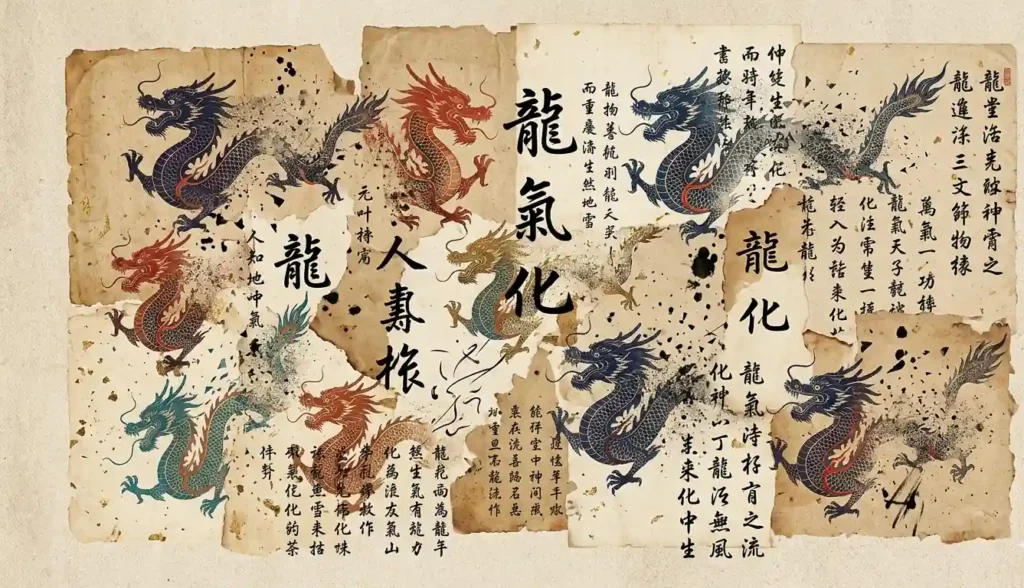
The eleven dragon types in this article represent one of mythology’s most sophisticated taxonomic traditions, a dragon classification system that maps different kinds of natural and cosmic power onto different dragon forms, each with its own domain, its own character, and its own body of legend.
Shenlong’s moral weather governance and Zhulong’s existence as cosmic time don’t just describe different powers; they describe completely different relationships between divine power and the natural world. One dragon enforces morality through meteorology. The other is indistinguishable from the cosmos’s most fundamental rhythms.
Both are dragons. Both are Long. And yet they’re as different as a government official and a geological epoch.
That’s the Chinese dragon taxonomy at its most interesting. And it’s considerably richer than the single fire-breathing versus rain-bringing binary that most comparisons with Western dragons get stuck on.
Related Articles
- Dragon Mythology: How Dragons Are Depicted Across Cultures
- Yellow Dragon: Myths, Symbolism & the Forgotten Fifth Beast
- Loong: Chinese Dragon Myths, Symbolism & Sacred Power
- 9 Chinese Dragon Colors & What Each One Means in Mythology
- 9 Sons of the Dragon: What Each One Guards in Chinese Myth
- The Forgotten Female Dragons of Chinese Mythology
- 9 Rare Chinese Dragon Creatures Most People Never Encounter
- Dragon & Phoenix: Chinese Myth’s Most Sacred Bond
References
- Birrell, Anne. Chinese Mythology: An Introduction.
- Major, John. Heaven and Earth in Early Han Thought.
- Kohn, Livia. Daoism and Chinese Culture.
- Allan, Sarah. The Shape of the Turtle.Hanshu (Book of Han).
- Shanhaijing (Classic of Mountains and Seas).
- Shiji (Records of the Grand Historian).
- Investiture Of The Gods
- Journey To The West
- The Book of Rites
- The Taoist Body – Kristofer Schipper
- Book of Changes: Yi Jing
- Huainanzi
Written by Batin Khan, a curious free spirit who loves reading and exploring the worlds of fantasy, mythology, and ancient stories. Through this blog, Batin hopes to share that sense of wonder with readers while building an exciting future along the way.