
 By
By Quick Takeaways:
- Chinese dragon colors aren’t arbitrary or merely decorative. Each carries a specific cosmological, elemental, and social meaning rooted in classical Chinese symbolic tradition
- The color system connects to Wu Xing (five elements), directional cosmology, imperial hierarchy, and Chinese religious philosophy simultaneously
- Several color associations are genuinely surprising. Purple dragons, for example, have a specific celestial origin story that most popular accounts miss entirely
- Some color meanings conflict with what Western readers would expect. White in Chinese tradition carries associations that make a white dragon’s symbolism almost the opposite of its Western counterpart
- Understanding these color meanings changes how you read Chinese art, architecture, religious iconography, and mythology all at once
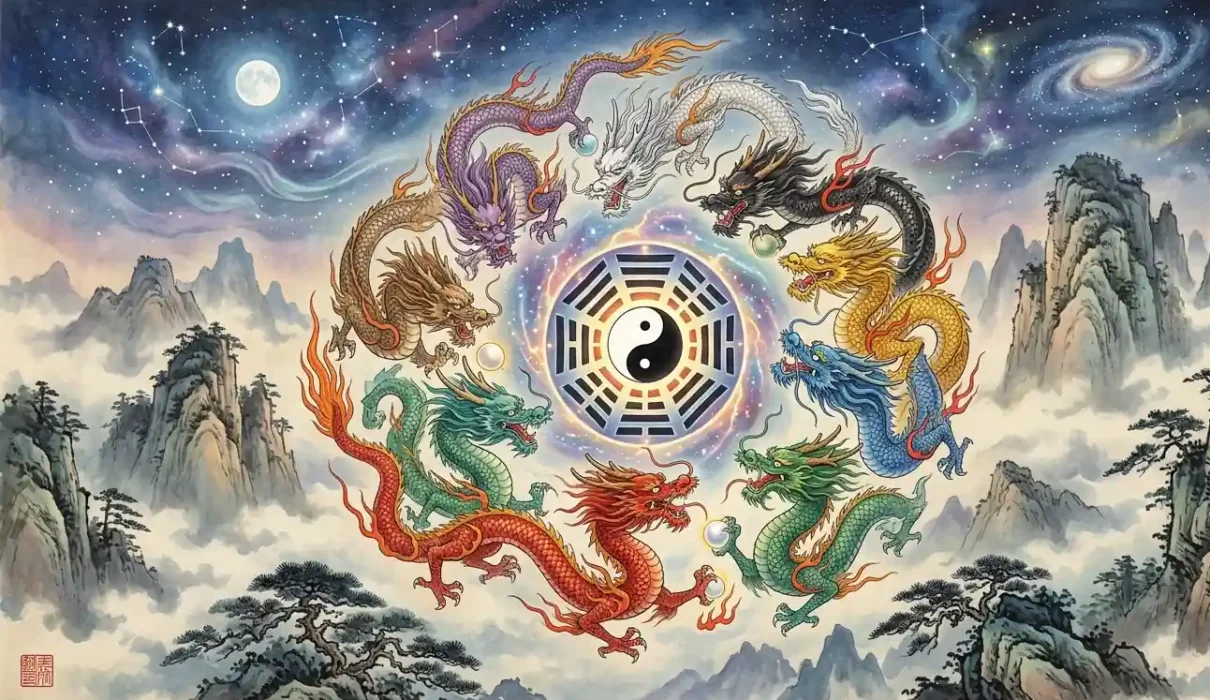
Colors in Chinese culture are never just colors. They’re a compressed symbolic language encoding cosmological position, elemental affiliation, social rank, and divine function into a single visual choice.
Chinese dragon colors are the clearest example of this I know. When a classical Chinese text or a traditional painting specifies what color a dragon is, that specification carries a precise meaning that a reader fluent in Chinese symbolic tradition would immediately understand. The color tells you where the dragon sits in the cosmos, what element it commands, and what its relationship to humanity actually is.
Chinese Dragon Colors: What the Five Cosmological Colors Actually Mean and Where Purple, Gold, Silver, Blue, and Green Fit In
1. Yellow and Gold: The Imperial Dragon
The Color of Heaven’s Mandate
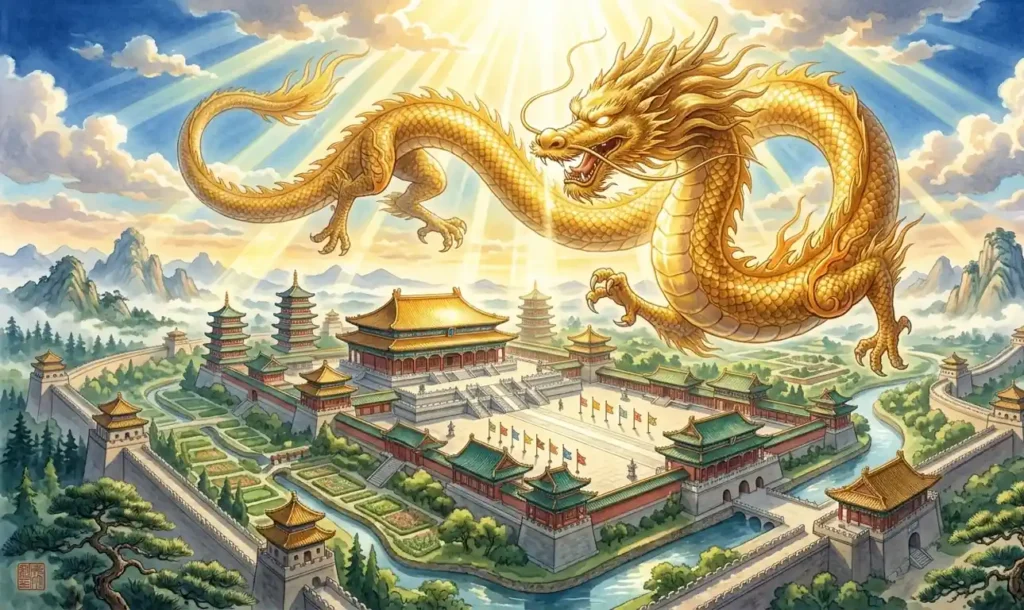
Yellow is the color of the Chinese emperor, and it’s no accident that the imperial dragon is specifically golden yellow. The connection runs deep into Chinese cosmological thinking.
In the Wu Xing (five elements) system, yellow corresponds to the Earth element and the Centre direction. The Centre is the axis around which all four cardinal directions rotate. It’s the most cosmologically significant position available, which is why the emperor, as the cosmic axis of human governance, wore yellow and sat beneath yellow dragon insignia.
The Yellow Dragon (Huanglong) we discussed in other articles on this blog is the mythological expression of this principle. Its five-colored scales incorporate all five elemental colors, but its defining color is yellow because yellow is the color of integration, of the center that holds everything together.
Practically, this connection had real legal weight. Five-clawed golden dragons were reserved for imperial use during the Ming and Qing Dynasties. Unauthorized display was punishable as a form of treason, which tells you exactly how seriously the color-dragon-emperor connection was taken.
Gold Versus Yellow
Classical Chinese tradition distinguishes between huang (yellow) and jin (gold) in ways that translate imperfectly into English. Huang yellow is the Earth element color. Jin gold carries additional associations with refinement, celestial radiance, and achieved spiritual perfection.
A golden dragon isn’t simply a yellow one. The gold implies something that has been refined to its highest expression, which is why golden dragons in classical texts typically appear in contexts of maximum divine significance rather than ordinary imperial symbolism.
2. Azure and Blue-Green: The Eastern Guardian
Qinglong and the Color of Spring
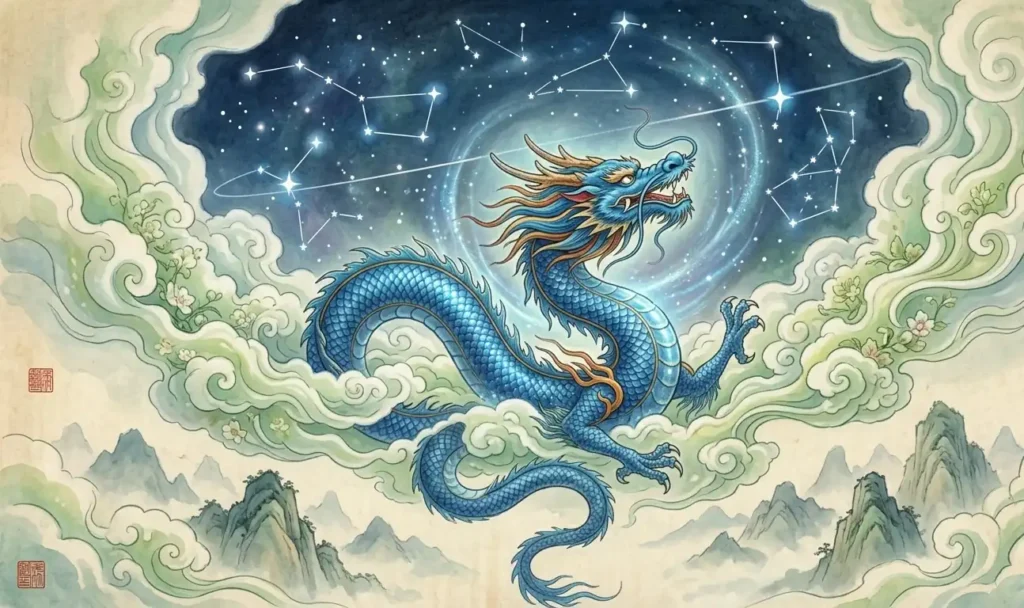
The Azure Dragon (Qinglong) is the eastern guardian of the four holy beasts, and its color is qing, a term that occupies the space between blue and green in a way that English can’t quite capture with a single word.
Qing corresponds to the Wood element in Wu Xing cosmology. Wood is associated with the East, spring, new growth, upward vital movement, and the quality of life asserting itself after winter. A qing dragon isn’t merely blue or green. It’s the color of spring’s first growth, of the first leaves on bare branches, of the morning sky in early spring when the world is turning again.
This specific color matters for understanding why the Azure Dragon has the character it does in Chinese mythology. The vitality, the upward energy, the association with new beginnings and growth rather than with an established order, all of this flows from the elemental and seasonal position that qing occupies in the cosmological system.
Classical Chinese astronomical texts describe the Azure Dragon’s seven lunar mansion constellation as tracing the color of the spring sky in the eastern quadrant. The dragon’s color is the color of the sky it inhabits and governs.
3. Red: Power, Celebration, and Protective Force
Not Aggression but Auspicious Energy
Red is one of the most important colors in Chinese symbolic tradition, and a red dragon carries that importance concentrated.
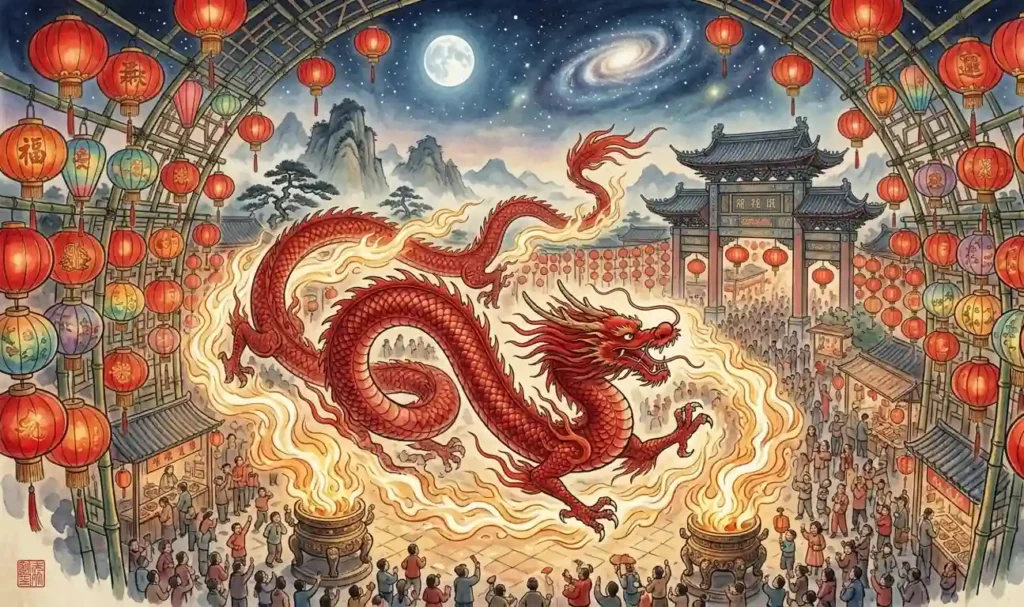
In the five-element system, red corresponds to Fire and the South. But red’s significance in Chinese tradition goes well beyond elemental correspondence. It’s the color of celebration, of good fortune, of the vital life force at maximum outward expression. Red envelopes, red lanterns, red wedding decorations: the pervasiveness of red in Chinese festive contexts reflects its deeply rooted association with positive, active, life-affirming energy.
A red dragon therefore isn’t a threatening figure in the way that Western symbolic association might suggest. It’s an enormously energetic, auspicious, powerful being whose red color signals vitality and the full expression of yang energy rather than danger or aggression.
The Vermilion Bird (Zhuque), the southern guardian of the four holy beasts, shares this red-fire-south-summer combination but in bird form rather than dragon form. The color connection between them reinforces the coherence of the five-element system’s color assignments: red consistently marks the south-fire-summer-yang-maximum position regardless of which divine being holds it.
Red in Protective Contexts
Red dragons appear specifically in protective contexts in Chinese folk art and temple decoration. Their red color signals an active protective force rather than passive guardianship. You’ll find red dragon imagery at entrances and thresholds where active spiritual protection is specifically wanted.
4. Black: Depth, Mystery, and Water’s Hidden Power
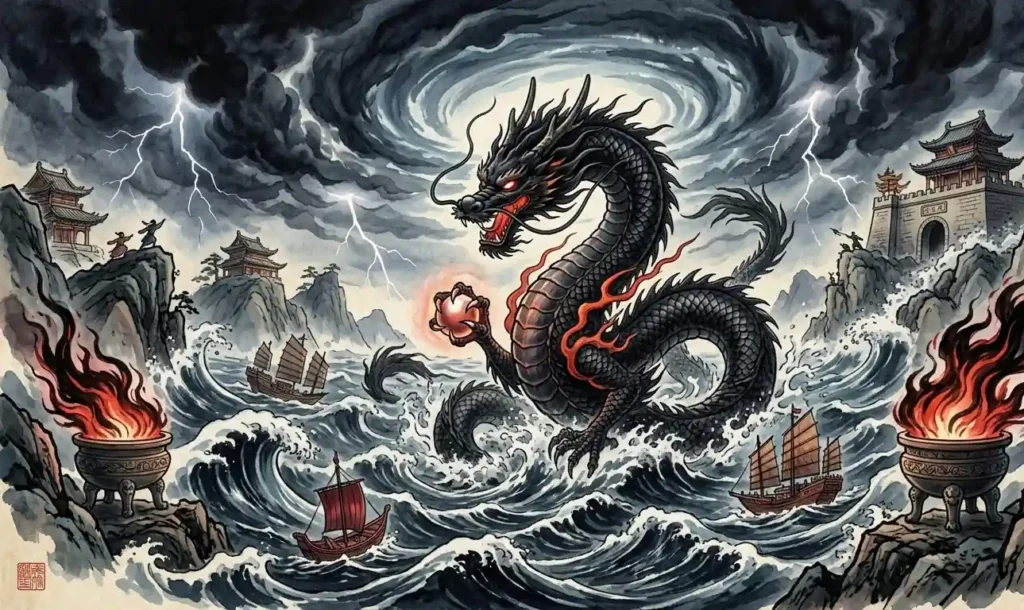
The North Sea’s Sovereign Color
Black corresponds to the Water element and the North in the Wu Xing system, making it the elemental color of depth, hidden potential, and the quality of winter’s contracted stillness.
The Black Tortoise (Xuanwu) of the northern holy beast position shares this color precisely because black and the north and water all occupy the same cosmological position. A black dragon carries the same associations: depth that conceals power, patience that accumulates strength, the darkness before dawn that makes the subsequent light meaningful.
Black dragons in Chinese mythology tend to appear in contexts involving deep water, profound mystery, and power that hasn’t yet expressed itself. They’re associated with the dangerous potential of flooded rivers, of ocean depths, of weather systems gathering before a storm breaks.
The Ao Shun, Dragon King of the North Sea, governs a domain whose character aligns with black’s symbolic associations: the coldest, deepest, most inward of the four sea domains.
What’s interesting is how completely this differs from Western symbolic usage of black. In Chinese tradition, black isn’t the color of evil or corruption. It’s the color of the depth that makes fertility possible, of winter that makes spring meaningful, of yin at its fullest expression.
5. White: Metal, Mourning, and Purity’s Double Edge
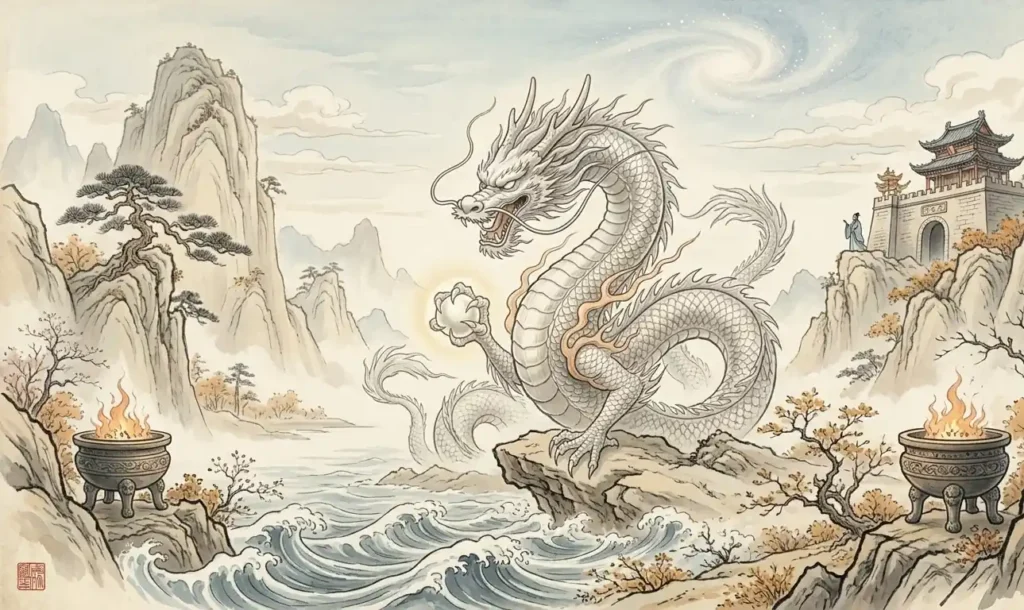
The Most Misunderstood Dragon Color
White is where Chinese and Western symbolic systems diverge most dramatically, and a white dragon in Chinese tradition carries meanings that Western readers almost universally misread on first encounter.
White corresponds to the Metal element and the West in the Wu Xing system. Metal’s qualities are refinement, precision, contraction, the harvesting of what summer produced. The West is the direction of autumn and of completion. White in Chinese culture is the mourning color, worn at funerals, associated with death and transition.
A white dragon is not a pure, good, heavenly dragon in the way that white imagery functions in European symbolic tradition. It’s a dragon of the Metal element’s precise, sharp, contracting energy, associated with the western direction’s autumn harvest and completion, and carrying the cultural weight of mourning and transition.
The White Tiger (Baihu) of the western holy beast position shares this color for the same reasons. White here signals martial precision, the endpoint of cycles, and the specific kind of power that emerges from reduction to essence rather than from abundance.
This doesn’t make white dragons malevolent. It makes them complex in ways that require the five-element framework to understand properly. A white dragon governs processes of completion, refinement, and transition, which are cosmologically necessary even when they involve loss.
6. Purple: Celestial Origin and Divine Exception
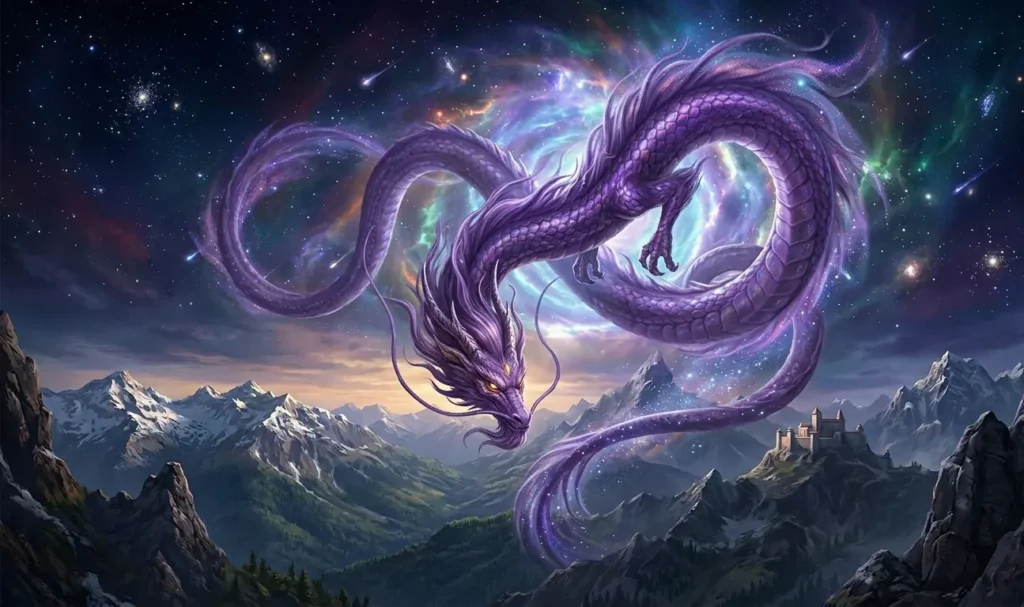
The Color Outside the System
Purple is the most cosmologically exceptional dragon color, and it’s the one that took me longest to properly understand.
The five-element system has five colors: green-blue (Wood), red (Fire), yellow (Earth), white (Metal), and ,black (Water). Purple is not one of them. So where does a purple dragon come from, and what does the color mean?
Purple in classical Chinese tradition is associated with two specific cosmological locations. One is the Purple Forbidden Enclosure (Zǐwēi Yuán), the central constellation cluster in Chinese astronomical mapping that corresponds to the celestial pole and the emperor’s heavenly residence. The other is the phrase “purple vapor from the east” (zǐ qì dōng lái), which classical texts associate with the appearance of Laozi traveling west and with celestial auspiciousness of a specifically transcendent kind.
A purple dragon doesn’t belong to any of the five elemental categories. It comes from outside the system, from the celestial pole, from the space of transcendent divine significance that exists above the five-element cosmological wheel.
Classical texts that describe purple dragons treat them as exceptionally auspicious manifestations, appearing at moments of profound cosmic significance rather than as regular inhabitants of the mythological world. Their color signals something that cannot be categorized within ordinary cosmological frameworks.
Read: 9 Rare Chinese Dragon Creatures Most People Never Encounter
7. Blue: Healing, Wisdom, and the Sky’s Depth
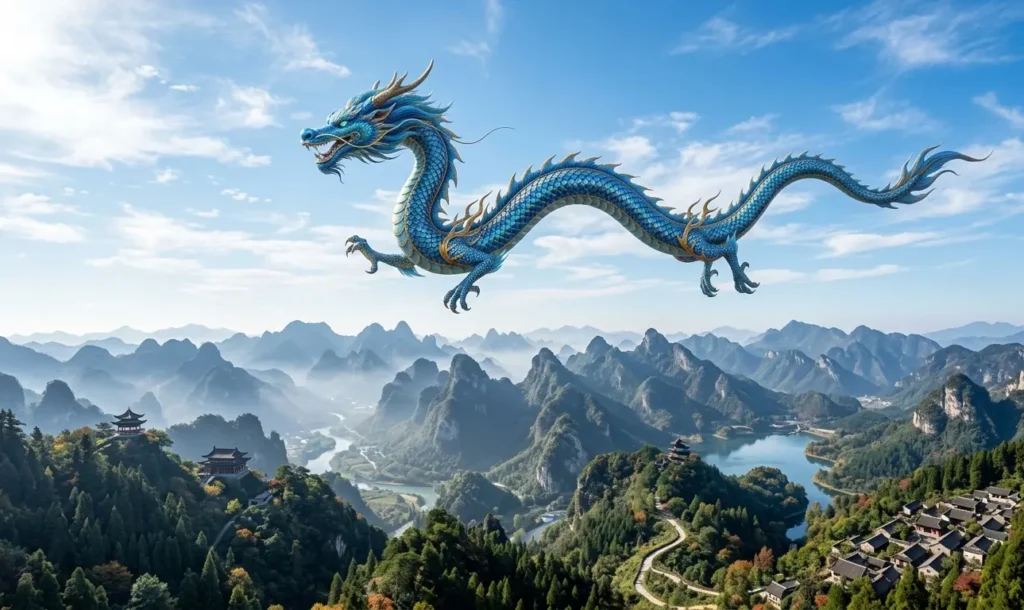
Distinct From Azure
Blue (lán) in Chinese dragon tradition is worth distinguishing carefully from the azure-green qing of the Azure Dragon. The colors occupy different symbolic positions.
Where qing captures the blue-green of spring vegetation and the eastern spring sky, lán blue is the deeper blue of the sky at its clearest, of water at its most transparent, of the specific quality of clarity that allows deep perception.
Blue dragons in Chinese folk tradition and temple art appear specifically in contexts connected to healing, wisdom, and the ability to perceive truth through apparent complexity. Some regional traditions in China associate blue dragons with physicians and medical knowledge, with the clarity of perception that allows accurate diagnosis.
The connection makes cosmological sense. Deep blue is the color of depth made visible, of something clear enough to see through completely. A being whose domain is wisdom and healing carries that quality of transparent depth in its color.
8. Green: Nature’s Vitality and Earthly Abundance
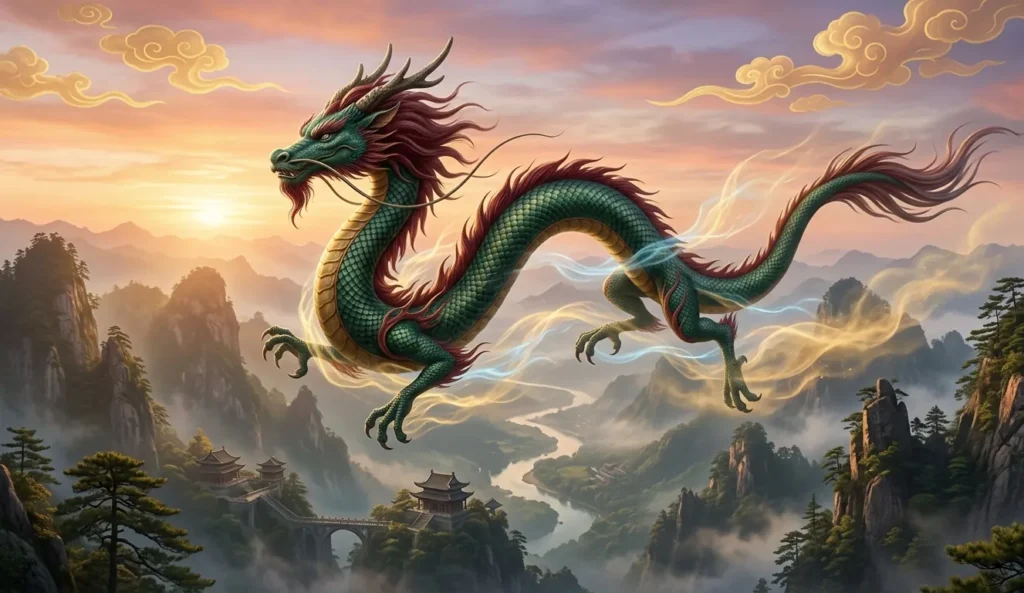
Distinct From Azure, Connected to Life
Green (lǜ) in the specific sense of growing vegetation, distinct from the blue-green qing, connects to the most immediate and physical expressions of the Wood element’s vitality.
Where the Azure Dragon’s qing color corresponds to the elemental and cosmological position of Wood, green in the sense of lush growing plants corresponds to what the Wood element produces when it’s functioning at maximum abundance.
Green dragons in Chinese folk tradition tend to appear in contexts of agricultural fertility, forest abundance, and the kind of life force that expresses itself in the immediate physical world rather than in celestial or cosmological registers. They’re the dragons of rice paddies, of forest watersheds, of the specific local vitality that makes a particular landscape thrive.
Regional temple traditions in southern China, where the landscape’s fertility was particularly abundant and visually striking, have particularly developed traditions of green dragon veneration connected to agricultural success and the health of the land itself.
9. Silver: The Moon, the Feminine Principle, and Reflected Light
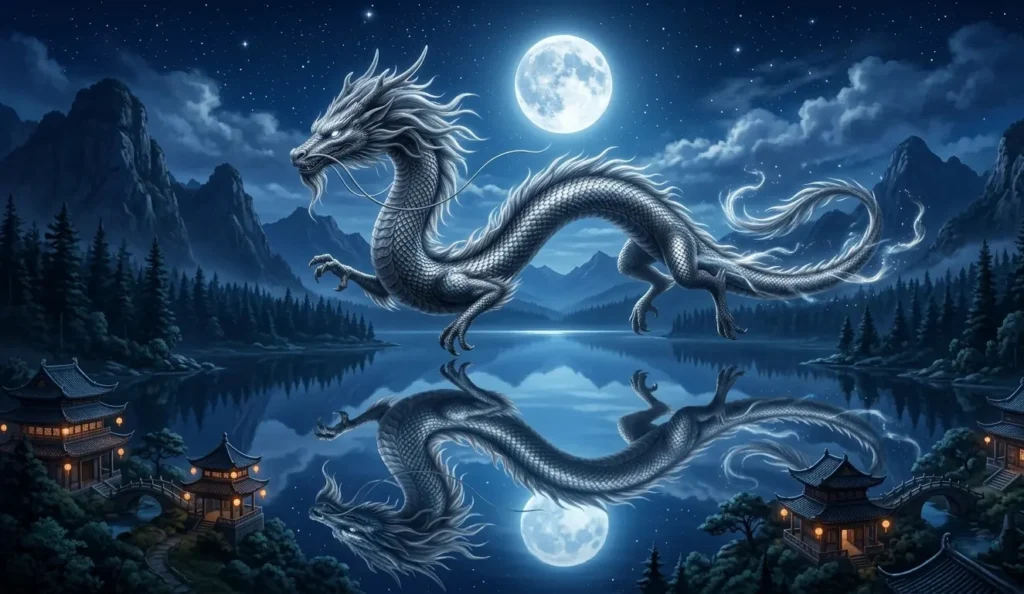
The Lunar Dragon Color
Silver (Yin) in Chinese dragon tradition carries the specific associations of the moon and the yin principle at its most refined and luminous.
Where gold corresponds to the sun, to yang energy, to the emperor and the direct expression of celestial authority, silver corresponds to the moon, to yin energy, to the empress and the reflected, receptive, deeply wise aspect of cosmic power.
A silver dragon is a lunar being. Its light is not the direct blaze of gold but the clear, cool, reflective light that makes night navigation possible, that governs tidal rhythms, that corresponds to the yin principle’s quality of receptive depth.
The silver dragon’s gender associations are specifically feminine in classical tradition, connecting it to the lunar goddesses, to Chang’e in her Moon Palace, and to the yin-principle divine figures whose power is the power of depth and reflection rather than outward expression.
Silver also appears in alchemical contexts within classical Chinese tradition. Silver (alongside gold) was one of the two perfect metals in Chinese alchemical theory, representing the moon’s perfection as gold represented the sun’s. Dragon imagery in alchemical texts sometimes deploys silver specifically to mark a figure associated with the yin-water-moon-feminine axis of the alchemical symbolic system.
The Color System as a Whole
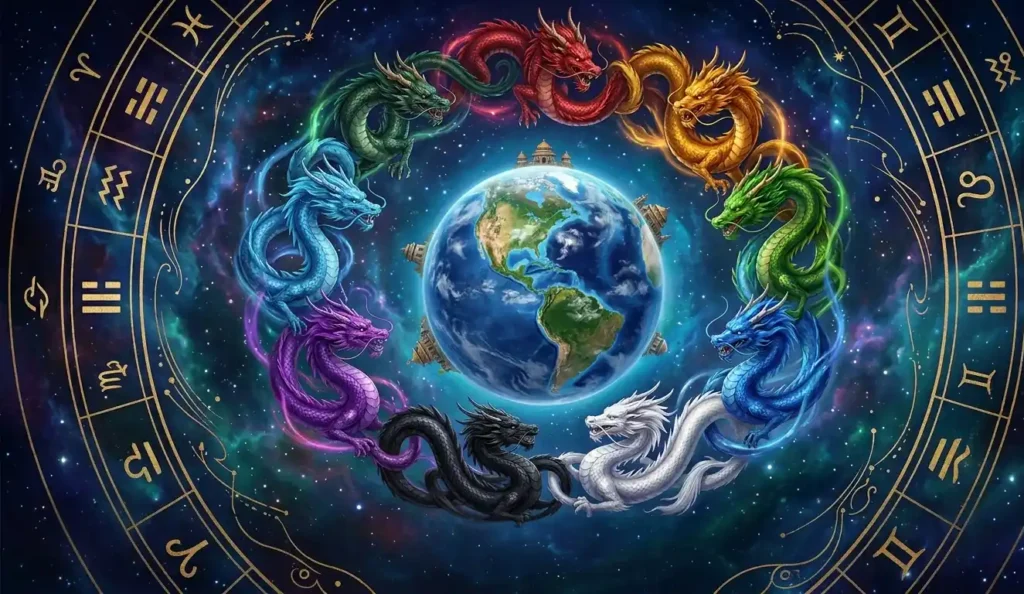
How the Colors Relate to Each Other
Looking at all nine colors together, several patterns emerge.
Five of them (azure-green, red, yellow, white, black) map directly onto the Wu Xing five-element system. These are the foundational dragon colors, and their meanings derive from the elemental system’s precise cosmological assignments rather than from cultural convention.
Two of them (purple and silver) sit outside the five-element grid, connecting instead to celestial and lunar symbolism that operates alongside rather than within the five-element framework.
Two of them (blue and green in the specific sense of deep sky and living vegetation) are differentiated expressions of the Wood and Water element colors, capturing the specific phenomenological qualities those elements produce rather than their abstract cosmological positions.
Reading Color in Chinese Dragon Art
Once you understand this system, reading Chinese dragon art changes significantly.
A golden dragon on an imperial robe isn’t simply decorative. It’s a statement about the wearer’s cosmological position as the earthly axis of the five-element system. A qing dragon on the eastern wall of a ritual space isn’t a color choice. It’s the correct placement of the eastern guardian’s color in the eastern position. A black dragon in a painting of flooding waters isn’t ominous imagery. It’s the accurate representation of the deep-water dragon type in its natural element.
The colors are a language. Learning it doesn’t just tell you about dragons. It gives you access to a complete symbolic vocabulary that Chinese culture has used for thousands of years to encode cosmological meaning into visual experience.
Frequently Asked Questions
Is there a hierarchy among the nine dragon colors?
Yellow-gold holds the highest social rank due to its imperial associations. Purple holds the highest cosmological rank due to its transcendent celestial origin outside the five-element system. The other colors aren’t ranked against each other in a simple hierarchy but rather positioned within the five-element system where each holds equal cosmological significance within its own domain.
Can a single dragon have multiple colors?
Yes. The Huanglong (Yellow Dragon) is specifically described as having scales in all five elemental colors, making it a synthesis figure rather than a single-color being. This multi-colored characteristic is part of what marks the Yellow Dragon as the guardian of the Centre, the position that integrates all five elements rather than governing one.
Why don’t all these colors appear equally in Chinese dragon art?
Imperial regulation restricted certain colors, particularly gold, to specific contexts and users. Additionally, the most common subjects for large-scale dragon art were imperial commissions, which naturally emphasized imperial golden and azure dragons over the full range of colors. Regional temple art and folk traditions preserved the wider color range better than courtly art typically did.
What does a red Chinese dragon represent?
A red Chinese dragon represents good luck, happiness, success, and celebration. It is commonly seen during festivals and special occasions because it is believed to bring positive energy and fortune.
Is the black Chinese dragon a bad symbol?
No, the black Chinese dragon is not considered evil. It is usually associated with strength, resilience, water, and natural forces. In many stories, it is viewed as a powerful and protective figure.
A Final Thought
The nine Chinese dragon colors covered in this article aren’t exotic curiosities from a distant tradition. They’re a coherent color philosophy built on a cosmological framework that organized Chinese thinking about nature, society, time, and divinity for several thousand years.
Understanding them changes how you see Chinese art. A color choice that looks arbitrary becomes precise. An image that seemed decorative reveals its cosmological argument. The dragons stop being fantastic creatures and become what they always were in the tradition that created them: visible expressions of the invisible forces that organize reality.
That’s the reward for learning the language. The art starts talking.
Related Articles
- Dragon Mythology: How Dragons Are Depicted Across Cultures
- Western Dragon vs Eastern Dragon [Myth, Power & Origin]
- 11 Chinese Dragon Types & the Legends Behind Their Powers
- 9 Sons of the Dragon: What Each One Guards in Chinese Myth
- 9 Chinese Dragon Myths Born From Real Natural Disasters
- Chinese, Japanese & Korean Dragons: How They Actually Differ
- Dragon & Phoenix: Chinese Myth’s Most Sacred Bond
- Zhulong: The Chinese Dragon Who Ruled Time Itself
Further Reading
- Five Basic Colour Terms and Colour Taboos in Ancient China
- “COLOR, POWER, AND MEANING” by Xin Zhang
- Chinese Color Language – Victoria
- Symbolism and Meaning of Colours in Early Chinese Sources
- Yellow Dragon – Chinese Text Project
- Purple Celestial Symbolism
Written by Batin Khan, a curious free spirit who loves reading and exploring the worlds of fantasy, mythology, and ancient stories. Through this blog, Batin hopes to share that sense of wonder with readers while building an exciting future along the way.