
 By
By Quick Takeaways:
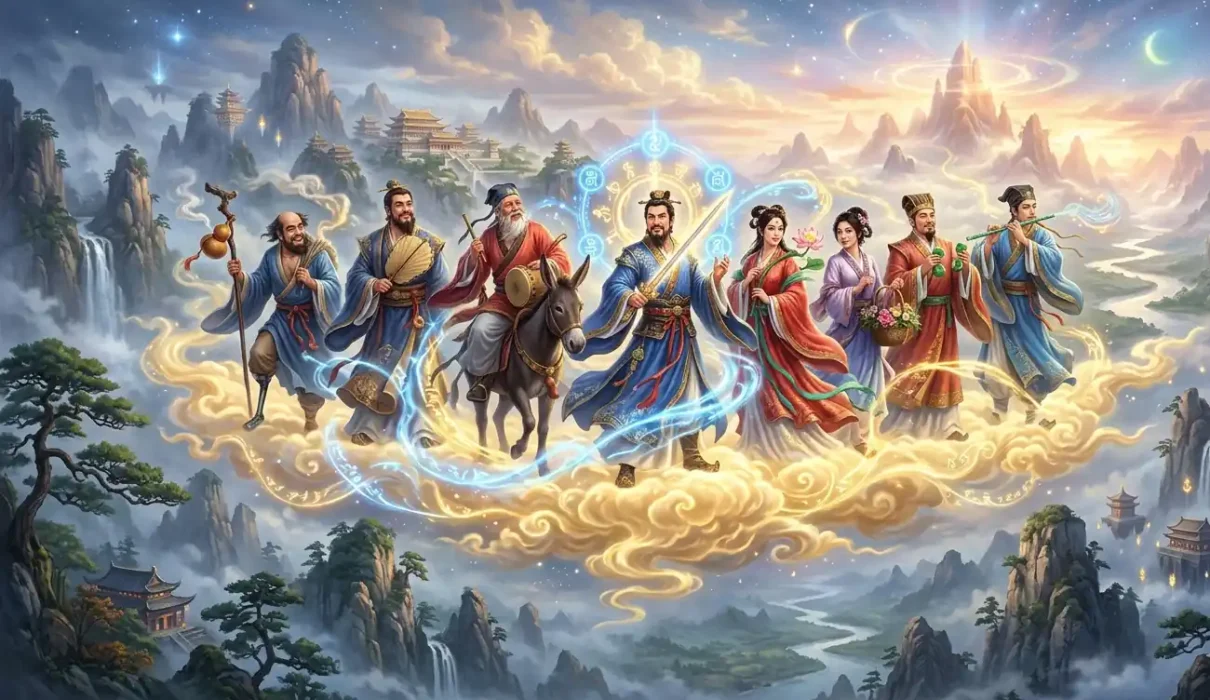
- The Eight Immortals (Ba Xian) are eight figures from Chinese Daoist mythology who achieved immortality from different starting conditions representing different ages, genders, social classes, physical abilities, and personality types
- Their diversity is deliberate and philosophically significant. The Daoist tradition is asserting that the immortality path is genuinely open to everyone, not just the privileged or naturally gifted
- Each immortal carries a sacred object (their “attribute” or “emblem“) that both identifies them and encodes their specific power and symbolic meaning
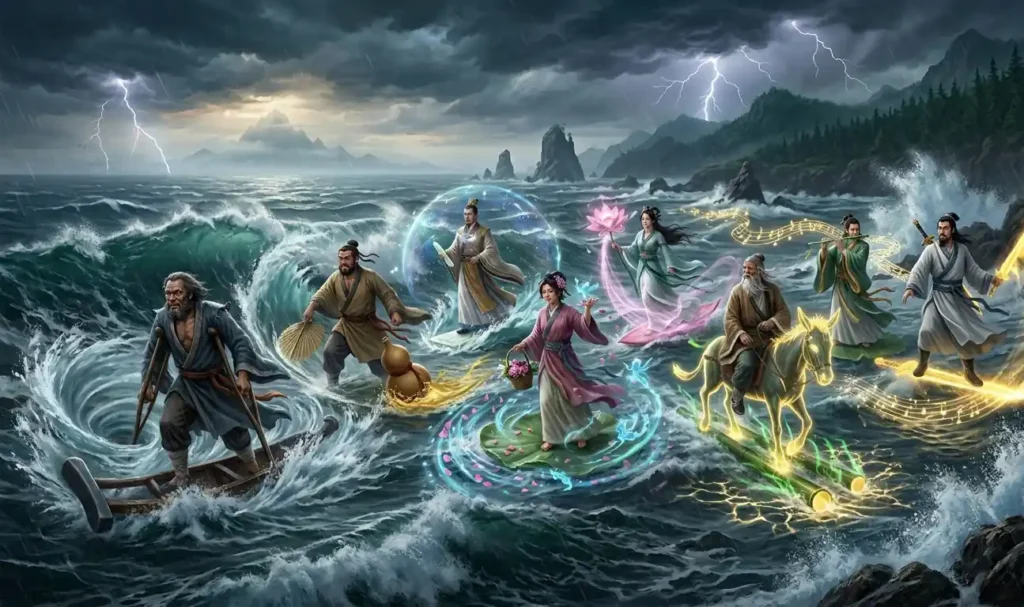
- The “Eight Immortals Cross the Sea” is the most famous collective narrative. Each immortal crosses using only their own attribute, demonstrating that each path to transcendence is unique
- The 8 Immortals appear everywhere in Chinese decorative arts, and knowing their attributes lets you identify each figure even when they’re not labelled
If you’ve spent any time around Chinese art, porcelain, temple decoration, or traditional textiles, you’ve almost certainly encountered the Eight Immortals, even if you didn’t know that’s what you were looking at.
They appear on blue-and-white Ming Dynasty porcelain, on carved jade pendants, on temple murals, on birthday gifts, on the carved wooden panels of Qing Dynasty furniture. Eight figures, each carrying a distinctive object. A gourd, a sword, a flute, a fan, a lotus, a basket of flowers, a pair of clappers, a drum. Once you know what you’re looking at, you start seeing them everywhere.
After 10 years of following Chinese mythology in my 20-year-long journey of mythology, I’ve come to think the Eight Immortals are one of the tradition’s most carefully designed symbolic ensembles. They’re not just eight interesting characters from Daoist legend. They’re a philosophical statement about who can achieve transcendence, and the answer the tradition gives is everyone. Regardless of your starting point.
That’s what this article is about.
Why Eight? The Symbolic Significance of the Group
The Deliberate Diversity
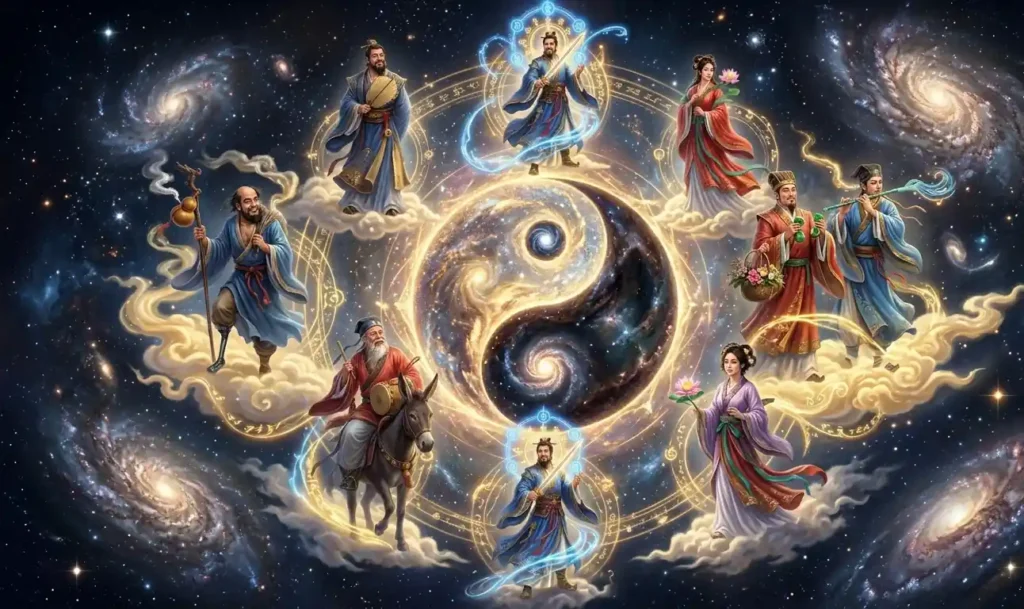
The Eight Immortals as a group are selected from very different segments of Chinese society. Together they represent:
- Different ages: An old man, a middle-aged man, young adults, an adolescent, and ambiguous figures
- Different genders: One woman (He Xiangu), one figure of ambiguous gender (Lan Caihe), and six men
- Different social classes: An imperial court official, a scholar-official, a military general, a beggar, a wandering Daoist, a commoner, a disabled person
- Different abilities: One figure is lame (Li Tieguai), one is very old (Zhang Guolao), one was a drunkard and wanderer
- Different temperaments: The serious and the playful, the solitary and the sociable, the ascetic and the sensual
This diversity isn’t accidental. It’s the tradition’s most explicit statement about the nature of the immortality path. It doesn’t require a particular social position, physical form, gender, age, or personality type. What it requires is genuine cultivation, and that’s available to everyone.
The Auspicious Eight
The number eight carries its own significance in Chinese cultural context. The word for eight (ba) sounds similar to the word for prosperity (fa) in Cantonese, which is one reason eight is considered exceptionally auspicious in Chinese culture.
But beyond the phonetic auspiciousness, eight is the number of trigrams in the I Ching (Bagua), making it associated with the complete mapping of natural forces. Eight immortals suggest completeness, not just some paths to transcendence, but the full range.
The Eight Immortals: Complete Profiles
He Xiangu: The Woman Who Chose Transcendence
Who She is
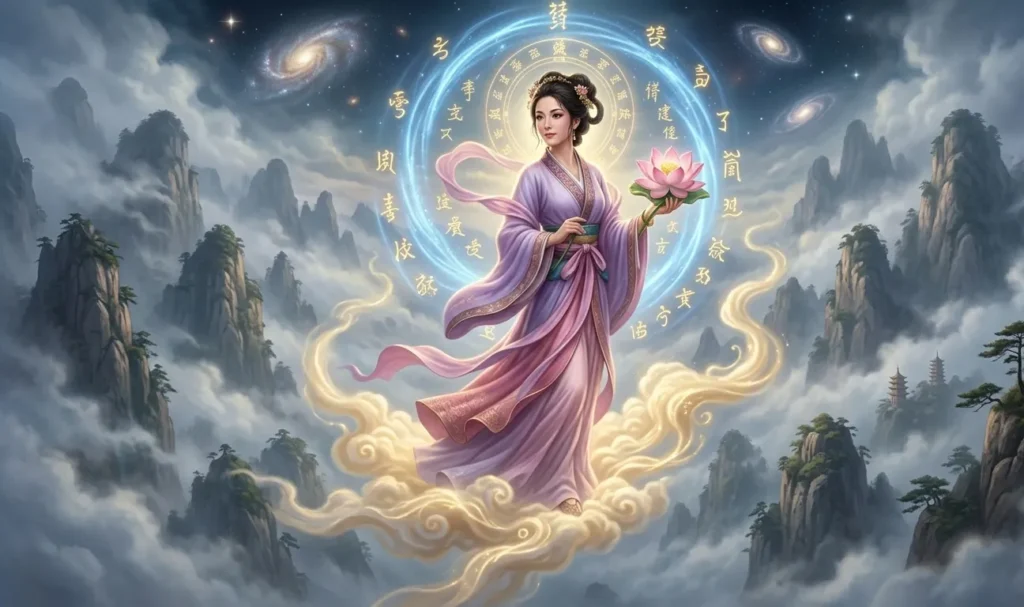
He Xiangu is the only female figure among the Eight Immortals, and her story is one of the most psychologically interesting in the group.
Born in the Tang Dynasty (most accounts give her 7th-century origins), she was a young woman who ate a supernatural peach or, in other accounts, ground and consumed mother-of-pearl powder on the advice of a divine being who appeared to her in a dream. After this, she swore an oath of celibacy, began wandering the mountains, and gradually achieved immortal status through a combination of dietary cultivation, meditation, and spiritual development.
Her Sacred Emblem
He Xiangu carries the lotus flower, sometimes a single bloom, sometimes on a long stem, sometimes depicted with the morning star. The lotus represents purity emerging from muddy water, spiritual cultivation that rises above its origins, and feminine virtue.
What She Represents
She represents women, and specifically young unmarried women. Her immortality was achieved through her own practice and her own commitment, not through marriage, family connection, or male patronage. In the context of the social structures of imperial China, that’s a significant statement.
Li Tieguai: The Immortal in the Beggar’s Body
Who He is
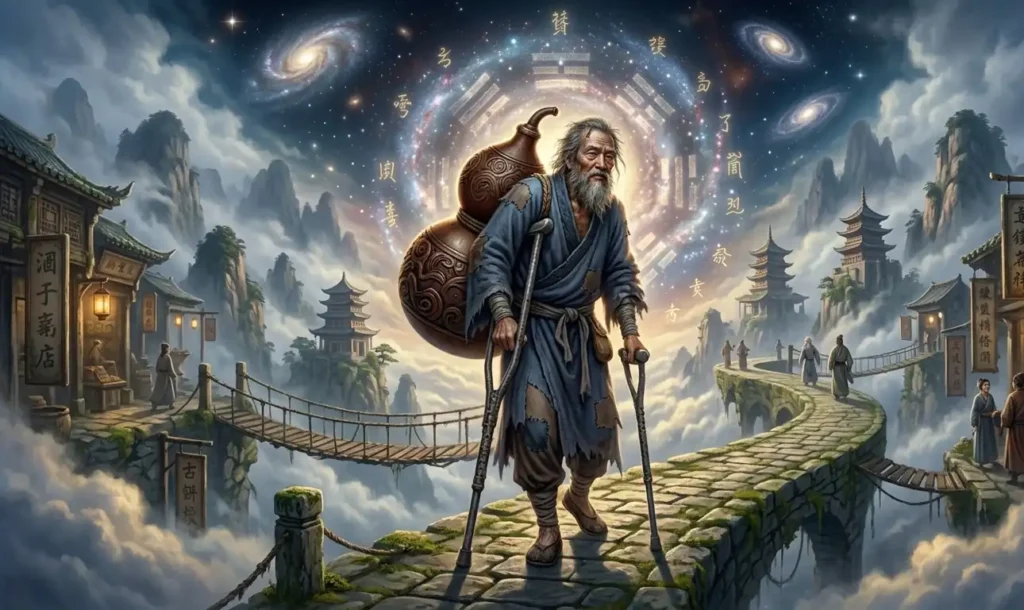
Li Tieguai is probably my favourite of the eight. Tieguai’s story is the strangest and most philosophically provocative.
He was a Daoist adept whose spirit left his body to visit the immortal realm. He instructed his disciple to watch over his body for seven days, and if the spirit hadn’t returned by then, to burn it. On the sixth day, the disciple received news that his own mother was dying and felt he couldn’t wait any longer. He burned the body and left.
When Li Tieguai’s spirit returned on the seventh day, it found its body gone. The only available body nearby was that of a recently deceased lame beggar. Li Tieguai entered the beggar’s body and remained in it permanently, the great Daoist master now lame, now begging, now physically disabled and socially marginalized.
The tradition says he was given an iron crutch by Laozi himself as a compensation for his situation, which became his identifying attribute.
His Sacred Emblem
The iron crutch (tie guai) is his primary attribute, often shown with a gourd from which mist or smoke emerges. The gourd contains medicinal elixirs, and the mist represents the immortal realm.
What He Represents
Li Tieguai represents the sick, the disabled, and the physically marginalized. His story makes a radical point. The great Daoist master is now indistinguishable from the lowest social figure. And yet his immortal nature is unchanged. The body’s condition doesn’t determine the spirit’s cultivation.
Han Zhongli: The General Who Walked Away
Who He is
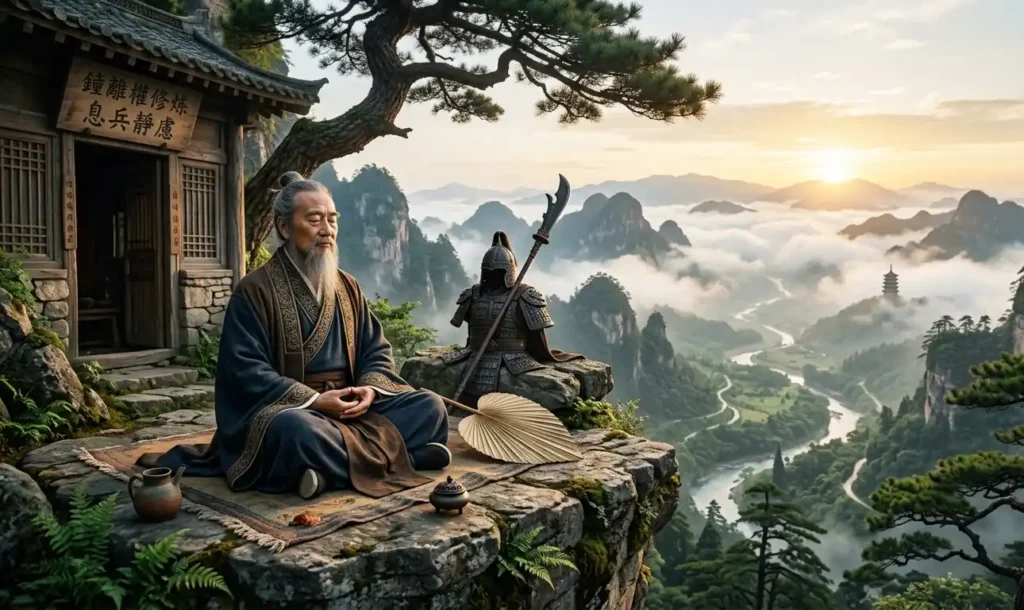
Han Zhongli is traditionally depicted as a fat, cheerful, bare-bellied figure. He’d look at home on a temple roof, exuding the specific kind of contentment that comes from someone who has genuinely stopped worrying about social appearances.
His origin story has him as a Han Dynasty military general who experienced a series of military defeats that forced a complete reassessment of his life’s direction. Rather than continuing to serve a court that had failed him, he retreated to the mountains, encountered a Daoist sage, and devoted himself to cultivation.
He’s considered one of the most senior figures in the Quanzhen Daoist lineage.
His Sacred Emblem
Han Zhongli carries a large fan (specifically a palm-leaf fan) that has the power to revive the dead and transmute base metals into silver and gold. He’s often depicted fanning himself with cheerful abandon, his bare belly prominently displayed.
What He Represents
He represents military men and by extension those who have experienced dramatic reversals of fortune. His immortality emerged from failure, from the willingness to abandon a prestigious social role when that role proved hollow, and from the humility to begin learning from scratch.
Zhang Guolao: The Ancient Mystery
Who He is
Zhang Guolao is the figure I find most genuinely enigmatic, and I suspect that’s entirely intentional.
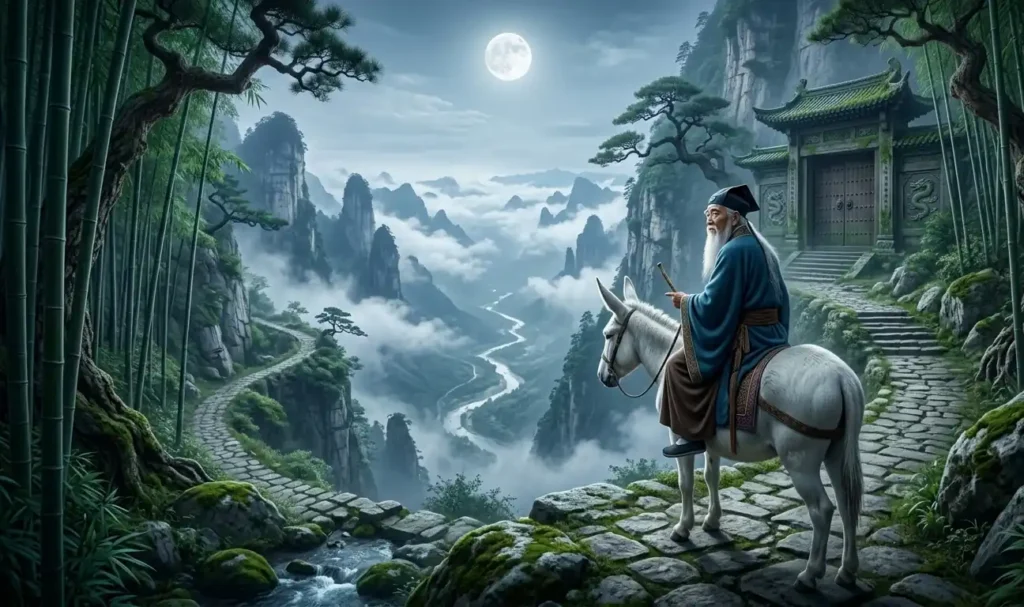
He’s depicted as an extremely old man, often white-haired and leaning, who rides a white donkey. But here’s the thing. He rides the donkey backwards. The great joke of Zhang Guolao’s iconography is that the ancient sage who has mastered Daoist wisdom rides facing away from where he’s going.
Whether this is a comment on the irrelevance of conventional direction, the wisdom of looking at where you’ve come from rather than where you’re going, or simply the playful absurdity that characterizes Daoist thought at its most Zhuangzi-influenced is left deliberately open.
When he finishes travelling, Zhang Guolao folds the donkey up like paper and puts it in his bag. When he needs it again, he spits water on it and it unfolds back into a real donkey.
His Sacred Emblem
His attribute is a fish drum (yu gu), a bamboo tube that he beats rhythmically, though he’s equally identified by the white donkey he rides backwards.
What He Represents
Zhang Guolao represents the elderly. His immortality comes not from youth or physical vigor but from extreme age and the accumulated wisdom it represents. The reversed riding suggests that conventional forward-looking orientation is not necessarily the wisest approach. Sometimes, looking back at where you’ve been is the more illuminating direction.
Lu Dongbin: The Most Beloved
Who He is
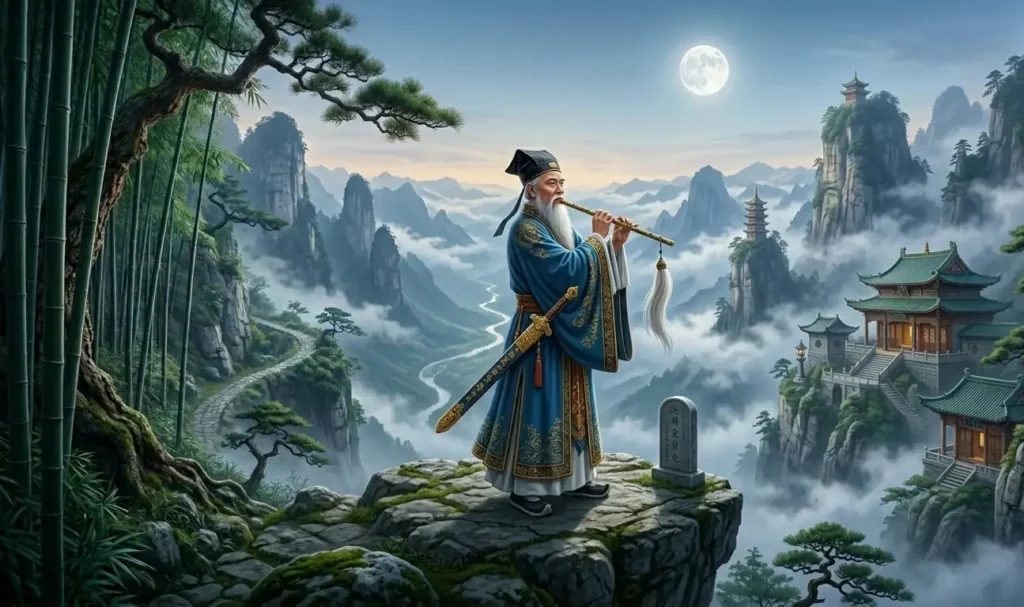
Lü Dongbin is probably the most widely venerated of the Eight Immortals in religious practice. Temples dedicated specifically to him exist across China and the Chinese diaspora. He’s a patron of barbers, scholars, and the sick.
His story is one of the tradition’s most compelling. He was a Tang Dynasty scholar who failed the imperial examinations twice. While resting at an inn, he fell asleep and dreamed an entire life passing the examinations, a successful career, wealth, family, and then gradual loss of everything through political reversal. He woke up to find his innkeeper host still preparing the millet porridge that had been on the stove when he fell asleep.
This dream, the “Yellow Millet Dream” was sent by the Daoist sage Zhongli Quan (Han Zhongli) to teach him the illusory nature of worldly ambition. Lü Dongbin recognized the teaching, became Han Zhongli’s student, and eventually achieved immortality.
His Sacred Emblem
Lü Dongbin carries a sword across his back, specifically a demon-slaying sword and a fly-whisk (fu chen) used for dispelling illusion and evil. The sword is his most distinctive attribute.
What He Represents
He represents scholars and literati, the educated class who pursued conventional success through the examination system. His immortality came from recognizing that conventional success was an illusion, a dream. The dream teaching is one of the tradition’s most elegant philosophical devices.
The entire arc of a successful life compressed into a nap, revealing the insubstantiality of everything the dreamer had been pursuing.
Han Xiang Zi: The Musician
Who He is
Han Xiang Zi is traditionally identified as the nephew of the great Tang Dynasty Confucian scholar Han Yu, which makes him an interesting figure because his Daoist pursuit of immortality stood in direct contrast to his uncle’s Confucian values.
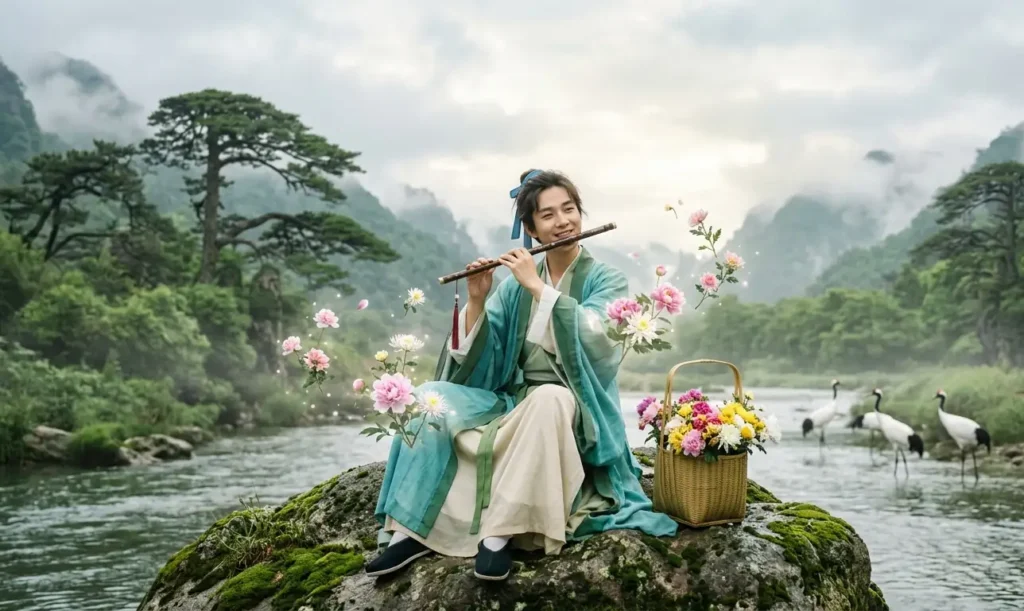
He’s depicted as a young man, often the youngest-looking of the eight, associated with music, flowers, and a kind of carefree joy that suggests someone who has genuinely stepped outside the anxieties of conventional social life.
Legend says he could make flowers bloom instantaneously and produce wine from thin air, both abilities suggesting the mastery of natural processes that the cultivation tradition associated with advanced immortal status.
His Sacred Emblem
Han Xiang Zi carries a flute (specifically a jade flute or bamboo flute) whose music can cause flowers to bloom and animals to become tranquil. Music is his path and his power.
What He Represents
He represents musicians and artists whose path to transcendence runs through aesthetic cultivation rather than scholarly study or physical austerity. The flute suggests that beauty and harmony, properly cultivated, are legitimate paths to the same transcendence that more obviously “serious” practices achieve.
Cao Guojiu: The Courtier Who Left
Who He is
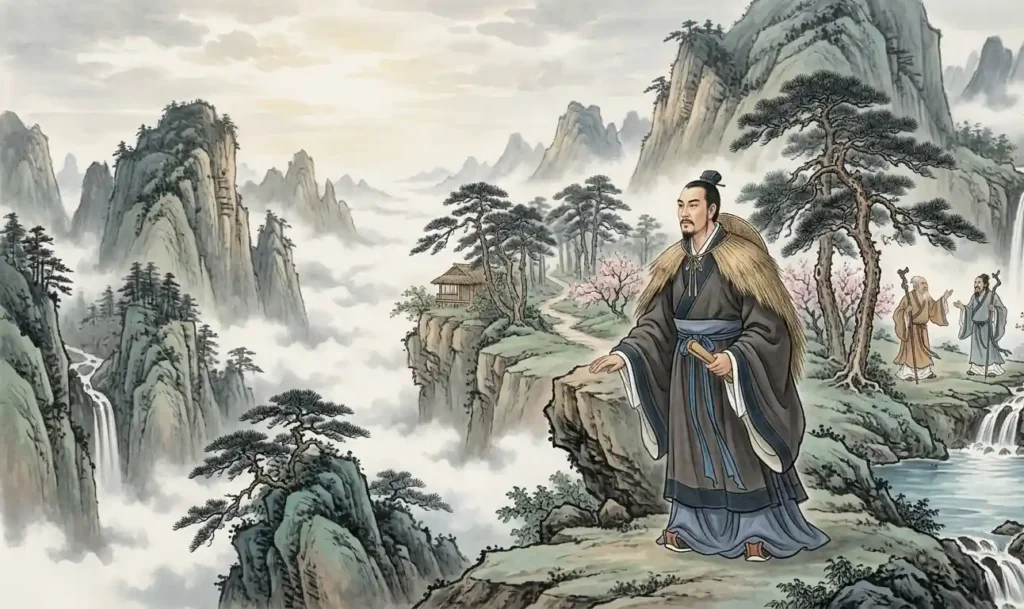
Cao Guojiu is the Eight Immortals’ most explicitly aristocratic figure, traditionally identified as the brother of Empress Cao, consort of the Song Dynasty Emperor Renzong.
His story has two versions. In the more flattering account, he was troubled by his younger brother’s criminal behavior (the brother used their family’s imperial connection to commit crimes with impunity) and retreated from court life in shame and moral distress. In the mountains, he encountered Han Zhongli and Lü Dongbin, who recognized his spiritual potential and instructed him in Daoist cultivation.
In the less flattering version, he himself was a participant in his brother’s crimes before his conversion. The reformed criminal who achieves transcendence is a compelling narrative archetype, and both versions carry the essential point. The court connection that defined his identity became the thing he had to leave behind.
His Sacred Emblem
Cao Guojiu carries jade clappers (also described as court tablets or jade tablets used by officials in court ceremonies). These connect him to his aristocratic origin while indicating he’s transmuted that connection into a spiritual attribute.
What He Represents
He represents the nobility and court officials. His immortality required leaving behind the world of imperial privilege that defined his social identity, and the spiritual path demanded the abandonment of what conventional society considered his greatest advantage.
Lan Caihe: The Wanderer
Who They Are
Lan Caihe is the most enigmatic figure of the eight, and deliberately so. Classical texts describe Lan Caihe as of uncertain gender, dressed sometimes as a man, sometimes in a way that blurs conventional gender categories. Some texts use masculine pronouns, others feminine, others avoid the question entirely.
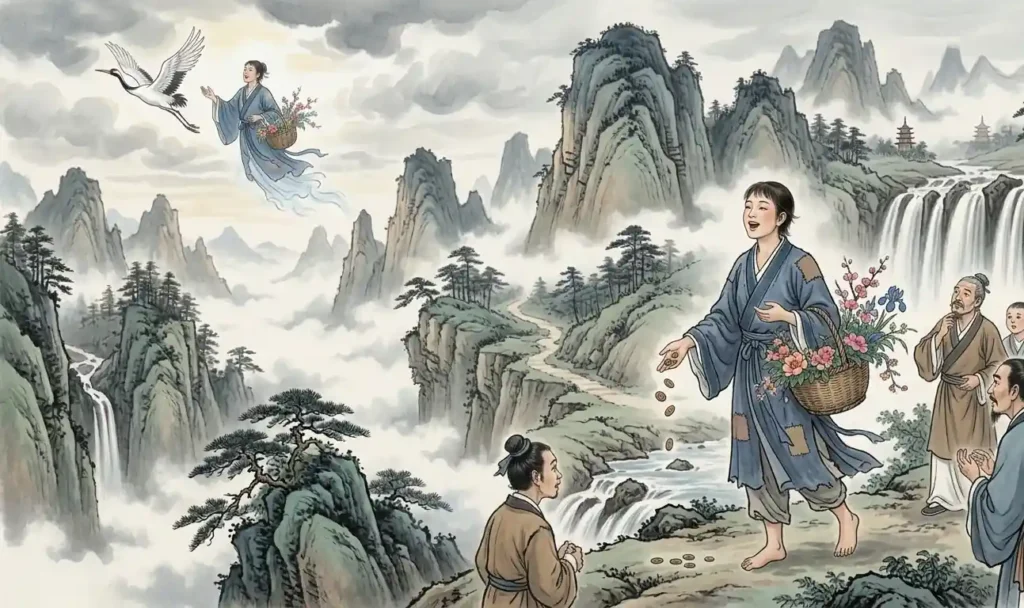
They’re depicted as a wandering street performer, barefoot in winter and dressed in a blue robe, often carrying a basket of flowers. They sang Daoist songs in the marketplace and gave away whatever money they received. They were considered either eccentric or enlightened depending on the observer’s perspective,, possibly both simultaneously.
One account says Lan Caihe was observed ascending to heaven on a crane while still singing. Another says they simply disappeared, their clothing falling empty to the ground.
Want to understand the Chinese Heavenly Court clearly? Read my complete guide here
Their Sacred Emblem
Lan Caihe carries a flower basket containing flowers of the seasons, a symbol of the passage of time, the beauty of the world, and the cultivation of nature’s gifts. The flowers are sometimes medicinal herbs rather than ornamental flowers.
What They Represent
Lan Caihe represents the poor, the wandering, and those outside conventional gender categories. Their immortality came from radical simplicity, giving everything away, sleeping in the street, being moved by music and beauty, refusing the categories that conventional society imposed.
The Eight Emblems: Knowing The Immortals By Their Objects
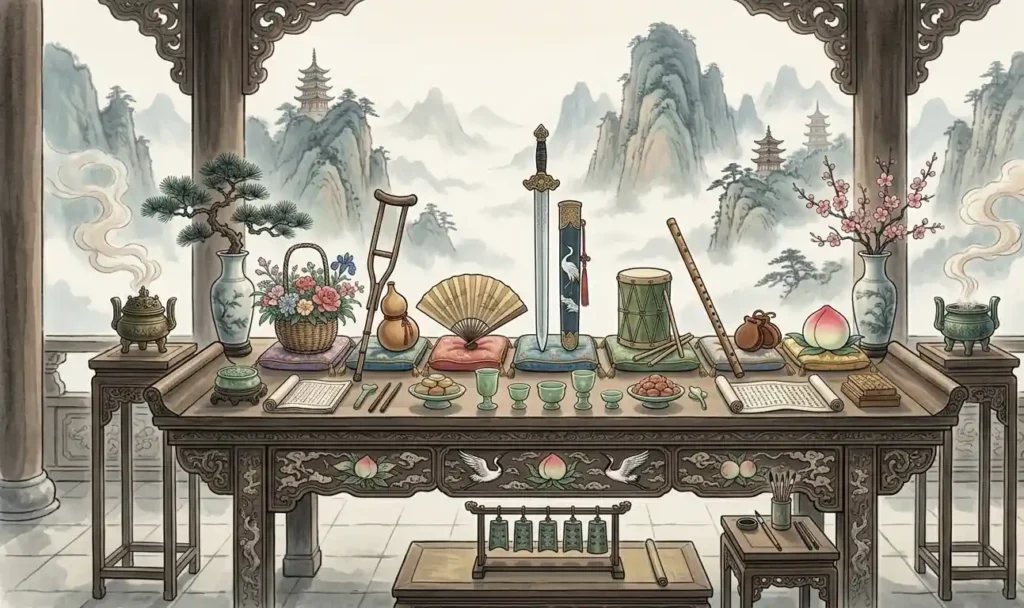
The Eight Immortals’ sacred objects are so distinctive that in Chinese art, the objects alone are often used without depicting the figures themselves. A group of eight objects, the flute, the sword, the fan, the gourd, the lotus, the flower basket, the jade clappers, and the fish drum, is recognizable as a reference to the Eight Immortals even without any human figure present.
This gives the “hidden Eight Immortals” or “Covert Eight Immortals” (an ba xian) motif the objects standing in for the immortals themselves a significant place in Chinese decorative arts. You’ll find these eight object groupings on everything from porcelain to lacquerware to architectural carvings.
The objects and their associations:
| Immortal | Primary emblem | Power/meaning |
|---|---|---|
| He Xiangu | Lotus flower | Purity, spiritual cultivation |
| Li Tieguai | Iron crutch and gourd | Healing, transformation of base to refined |
| Han Zhongli | Palm-leaf fan | Revival of the dead, transmutation |
| Zhang Guolao | Fish drum | Prophecy, the wisdom of reversal |
| Lü Dongbin | Sword and fly-whisk | Demon-slaying, dispelling illusion |
| Han Xiang Zi | Flute | Natural harmony, the cultivation of beauty |
| Cao Guojiu | Jade clappers | The transmutation of aristocratic connection |
| Lan Caihe | Flower basket | The seasons of life, medicinal cultivation |
The Eight Immortals Cross the Sea: The Definitive Collective Story
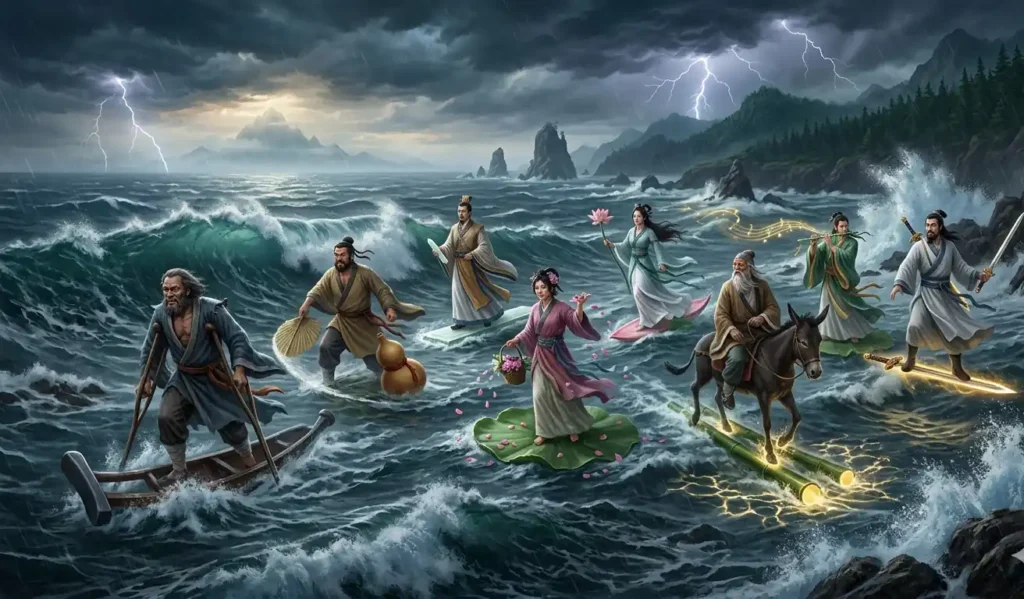
The most famous narrative involving the Eight Immortals as a group is the story of their crossing the Eastern Sea to attend a celestial celebration. A simple ferry across water would have been adequate. Instead, each immortal cast their personal attribute into the water and crossed using only that.
The crossings:
- Li Tieguai floated on his iron crutch
- Han Zhongli used his fan as a boat
- Zhang Guolao rode his unfolded paper donkey
- He Xiangu stood on her lotus flower
- Lü Dongbin floated on his sword
- Han Xiang Zi played his flute and was carried on the sound
- Cao Guojiu used his jade clappers as a raft
- Lan Caihe stood on their flower basket
The Chinese proverb that emerged from this story, “The Eight Immortals cross the sea, each displaying their divine powers,” became a common saying meaning that each person has their own particular abilities, their own way of achieving their goals. It’s one of the most elegant summaries of the Eight Immortals’ collective symbolic message.
The crossing story reveals something important: the objects aren’t just emblems or badges. They’re genuine vehicles of transcendence, extensions of each immortal’s specific cultivation path. The path that Lü Dongbin used to achieve immortality (the path of the scholar, of seeing through worldly illusion, symbolized by the sword of discernment) is literally what carries him across the water. You travel on the path that brought you here.
Frequently Asked Questions
Are the Eight Immortals historical figures or purely mythological?
Some have clearer historical origins than others. Lü Dongbin and Zhang Guolao are linked to Tang Dynasty figures who may have been real people, though the miraculous elements are legendary. Han Zhongli also has historical associations. Others, like Lan Caihe, seem more mythical. The Eight Immortals became a stable group during the Song and Yuan Dynasties.
Why is there only one woman among the Eight Immortals?
He Xiangu’s role as the only female immortal reflects both the limits placed on women in imperial China and the belief that spiritual transcendence remained open to them. Lan Caihe’s ambiguous gender adds another layer to the group’s symbolism, giving these two figures an influence that outweighs their numbers.
What’s the difference between the Eight Immortals and the Eight Trigrams?
These are separate concepts that simply share the number eight. The Eight Trigrams (Bagua) are symbols from the I Ching representing cosmic forces through yin and yang patterns. The Eight Immortals (Ba Xian) are legendary figures who attained immortality. The shared number reflects completeness, but the two systems are not directly connected.
Which of the Eight Immortals is most commonly worshipped?
Lü Dongbin is the most widely venerated of the Eight Immortals, with temples dedicated to him across China and the Chinese diaspora. He is regarded as patron of barbers, scholars, and the sick, and is linked to protection from evil and romance in some traditions. Han Zhongli often appears in art as a symbol of prosperity and contentment.
What does it mean to receive a gift decorated with the Eight Immortals?
Gifts featuring the Eight Immortals, especially for birthdays, carry strong auspicious meaning. The group symbolizes longevity, human potential, and the possibility of transcendence regardless of social status or background. Such a gift expresses the wish that the recipient will achieve a full and flourishing life in their own way.
Final Thoughts
Individually, each of the Eight Immortals is interesting. The great master who ended up in a beggar’s body. The scholar who dreamed his entire successful life in a nap. The old man who rides his donkey backwards. The woman who achieved transcendence through her own practice in a world that didn’t particularly facilitate female spiritual development.
But as a group, they make an argument. And it’s an argument I find genuinely compelling after two decades of following wisdom traditions across multiple cultures.
The argument is: the path to transcendence is not reserved for the young, the healthy, the male, the privileged, the educated, the conventionally devout, or the naturally gifted. It’s available to the lame beggar and the imperial cousin. To the old man and the young woman. To the scholar who failed his examinations and the street performer who gave all their money away. To the general who experienced defeat and the musician who made flowers bloom.
Each carries their own attribute. Each crosses the sea their own way. Each path is specific to who that person actually is.
That’s the Eight Immortals’ collective wisdom. And it’s one of the most genuinely inclusive statements I’ve encountered about who gets to achieve transcendence.
Related Articles
- How to Become Immortal According to Chinese Myth & Daoism
- Yin Yang in Daoism: Meaning, Symbolism & Sacred Origins
- The 3 Paths of Cultivation: Taoism vs Buddhism vs Confucianism
- Why Daoist Masters Pursued Immortality [The Real Reasons]
- How Daoist Meditation Became the Root of Cultivation
- Queen Mother of the West: Myths, Symbolism & Sacred Power