
 By
By Quick Takeaways:
- The Queen Mother of the West (Xīwángmǔ) is one of China’s oldest divine figures, predating Daoism as a religious system and appearing in oracle bone inscriptions from the Shang Dynasty
- Her earliest form in the Shanhaijing is a wild, dangerous deity with tiger’s teeth, a leopard’s tail, and dominion over plague, punishment, and the western wilderness
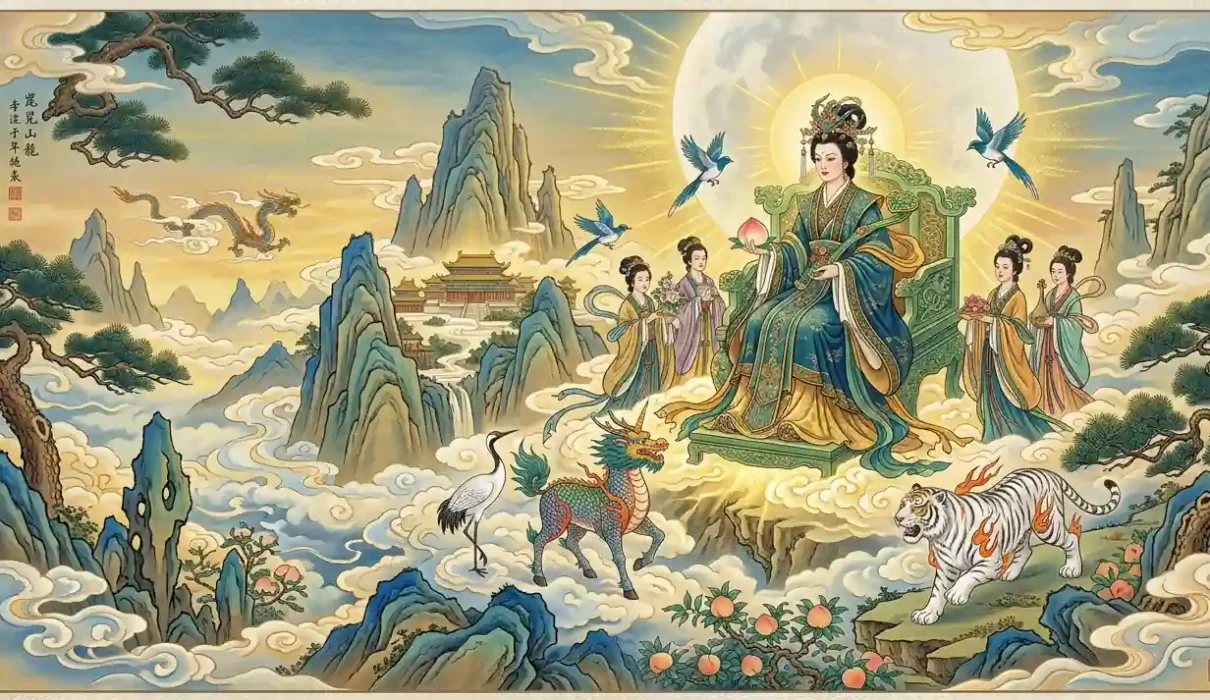
- Her later Daoist form, the elegant immortal who tends the divine peach garden, is a transformation so complete it’s almost a different figure built on the same foundations
- The divine peaches she cultivates confer immortality on whoever eats them, making her garden the most important location in the Chinese immortality tradition
- She’s the supreme female deity of the Daoist tradition and one of Chinese mythology’s most powerful figures, regardless of gender
Here’s what most people know about the Queen Mother of the West: she has a peach garden, and the peaches grant immortality, and Sun Wukong stole them in Journey to the West.
That’s real. But it’s approximately the last chapter of a story that begins somewhere considerably stranger.
After I started following Chinese mythology seriously, I came to realize the Queen Mother of the West’s transformation from the terrifying wild deity of China’s oldest mythological texts to the serene immortal goddess of Daoist religious tradition is one of the most revealing stories in Chinese religious history. Both versions are fascinating on their own terms. The distance between them is where the real insight lives.
The Oldest Version: What Xiwangmu Actually Was
The Shanhaijing Description
The Shanhaijing (Classic of Mountains and Seas) is one of China’s oldest and strangest texts, a geography of the mythological world that describes impossible mountains, supernatural creatures, and divine beings in the flat, matter-of-fact tone of a naturalist’s field guide.
Its description of the Queen Mother of the West is worth quoting fully, because it’s nothing like the figure most people know:
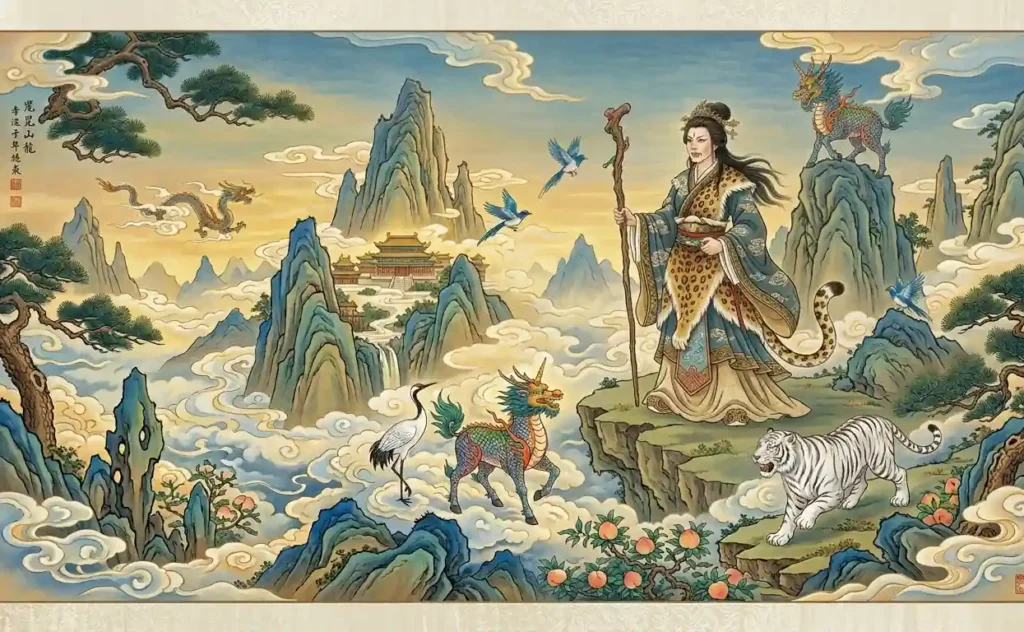
“The Queen Mother of the West rests on a small table and wears a sheng headdress. She has tiger’s teeth and a leopard’s tail, and she is good at whistling. She controls the disasters of Heaven and the five punishments.”
Tiger’s teeth. Leopard’s tail. She whistles, and the world’s plagues and punishments come. This is not the elegant immortal goddess of later Daoist tradition. This is a wild, liminal, genuinely dangerous deity whose domain is the western wilderness and whose powers are specifically destructive.
What the Sheng Headdress Meant
The sheng headdress deserves specific attention because it appears in virtually every ancient description and depiction of Xiwangmu, and it encodes her cosmological status.
The sheng is an ornament shaped like a specific weaving instrument, an H-shaped jade or metal object worn on the head. Its cosmological significance is debated among scholars, but two interpretations are most compelling:
- It marks her as a cosmic weaver, the deity who controls the threads of fate and the natural order
- It marks her as a celestial axis figure, the pivot around which the western sky turns
Either interpretation positions her as a figure of fundamental cosmic importance rather than a regional deity. This wild western goddess with tiger’s teeth is simultaneously someone who governs the structure of celestial reality.
The Shamanic Interpretation
Some scholars of early Chinese religion interpret the early Xiwangmu as a shamanic deity rather than a mythological figure in the later Daoist sense.
In this reading, the tiger’s teeth and leopard’s tail aren’t characteristics of her permanent divine body but shamanic costume elements, the markers of a spirit-world traveler who takes on animal form to move between the human and divine realms. The whistling associated with her matches documented practices in early Chinese shamanic tradition for calling spirits.
This shamanic interpretation explains the wildness and danger of the early Xiwangmu more coherently than later domesticating interpretations. She’s dangerous because the spirit world is dangerous. She controls plague and punishment because those powers belong to the divine realm that shamanic practice navigates.
The Transformation: From Wild Deity to Immortal Goddess
The Han Dynasty Shift
The transformation of Xiwangmu from terrifying wild deity to benevolent immortal goddess happened primarily during the Han Dynasty (206 BCE – 220 CE), and it happened with extraordinary speed and thoroughness.
Han Dynasty texts describe her in ways that would be unrecognisable to readers of the Shanhaijing:
- A beautiful woman of middle apparent age
- Wearing elegant Daoist robes
- Residing in a palace on Kunlun Mountain
- Governing the divine peach garden that produces immortality peaches
- Hosting divine gatherings attended by the most exalted immortals
- In some accounts, ruling the western heaven as the counterpart of the Jade Emperor
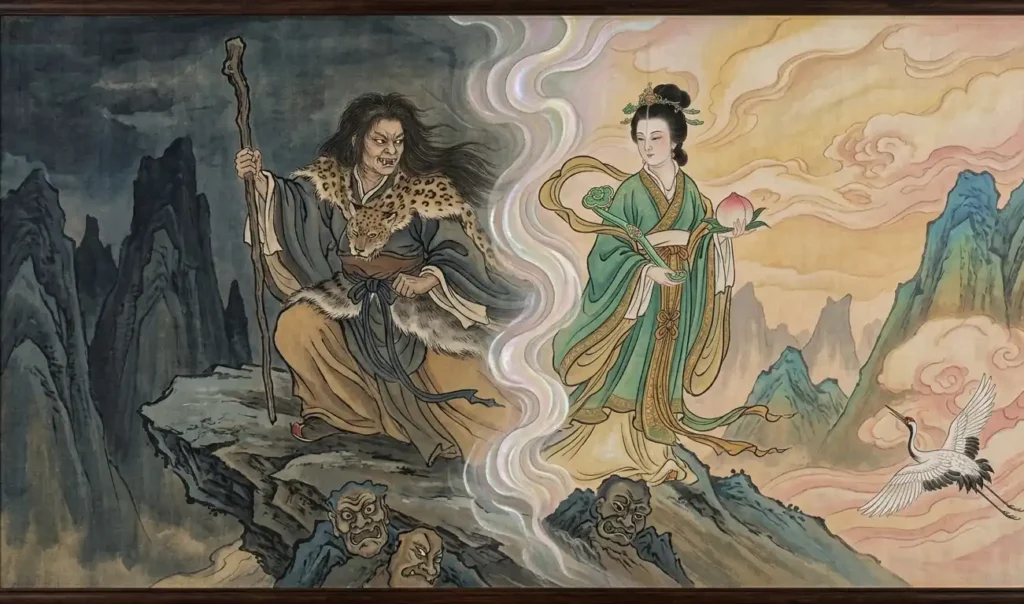
The tiger’s teeth are gone. The leopard’s tail is gone. The plague control is replaced by immortality gifting. The wild western wilderness is replaced by a magnificent mountain palace.
Why The Transformation Happened
I find this transformation one of Chinese mythology’s most interesting historical questions. What drove such a thorough reinvention of an ancient divine figure?
Several factors converged:
Imperial cosmology: The Han emperors were intensely interested in immortality and sponsored the Daoist tradition that was developing sophisticated immortality theology. A supreme female deity who controlled the means of immortality fit perfectly into that theological framework, but only if she was reframed as benevolent rather than dangerous.
The Four Cardinal Directions: As the four-direction cosmological system developed, the western direction needed a supreme divine ruler. The Queen Mother of the West’s name and ancient Western associations made her the natural candidate, but her wild Shanhaijing form needed civilizing to serve as a cosmic royal figure.
Gender in divine hierarchy: The developing Daoist divine court needed a supreme female figure to balance the increasingly male-dominated pantheon. Xiwangmu’s transformation into an elegant immortal goddess gave the tradition its most powerful female deity.
The transformation is a case study in how cultures reshape old religious figures to serve new theological needs. The ancient shamanic deity and the elegant immortal goddess share a name and a western direction. Almost everything else was rebuilt.
The Divine Peach Garden: Immortality’s Source
What the Peach Garden is
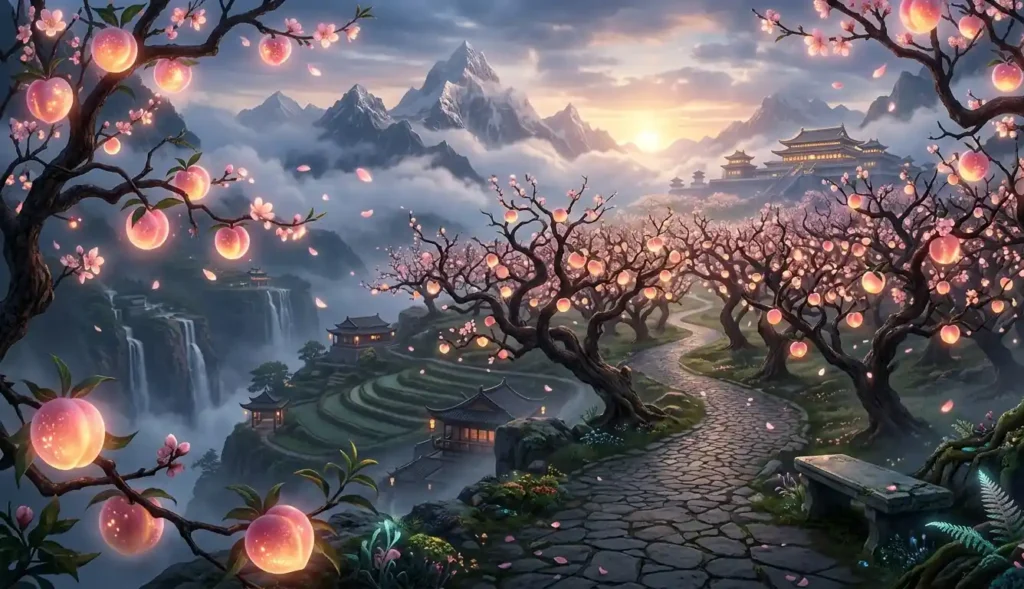
The Queen Mother of the West’s most famous domain in her Daoist form is the Pantao Yuan the Flat Peach Garden on Kunlun Mountain, where the divine peach trees grow.
These are no ordinary peach trees. Classical texts describe three types of divine peaches grown in specific sections of the garden:
First section: Peaches that ripen every 3,000 years. Whoever eats one becomes immortal and their body becomes light and capable of flight.
Second section: Peaches that ripen every 6,000 years. Whoever eats one can ascend through clouds and attain eternal youth.
Third section: Peaches that ripen every 9,000 years. Whoever eats one achieves the lifespan of heaven and earth, effectively becoming coeval with the cosmos itself.
The escalating time scales and escalating outcomes encode the tradition’s understanding of immortality as a spectrum rather than a single threshold.
The Pantao Feast
Every few thousand years, when the peaches ripen, the Queen Mother hosts the Pantao Banquet, a celebration attended by the most exalted divine figures in the Chinese pantheon.
This feast is one of the Chinese divine court’s most significant events, the moment when the supreme female immortal exercises her unique power of immortality gifting for the benefit of the assembled divine hierarchy.
Sun Wukong’s theft of the peaches in Journey to the West is framed as a cosmic scandal precisely because of what it represents: a trespasser consuming resources intended for the feast, disrupting the Queen Mother’s careful immortality governance. The peaches aren’t just food. They’re the substance that maintains the divine order.
Xiwangmu and Chang’e
The Queen Mother of the West’s peach garden connects her to one of Chinese mythology’s most affecting love stories.
In one version of the Chang’e mythology, the archer Yi, having obtained an immortality elixir from the Queen Mother of the West as a reward for shooting down nine of the ten suns, has the elixir stolen by Chang’e, who drinks it and ascends to the moon. Yi’s grief at her departure and Chang’e’s perpetual loneliness in the Moon Palace are the emotional heart of the myth.
The Queen Mother’s role in this story is as the original source of the immortality substance, the divine power that enabled both Yi’s temporary possession of immortality and Chang’e’s permanent, lonely ascent. She’s the wellspring from which the myth’s tragedy flows.
Xiwangmu’s Powers and Sacred Role
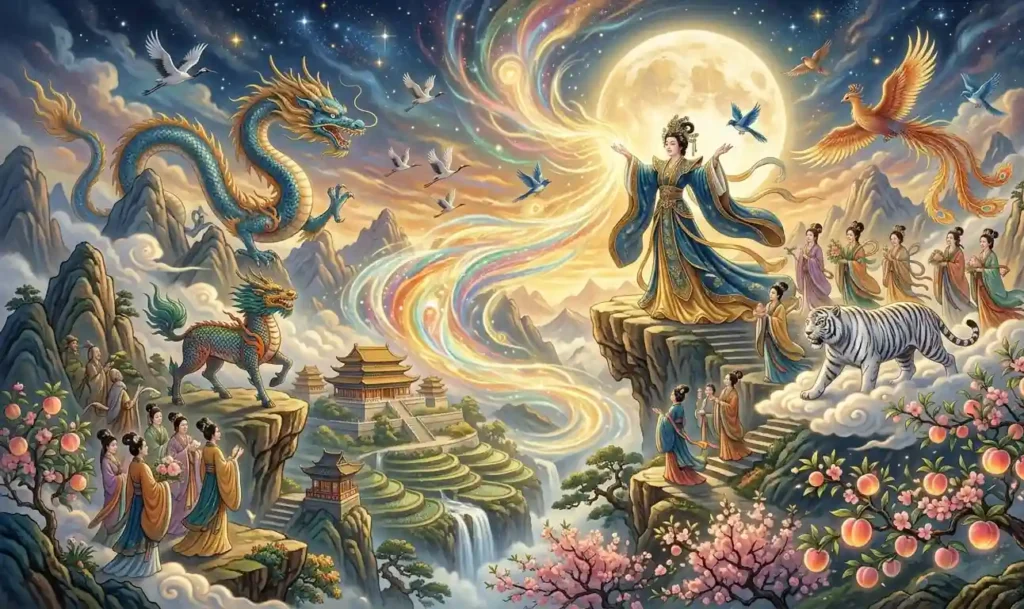
The Immortality Dispenser
In her developed Daoist form, Xiwangmu’s primary sacred role is as the controller and dispenser of immortality, the divine figure who governs access to the most fundamental aspiration of the Chinese religious imagination.
This role is unique in the Chinese divine hierarchy. The Jade Emperor governs the administration of cosmic order. The Dragon Kings govern water. But immortality, the possibility of transcending ordinary human limitation entirely, flows specifically through Xiwangmu.
This makes her, in practical terms, the most important deity for practitioners of Daoist cultivation. Whatever methods they’re using to pursue immortality, she’s the divine figure who oversees the outcome.
The Western Paradise
Kunlun Mountain, where Xiwangmu resides, functions in Chinese mythology as the axis mundi, the cosmic mountain at the center of the world, the point where heaven and earth connect.
Her palace on Kunlun is described with extraordinary richness:
- Nine-tiered jade palaces on the mountain’s summit
- Jade pools where divine beings bathe
- Gardens of miraculous herbs alongside the peach trees
- A court of female immortals serving as attendants
- The capacity to receive worthy seekers who’ve undertaken the journey to find her
The great mythological seekers who journey to Kunlun, including the mythological King Mu of Zhou, who reportedly met Xiwangmu in person, undertake the journey specifically to receive her teaching and potentially her immortality gifts.
The Supreme Female Deity
One aspect of Xiwangmu that I find significant is that she’s the most powerful female divine figure in the Chinese tradition.
The Jade Emperor rules through administrative authority earned through cultivation. Guanyin embodies compassion as a Bodhisattva. But Xiwangmu governs something that neither of them controls: the substance and governance of immortality itself.
In a tradition that often foregrounds male divine figures, her power is specifically non-derivative. She doesn’t derive her authority from a male consort or from a male-dominated hierarchy. Her peach garden, her immortality gifts, her western domain, and her ancient origins predate the Jade Emperor’s court and exist partly independent of it.
Xiwangmu in Chinese Religious Practice
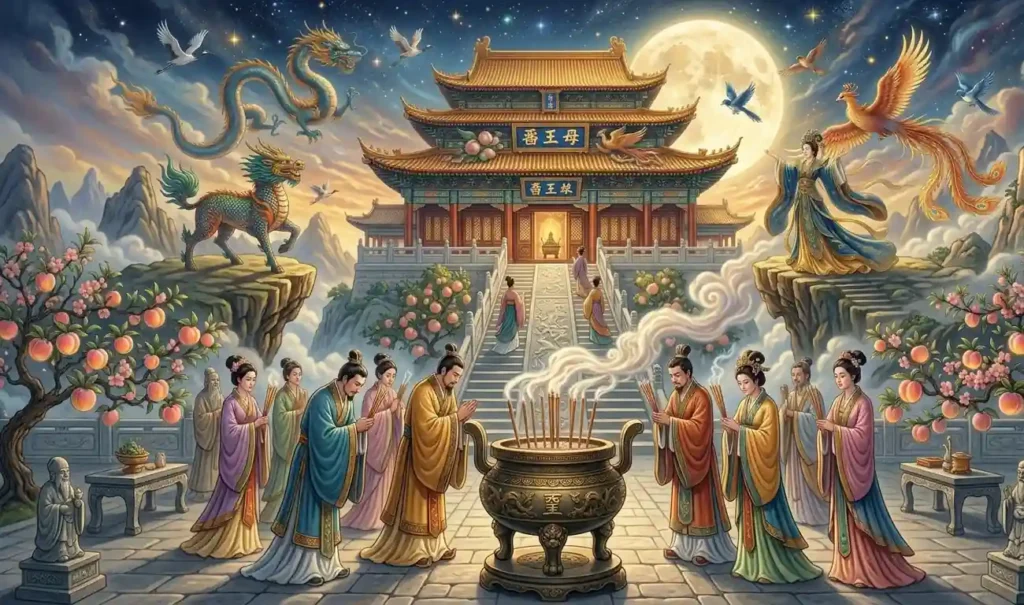
Historical Worship
The Queen Mother of the West was the object of significant popular religious movements in Chinese history. The most documented was a millenarian religious movement during the Han Dynasty (around 3 BCE) in which ordinary people across a wide region passed jade tokens and messages to each other, performing rituals in Xiwangmu’s name and believing that her direct intervention in the human world was imminent.
The movement spread rapidly, crossing significant geographic distances, before eventually dissipating. It demonstrates that Xiwangmu wasn’t merely a deity for educated Daoist practitioners. She had genuine mass religious appeal for ordinary people who sought divine protection and blessing.
Contemporary Worship
Xiwangmu remains an actively worshipped deity in Chinese Daoist temples and folk religion today. Her temple presence is significant throughout Taiwan, Hong Kong, and among Chinese diaspora communities globally.
The most important contemporary religious site associated with her is Yaochi (Jade Pool), a name given to various sacred pools and lakes believed to be earthly reflections of her divine residence. Pilgrimages to such sites remain part of living Daoist practice.
Her worship is particularly significant among female practitioners and those pursuing Daoist cultivation. She’s both the tradition’s supreme female divine figure and the guardian of the immortality aspiration that motivates the cultivation path.
Frequently Asked Questions
Is the Queen Mother of the West married to the Jade Emperor?
In later traditions, they are often paired as rulers of the western and eastern celestial realms, with her presiding over the west and him over the heavenly court. Some accounts describe her as the Jade Emperor’s consort. This pairing is a later development, as her origins significantly predate the Jade Emperor tradition.
Why does she appear with birds in Chinese art?
Xiwangmu is traditionally served by three blue birds (qīngniǎo) who act as her messengers and attendants. These birds reflect her shamanic origins, where birds served as guides between worlds, and appear in artistic depictions from the Han Dynasty onward. They are among her most recognisable iconographic features.
What happened to her tiger and leopard features?
They largely disappeared during the Han Dynasty transformation, replaced by the image of an elegant immortal goddess. However, her connection to tigers did not vanish entirely. Some later depictions retain tiger imagery, reflecting her ancient wild character. These features preserve traces of an older shamanic tradition that was gradually reshaped within developing Daoist theology
How does Xiwangmu relate to the Eight Immortals?
The Eight Immortals attend her Pantao Banquet in several classical stories, receiving her peaches of immortality as gifts. As the divine host and source of immortality, she occupies a higher position in the celestial hierarchy, providing the sustenance and renewal that underpin the immortals’ status.
Was the Queen Mother of the West always portrayed as a benevolent goddess?
No. Early traditions describe her as a powerful and sometimes fearsome deity with wild, animalistic features. Over time, she evolved into the refined goddess of immortality seen in later Daoist and popular traditions.
Final Thoughts
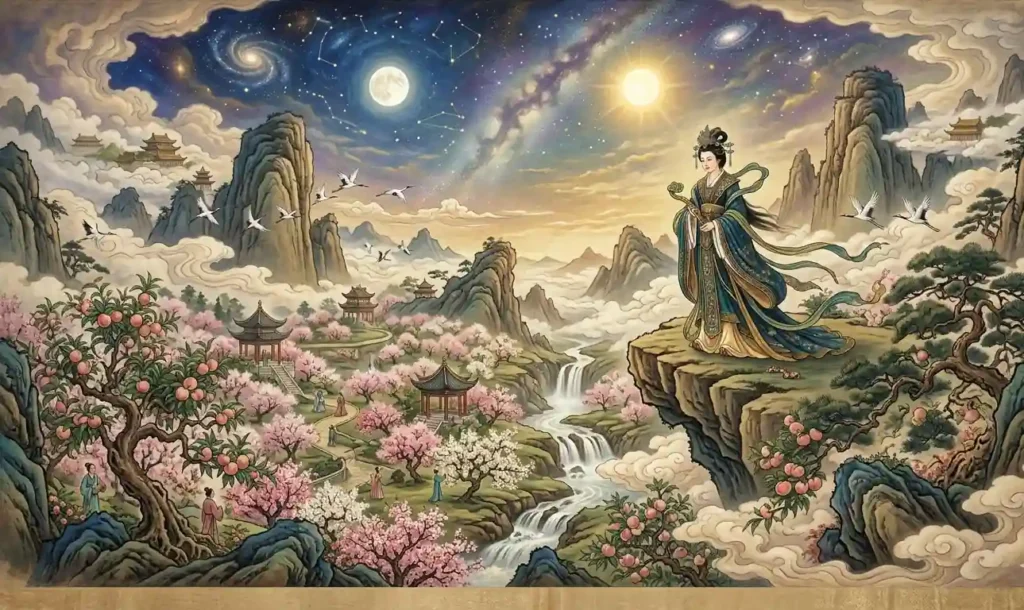
The Queen Mother of the West’s journey from tiger-toothed shamanic deity of plague and punishment to the serene immortal goddess of the peach garden is one of Chinese mythology’s most dramatic divine transformations.
What is interesting is that both versions are powerful on their own terms. The Shanhaijing Xiwangmu is terrifying in the way that genuinely liminal divine figures are terrifying. She governs forces that respect no human boundaries. The Daoist Xiwangmu is magnificent in the way that supreme divine patronage is magnificent, the source of the one thing every practitioner is working toward.
The transformation between them reveals something important about how religious traditions reshape their inherited figures to serve current needs. The Queen Mother of the West was ancient enough and powerful enough that she couldn’t be ignored. She was reimagined rather than abandoned. And the reimagined version served the Daoist tradition’s needs so well that most people today know only that version if they know her at all.
She deserves to be known fully. Both versions. And the fascinating distance between them.
Related Articles
- Eight Immortals: symbols, sacred roles and Daoist meaning
- Jade Emperor: Origin, Powers & Sacred Meaning in Mythology
- What Is the Heavenly Court? Chinese Myth’s Divine Authority
- Jade Emperor Family: The Divine Family of Chinese Mythology
- Are the Jade Emperor & Queen Mother of the West Married?
- Xiwangmu vs Jade Emperor: Who is More Powerful in Chinese Myth?
References
- Birrell, Anne. Chinese Mythology: An Introduction.
- Major, John. Heaven and Earth in Early Han Thought.
- Kohn, Livia. Daoism and Chinese Culture.
- Allan, Sarah. The Shape of the Turtle.Hanshu (Book of Han).
- Shiji (Records of the Grand Historian).
- Tao Te Ching – Translated by J. Legge
- Daozang – Daoist Canon
- Zhuangzi – Chinese Text Project
- Investiture Of The Gods
- Journey To The West
- The Book of Rites
- The Taoist Body – Kristofer Schipper
- Transcendence and Divine Passion: The Queen Mother of the West in Medieval China – Suzanne Elizabeth Cahill