
 By
By Quick Takeaways:
- Most popular understanding of yin-yang captures the surface features while missing the philosophically interesting content
- One of the most damaging misconceptions about yin yang is that it describes opposites. It actually describes complementary aspects of a unified reality, which is a completely different claim
- Yin and yang carry no moral valence. neither is good, neither is evil, neither is superior
- The balance goal is dynamic, not static. Perfectly equal halves is a misreading of what the tradition is actually recommending
- The taijitu (the symbol itself) encodes five specific philosophical principles that most people who display it have never examined
Let me start with something I notice everywhere: the yin yang symbol on tattoos, phone cases, corporate logos, wellness app icons, and café walls. The people displaying it almost certainly understand it as “balance between opposites” or “dark and light coexisting.”
That’s not wrong exactly. But it’s approximately as complete as describing the Mona Lisa as “a painting of a woman who’s smiling.” Technically accurate. Missing almost everything interesting about the subject.
After twenty years of studying Daoist philosophy, here are the seven misconceptions I encounter most consistently and the actual philosophical content they’re obscuring.
Misconception 1: Yin Yang Means Opposites

What People Think
The most pervasive misconception is that yin and yang are opposites. Light and dark. Hot and cold. Up and down. Two forces on opposing sides of a divide.
This framing shows up everywhere in pop psychology, in wellness content, in most introductory descriptions. It feels right because yin and yang qualities do contrast with each other.
What’s Actually Correct
Yin and yang aren’t opposites. They’re complementary aspects of a unified reality.
This sounds like a subtle distinction. It’s not. It’s the difference between two things that conflict and two faces of the same thing.
The classical Chinese conception is clearest in the etymology: yang originally meant the sunny side of a hill, yin meant the shady side. One hill. Two aspects. Neither exists without the other, neither makes sense without the other, and critically, neither is fighting the other.
Opposites imply conflict. Complementary aspects imply mutual constitution. When you say fire and water are opposites, you’re saying they oppose each other. When you say they’re complementary aspects of elemental reality, you’re saying they’re both expressions of the same underlying natural world, each incomplete without the other.
Yin Yang in Daoism: Meaning, Symbolism & Sacred Origins
Why this matters: Framing yin yang as opposites makes the tradition look like it’s describing conflict. It’s actually describing the unity underlying apparent differences. That’s a completely different and considerably more interesting philosophical claim.
Misconception 2: Yang is Good & Yin is Bad (or vice versa)
What People Think
Because yang is light, active, and warm, and yin is dark, passive, and cold, there’s a persistent tendency to assign positive moral valence to yang and negative to yin. Yang is the bright good side. Yin is the shadowy concerning side.
Some wellness traditions have overcorrected by romanticizing yin — all that beautiful darkness and receptivity while implicitly framing yang as aggressive and problematic. Same structure, reversed polarity.
What’s Actually Correct
Neither yin nor yang is morally superior. Neither is good or bad. Both are completely morally neutral natural qualities.
The classical tradition is explicit about this. Darkness is not sinful. Cold is not evil. Passivity is not weakness. Activity is not virtue. These are natural qualities of processes and phenomena, not moral classifications.
What the tradition is working with is something like: rest and activity are both natural and both necessary. Summer and winter are both real. Neither season is better than the other in any cosmic sense each has its appropriate time and each serves functions the other cannot.
Is Yin Yang Demonic? The Truth You Don’t Know
Why this matters: Moralizing yin and yang imports value judgments that completely distort the philosophy’s actual content. The framework was designed to describe natural reality without moral overlay. Adding moral overlay transforms a cosmological tool into an ethical hierarchy which it was never meant to be.
Misconception 3: Balance Means Equal Halves

What People Think
The image of the taijitu, the circular symbol with equal dark and light halves, leads people to think that the “balance” yin yang recommends is having equal amounts of both. Fifty percent yin, fifty percent yang. Equilibrium. Stasis.
Wellness culture has amplified this with the goal of “finding your yin yang balance,” meaning something like emotional stability or personal equilibrium maintained as a constant state.
What’s Actually Correct
The balance yin yang describes is dynamic, not static. And the appropriate proportions change constantly depending on context, time, and need.
The seasons demonstrate this clearly. Summer isn’t balanced at fifty percent yang. It’s appropriately maximum yang. Winter isn’t balanced at fifty percent yin. It’s appropriately maximum yin. The balance is in the whole cycle, not in any single moment.
A person actively engaged in physical work is appropriately more yang in that moment. A person in deep sleep is appropriately more yin. “Balance” doesn’t mean maintaining a constant ratio. It means having the right ratio for the current context and the capacity to shift that ratio as contexts change.
The Tao Te Ching’s Chapter 16 makes this precise: “Reach the ultimate emptiness. Hold fast to stillness. Ten thousand things arise together, I watch their return.” The sage doesn’t maintain a static equilibrium. They rest in the dynamic process itself.
Why this matters: Pursuing static fifty-fifty balance as the goal actually works against the tradition’s wisdom. The wisdom is in the capacity for appropriate dynamic response, not in maintaining a fixed center point.
Misconception 4: Yin is Feminine & Yang is Masculine
What People think
Yin’s associations with the moon, receptivity, and softness, and yang’s associations with the sun, activity, and force, have been widely mapped onto a simple equation: yin = feminine, yang = masculine. This shows up constantly in pop psychology, New Age spirituality, and even some serious scholarship.
What’s Actually Correct
The classical tradition does use masculine-feminine as one of yin and yang’s many correspondences. But it’s one correspondence among dozens, not a defining equivalence.
The full list of yin correspondences includes: dark, cool, moist, interior, descending, soft, passive, night, winter, moon, earth, and receptive. Feminine is one of these, not the defining one.
More importantly, the tradition explicitly describes every individual person as containing both yin and yang aspects simultaneously. No person is simply yin or simply yang. The Daoist internal cultivation tradition describes two energy channels running through every person’s body, the solar Pingala (yang) and the lunar Ida (yin), in Hindu terms, or the Du Mai and Ren Mai in Daoist terms, both present in everyone regardless of gender.
Equating yin with women and yang with men creates a static gender essentialism that the philosophy doesn’t actually support and that distorts both the philosophy and gender understanding simultaneously.
Why this matters: The yin-yang framework is most useful as a way of understanding dynamic qualities of processes and situations not as a fixed classification of people into two types. Using it as gender essentialism reduces a dynamic relational tool to a static identity label.
Misconception 5: The Taijitu is Just a Symbol
What People Think
The taijitu, the circular yin yang symbol, is treated primarily as a visual identifier. It means “yin yang,” the way a cross means “Christianity.” A symbol that stands for the concept without necessarily encoding specific content.
What’s Actually Correct
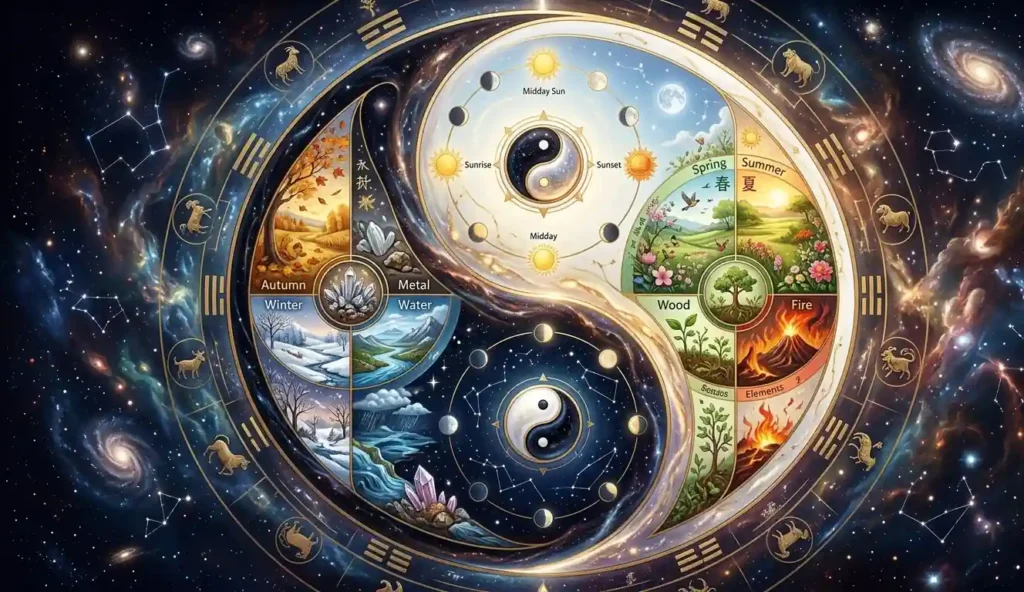
The taijitu encodes five distinct philosophical principles in its specific visual form. It’s a diagram, not just a logo.
The five principles:
- Mutual arising: Neither yin nor yang precedes the other. They arise together, each giving rise to the other. The two halves emerge simultaneously from the circle’s completion.
- Interpenetration: The S-curve dividing line shows that yin and yang interpenetrate each other. They don’t divide at a clean, straight boundary. There’s always a zone of transition between them.
- The seed of the opposite: The small circle of each colour within the other half encodes the principle that each pole contains the seed of its complement at maximum expression. When yang reaches its peak, yin begins to grow within it.
- Constant motion: The swirling form depicts dynamic process, not static state. The symbol shows a cycle in motion, not two fixed territories.
- Unity: The outer circle enclosing both halves shows that yin and yang together constitute a single whole. The duality exists within unity, not in opposition to it.
Every element of the taijitu’s specific design is philosophically intentional. It’s one of the most information-dense symbols in any philosophical tradition.
Why this matters: When you understand what the symbol actually encodes, you stop seeing a decorative circle with contrasting halves and start seeing a philosophical diagram with specific, sophisticated content. It earns the attention it receives.
Misconception 6: Yin Yang is a Religious Belief
What People Think
Because the taijitu appears on Daoist temples, altars, and religious objects, many people assume yin yang is specifically a religious symbol, a mark of Daoist religious identity similar to how a cross marks Christian identity.
Some people therefore either treat it with religious reverence (it’s sacred!) or religious suspicion (it’s pagan!), depending on their own commitments.
What’s Actually Correct
Yin-yang is primarily a philosophical framework for understanding how natural processes work. It was developed through observation of natural phenomena, the sun’s movement, seasonal cycles, and the interaction of heat and cold, not through religious revelation.
It’s used within Daoist religious contexts, yes. But it’s also used in traditional Chinese medicine, in Chinese astronomy, in feng shui, in the I Ching, in martial arts, and in Chinese philosophical reasoning generally. It crosses institutional religious boundaries because it’s fundamentally a cosmological tool rather than a devotional symbol.
The distinction matters because it determines how the framework should be evaluated. A religious symbol is evaluated on its spiritual authority. You either accept the tradition that underwrites it, or you don’t. A philosophical framework is evaluated on its descriptive and analytical usefulness. Does it help you understand the phenomena it describes?
Yin yang, evaluated as philosophy, has an impressive two-thousand-year track record of being useful across multiple domains of Chinese intellectual life.
Why this matters: Treating yin-yang as purely religious prevents engagement with it as the philosophical tool it primarily is and prevents non-religious readers from accessing genuine philosophical content that has nothing to do with devotional practice.
Misconception 7: Yin Yang Balance is a Personal Wellness Goal

What People Think
The wellness industry’s adoption of yin yang has repackaged it primarily as a personal emotional management framework. Finding your yin yang balance means managing your stress levels, balancing work and rest, not being too much of a type-A person, cultivating calm to offset busyness.
This isn’t entirely wrong, the framework does apply to individual life management, and it does suggest that both activity and rest are necessary.
What’s Actually Correct
The yin-yang framework was developed as a cosmological description of how the universe works, not primarily as a personal wellness prescription.
It describes the movement of seasons. The interaction of cosmic forces. The structure of the I Ching’s change dynamics. The way elemental processes relate to each other across natural phenomena. It was applied to medicine (traditional Chinese medicine’s diagnostic framework), to governance (how rulers should align their actions with seasonal qi), to astronomy, and eventually to personal cultivation.
Personal application is real and legitimate. But framing yin yang primarily as “work-life balance advice from ancient China” strips away the cosmological architecture that makes the personal applications meaningful.
The reason rest and activity need to balance in a human life is the same reason winter and summer need to cycle in nature, because the same underlying dynamic of yin and yang cycling governs both. The personal application only makes sense against the cosmological background.
Why this matters: Disconnected from its cosmological framework, yin yang becomes generic wellness advice that happens to use Chinese vocabulary. Connected to the cosmological framework, it becomes a sophisticated claim about the nature of reality that the personal applications are grounded in. The second version is considerably more interesting.
The Common Thread
Looking across all seven misconceptions, there’s a pattern.
Every misconception takes a genuinely sophisticated, dynamic, relational philosophical framework and flattens it into something simpler: two opposing forces, a binary gender system, a static balance goal, a personal wellness tool, a decorative logo.
The actual yin yang philosophy is working with something considerably more interesting: the unity underlying apparent duality, the dynamic cycling of complementary aspects, the mutual constitution of seemingly opposite qualities, the seed of each within the other at maximum expression.
That’s a serious philosophical contribution to how humans think about change, relationship, and the structure of natural reality. It deserves to be understood as what it actually is.
Frequently Asked Questions
If yin yang isn’t about opposites, how should I think about it?
Think of it as describing two complementary aspects of a single unified reality like the two sides of the same coin, rather than two different coins. Every phenomenon has both yin and yang aspects. The warm side of the stone and the cool underside are yin and yang, not two different things, but two aspects of one thing, each making the other meaningful.
Is it disrespectful to use the yin yang symbol decoratively?
This depends on your values and context. Philosophically, using a symbol without understanding what it encodes is a missed opportunity, not a disrespect. It is a philosophical diagram. Understanding what it encodes seems more respectful than using it reverentially or dismissively without comprehension.
Does yin yang apply to individual people?
Yes, but dynamically rather than as a fixed classification. Everyone has both yin and yang aspects: times of rest and activity, expression and receptivity, expansion and contraction. The framework is meant to understand these shifting dynamics within oneself, not to label oneself as a yin or yang type.
Why does each side of the symbol contain a dot of the opposite color?
The dots symbolize that yin contains the seed of yang and yang contains the seed of yin. Nothing is ever purely one or the other.
Is yin always passive and yang always active?
Not in a simplistic sense. Yin and yang describe relational qualities that depend on context. What is yin in one situation may be yang in another.
Can yin and yang ever exist independently?
No. Yin and yang are mutually arising concepts. Day makes sense in relation to night, and rest in relation to activity.
Final Thoughts
Twenty years of following mythology and philosophy across traditions has made me deeply interested in the gap between how ideas are received in popular culture and what they actually say.
The yin yang philosophy available in its actual classical sources is considerably richer than its popular reception suggests. It’s making specific, sophisticated claims about the nature of change, the structure of natural reality, and the relationship between apparent opposites that have been genuinely useful across two thousand years of Chinese intellectual life.
The popular version is balance your dark and light sides, don’t be too extreme, isn’t false. It’s just the thinnest possible slice of something much more substantial.
The full version is worth knowing. It always is.
Related Articles
- Is Yin Yang Demonic? The Truth You Don’t Know
- Yin Yang in Daoism: Meaning, Symbolism & Sacred Origins
- Ba Gua: Eight Trigrams, Meaning & Sacred Origins
- Yin Yang and the Five Elements: Why Neither Works Alone
- Yin Yang, Five Elements & Four Symbols: China’s Complete Cosmos
Yin Yang Sun & Moon: Duality, Myth & Spiritual Meaning
Written by Batin Khan | Mythology and philosophy reader across world cultures (20 years), Cultivation novels reader for the past 10 years | Specialist in Xianxia, Eastern and Western mythological traditions, and fantasy worldbuilding