
 By
By Quick Takeaways:
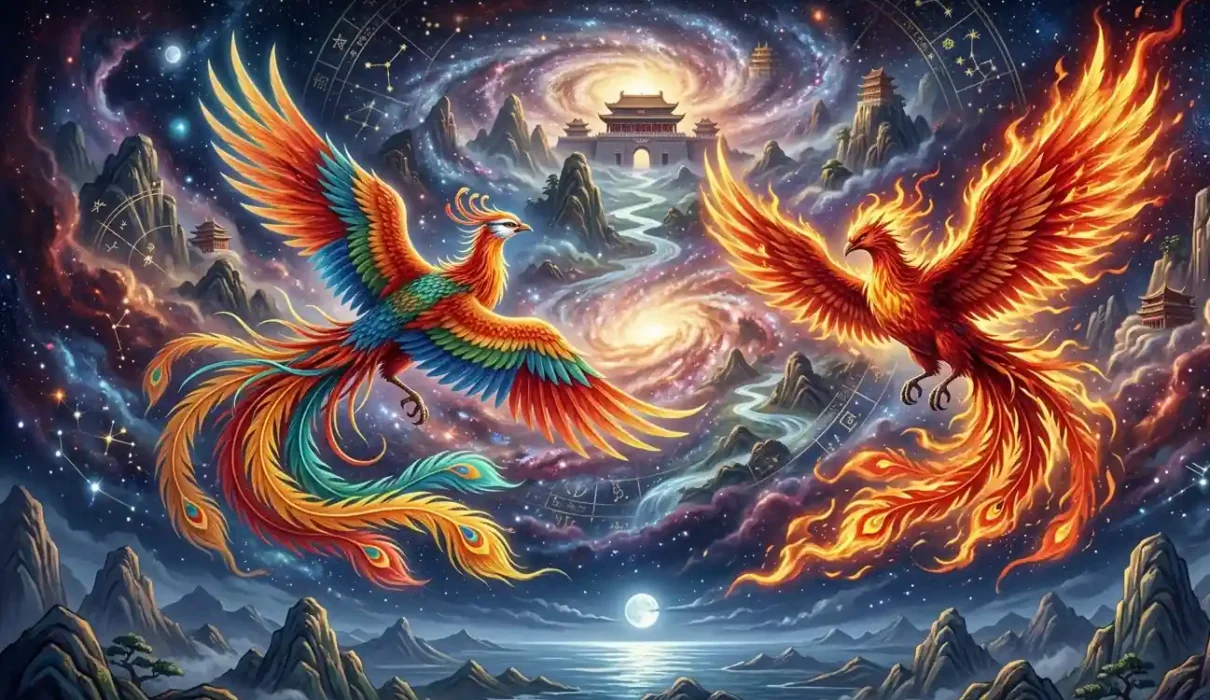
- The Fenghuang & Vermilion Bird (Zhuque/Suzaku) are frequently conflated but are genuinely different figures with different origins, different cosmological roles, and different symbolic meanings
- The Fenghuang is a virtue and harmony bird. Its appearance signals that the world is in right order and a virtuous ruler reigns
- The Vermilion Bird is a cosmological guardian one of the Four Holy Beasts governing the South, Fire element, and summer season
- They share fire associations and magnificent bird form, which is why the confusion happens, but those shared surface features conceal fundamental differences underneath
- Once you understand the distinction, both figures become considerably more interesting
I’ll be honest: this is one of the conflations that genuinely frustrates me after years of studying Chinese mythology.
Not because it’s a rare mistake, it’s extremely common, even in otherwise careful sources. But because the conflation actively prevents people from understanding what makes each figure distinctive and interesting. The Fenghuang gets reduced to a generic firebird. The Vermilion Bird gets attributed philosophical meanings it doesn’t carry. Both lose something.
So let’s fix it properly.
Why People Confuse Them
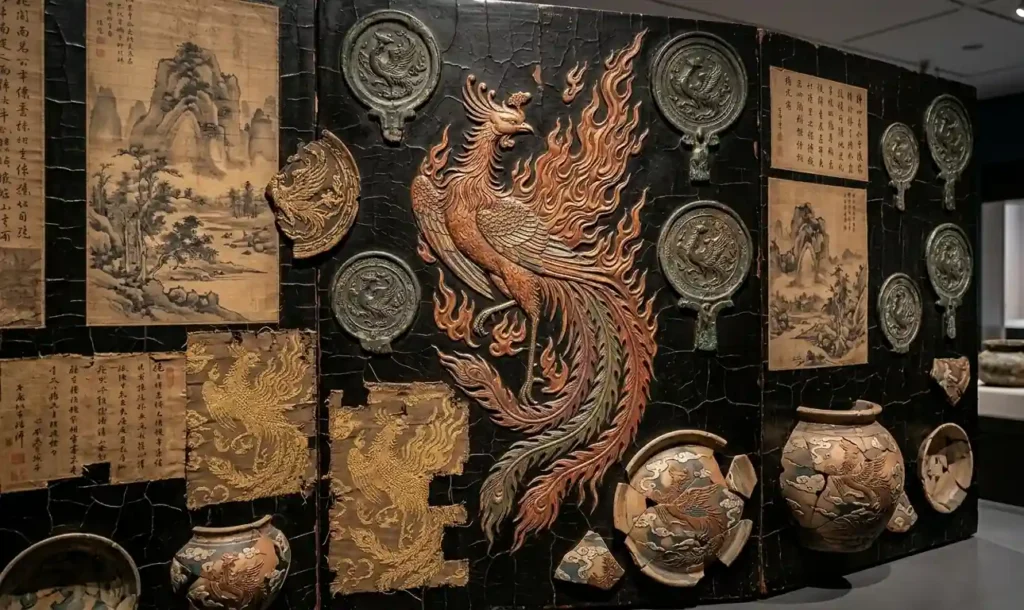
Before separating them, let’s be honest about why the confusion happens. It’s not entirely unreasonable.
The surface similarities are real:
- Both are birds
- Both are associated with fire
- Both appear in Chinese mythology and art
- Both are magnificent, sacred, divine figures
- Both have red and gold plumage in most artistic depictions
- Both are auspicious symbols
If you encounter either figure in Chinese temple decoration or decorative arts without prior knowledge, they look like variations on the same theme. A glowing red sacred bird, which specific one depends on context that requires specialist knowledge to read.
The confusion also gets reinforced by the inconsistent way both figures are labelled in English. The Vermilion Bird (Zhuque) is sometimes called the Red Phoenix. The Fenghuang is called the Chinese Phoenix. Both get filed under “Chinese fire bird” in the casual reader’s mental taxonomy.
Here’s where it goes wrong: beneath those shared surface features are two figures with fundamentally different jobs, different origins, and different symbolic logic.
What the Fenghuang Actually is
The Virtue Bird
I covered this in depth in the Fenghuang Post, but a quick, precise summary is essential here.
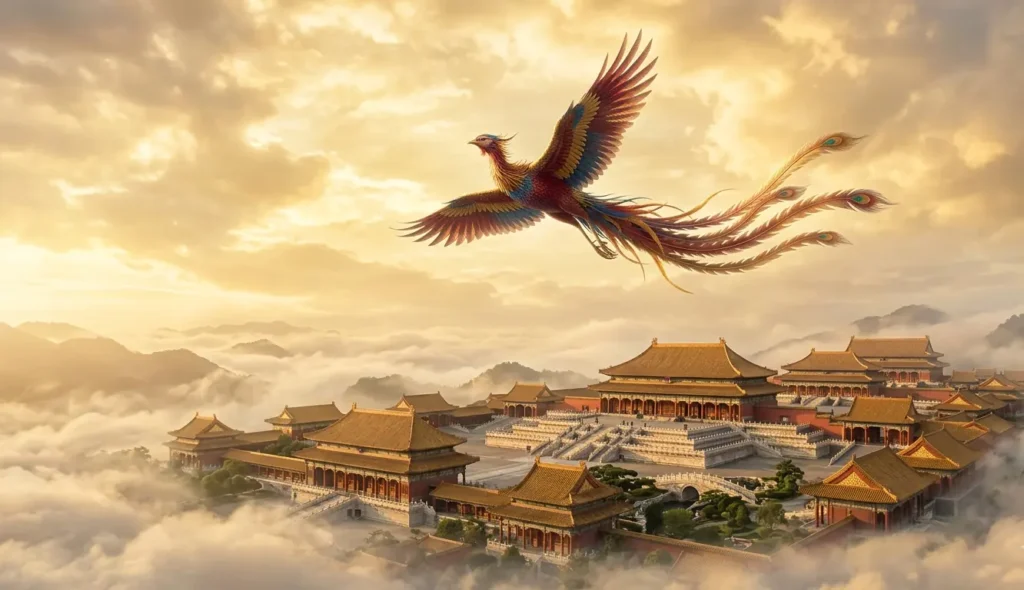
The Fenghuang is a composite divine bird that embodies cosmic harmony and Confucian virtue. Its appearance isn’t dramatic. It’s diagnostic. It appears when the world is in right order, and it disappears when things go wrong.
Its appearance signals:
- A ruler of exceptional virtue is reigning
- Heaven approves of the current state of governance
- The cosmic alignment of yin and yang, heaven and earth, human order and natural principle is functioning correctly
The Fenghuang has no fixed life cycle. It doesn’t appear on a schedule. It appears when conditions are right, which is relatively rare.
The Five Virtues
The most important physical fact about the Fenghuang is that the Shanhaijing (Classic of Mountains and Seas) explicitly describes its body as encoding the five Confucian virtues:
- Head: Virtue
- Wings: Righteousness
- Back: Ritual propriety
- Breast: Benevolence
- Abdomen: Trustworthiness
This is not a description of a fire bird or a cosmological guardian. This is a description of a walking embodiment of the Confucian ethical system. The Fenghuang’s body is a moral diagram.
The Empress Connection
The Fenghuang is paired with the Loong (Chinese Dragon) in Chinese imperial symbolism the dragon representing the emperor, the Fenghuang representing the empress. This pairing encodes:
- Dragon = yang, masculine, imperial authority
- Fenghuang = yin, feminine, imperial virtue
Together they represent the complete cosmic order. The Fenghuang’s role as the empress’s symbol gives it a specifically social and political meaning that the Vermilion Bird completely lacks.
What the Vermilion Bird Actually is
The Cosmological Guardian
The Vermilion Bird – Zhuque in Chinese, Suzaku in Japanese is something completely different.
It’s one of the Four Holy Beasts (Si Xiang) the four cosmological guardian animals that govern the four cardinal directions in Chinese astronomical tradition:
- Azure Dragon (Qinglong) – East
- Vermilion Bird (Zhuque) – South
- White Tiger (Baihu) – West
- Black Tortoise (Xuanwu) – North
The Vermilion Bird’s role is cosmological governance, not virtue embodiment. Its specific domain:
- Direction: South – the direction of maximum solar intensity
- Season: Summer – the peak of yang energy
- Element: Fire – transformation, outward expression, blazing peak
- Yin-yang phase: Greater Yang – maximum yang, the fullest outward expression
The Vermilion Bird doesn’t appear auspiciously when virtuous rulers reign. It exists permanently as a cosmological principle, the animating intelligence of the southern sky’s seven lunar mansions.
The Astronomical Origin
This is the deepest distinction between the two figures, and it’s the one most people don’t know about.
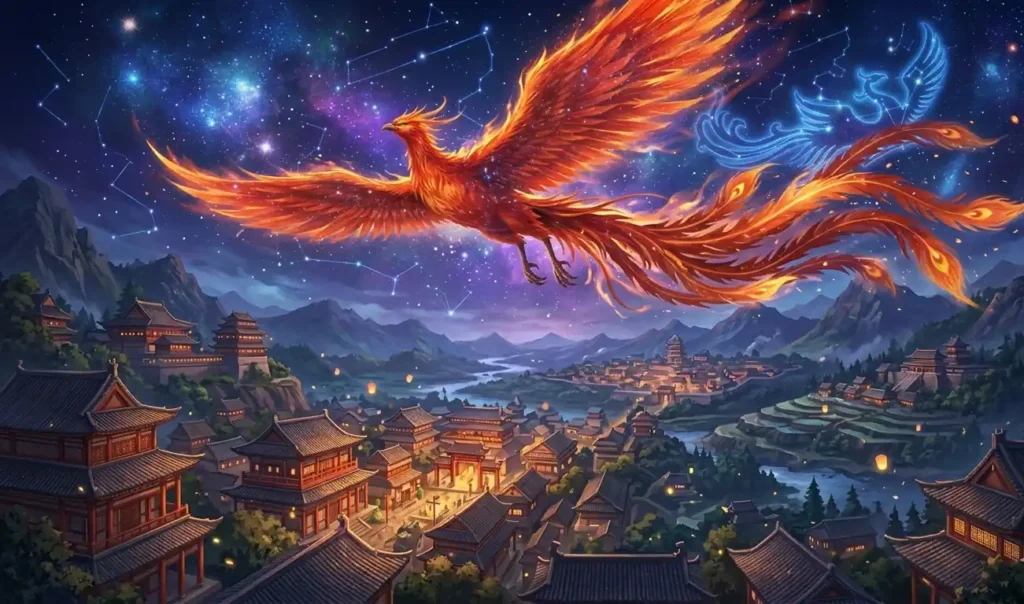
The Four Holy Beasts originate in Chinese astronomical observation. Ancient Chinese astronomers divided the night sky into four quadrants, each associated with a direction, season, element, and guardian figure. The Vermilion Bird’s form can be traced in the star positions of the seven southern lunar mansions. It’s literally a constellation figure made into a divine being.
The Fenghuang has no astronomical origin. It emerged from Chinese cultural and philosophical traditions from the composite divine bird mythology of the Shang and Zhou periods, from the Confucian ethical framework that gave it its virtue encoding, and from the imperial symbolism that made it the empress’s cosmic counterpart.
Different origins. Different purposes. Different mythological languages.
The Five Differences Between Fenghuang & Vermilion Bird
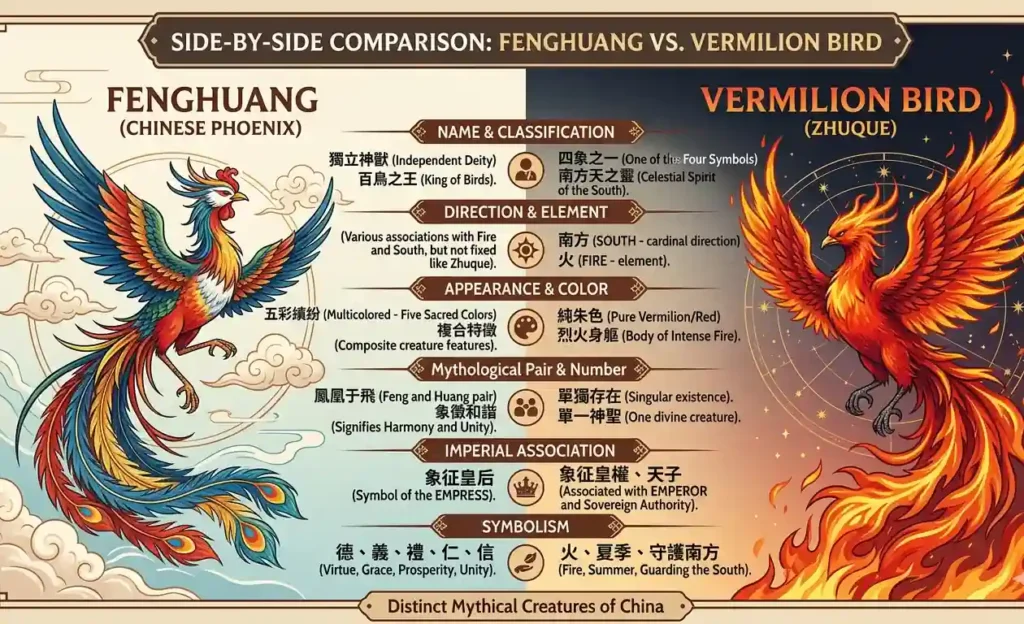
1. Cosmological Function
Fenghuang: Appears auspiciously when the world is in right order. An omen. A moral diagnostic.
Vermilion Bird: Exists as a permanent cosmological guardian of the South. Not an omen, a structural element of the cosmos.
This is the most fundamental difference. The Fenghuang is event-based. It appears when conditions are right. The Vermilion Bird is continuous. It’s always there, governing the southern sky whether anyone’s watching or not.
2. Relationship With Fire
Fenghuang: Has fire associations as one of its five elemental attributes. Its five-color plumage includes red (fire element) alongside black, blue-green, white, and yellow, the full five-element spectrum. Fire is one aspect of a complete whole.
Vermilion Bird: Governs the Fire element specifically and exclusively. Fire is its domain, its nature, its cosmological assignment. The fire association is primary and definitional rather than one attribute among five.
This distinction matters more than it might seem. The Fenghuang’s five-color plumage is a symbol of its cosmic completeness. It encompasses all elements, not one. The Vermilion Bird’s vermilion coloring is elemental governance, not completeness symbolism.
3. Relationship With the Four Holy Beasts
Fenghuang: Not one of the Four Holy Beasts. It exists outside and independent of the Si Xiang system. You won’t find the Fenghuang on the four walls of a classical Chinese tomb in the positions where the four directional guardians appear.
Vermilion Bird: Is one of the Four Holy Beasts by definition. It exists specifically within the Si Xiang system, defined by its relationship to its three companion guardians. Remove it from that system and it loses its primary cosmological context.
4. Symbolic Content
Fenghuang:
- Five Confucian virtues
- Cosmic harmony and right order
- Imperial feminine virtue (the empress)
- The yin-yang union (paired with the dragon)
- Auspiciousness of governance
Vermilion Bird:
- Southern directional authority
- Fire element governance
- Summer season
- Maximum yang energy
- Cosmological structure
These are completely different symbolic vocabularies. The Fenghuang’s vocabulary is ethical and political. The Vermilion Bird’s vocabulary is cosmological and elemental.
5. Physical Description Focus
Fenghuang: A composite bird incorporating features from multiple species peacock, pheasant, crane, swallow. The composite form encodes its role as a synthesis figure embodying multiple virtues and qualities.
Vermilion Bird: Typically depicted as a blazing red bird, sometimes more stylized, sometimes more naturalistic, but consistently fire-colored and fire-natured. The form serves the cosmological function of southern fire governance.
The Comparison Table
| Dimension | Fenghuang | Vermilion Bird (Zhuque) |
|---|---|---|
| Origin | Chinese composite bird mythology | Chinese astronomical observation |
| Primary role | Virtue and harmony omen | Cosmological guardian of the South |
| Fire relationship | One of five elemental colours | Primary elemental domain |
| Part of Four Holy Beasts? | No | Yes – essential member |
| Appearance pattern | Appears when world is in right order | Permanent cosmological presence |
| Symbolic content | Five Confucian virtues, imperial virtue | Direction, season, element |
| Imperial association | Paired with dragon as empress symbol | Directional architecture and feng shui |
| Rebirth narrative | None | None |
| Yin-yang role | Yin (paired with yang dragon) | Greater Yang (max yang expression) |
Where The Confusion Gets Reinforced
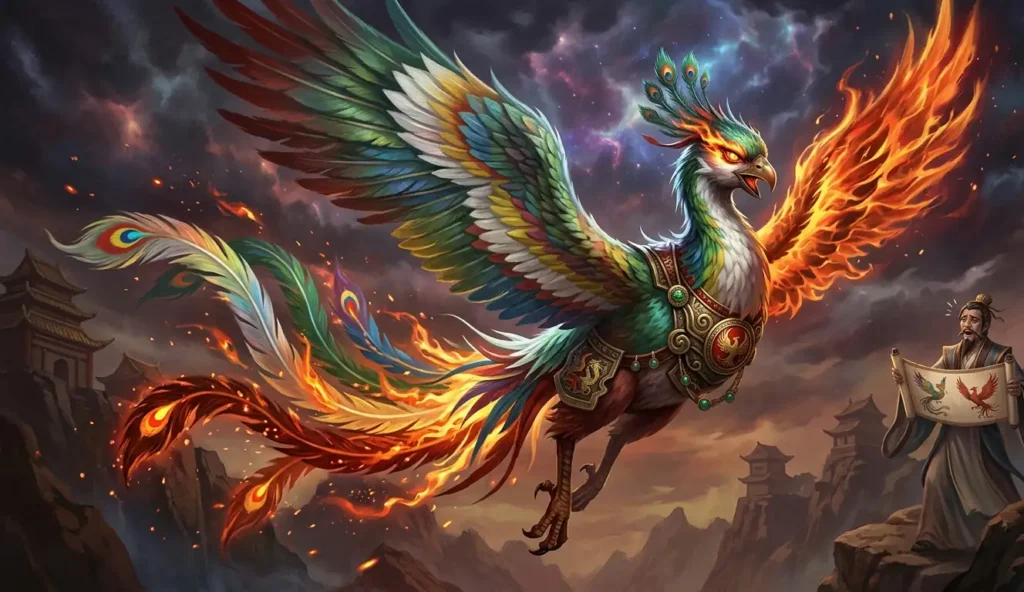
The “Chinese Phoenix” Problem
Both figures sometimes get called the “Chinese phoenix” in English, which makes them sound identical before any content is read.
The Fenghuang’s “Chinese phoenix” label is already misleading, as I’ve argued at length in the Fenghuang Article. Applying the same label to the Vermilion Bird compounds the confusion by making three different figures (Western phoenix, Fenghuang, Zhuque) all sound like variations on the same thing.
They’re not. The Western phoenix is about rebirth cycles. The Fenghuang is about virtue and cosmic harmony. The Vermilion Bird is about southern cosmological governance. Three completely different symbolic functions in three completely different traditions.
Artistic Overlap
In Chinese decorative art, both figures appear in red and gold as magnificent birds, which makes visual identification genuinely difficult without specialist knowledge.
The contextual clues that experts use:
It’s likely the Vermilion Bird if:
- It appears as one of four figures at compass positions
- It appears specifically on the south wall of a tomb
- It appears alongside the Azure Dragon, White Tiger, and Black Tortoise
- It appears in architectural orientation contexts
It’s likely the Fenghuang if:
- It appears paired with a dragon (Long)
- It appears on imperial objects associated with the empress
- It appears on wedding iconography
- It appears without the other three guardian beasts
Journey to the West Complications
Journey to the West and other popular Chinese literature occasionally deploy fire bird imagery loosely contributing to a cultural environment where distinct figures can blur in popular usage.
This is the literature doing what literature does: borrowing from symbolic traditions for narrative effect without necessarily maintaining theological precision. It’s fine for fiction. It’s problematic if you’re trying to understand the mythology itself.
Why The Distinction Matters
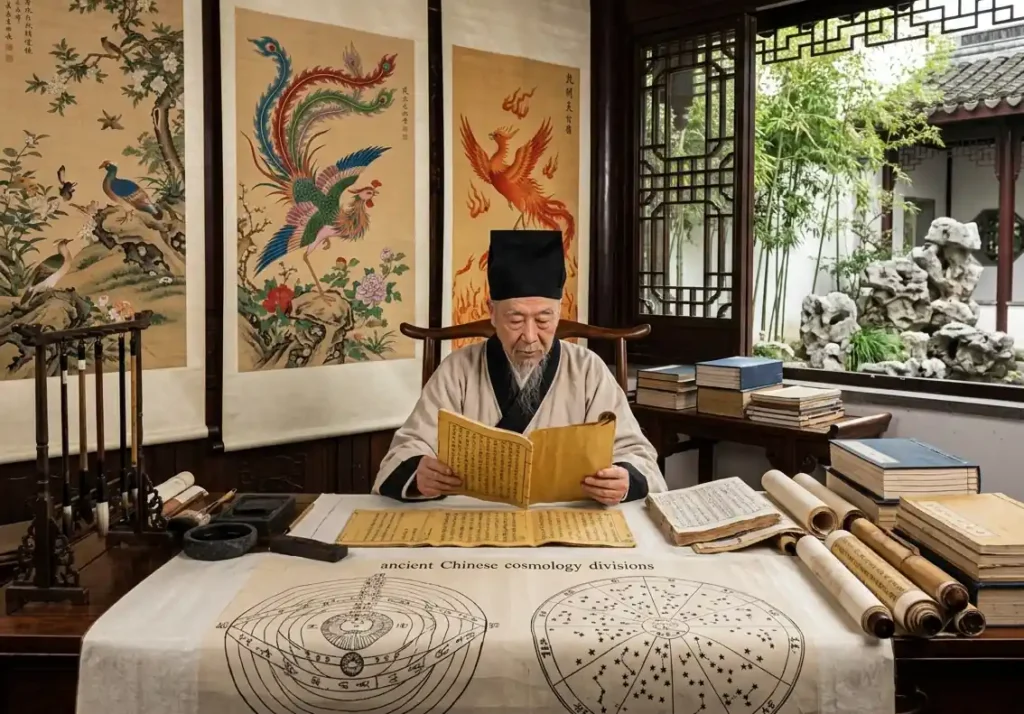
At this point you might be wondering: does it actually matter that these two figures are confused?
my answer is yes for two specific reasons.
First, the Fenghuang loses its most interesting quality. The Fenghuang’s role as a virtue-embodying cosmic harmony figure is genuinely sophisticated and philosophically interesting. When it gets conflated with the Vermilion Bird, it becomes “the fire guardian bird associated with the south.” That’s not wrong exactly, but it’s missing the figure’s most important characteristic, its status as a walking diagram of Confucian ethics whose appearance diagnoses the moral state of governance.
Second, the Vermilion Bird loses its cosmological precision. The Vermilion Bird’s value is its specific, defined place in an elegant cosmological system. When it gets attributed the Fenghuang’s virtue symbolism, its actual function as a cosmological guardian becomes obscured. It starts to look like a generic auspicious fire bird rather than the precise elemental-directional-seasonal governor that the Four Holy Beasts system needs it to be.
Both figures become more interesting when you understand them properly. That’s almost always true of mythology. Precision reveals depth that vagueness conceals.
Frequently Asked Questions
Are the Fenghuang and Zhuque ever treated as the same figure in Chinese tradition?
Some popular sources and periods of Chinese artistic tradition treated them loosely as related fire bird figures without strict distinction. But classical texts like the Shanhaijing and ancient astronomical traditions treat the Fenghuang and Zhuque as distinct. The conflation is popular tradition. The distinction is scholarly tradition.
Which is more important in Chinese mythology?
They matter in different contexts. The Fenghuang has a broader cultural presence in daily life, appearing on wedding items, decorative arts, and as the empress’s symbol. The Zhuque is more important within the Four Holy Beasts cosmological system tied to Chinese astronomy, feng shui, and directional ritual. Different domains, different significance
Can I identify which figure it is in art without specialist knowledge?
The most reliable rule: if the firebird appears with an Azure Dragon, White Tiger, and Black Tortoise, it’s the Vermilion Bird. If it appears paired with a dragon alone, it’s almost certainly the Fenghuang. Context of four equals Vermilion Bird, context of two equals Fenghuang.
Is the Fenghuang the Chinese version of the phoenix?
The Fenghuang is often translated as “Chinese phoenix,” but it differs from the Western phoenix in symbolism, origin, and mythology.
Why do people confuse the Fenghuang and Vermilion Bird?
Both are associated with fire, bright plumage, and auspicious symbolism, leading many later traditions and modern media to merge their identities.
Final Thoughts
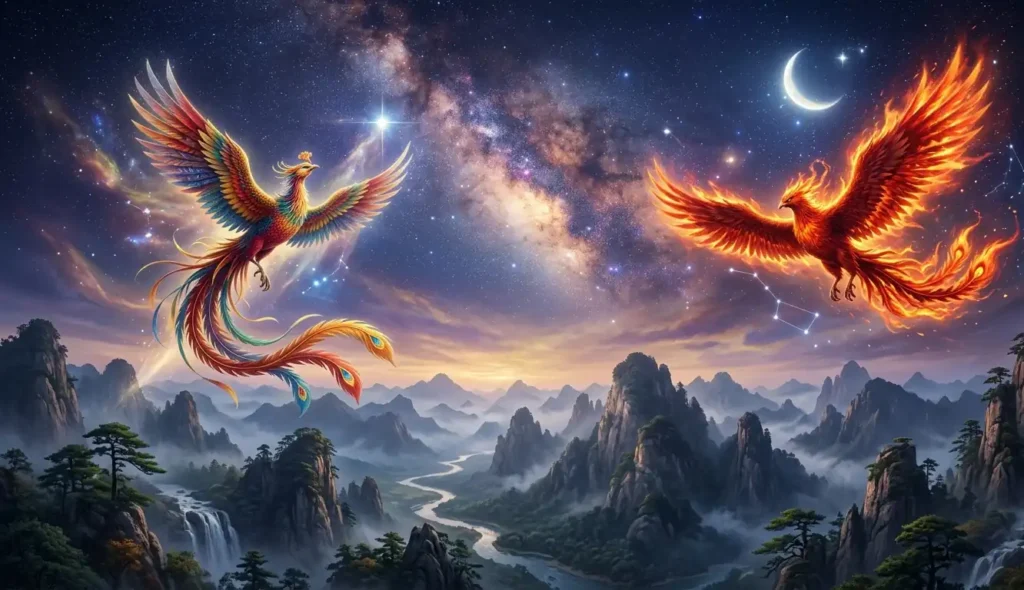
Both the Fenghuang and the Vermilion Bird deserve better than being merged into a single “Chinese fire bird” category.
The Fenghuang is a moral figure one of the most precisely encoded virtue symbols in any mythological tradition. The Vermilion Bird is a cosmological guardian the southern sky’s animating intelligence, one structural element of an elegant astronomical framework.
They look similar from a distance. They aren’t, up close.
That gap between surface similarity and genuine difference is where mythology’s real interest lives.
Related Articles
- Suzaku: Vermilion Bird symbolism, myths and sacred meaning
- The Four Holy Beasts: complete guide to the Si Xiang
- Dragon mythology: East, West, and every culture in between
- Phoenix Bird Mythology: Origins, Symbolism & Sacred Meaning
- Fenghuang: Chinese Phoenix Meaning, Symbolism & Origins
- Loong: Chinese Dragon Myths, Symbolism & Sacred Power
References
- Birrell, Anne. Chinese Mythology: An Introduction.
- Major, John. Heaven and Earth in Early Han Thought.
- Kohn, Livia. Daoism and Chinese Culture.
- Allan, Sarah. The Shape of the Turtle.Hanshu (Book of Han).
- Shanhaijing (Classic of Mountains and Seas).
- Shiji (Records of the Grand Historian).
- The Book of Rites
- The Taoist Body – Kristofer Schipper
- Book of Changes: Yi Jing
- Huainanzi
- Chinese Ornament: The Lotus and the Dragon