
 By
By Quick Takeaways:
- Jade Emperor vs Sun Wukong – The obvious answer Sun Wukong won militarily, the Jade Emperor won institutionally, is correct but incomplete
- The more interesting answer is that they were never competing for the same thing, which means conventional “who won” framing doesn’t apply cleanly
- Sun Wukong wanted recognition that supreme capability equals supreme cosmic authority, but he never got that
- The Jade Emperor wanted cosmic order to be maintained without his authority being fundamentally challenged. He partially got that, but his court was permanently changed by the encounter
- Both figures are transformed by the rivalry in ways that go beyond simple victory or defeat
This is one of those questions that has an obvious answer and a much better answer underneath it.
The obvious answer: Sun Wukong won the military contest but was stopped by the Buddha. The Jade Emperor kept his throne. Institutional authority prevailed over raw capability. Jade Emperor wins.
I’ve been sitting with this question for most of 10 years of my Chinese mythology study, and I don’t think that answer is wrong exactly, but it misses what’s most interesting about the rivalry. Because Sun Wukong and the Jade Emperor weren’t competing for the same thing.
That distinction changes everything.
What They Were Actually Fighting Over
Sun Wukong’s Actual Claim
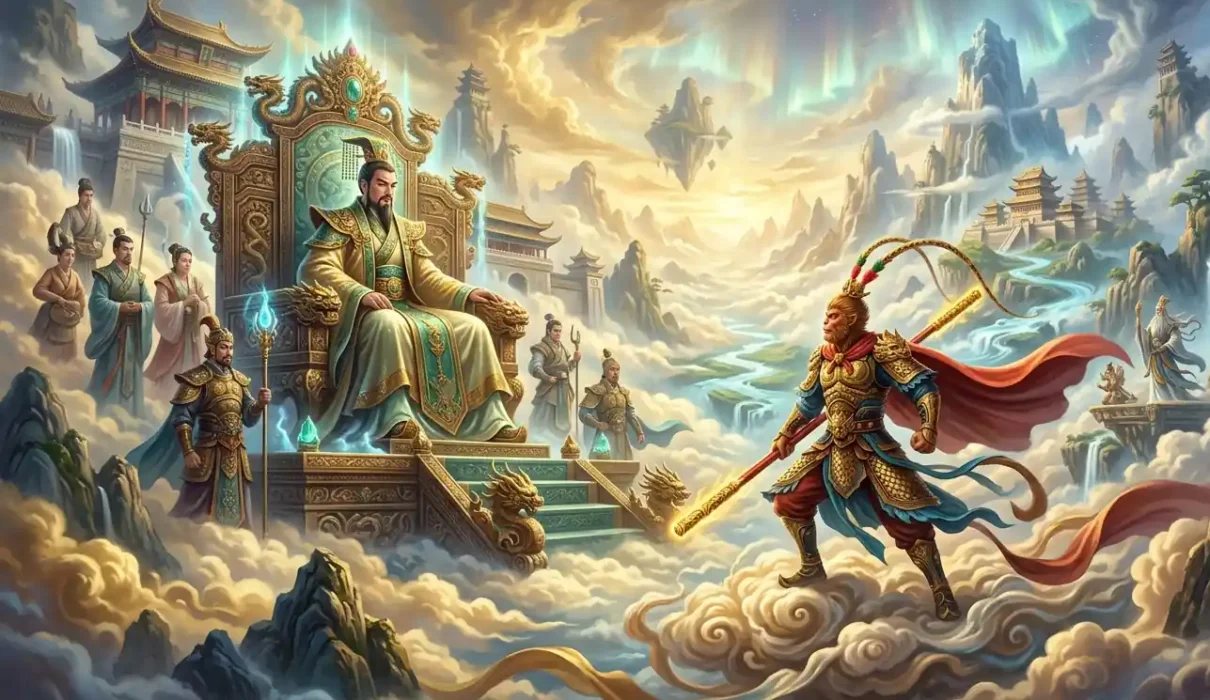
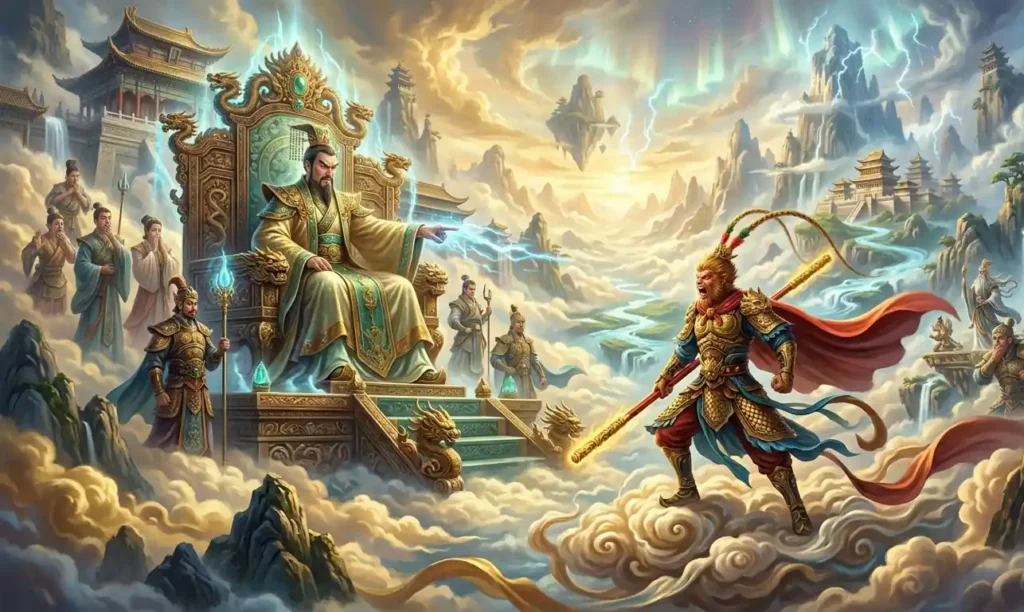
People often describe Sun Wukong’s rebellion as a power grab by a strong figure who wants the top seat. But his specific demand is worth examining precisely.
He didn’t initially want the Jade Emperor’s throne. He wanted the title Great Sage Equal to Heaven (Qí Tiān Dà Shèng).
Equal to. Not replacing. Equal to.
His fundamental claim was that his capability, his combat power, his cultivation achievements, and his demonstrated ability to defeat every divine army the court sent against him entitled him to cosmic recognition at the highest level. Not a governance authority. Recognition that his power placed him alongside the greatest divine figures.
This is a specific claim about what determines cosmic status. Sun Wukong was arguing: the most capable being should have the highest recognition. Power determines standing.
The Jade Emperor’s Actual Position
The Jade Emperor’s position is the opposite. His authority derives from cultivated virtue accumulated across 1,750 aeons, from legitimate succession within the cosmic order, from the Three Pure Ones’ underlying framework within which governance operates.
His implicit counter-argument to Sun Wukong: standing isn’t determined by capability. It’s determined by cultivation, merit, and the legitimate authority structure that maintains the cosmic order for all beings.
This isn’t a fight about who’s stronger. It’s a philosophical disagreement about what the basis of cosmic authority should be. And neither of them ever clearly wins that argument, because the novel doesn’t resolve it cleanly.
Round 1: The Military Contest
Sun Wukong’s Decisive Advantage
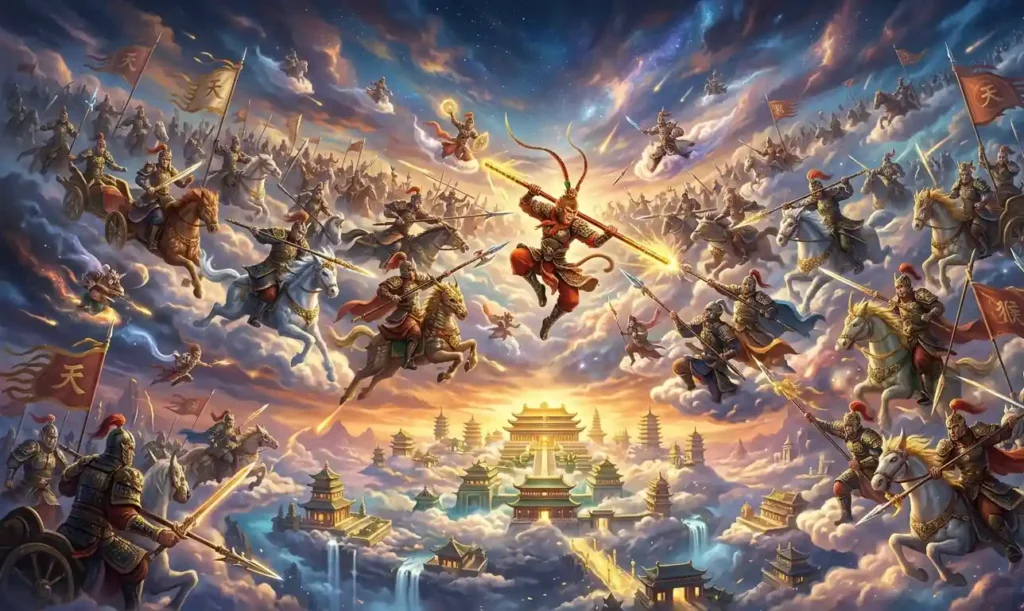
On pure military terms, Sun Wukong wins without serious competition. This is the part of the story most people remember because it’s spectacular.
He defeats every divine general. He defeats every celestial army. He defeats the combined forces. He eats the immortality peaches, drinks the immortality wine, and consumes Laozi’s refined pills, making himself essentially unkillable through ordinary divine means.
The Jade Emperor’s military options are genuinely exhausted. He has no combat instrument capable of defeating Sun Wukong.
What this proves: Sun Wukong’s claim about his own capability is correct. He’s the most formidable fighter in the heavenly court’s available arsenal. Nobody disputes this.
What this doesn’t prove: That capability should determine cosmic authority. That’s a separate argument that military victory can’t settle.
The Jade Emperor’s Response
The Jade Emperor does something that’s easy to read as weakness and is actually quite sophisticated. He correctly identifies that he’s facing a problem that his military instruments can’t solve, and he seeks the appropriate solution.
He calls in the Buddha.
I’ve argued on my blog post that this is the right move given the nature of the problem. The Buddha addresses what military force cannot: Sun Wukong’s fundamental misunderstanding of his own position in the cosmos.
But it does mean that on the military dimension of the rivalry, Sun Wukong is undefeated. The divine court couldn’t beat him. A figure outside the court stopped him.
Military verdict: Sun Wukong wins. Definitively.
Round 2: the Buddha Question
Why This Complicates the “Jade Emperor Wins” Narrative
The Buddha’s palm scene is the rivalry’s turning point, and it raises a question that most analyses skip over.
If the Jade Emperor wins because the Buddha stops Sun Wukong, whose victory is it, actually?
The Buddha isn’t the Jade Emperor’s subordinate. He doesn’t operate within the divine court hierarchy. The Jade Emperor can ask for his help; he can’t command it. When the Buddha resolves the Sun Wukong problem, he does so on his own authority, not as an instrument of the Jade Emperor’s power.
The Jade Emperor benefits from the outcome. He didn’t achieve it.
This matters for the “who won” question because it means the Jade Emperor’s victory, if we call it that, was achieved through borrowed authority from outside his system. His court couldn’t resolve it. An external power did.
What the Buddha Actually Demonstrated
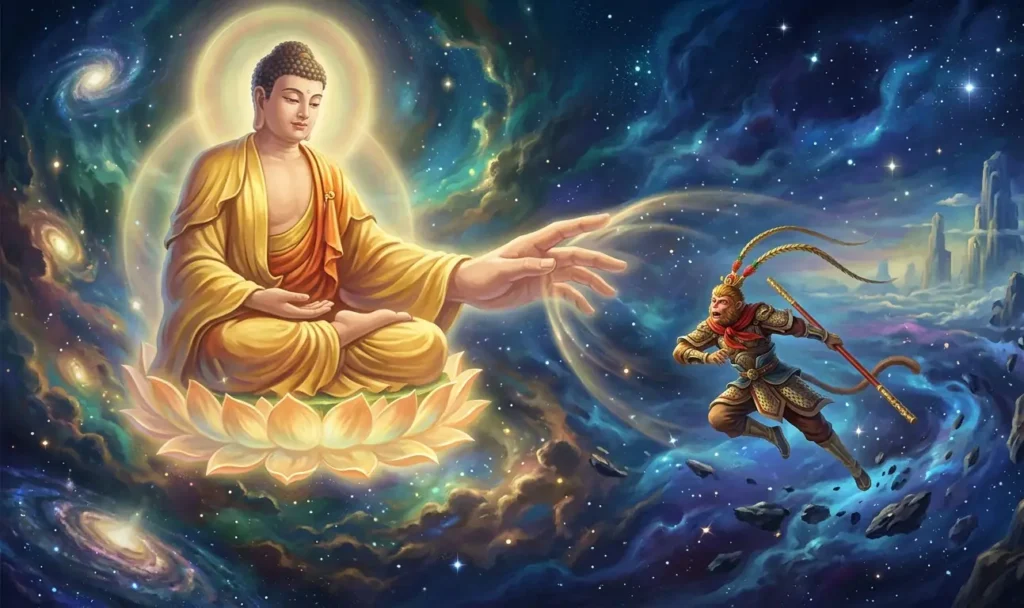
The Buddha’s palm scene doesn’t defeat Sun Wukong militarily. It defeats his argument.
Sun Wukong’s somersault takes him to the edge of existence. He inscribes his name on what he thinks are the world’s boundary pillars. He returns triumphant.
The pillars are the Buddha’s fingers. He never left the palm.
The demonstration is: your capability, however extraordinary, always operates within a context you haven’t fully understood. The premise of your claim that maximum capability equals maximum cosmic standing is based on a misunderstanding of what the cosmos actually is.
Sun Wukong isn’t defeated because he’s weaker. He’s defeated because his argument was wrong.
Buddha round verdict: Sun Wukong’s claim is refuted. His military capability is undiminished. His philosophical position is dismantled.
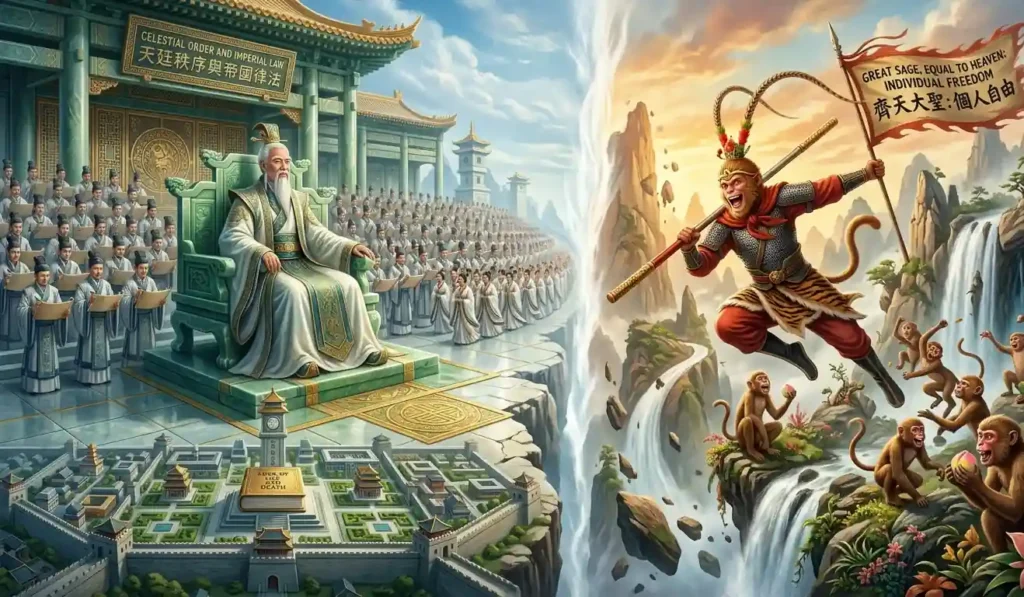
The Deeper Rivalry: Two Theories of Cosmic Authority
What Neither of Them Acknowledges Out Loud
The military contest and the Buddha scene are the visible rivalry. Underneath it is an unresolved philosophical debate that Journey to the West never cleanly settles because it probably can’t be cleanly settled.
Sun Wukong’s theory: Cosmic authority should reflect actual capability. The most powerful being should have the highest standing. Cultivation and virtue are paths to capability. Capability is what matters.
The Jade Emperor’s theory: Cosmic authority derives from cultivated virtue, legitimate succession, and the maintenance of the order that serves all beings. Capability is one component of virtue, but it’s not sufficient on its own.
Both positions have genuine merit. Sun Wukong is right that the divine court’s authority isn’t backed by superior capability. He proved that by defeating every army it sent. The Jade Emperor is right that capability alone doesn’t constitute the wisdom and virtue that legitimate governance requires.
The novel’s resolution, Sun Wukong becoming Victorious Fighting Buddha at the journey’s end, actually synthesizes both positions rather than choosing between them. His capability is preserved and fully recognized. His standing reflects achieved wisdom rather than just power.
Neither won the argument. The argument transformed both of them.
What Each of Them Actually Got
What Sun Wukong Got
At the end of Journey to the West, Sun Wukong receives the title Victorious Fighting Buddha, a cosmic recognition that explicitly validates both his combat capability (Victorious Fighting) and his achieved wisdom (Buddha).
This is a higher title in one sense than Great Sage Equal to Heaven. It reflects genuine spiritual achievement rather than just capability demonstration. But it was earned through the pilgrimage journey rather than simply claimed.
What he got:
- Full cosmic recognition at the highest level
- A title that validates his fundamental identity rather than requiring him to abandon it
- Genuine wisdom to match his capability, which he didn’t have at the start
What he didn’t get:
- The acknowledgment that capability alone entitles anyone to cosmic authority
- The Jade Emperor granting him that recognition on his terms
- A victory that didn’t require five hundred years under a mountain and eighty-one tribulations
What the Jade Emperor Got
The Jade Emperor’s court survived. The cosmic order was maintained. Sun Wukong was eventually redirected from adversary to protector of the pilgrimage.
What he got:
- Institutional continuity – the divine court persists
- Sun Wukong’s capabilities directed toward cosmic benefit rather than cosmic disruption
- Confirmation that the cosmic order’s framework is more durable than any individual rebellion against it
What he didn’t get:
- A demonstration that his court could handle extreme individual capability from within its own resources
- The resolution of Sun Wukong’s fundamental challenge to authority-by-legitimacy as opposed to authority-by-capability
- A Sun Wukong who agreed with him, only a Sun Wukong who found a path that didn’t require the argument to be settled
Who Won? The Real Answer
Here’s where I’ll give you my definitive position after 10 years with Chinese mythology.
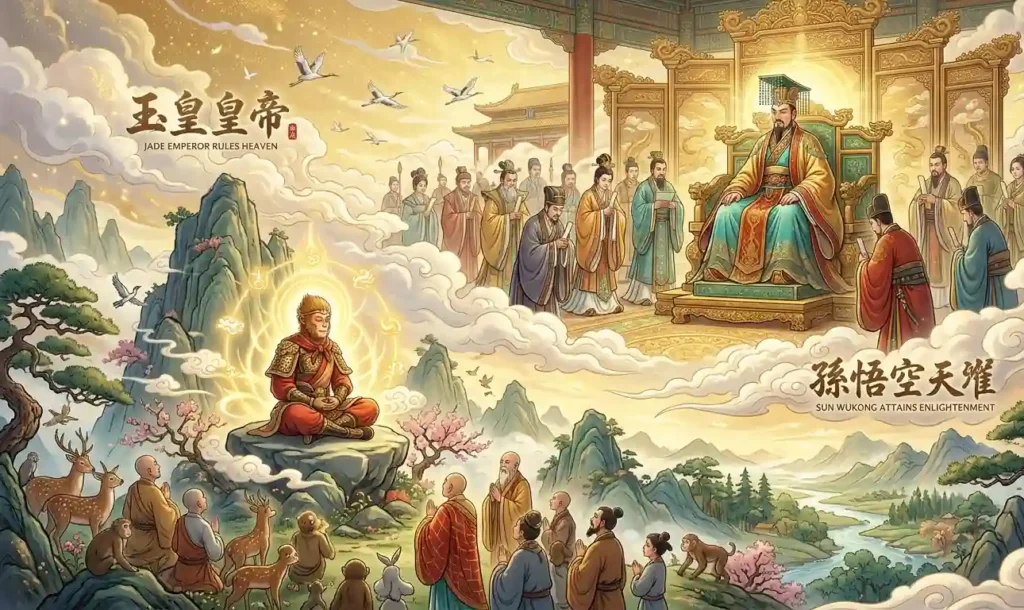
Sun Wukong won the argument he could win: the military demonstration. He proved beyond any doubt that capability can exceed institutional authority’s capacity to control it. No one in the tradition disputes this.
The Jade Emperor won the argument he could win: the institutional continuity demonstration. The cosmic order survived, adapted, and eventually incorporated Sun Wukong’s capabilities into its service. Governance outlasted individual rebellion.
Neither won the argument neither could win: whether capability or virtue should be the primary basis of cosmic authority. The novel doesn’t resolve this. The Buddha’s palm scene suggests that both Sun Wukong’s capability-based claim and the Jade Emperor’s virtue-based claim are incomplete. The actual cosmos contains both, and the synthesis is something neither of them had at the start.
The genuine winner is the pilgrimage itself: the process that transformed a capability without wisdom into a Victorious Fighting Buddha. Sun Wukong’s journey to that title required everything: the military victories, the philosophical defeat, the five hundred years under the mountain, and the eighty-one tribulations. The Jade Emperor’s institutional persistence made the context for that transformation possible.
They needed each other to produce the outcome that neither of them planned.
Frequently Asked Questions
Did the Jade Emperor ever directly fight Sun Wukong?
No. The Jade Emperor never personally fights Sun Wukong in Journey to the West. Instead, he commands Heaven’s forces and, when they fail, seeks outside help. Combat is not the basis of his authority. His role is to govern, not to serve as Heaven’s frontline warrior.
Could the Jade Emperor have stopped Sun Wukong without the Buddha?
Nothing in the narrative suggests he could have, and no divine instrument he possessed proved effective. However, this may reflect Wu Cheng’en’s satirical point about institutional authority’s limits rather than a theological statement about the Jade Emperor’s cosmic power ceiling. Outside Journey to the West, his origin story describes cultivation that would make him considerably more than a helpless bureaucrat.
Was Sun Wukong justified in his rebellion?
This is a question the novel intentionally leaves unresolved. Sun Wukong proved his capabilities, but his belief that power alone justified ruling Heaven was challenged by the Buddha. His rebellion ultimately led to his transformation into Victorious Fighting Buddha. Whether that outcome justified five centuries beneath a mountain is left to the reader.
Why didn’t the Jade Emperor fight Sun Wukong personally?
The Jade Emperor’s role is that of a ruler and administrator, not a frontline warrior. He responds to threats by directing Heaven’s resources and seeking assistance when necessary.
How did the conflict between Sun Wukong and the Jade Emperor end?
The conflict ended when the Buddha intervened, trapped Sun Wukong beneath a mountain, and set him on the path that eventually led to enlightenment.
Final Thoughts
The “who won” framing is irresistible and ultimately insufficient for this rivalry, which is why I find it so interesting.
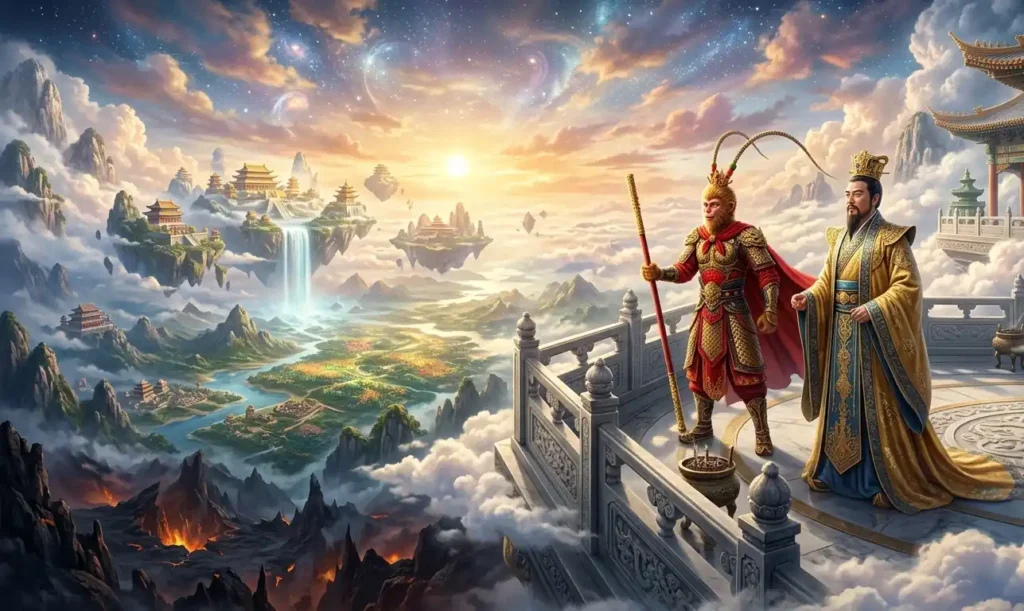
Sun Wukong and the Jade Emperor represent two genuinely different theories about what makes power legitimate. The military contest settled which one had more combat capability, Sun Wukong, clearly. The philosophical contest settled which theory was complete on its own, neither one, as it turned out.
What the rivalry produced was a transformation. A being of extraordinary capability who became wise enough to deserve it. A cosmic order that proved durable enough to survive its greatest individual challenge and absorb the challenger into its service.
Because of my reading I have become suspicious of simple victories. The interesting outcomes are the ones where both parties are changed by the encounter. This rivalry changed both of them and produced something that neither planned, which is exactly what genuine conflict in mythology is supposed to do.
Related Articles
- Journey to the West: The Chinese Classic Behind Fiction
- Sun Wukong: Monkey King Symbolism, Myths & Sacred Power
- Jade Emperor: Origin, Powers & Sacred Meaning in Mythology
- What Is the Heavenly Court? Chinese Myth’s Divine Authority
- Xiwangmu vs Jade Emperor: Who is More Powerful in Chinese Myth?
- Jade Emperor vs Buddha: Who Actually Outranks Whom?
- Jade Emperor vs Zeus: Same Power, Different World
- Sun Wukong Powers Ranked: From Weakest to Absolute
References
- Andrew H. Plaks – The Four Masterworks of the Ming Novel
- Journey To The West
- Wilt L. Idema – Chinese Vernacular Fiction
- Victor H. Mair – The Columbia History of Chinese Literature
- C. T. Hsia – The Classic Chinese Novel
- Crazy Ji: Chinese Religion and Popular Literature – Meir Shahar
- Stephen Teiser – The Spirits of Chinese Religion
- Records of the Western Regions in the Great Tang Dynasty – Xuanzang