
 By
By Quick Takeaways:
- Most popular accounts of the Jade Emperor present the surface version the supreme ruler of the heavenly court. The interesting version is considerably deeper.
- Several of these Jade Emperor facts I didn’t know myself until years into studying Chinese mythology, which tells you how effectively they get buried under the well-known material
- Every fact here is documented in classical sources, religious practice, or historical record, not mythology trivia invented for engagement
- Understanding these facts changes how you read Chinese mythology, Chinese religious practice, and Chinese history simultaneously
Ten years of studying Chinese mythology means you eventually stop finding the famous stories surprising and start noticing the specific details that most introductory accounts skip over.
Here are eleven of those facts about the Jade Emperor that change how you understand him, his mythology, and his place in Chinese religious culture.
Jade Emperor Facts You Should Know
Fact 1: He’s Not Actually the Highest Deity
This is the one that surprises people most consistently, because every popular account describes the Jade Emperor as “the supreme deity of Chinese mythology.”
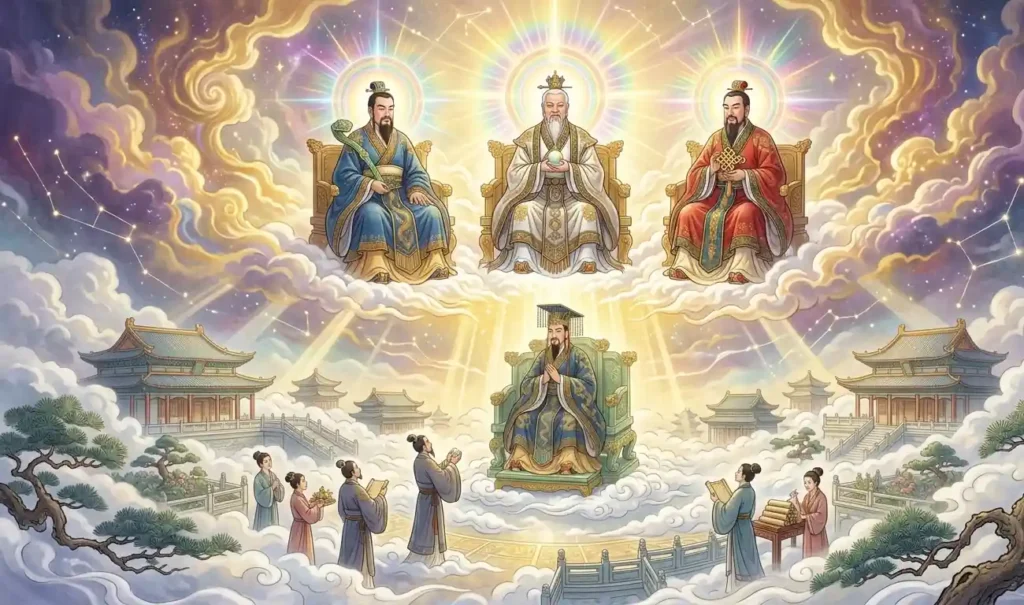
He is the supreme ruler of the Heavenly Court. But above him sit the Three Pure Ones Yuanshi Tianzun, Lingbao Tianzun, and Daode Tianzun (the deified Laozi), who represent transcendent metaphysical principles that the Jade Emperor’s governance operates within.
The distinction is like the difference between a prime minister and a constitution. The prime minister governs everything. The constitution represents principles that the prime minister’s governance must serve and cannot override.
The Jade Emperor runs the government of heaven. The Three Pure Ones are the philosophical ground from which legitimate governance emerges. He’s second from the top, not because he’s weak, but because Chinese theological thinking is careful about what “supreme” actually means.
Fact 2: He Was Born a Mortal Prince
The popular image of the Jade Emperor as an eternally enthroned cosmic sovereign obscures something philosophically significant: he wasn’t born a god.
Jade Emperor’s origin story from the Gaoshang Yuhuang Benyuan Jing (The Jade Emperor’s Origin Scripture) describes him as a prince of the Pure Felicity and Majestic Jade Kingdom who abdicated his throne to pursue cultivation.
He gave up actual royal power to develop something he valued more: the genuine capacity to relieve all beings’ suffering. The cosmic throne he currently occupies isn’t a birthright. It’s what happened after inconceivable amounts of cultivation and moral development.
This makes him philosophically different from most supreme deities in world mythology. His authority is earned rather than inherent.
Fact 3: The 1,750 Aeons Are a Serious Theological Claim

When people encounter the “1,750 aeons of cultivation” figure in the Jade Emperor’s origin story, they often read it as poetic exaggeration, “he cultivated for a very long time.”
It’s not just poetic. It’s a specific theological statement about what genuine virtue at a cosmic scale actually requires.
An aeon (kalpa) in Chinese-Buddhist cosmological thinking represents billions of years. 1,750 of them is a number specifically designed to make human time-consciousness inadequate to the task of comprehension.
The tradition is saying: whatever you imagine sufficient cultivation requires, multiply it by something that breaks your imagination. The authority to govern the cosmos can’t be achieved quickly. The number is the point.
Fact 4: Journey to the West Deliberately Portrays Him as Weak
If you’ve read Journey to the West, you might have noticed that the Jade Emperor, the supreme ruler of all heaven, can’t handle Sun Wukong and has to call in the Buddha for help.
This bothered me when I first encountered it, until I understood the context.
Journey to the West was written by Wu Cheng’en during the Ming Dynasty, a period of elaborate bureaucratic governance whose dysfunction was well-known to educated readers. The Jade Emperor’s helpless-bureaucrat portrayal was political satire about institutional authority that can’t function without outside intervention.
The novel isn’t saying the Jade Emperor is cosmically weak. It’s saying that institutional authority, however legitimate, sometimes requires different kinds of power than it commands. The satire was aimed at Ming Dynasty governance, not at the deity himself.
Fact 5: Real Emperors Literally Died Trying to Achieve What He Represents
The Jade Emperor is the supreme immortal who governs eternity. Real Chinese emperors found this so aspirational that they pursued physical immortality through the same Daoist cultivation tradition, and several of them died in the process.
Emperor Taizong of the Tang Dynasty – one of China’s greatest rulers, who conquered vast territories and governed with sophisticated administrative intelligence died at fifty-one from mercury poisoning. He’d been taking immortality elixirs prepared by Daoist alchemists.
Emperor Muzong, Jingzong, and Wuzong also died from elixir ingestion during the Tang Dynasty. The emperor who most completely embodied the Jade Emperor mythology in human form kept trying to become him, and the gap between the aspiration and the achievement was fatal.
Fact 6: His Position is Theoretically Term-Limited in Some Traditions
This one genuinely surprised me when I first encountered it.
Some Buddhist-influenced accounts of the Chinese cosmological hierarchy suggest that even the Jade Emperor’s position isn’t permanent in the ultimate sense that it’s held for an extraordinarily long cosmic period but is eventually subject to the same cycles of change that govern all conditioned existence.
This reflects the Buddhist cosmological framework’s influence on Chinese religious thinking. In Buddhist cosmology, even the highest heavenly rulers eventually experience the exhaustion of their merit and descend from their positions. The integration of this framework into Chinese folk religion creates a Jade Emperor whose tenure, however vast, operates within cosmic impermanence rather than beyond it.
Fact 7: The Sticky Candy Offering for His Kitchen God Report is Genuinely Fascinating
Every year before the Lunar New Year, the Kitchen God ascends to report on each household’s behaviour to the Jade Emperor. The report determines the household’s fortune for the coming year.
Families traditionally offer Tang Gua a sticky-sweet candy to the Kitchen God before his departure. The reason is brilliantly pragmatic: the sticky candy is meant to either stick the Kitchen God’s mouth shut (so he can’t report the bad things) or sweeten his words (so he reports only good things).
You’re essentially bribing the cosmic auditor with candy before he files his annual report to the supreme deity. and I’m still delighted by its cheerful pragmatism about the relationship between humans and divine governance.
Fact 8: He Personally Reviews Every Chinese Household’s Annual Moral Record
Building on the Kitchen God fact: the Jade Emperor doesn’t just passively receive these reports. The divine audit system means he personally oversees the annual moral accounting of every household in China.
The Kitchen God is the household-level official. Below him are village earth gods. Above them are city gods. Above them are regional divine officials. The whole reporting chain ultimately reaches the Jade Emperor.
This means the supreme ruler of the cosmos is, in practical religious terms, personally concerned with whether your family behaved well last year. The most cosmically important deity is also the most locally relevant one which is one of the most distinctively Chinese features of the entire divine system.
Fact 9: There’s a Celestial Dog in the Extended Story
Erlang Shen’s Howling Celestial Dog (Xiaotian Quan) is one of the most useful animals in the divine court, but it’s frequently overlooked in popular accounts.
During the battle with Sun Wukong in Journey to the West, this dog bites the Monkey King’s leg at a critical moment, contributing to his temporary capture. Without the dog’s intervention, the battle might have gone differently.
The dog isn’t the Jade Emperor’s dog specifically. It belongs to his nephew, Erlang Shen. But it operates within the extended Jade Emperor family’s sphere of celestial enforcement, which is a reminder that divine governance, like human governance, often depends on specific individuals’ specific capabilities rather than on the supreme authority’s direct action.
Fact 10: His Full Title is Absurdly Long – Like Mother of Dragons Falls Short
The Jade Emperor’s common names, Yuhuang Dadi or Yudi, are convenient abbreviations. His full formal title is:
Xuanling High Perfected Jade Emperor of the Mysterious and Numinous, the Awe-inspiring One of the August Heaven, the Father-King of the Golden Watchtower, the Jade Emperor of the Lofty Heaven, the Numinous Treasure of High Perfection, the High Divine One of the August Jade, the Supreme Lord of the Great Dao
This reads as bureaucratic excess until you examine what each component is doing. Each phrase encodes a specific theological claim about the nature and source of his authority:
- “Mysterious and Numinous” – his authority connects to the Dao’s ineffable ground
- “Awe-inspiring One” – his power commands genuine reverence rather than mere compliance
- “Father-King” – his governance has the quality of parental concern rather than merely administrative authority
- “High Perfected” – his cultivation has reached a specific and recognized level of completion
The length isn’t vanity. It’s a compressed theological treatise.
Fact 11: He Received Official Government Recognition as a Real Deity in Living Memory
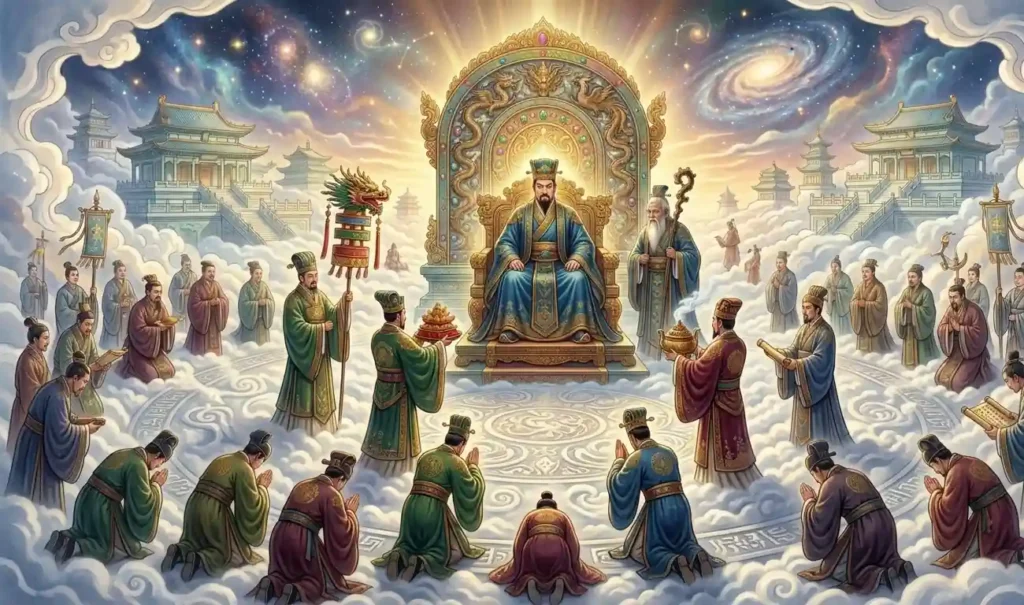
In 2009, the Jade Emperor Temple in Tainan, Taiwan, received government recognition as a historic site maintaining the living religious tradition of Jade Emperor worship as part of Taiwan’s formally recognized cultural heritage.
More striking: in contemporary Taiwan, the Jade Emperor’s birthday celebration on the ninth day of the first lunar month is one of the most significant religious observances of the year, with elaborate midnight ceremonies that include community prayers, spectacular offerings, and practices that have continued with minimal interruption for centuries.
The Jade Emperor isn’t a historical figure studied in texts. He’s a living religious presence with an active worship community, which means the mythology we are spending time studying is also someone else’s living faith. That’s worth remembering.
Frequently Asked Questions
Why is the ninth day of the first lunar month the Jade Emperor’s birthday?
The ninth day (chū jiǔ) holds deep cosmological significance. Nine is the supreme yang number, while the first lunar month marks the start of the new year cycle. Hokkien communities in Southern Fujian and Taiwan celebrate it as the most important religious observance of the new year.
Is the Jade Emperor worshipped differently in Taiwan than in mainland China?
Taiwan’s strong Jade Emperor worship reflects the preservation of folk religious traditions that faced greater disruption in mainland China during the 20th century. While the theology remains largely similar, Taiwan is known for more elaborate temple culture and public ceremonial expressions.
What’s the relationship between the Jade Emperor and the Chinese zodiac?
A popular folk story tells of the Jade Emperor holding a race to choose the twelve animals of the zodiac. The order in which they reached his celestial court determined their zodiac positions. Though a folk tale rather than classical theology, it portrays the Jade Emperor as the originator of this influential cultural system.
Why is the Jade Emperor associated with the number nine?
The number nine is considered the supreme yang number in Chinese cosmology. Because of its association with power, authority, and Heaven, it is closely linked to the Jade Emperor.
Why is the Jade Emperor important in Chinese culture?
Beyond religion, the Jade Emperor symbolizes justice, leadership, and harmony. His influence can be seen in festivals, folklore, temple traditions, and popular stories.
Final Thoughts

Eleven facts. Each one, I hope, gives you something specific that changes or deepens how you think about the Jade Emperor.
The one I find most personally interesting is fact four that Journey to the West’s weak Jade Emperor is deliberate satire rather than theological carelessness. Understanding that transforms the entire novel from a confusing inconsistency into a sophisticated commentary on institutional authority. The supreme ruler who can’t handle a monkey because bureaucracy isn’t built for problems that don’t follow procedure.
That’s genuinely insightful about power. And it took me years of reading Chinese mythology to see it clearly.
Related Articles
- Jade Emperor: Origin, Powers & Sacred Meaning in Mythology
- What Is the Heavenly Court? Chinese Myth’s Divine Authority
- Who Was the Jade Emperor Before He Became a Supreme Ruler?
- Jade Emperor Family: The Divine Family of Chinese Mythology
- Are the Jade Emperor & Queen Mother of the West Married?
- Jade Emperor and the Chinese Zodiac: The Great Race Story
- Was the Jade Emperor Weak? The Answer Might Surprise You
References
- Birrell, Anne. Chinese Mythology: An Introduction.
- Major, John. Heaven and Earth in Early Han Thought.
- Kohn, Livia. Daoism and Chinese Culture.
- Shiji (Records of the Grand Historian).
- Tao Te Ching – Translated by J. Legge
- Daozang – Daoist Canon
- Investiture Of The Gods
- Journey To The West
- Jade Emperor Origin Scripture
- The Taoist Body – Kristofer Schipper
- The Peking Temple of the Eastern Peak
- The Four Masterworks of the Ming Novel
- The Ghost Festival in Medieval China – Stephen F. Teiser
- Old Tang Book – Chinese Text Project