
 By
By Quick Takeaways:
- Every fact stated below comes from documented classical sources, not from internet mythology lists or invented lore
- Several facts directly contradict widely stated facts about Eastern Dragons in popular accounts
- The toe-count system is the most practically useful fact here if you want to identify dragon origins in art
- The Shanhaijing, the Bencao Gangmu, and classical Korean and Japanese texts are the primary sources throughout
- Understanding these facts changes how you read classical Chinese, Japanese, and Korean mythological texts
There’s a particular quality to the moment when a tradition you’ve studied for years hands you something genuinely unexpected. It happened to me fairly often in my early deep dives. But as the time passed and I gained more knowledge about mythology, it started happening less frequently but hitting harder when it did.
Here are nine facts about Eastern dragons that produced that experience for me. Every one comes from actual classical sources. Some directly contradict widely repeated popular accounts. All of them reveal something specific about the traditions that produced them.
Fact 1: Eastern Dragons Grow Their Body Parts on a Specific Developmental Timeline
The Classical Schedule
Li Shizhen’s Bencao Gangmu (Compendium of Materia Medica, 1596) is primarily a medical text, but it contains one of the most specific descriptions of dragon development found in any classical source. Li Shizhen compiled existing knowledge about dragons, including their physical development across time.
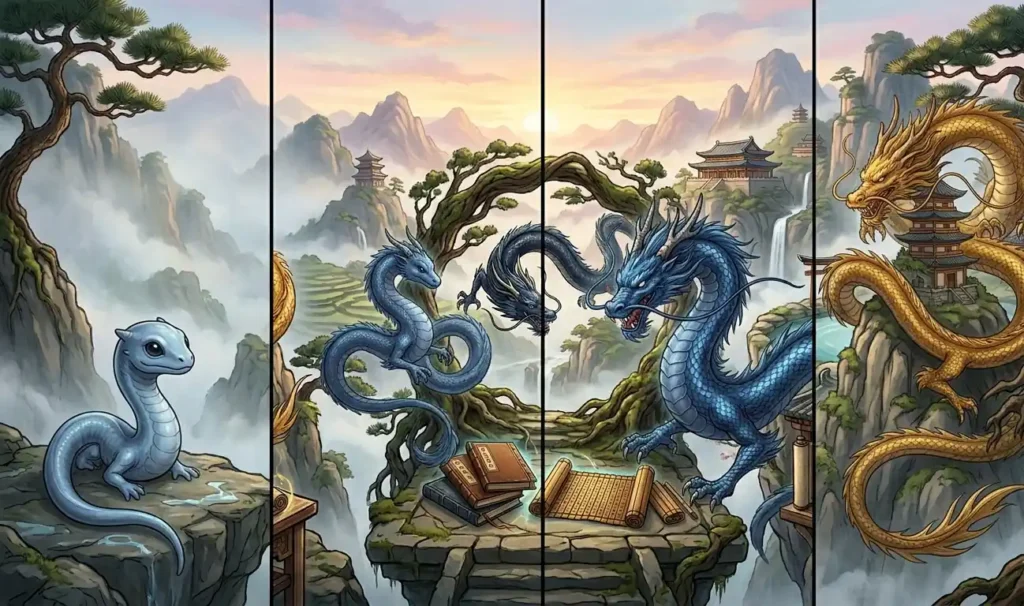
According to this account, a dragon develops its physical features on a precise schedule:
- At 500 years old, it grows scales
- At 1,000 years, it grows a beard
- At 1,500 years, it grows horns
- At 2,000 years, it grows wings
The developmental sequence matters because it means that the dragon’s appearance in classical art encodes its age. A hornless dragon is young. A winged dragon is ancient. This wasn’t a stylistic choice but a mythological age indicator.
The Yinglong (winged dragon), consistently described as the most ancient and powerful dragon type in classical texts, has wings because it has lived long enough to develop them. The developmental timeline makes the wing status both a physical feature and a cosmological indicator of accumulated time.
Fact 2: The Number of Toes on a Dragon Tells You Which Country It Comes From
A Genuinely Useful Identification System
This is the fact I use most often when looking at Eastern dragon art, and it’s one of the clearest examples of a mythological detail that has direct practical application.
The toe count varies systematically by country:
- Chinese imperial dragons have five toes
- Korean dragons have four toes
- Japanese dragons have three toes
The five-toed dragon was specifically reserved for Chinese imperial use. Korean and Japanese traditions, receiving dragon mythology from China, developed their own distinct toe counts that simultaneously acknowledged Chinese influence and marked their own cultural identity.
The system was legally enforced in China. During the Ming and Qing Dynasties, unauthorized display of five-clawed dragons was treated as an imperial usurpation. The toe count was a regulated insignia of national and political identity, not merely a stylistic variation.
When looking at any piece of Eastern dragon art, counting toes immediately tells you which cultural tradition produced it. A three-toed dragon is definitely Japanese. A five-toed dragon is definitely Chinese imperial.
Fact 3: Classical Chinese Texts Describe Dragons Being Born from Fish
The Fish Transformation Tradition
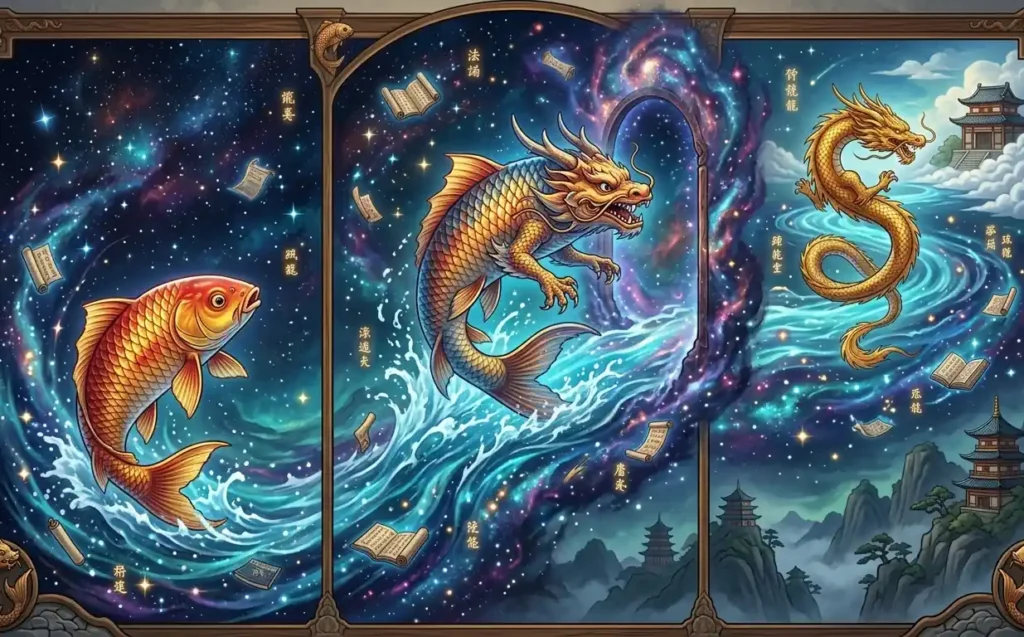
The most famous dragon-from-fish tradition is the Dragon Gate (Longmen) story, where carp that leap successfully through the waterfall transform into dragons. But classical texts describe a related and less well-known tradition: specific fish species transforming into dragons after extreme age without any gate-jumping required.
The Taiping Guangji (Extensive Records of the Taiping Era, compiled 978 CE) contains multiple accounts of fish transforming into dragons after approximately 500 years. The process is described as internal: the fish develops gradually, its internal structure changing until its essential nature is no longer that of a fish.
This tradition reveals something about how classical Chinese thought understood transformation. It’s not external events that produce the dragon. Time itself is the transformative agent for beings with sufficient inherent potential. The fish that becomes a dragon wasn’t elevated by anything external. It became what it was always capable of becoming.
The gate-jumping tradition is more dramatic and better known. The quiet internal transformation tradition is philosophically more interesting.
Fact 4: The Yellow Emperor Used a One-Legged Dragon as a Drum
Kui: The Strangest Dragon in the Shanhaijing
The Shanhaijing (Classic of Mountains and Seas) is one of Chinese mythology’s most ancient and most unusual texts. Its descriptions of the world’s beings and places include entries that resist easy categorization.
One of the most striking is Kui, described as a one-legged creature resembling an ox, blue-green in color, living in the Eastern Sea, causing storms when it enters or exits the water. The text explicitly calls it a type of dragon.
The Yellow Emperor (Huangdi) is said to have captured a Kui, killed it, and used its hide to make a drum. When beaten with a bone from the Thunder Beast, the drum could be heard for 500 li. The Yellow Emperor used this drum in his wars against Chi You.
The one-legged dragon-as-war-drum is not a minor mythological detail. It appears in one of China’s most important mythological texts in connection with one of the founding myths of Chinese civilization. The strangeness of the image, the cosmological significance of the music it produced, and the connection to the Yellow Emperor’s founding wars all give Kui a mythological weight that its obscurity doesn’t reflect.
Fact 5: Classical Chinese Sources Say Dragons Hear Through Their Horns
An Anatomical Detail with Cosmological Weight
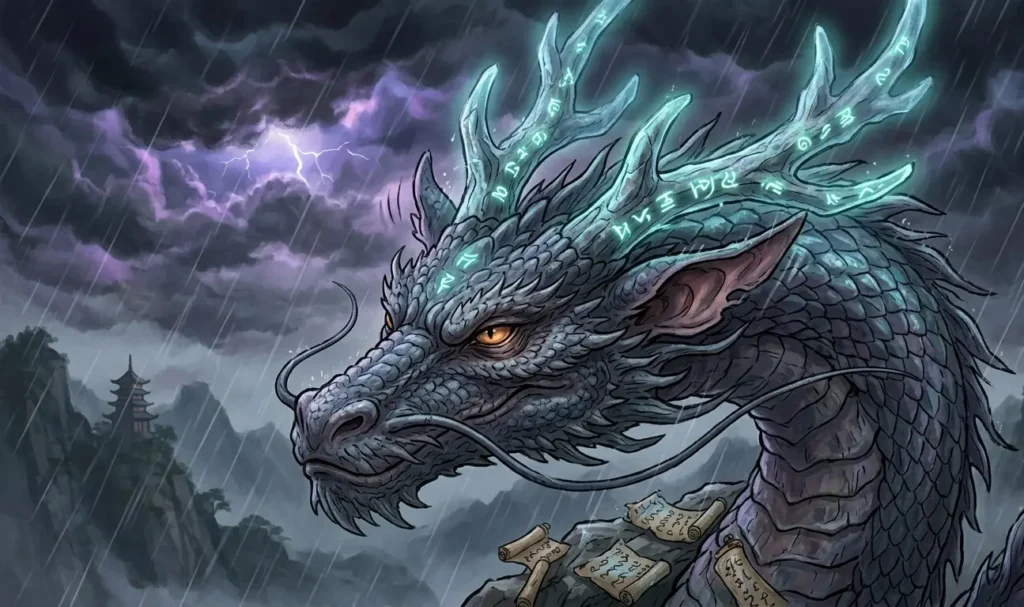
Multiple classical Chinese sources describe an unusual anatomical characteristic: dragons lack ears in the functional sense and hear through their horns instead.
This detail appears in several traditional natural history descriptions of dragons compiled across the Tang and Song periods. The horn is described as the dragon’s primary sensory organ for sound, which is why dragon horns were considered particularly precious in traditional Chinese material culture and pharmacology.
The mythological implication connects to the horn’s symbolic role. Dragon horns in classical iconography and temple art are shown pointing upward, oriented toward heaven. If hearing runs through the horns, then the dragon is perpetually oriented to receive communication from the celestial realm. The sensory anatomy encodes the dragon’s cosmological orientation.
Li Shizhen’s Bencao Gangmu discusses dragon anatomical features including this characteristic in the context of traditional medical uses of dragon-related materials, treating it as natural history rather than mythology.
Fact 6: In Korean Mythology, the Imugi is not a Failed Dragon
A Specific Intermediate Category
The Imugi is frequently described in popular accounts as a dragon that failed to transform, a kind of inferior or unsuccessful version of the full Korean Yong dragon. This description is significantly wrong about what the tradition actually says.
Classical Korean folk tradition describes the Imugi as a specific category of being: a large serpentine creature that is on the path to becoming a Yong dragon but has not yet completed the requirements. The requirements include living for a thousand years and catching a Yeouiju, the heavenly dragon pearl, as it falls from the sky.
An Imugi that hasn’t yet completed these requirements isn’t a failed dragon. It’s a patient one. The tradition treats the Imugi with specific respect as a being of considerable power in its own right, whose eventual transformation is genuinely possible rather than merely theoretical.
The distinction matters because it reveals something about how Korean mythology understands transformation. Failure to transform yet is not the same as the inability to transform ever. The Imugi’s long wait encodes the Korean mythological value of patient preparation rather than rushed achievement.
Fact 7: Yamata no Orochi is not a Water Dragon
The Oldest Japanese Dragon is a Mountain Creature
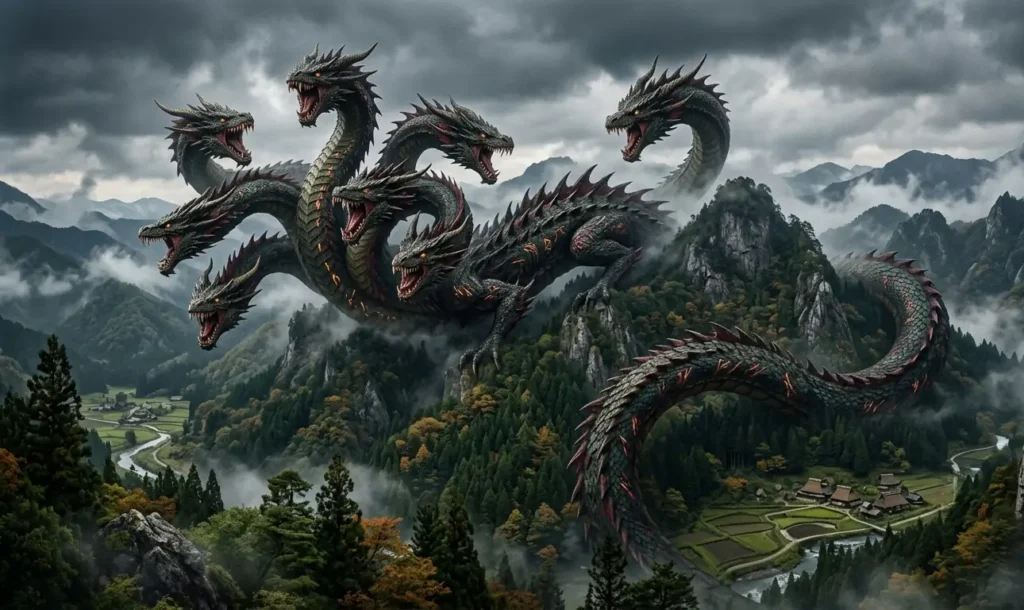
Yamata no Orochi, the eight-headed serpent of the Kojiki and Nihon Shoki, is Japan’s oldest and most mythologically significant dragon figure. Popular accounts frequently classify it as a water creature due to the standard association of Japanese dragons with water.
The oldest texts describe it differently. Yamata no Orochi is a mountain and forest creature. Its body is described as so large that eight valleys and eight peaks are contained within its length. It descends to the coastal region to demand tribute but its native domain is inland mountains.
The association of Japanese dragons with water developed and strengthened over centuries of Chinese cultural influence. The oldest stratum of Japanese dragon mythology, preserved in Yamata no Orochi’s story, shows a creature whose primary associations are with mountains, forests, and the earth rather than with rivers and seas.
The storm god Susanoo defeats Yamata no Orochi by getting it drunk on sake. The discovery of the divine sword Kusanagi within one of its tails then becomes the origin of one of Japan’s three imperial treasures. The dragon is not a water being but a terrestrial one whose defeat produces the sword that becomes a symbol of imperial legitimacy.
Fact 8: The Vietnamese Dragon Changed Dramatically Between Dynasties in Documented Ways
Traceable Artistic Evolution
The Vietnamese Rong (Rồng) dragon has one of the most thoroughly documented artistic evolutions of any Eastern dragon tradition. Vietnamese art historians and archaeologists can trace the dragon’s form across dynasties with specific differences in each period.
The Ly Dynasty dragon (11th to 13th centuries CE) has a distinctive form: sinuous, elongated, without legs, more serpentine than the Chinese Long. It moves through water in wave patterns and lacks the imposing scaled mass of Chinese imperial dragon imagery.
The Tran Dynasty dragon (13th to 14th centuries) developed more pronounced scales and a less elongated form.
The Later Le Dynasty dragon (15th century onward) shows increasing Chinese influence with more legs, more decorative scales, and a form closer to Chinese imperial dragons.
Each transition is documented through surviving architectural decorations, temple carvings, and royal objects. The Vietnamese dragon’s form was never static. It reflected the specific cultural and political conditions of each dynasty, including the degree of Chinese cultural influence and the strength of Vietnamese cultural self-assertion in each period.
Fact 9: The Dragon’s Pearl is Described as Internally Produced in Some Classical Sources
Not Found But Grown
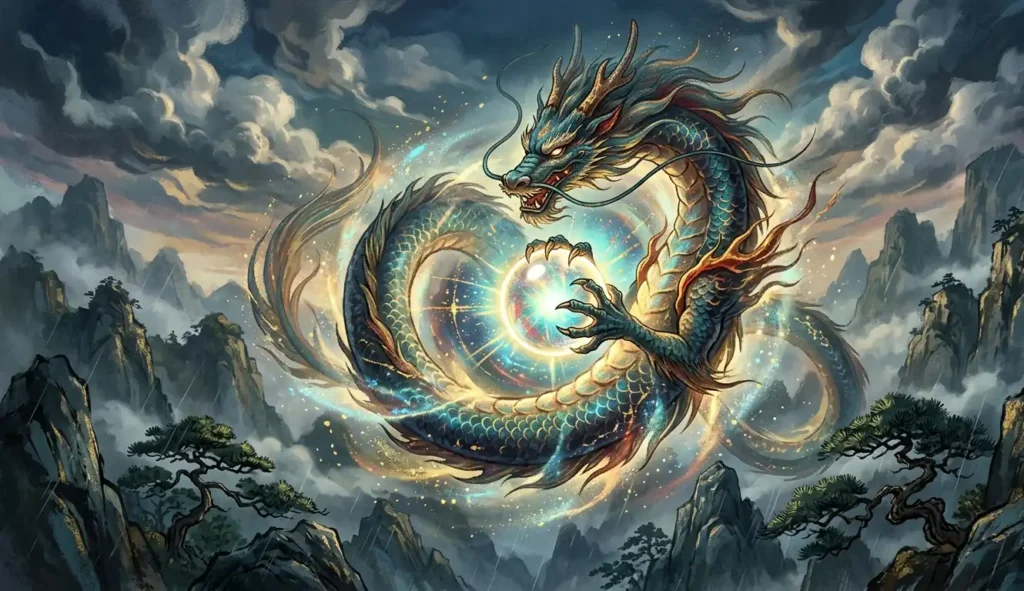
The luminous pearl carried by Eastern dragons is one of their most consistent iconographic features. Popular accounts treat it as something the dragon finds or guards. Several classical Chinese sources describe something more specific.
Certain texts in the Daoist alchemical tradition describe the dragon’s pearl as internally produced, similar to how a pearl forms in an oyster. The dragon develops the pearl within its body through accumulated essence over time. It’s not a possession the dragon carries but a product of the dragon’s own nature that eventually externalises.
This description appears in the context of neidan (internal alchemy) discussions where the dragon’s pearl serves as a metaphor for the cultivated inner essence that the practitioner develops through sustained practice. The alchemical texts are using the dragon’s naturally produced pearl as their primary image for what human internal cultivation produces.
Whether the internally produced pearl was understood literally or metaphorically in specific texts varies. But the image itself draws on a tradition that understood the pearl as something that grows from within the dragon rather than something it acquires from outside.
Frequently Asked Questions
Are all nine of these facts from primary classical sources?
Most are. Facts 1, 3, 4, and 5 come directly from classical texts (Bencao Gangmu, Taiping Guangji, Shanhaijing, and Kojiki respectively). Facts 2 and 6 are documented in both classical sources and scholarly secondary literature. Facts 7, 8, and 9 draw from classical primary sources with scholarly verification. None are invented or taken from undocumented internet mythology.
Which of these facts is most useful for understanding Eastern dragon art specifically?
The toe count (fact 2) is the most immediately applicable for art identification. The developmental timeline (fact 1) is the second most useful, as it explains why certain dragon types look the way they do in terms of body features. Together, these two facts give you a genuinely functional framework for reading Eastern dragon iconography.
Where can I read the Shanhaijing in English?
Anne Birrell’s translation “The Classic of Mountains and Seas” (Penguin Classics, 1999) is the most accessible English edition. Richard E. Strassberg’s “A Chinese Bestiary” (University of California Press, 2002) provides a partial translation with substantial scholarly context. Both are worth reading.
Who are the Dragon Kings in mythology?
Dragon Kings are powerful rulers of the seas in Chinese mythology. Each king governs a different ocean region and controls the weather and water within their domain.
Why were Eastern dragons respected instead of feared?
People viewed dragons as protectors who brought rain, fertility, and balance to the natural world. Their power was seen as beneficial when treated with respect.
Facts About Eastern Dragons – Final Thoughts
The nine facts in this article share a common quality: they reward attention to specific detail over general summary.
The developmental timeline is only visible if you look at dragon images carefully enough to notice what physical features are or aren’t present. The toe count requires actually counting rather than taking for granted. The Imugi’s specific status requires reading the tradition on its own terms rather than imposing a failure narrative onto it.
Eastern dragon mythology has been discussed broadly for long enough that the broad points feel familiar. The specific details are where the tradition is still genuinely surprising. Twenty years of study, and the Shanhaijing’s one-legged drumstick dragon still gets me every time.
Related Articles
- Dragon Mythology: How Dragons Are Depicted Across Cultures
- Western Dragon vs Eastern Dragon [Myth, Power & Origin]
- 11 Chinese Dragon Types & the Legends Behind Their Powers
- Loong: Chinese Dragon Myths, Symbolism & Sacred Power
- 9 Eastern Dragon Myths That Sound Too Strange to Be True
- 9 Chinese Dragon Colors & What Each One Means in Mythology
Written by Batin Khan | Mythology and philosophy reader across world cultures (20 years), Cultivation novels reader for the past 10 years | Specialist in Xianxia, Eastern and Western mythological traditions, and fantasy worldbuilding