
 By
By Quick Takeaways:
- Classical Chinese texts provide specific explanations for how the Loong dragon flies without wings, and “magic” as a vague answer isn’t what the tradition actually says
- The Chi Mu, a specific physical attribute on the dragon’s head, is one classical explanation documented in particular sources
- Cloud riding is the most visually consistent explanation: the dragon doesn’t fly through the air but moves through clouds as its natural medium
- The deeper philosophical answer is that Eastern dragons aren’t physical animals operating under physical laws but cosmological beings whose movement reflects their fundamental nature
- The winged Yinglong’s existence shows the tradition consciously distinguished winged flight from the standard Long’s movement, treating them as genuinely different things
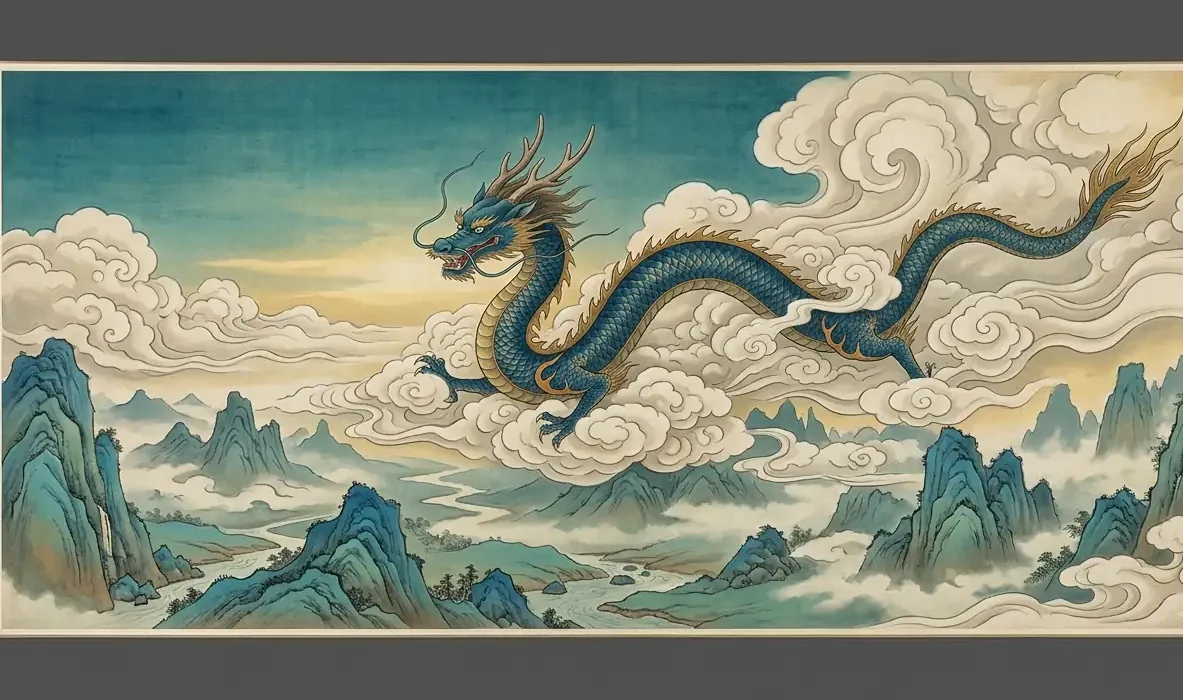
This question is one of my favorites because it forces you to engage with something that most popular accounts of Chinese dragon mythology just skip over. You’ll find endless descriptions of the Chinese Long soaring through the sky, surrounded by clouds, scales gleaming. What you almost never find is a clear answer to the obvious question: how exactly is it doing that?
There is an answer. Several of them, actually, because classical sources approach the question from multiple angles simultaneously.
The Question Itself Is Important
Why Ask How Wingless Dragons Fly?
The wingless flight question is more than a curiosity. It reveals something fundamental about how the Chinese dragon tradition understood what kind of being a dragon actually is.
Western dragons have wings because they’re conceived primarily as physical creatures that need physical mechanisms to do physical things. A Western dragon that flies has wings because that’s how physical creatures of its body plan would achieve flight. The biology is imagined consistently, if fantastically.
Eastern dragons don’t work that way. The Long is not primarily a physical creature that also happens to be powerful and divine. It’s a cosmological being that expresses itself in physical form. The distinction matters because cosmological beings aren’t limited by the physical constraints that apply to animals.
Understanding this doesn’t fully answer the question of mechanism, but it reframes it correctly. You’re not asking “how does this large animal achieve lift.” You’re asking “how does a cosmological being that isn’t fully subject to physical laws move through space.”
That’s a different question with different answers.
Classical Answer 1: The Chi Mu

What Classical Texts Say
The most specific classical answer to the wingless flight question involves a physical attribute mentioned in certain texts: the chi mu, typically translated as a foot of wood or the chi wood.
The tradition, documented in the Bencao Gangmu and referenced in classical commentary on dragon physiology, describes a specific feature on the dragon’s head that enables it to rise. The precise nature and appearance of the chi mu varies across sources, but its function is consistent: it is the mechanism by which the dragon achieves upward movement.
Some texts describe it as a growth or ridge on the dragon’s head. Others describe it more abstractly as a quality of energy concentrated in a specific location on the dragon’s cranium.
What This Means
The chi mu explanation is interesting because it gives the wingless dragon an actual physical mechanism for flight, just not the mechanism a Western dragon would use. Rather than wings providing lift, the dragon’s own body has a specialized attribute that produces upward movement.
This is the tradition taking the question seriously on its own terms: if you ask what enables the dragon to fly, here is the specific thing that does it. The answer isn’t “it’s a magic creature so it can fly.” The answer is “it has this specific physical feature that enables upward movement.”
The chi mu tradition also explains why dragons in classical art are often depicted with a prominent feature on their head, sometimes interpreted as a decorative ridge or a specific prominence. This isn’t purely aesthetic. It’s representing the feature that classical tradition understood as the mechanism of flight.
Read: 12 Best Dragon Books of 2026 [From the Hobbit to Seraphina]
Classical Answer 2: Cloud Riding, Not Flying
The Medium Matters
The second classical answer is perhaps the most important for understanding Eastern dragon imagery, and it’s one that most popular accounts don’t engage with specifically enough.
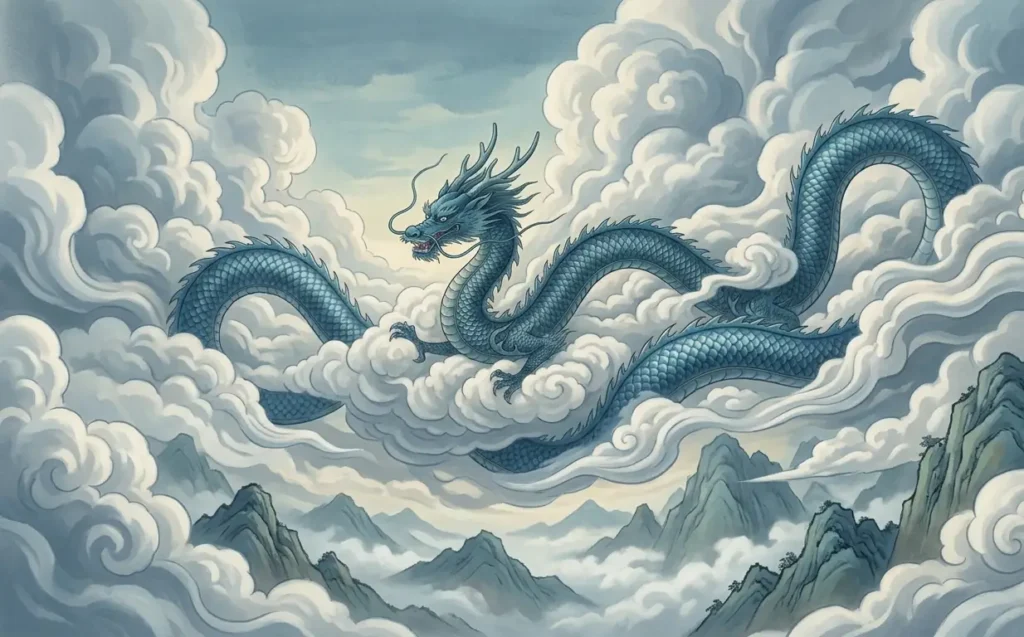
The Chinese Long doesn’t fly through air. It moves through clouds. This distinction matters enormously.
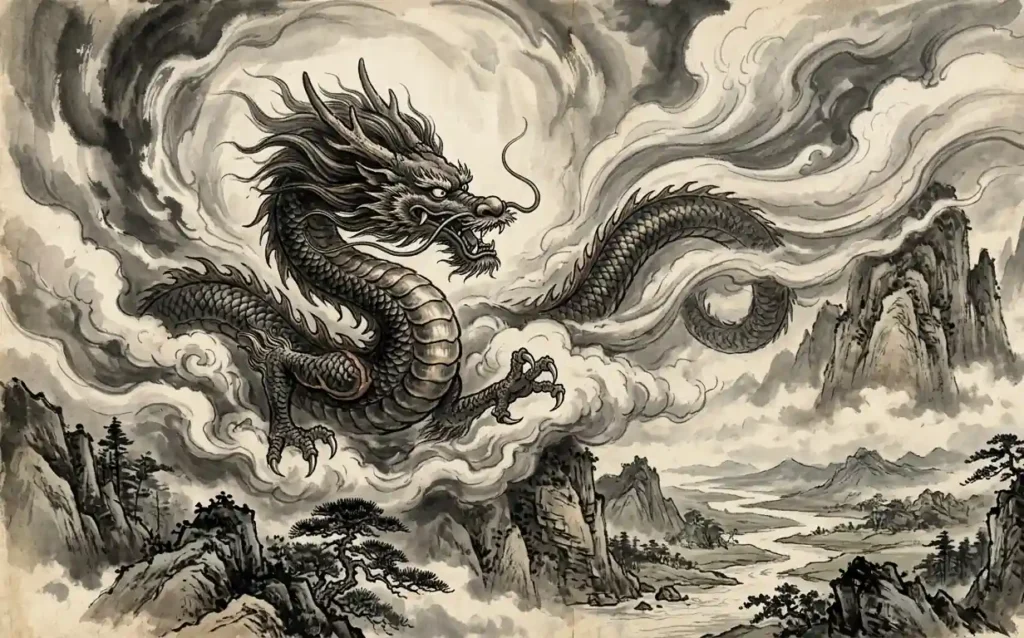
Classical texts and visual traditions consistently depict the Long not soaring in clear sky but inhabiting clouds, emerging from clouds, descending through clouds. The cloud isn’t a backdrop for the flying dragon. The cloud is the medium through which the dragon moves.
Clouds as Dragon Habitat
This makes sense when you consider the dragon’s fundamental association with water and atmospheric phenomena. Clouds in Chinese cosmological thinking aren’t just water vapor in the sky. They’re atmospheric manifestations of the same water-qi that the Dragon Kings govern in rivers and seas.
A being whose nature is fundamentally water-qi related would naturally inhabit its own medium the way a fish inhabits water. The dragon doesn’t fly through air the way a bird does. It moves through the water-qi medium of clouds the way a dragon naturally would.
This explains the visual convention in Chinese dragon art, where you almost never see a dragon in clear sky. The clouds aren’t decoration. They’re the dragon’s element, the medium that enables its movement.
Classical Answer 3: The Nature of a Cosmological Being
Beyond Physical Mechanics
The third and most philosophically complete answer lies in understanding what kind of being the Chinese Long actually is.
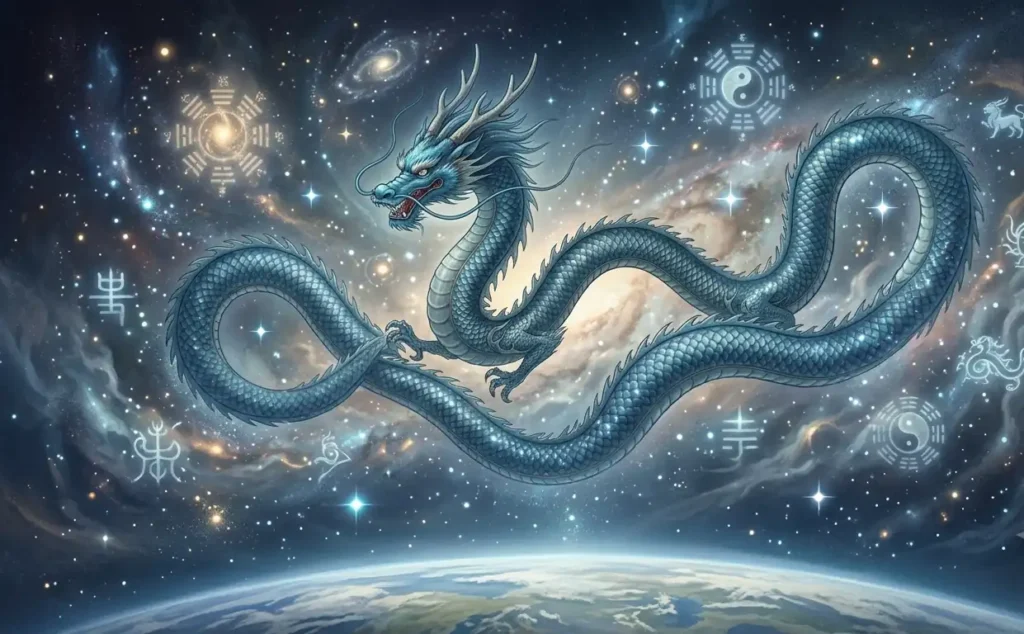
The Long isn’t a dragon in the sense of a large reptilian creature with supernatural abilities. It’s a cosmological being: an expression of the forces that govern natural reality, manifesting in a form that humans can perceive and relate to.
Cosmological beings in Chinese religious tradition don’t move through space the way material objects do. Their movement is an expression of their nature rather than the operation of physical mechanics. When a Dragon King brings rain, the rain isn’t a physical consequence of the dragon physically flying somewhere and performing some physical action. The rain and the dragon’s nature are expressions of the same cosmic qi.
Movement as Natural Expression
This framework means that asking “how does the dragon fly without wings” is somewhat like asking “how does the east wind blow without hands.” The question assumes a physical mechanism where the tradition is describing a natural expression.
The Long moves through the sky because its nature is to move through the sky at certain times and in certain ways. The absence of wings isn’t a problem to be solved but a reflection of the fact that wing-powered flight is a physical mechanism and the dragon’s movement isn’t primarily physical.
The Yinglong Exception Proves the Rule
The Winged Dragon
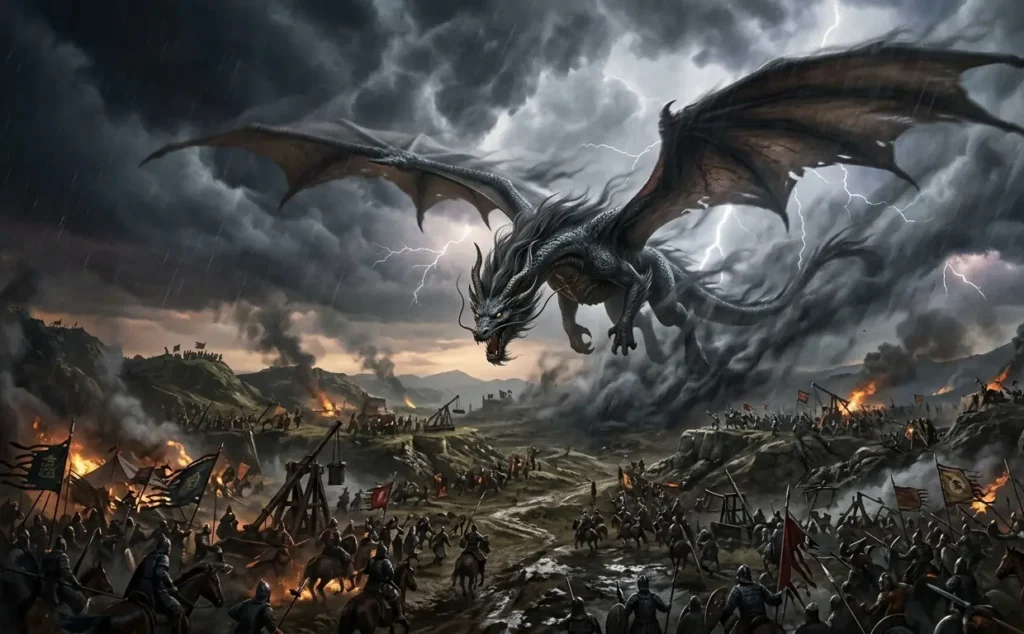
Here’s the piece of evidence I find most compelling for understanding why the standard Long doesn’t need wings: the tradition specifically describes a distinct dragon type that does have wings, the Yinglong (Winged Dragon), and treats this as a distinctive characteristic earned through extreme age.
The Bencao Gangmu describes dragon development across millennia, with wings appearing only at 2,000 years of age. This developmental sequence treats wings as one possible form of aerial capability that a dragon might eventually develop, not as the only or primary means of achieving flight.
If wings were necessary for a dragon to fly, the tradition wouldn’t need to specially note the Yinglong’s wings as a distinctive feature. All flying dragons would have wings. The fact that the Yinglong’s wings are specifically notable, specifically named, and specifically connected to extreme age implies that the standard Long’s flight operates through some other mechanism or principle.
What the Distinction Tells Us
The classical tradition is making a deliberate distinction between two different kinds of aerial movement. The Yinglong flies with wings, in a more physically explicit way. The standard Long moves through clouds via the chi mu and its own cosmological nature, in a less physically explicit way.
Both are real flight in the tradition’s understanding. But they’re different things. The conscious distinction the tradition maintains between them suggests that the wingless flight of the standard Long was understood as a genuine category of movement, not simply a visual convention the artists hadn’t worked out properly.
How This Connects to Dragon Art
Reading Dragon Imagery Correctly
Understanding wingless flight changes how you read classical Chinese dragon art.
When a painting shows a Long writhing through dense cloud formations, this isn’t a stylistic choice to make the composition more dynamic. It’s depicting the dragon in its actual medium of movement, the cloud-qi that is simultaneously atmospheric water and the medium through which this water-associated cosmological being moves.
When a dragon emerges from the sea in a burst of spray, it’s not jumping. It’s transitioning between water and water-qi states, two expressions of the same element it governs.
The details of dragon imagery that seem purely aesthetic often encode specific mythological content about how the dragon moves and what it moves through. The clouds aren’t decoration. The mist isn’t atmosphere. They’re the dragon’s element and medium.
Why This Is Different From Western Dragon Flight
A Useful Contrast
It’s worth being explicit about why this discussion applies specifically to Eastern dragons rather than dragon traditions generally.
Western dragon flight is biological. The dragon has wings because it’s imagined as a physical creature that needs physical mechanisms. The wings are large because the creature is large. Medieval natural historians debated whether dragons had two wings or four, treating the question as a natural history problem.
Eastern dragon flight is cosmological. The Long moves through the sky because its nature is atmospheric and cosmological, because it inhabits the medium of clouds and water-qi, because it has a specific head feature that enables upward movement, and because the category of physics that applies to material animals doesn’t apply in the same way to cosmological beings.
These are genuinely different frameworks for thinking about supernatural creatures, and the wingless flight question is the sharpest possible illustration of how different they are.
References
- Allan, Sarah. The Shape of the Turtle: Myth, Art, and Cosmos in Early China. SUNY Press, 1991.
- Yang, Lihui, Deming An & Jessica Anderson Turner. Handbook of Chinese Mythology. Oxford University Press, 2005.
- Birrell, Anne. Chinese Mythology: An Introduction. Johns Hopkins University Press, 1993.
- The Huainanzi: A Guide to the Theory and Practice of Government in Early Han – An Liu
- Shan Hai Jing – Chinese Text Project
- The Flood Myths of Early China – Mark Edward Lewis
- Xu Shen. Shuowen Jiezi
- Compendium of Materia Medica: Bencao Gangmu
- The Taoist Body – Kristofer Schipper
- Book of Changes : Yi Jing : Qian – Chinese Text Project
- Guangya – Chinese Text Project
Frequently Asked Questions
Do any classical texts give a specific mechanical explanation for wingless dragon flight?
Yes. The chi mu tradition, documented in the Bencao Gangmu and related texts, describes a specific head feature enabling upward movement. Cloud riding as a medium rather than simple flight is also consistently documented. These are genuine classical explanations, not modern inventions.
Is cloud riding the main explanation used in Chinese art?
Yes. Classical Chinese dragon painting almost universally depicts dragons within or emerging from cloud formations rather than flying through clear sky. This visual convention reflects the tradition’s understanding that clouds are the dragon’s movement medium, not simply decorative atmosphere in the composition.
What is the Yinglong and why does it have wings if other dragons don’t need them?
The Yinglong (Winged Dragon) is a distinct dragon type that has lived long enough, over 2,000 years according to the Bencao Gangmu, to develop wings. Its winged flight is different from the standard Long’s cloud movement. The distinction confirms the tradition treated these as genuinely different kinds of aerial movement.
Does the lack of wings make Eastern dragons less powerful than Western dragons?
The question doesn’t apply well because the traditions measure power differently. Eastern dragons’ wingless movement reflects their cosmological rather than physical nature. Western dragons’ wings reflect a biological imagination of flight. Neither tradition considers physical mechanism a primary measure of a dragon’s power or importance.
Do Japanese and Korean dragon traditions explain wingless flight the same way?
The cloud-riding and cosmological nature explanations apply across East Asian dragon traditions. The chi mu specific explanation is documented primarily in Chinese sources. Japanese and Korean dragon traditions share the wingless flight convention without having the same detailed anatomical explanation literature that Chinese tradition developed.
Final Thoughts
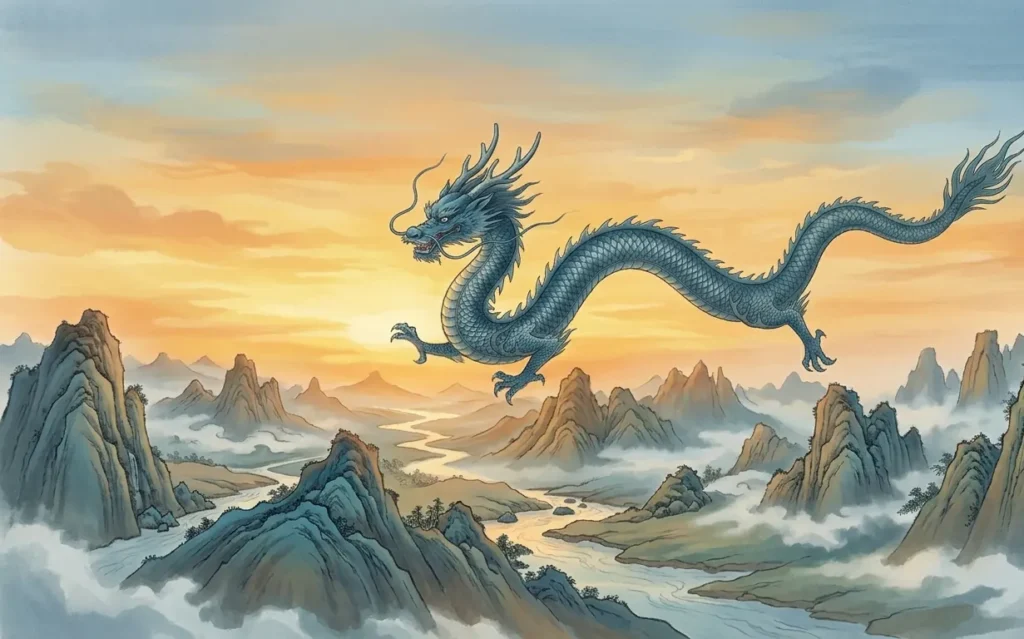
The wingless flight question is deceptively simple. It looks like a biology question: how does a creature fly without the physical mechanism for it?
The real answer is that it’s a cosmology question: what kind of being is the Chinese Long, and what does movement mean for such a being?
The tradition answers at multiple levels simultaneously. A specific head feature for upward movement. A cloud medium through which the dragon naturally moves rather than through which it mechanically pushes itself. A cosmological nature that means the physical mechanics of animal flight simply don’t apply in the same way.
The wingless dragon doesn’t fly. It moves through its own element the way all beings move through theirs. We’re the ones watching from outside, using the word “fly” because we don’t have a better one for what we’re seeing.
Related Articles
- Dragon Mythology: How Dragons Are Depicted Across Cultures
- Chinese, Japanese & Korean Dragons: How They Actually Differ
- 7 Eastern Dragon Facts Most People Believe But Are Wrong
- 11 Eastern Dragon Legends Still Shaping Fantasy Today
- 11 Oldest Dragons in World Mythology: Sumeria to China
- What If Dragons Were Real? Here’s What Would Happen