
 By
By The assumed answer is no. Dark Fantasy is not about Good VS Evil. Dark fantasy is the genre where everyone’s compromised, nobody’s clean, and moral categories dissolve into gray. I think that reading is wrong, and specifically backwards.
Dark fantasy is more morally committed than the fantasy it reacts against, not less. Working out why requires a detour through a religious argument that happened seventeen centuries ago.
Two Ancient Answers to What Evil Actually Is
Mani Said Evil Is a Substance
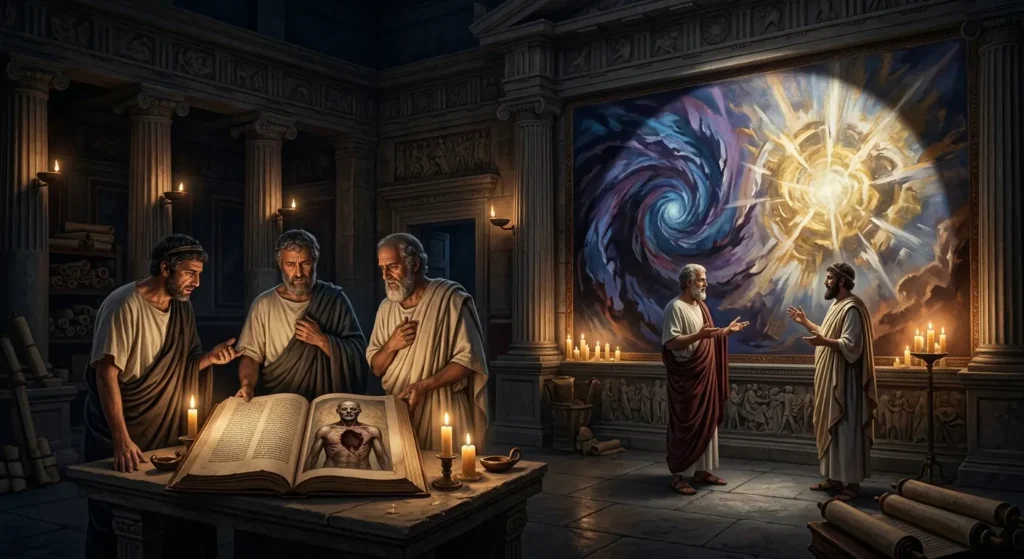
The prophet Mani founded his religion in third-century Persia, under the Sasanian Empire, and it spread remarkably far, reaching the Roman world in one direction and China in the other.
Manichaean cosmology is strictly dualistic. Light and Darkness exist as two co-eternal principles, neither derived from the other, locked in conflict.
Evil isn’t a failure or an absence. It’s a positive substance with its own independent existence, as real as goodness and equally fundamental.
Augustine Said Evil Is a Privation
Augustine of Hippo spent roughly nine years as a Manichaean hearer before converting to Christianity, and he spent much of his subsequent career arguing against the position he’d once held.
His alternative, developed across the Confessions and City of God, is usually called privatio boni.
Evil has no substance of its own. It exists only as a corruption, absence, or falling away from good, the way darkness is the absence of light rather than a competing material, or blindness is the absence of sight rather than a thing you possess.
Why This Distinction Matters for Fiction
These two positions produce completely different stories.
If evil is a substance, you get a cosmic conflict between two forces, and beings can simply be evil by nature. If evil is a privation, there’s no independent dark principle at all, only good things that have been twisted, hollowed out, or turned from their purpose.
Tolkien Was Augustinian. His Imitators Were Manichaean
The Common Assumption Gets Tolkien Wrong
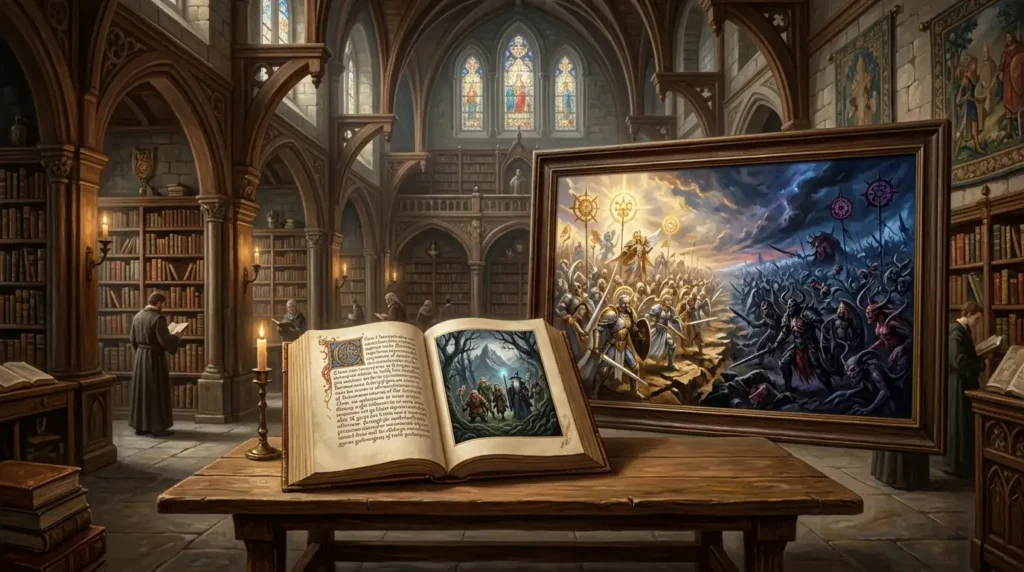
Popular criticism treats Lord of the Rings as the archetype of simplistic good against evil, and dark fantasy as the reaction against it. That framing misreads what Tolkien actually built.
Tolkien was a devout Catholic writing in a broadly Augustinian tradition, and his cosmology reflects it consistently. Melkor begins as the greatest and most gifted of the Ainur before falling. Sauron begins as a Maia, originally aligned with the Vala Aulë, before being corrupted.
In the version Tolkien most often worked with, orcs originate as corrupted elves rather than as an independently created evil race, though he genuinely struggled with this problem and never settled it definitively.
The Ring Corrupts, It Doesn’t Manufacture
The One Ring works by amplifying and twisting desires that already exist in whoever carries it. Boromir wants to save his city. Galadriel wants to protect her realm. Gandalf explicitly refuses it because he’d wield it out of a desire to do good, and knows that desire is exactly what would destroy him.
Nothing in that mechanism requires an evil substance. It requires good intentions with something eaten out of them, which is privation theory operating as a plot device.
What the Imitators Flattened
Commercial fantasy following Tolkien substantially simplified this. Dark Lords appeared who were simply evil, without fall narratives. Evil races appeared who were evil by species rather than by corruption. The cosmology went Manichaean even as the surface furniture stayed Tolkienesque.
Dark fantasy is reacting against that flattening, not against Tolkien himself. Which means the genre isn’t rejecting his moral seriousness. It’s arguably restoring it.
Dark Fantasy Is Aggressively Augustinian
Bayaz: A Purpose Hollowed Out
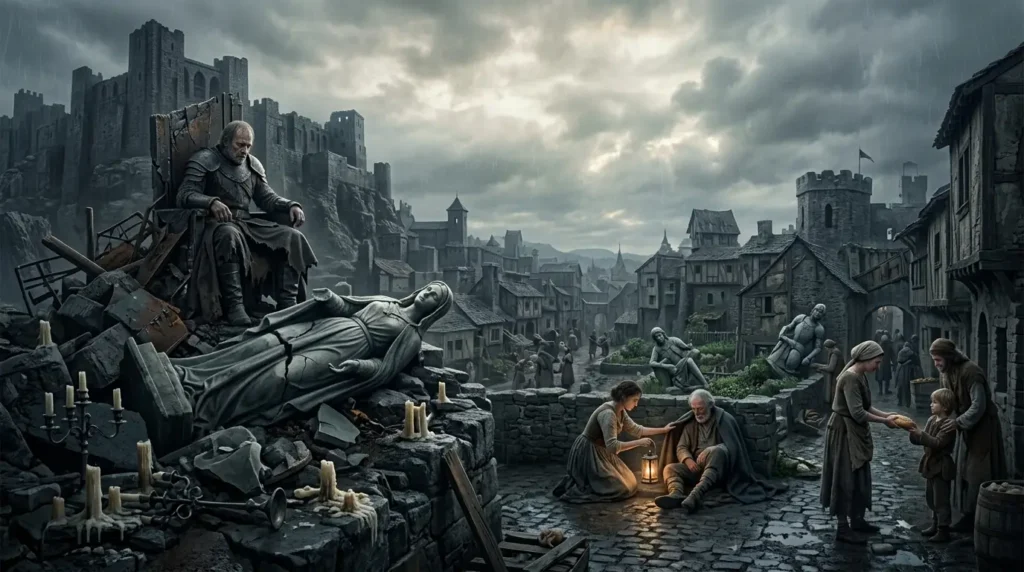
Joe Abercrombie’s Bayaz, First of the Magi, isn’t an evil substance wearing a wizard’s shape. He began with a legitimate function, and the trilogy reveals a man who kept the form of that role while emptying it of everything that made it worth having.
He still gathers parties, still guides young men toward destiny, still speaks in the register of wise counsel. The structure remains. The content is gone. That’s privation described precisely.
Altan: Justice Twisted Into Atrocity
R.F. Kuang’s Altan Trengsin carries a grievance the text refuses to dismiss as illegitimate. His people were subjected to genocide, and his rage begins as something recognizably like a demand for justice.
What follows isn’t the arrival of evil from outside. It’s a real good: the demand that a wrong be answered, corrupted past the point where it can distinguish between justice and further atrocity.
Cersei: Love Under Pressure
George R.R. Martin’s Cersei Lannister, once you reach her own viewpoint chapters, contains genuine maternal devotion and real political capability, both constrained by a system that consistently denied her the position her abilities warranted.
Her cruelty grows out of those real qualities under sustained pressure. Remove the love and the capability and there’s nothing left for the corruption to work on.
The Pattern Holds Across the Genre
Run this test on dark fantasy villains generally and they keep coming back Augustinian. Fallen paladins, corrupted institutions that once served a purpose, gods who were something else before, mentors who genuinely protected something once.
Almost nobody in this genre is evil the way a Manichaean principle is evil. They’re all privated, which requires that something good was there first.
Why This Makes the Genre More Moral, Not Less
Corruption Requires a Standard
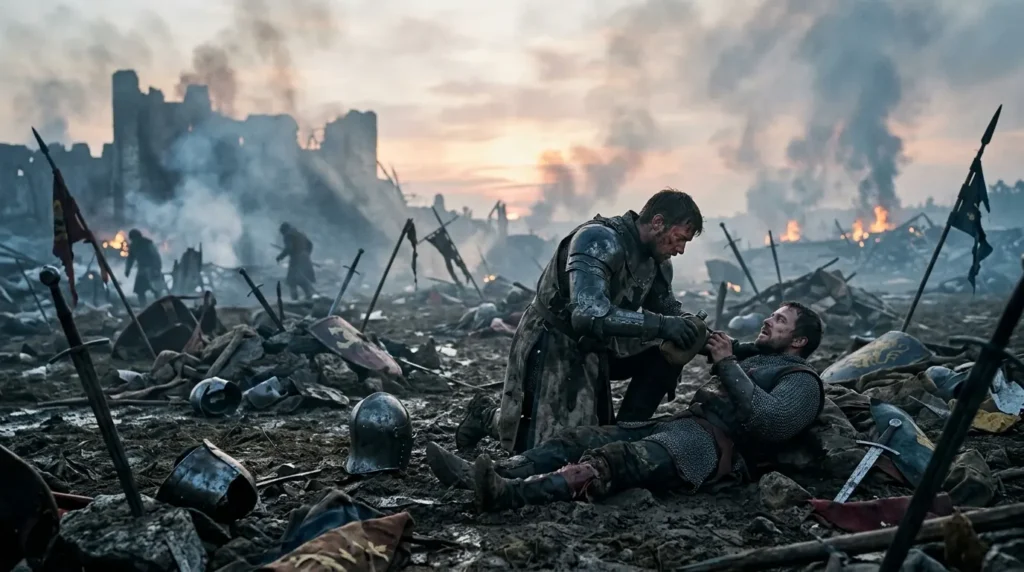
You cannot have corrupted good without good existing to be corrupted. A privation theory of evil is only coherent if there’s a real, positive standard that the privation falls short of.
Dark fantasy, in reaching so consistently for corruption narratives, quietly commits itself to moral realism. The genre needs a genuine good to be recognizable, or its villains stop making structural sense.
Complexity Isn’t Ambiguity
There’s a distinction worth being precise about here, because casual discussion collapses the two constantly.
Moral ambiguity means we genuinely don’t know what’s right. Moral complexity means we know what’s right and it’s difficult, costly, or impossible to achieve without loss.
Dark fantasy almost always does the second. Readers of The Poppy War aren’t uncertain whether the atrocities are wrong. They know exactly what’s wrong, and they watch a character they’ve invested in do it anyway. That’s not ambiguity. That’s clarity with a price attached.
The Reader Supplies the Baseline
Darkness Is a Relational Property
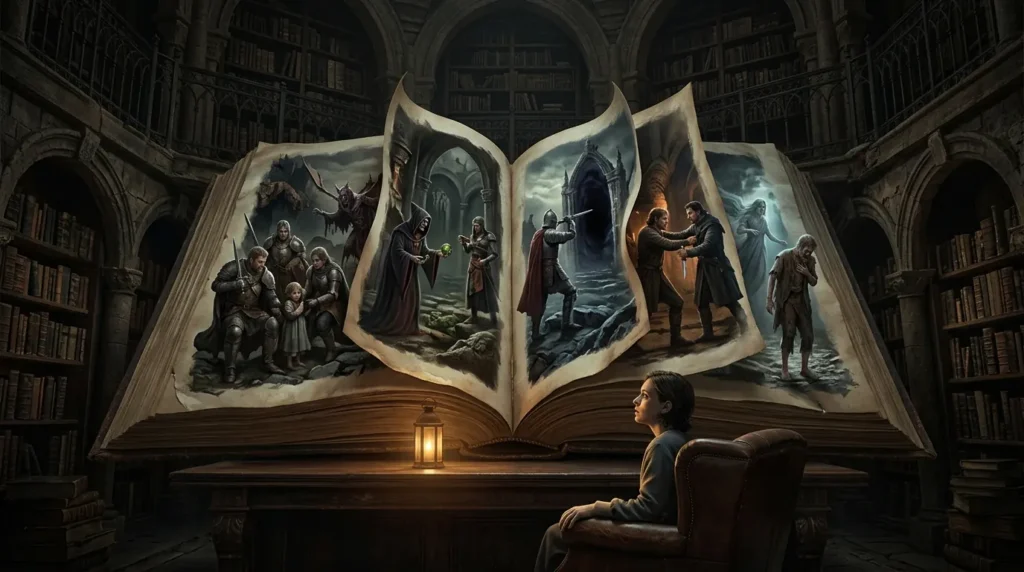
If nothing in a world is good, nothing in it can be dark. Darkness requires contrast to register at all, and a story where cruelty is universal, unremarkable, and unmourned isn’t dark. It’s flat.
This is why relentless grimness without any moral texture reads as tedious rather than disturbing. The reader has nothing to measure the cruelty against.
The Genre Outsources Moral Realism to the Audience
Here’s the mechanism I think explains dark fantasy’s actual moral architecture. No character has to voice the moral standard for that standard to operate in the story.
Abercrombie never has anyone deliver a speech about what Logen should have become instead. He doesn’t need to. The reader’s own discomfort supplies the standard, and the book’s darkness registers precisely because that discomfort is doing exactly what a moral framework does.
The genre trusts its audience to hold the good so the text doesn’t have to state it.
Where This Reading Breaks
Cosmic Horror Isn’t Privation
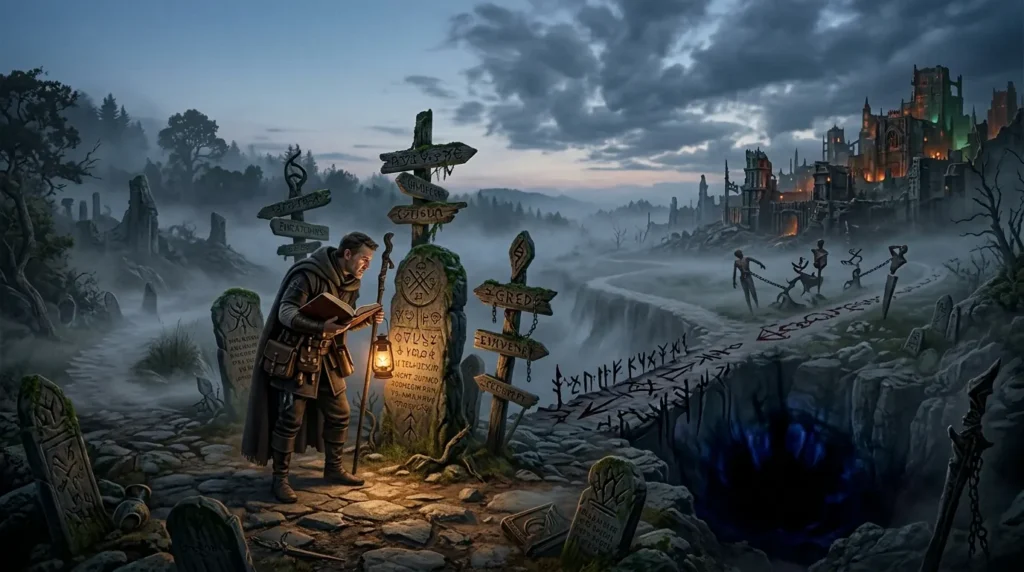
Lovecraftian entities and their descendants don’t fit the Augustinian frame, and I don’t want to force them into it.
An entity that’s genuinely indifferent to human existence isn’t corrupted good. It’s a third category entirely, amoral rather than evil, operating outside the good and evil distinction rather than on the wrong side of it.
That’s a genuine limit on my argument. Cosmic-horror dark fantasy specifically is doing something the privation model doesn’t describe.
Bakker’s Consult Resists It Too
R. Scott Bakker’s Second Apocalypse series constructs antagonists who read as close to irreducibly malevolent, built around goals that don’t obviously trace back to any corrupted good.
Whether that’s a genuine exception or a case where the corruption simply happened so far in the past that the text no longer shows it, I’m not certain. It’s a fair challenge to the reading either way.
Good VS Evil – The Other Side of The Coin
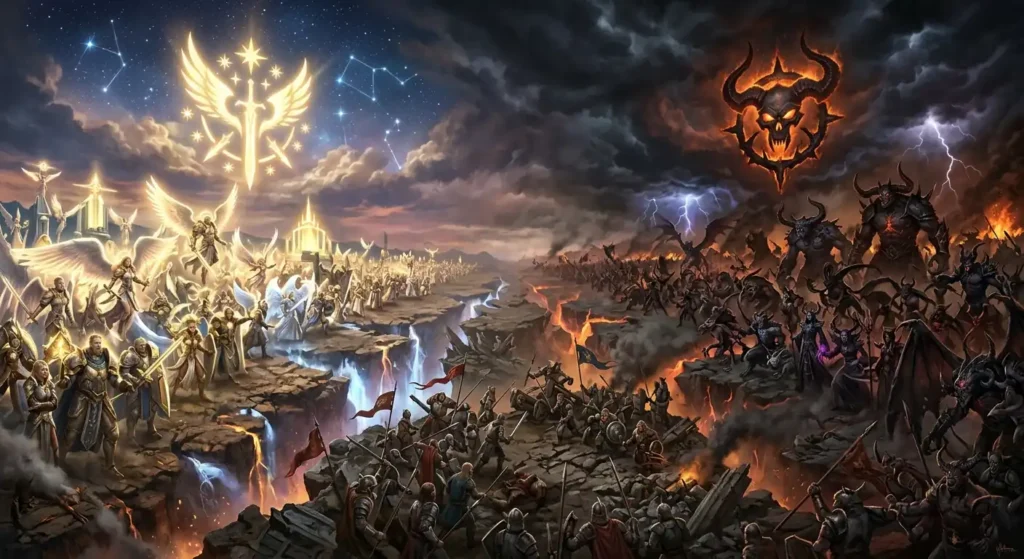
The obvious objection is that I’m smuggling fourth-century Christian theology into books whose authors never touched it and would probably find the framing bizarre.
Abercrombie isn’t writing Augustine. Kuang is drawing on Chinese history, not the Confessions. Martin has never, to my knowledge, described his villains in terms of privated good.
My response is that the structural claim doesn’t require authorial intent. Augustine wasn’t describing a doctrine he invented so much as identifying a pattern in how corruption actually works, and writers who observe human moral failure carefully will tend to arrive at similar structures whether or not they’ve read him.
The theology is a useful lens for seeing what these books are doing. It isn’t a claim about where they got it, and I’d rather be clear about that distinction than let the framework do more work than it’s earned.
Frequently Asked Questions
Is Manichaeism still practiced anywhere today?
No surviving Manichaean communities are known to exist. The religion persisted for roughly a thousand years across a wide geographic range before declining under sustained persecution from Christian, Zoroastrian, and later Islamic and Chinese authorities.
Is calling something Manichaean an insult in modern criticism?
Frequently, yes. The adjective is commonly used in political and literary commentary to accuse an argument or narrative of oversimplifying a complex situation into two starkly opposed sides, generally implying a lack of nuance rather than describing actual religious content.
Are there fantasy works that are deliberately, self-consciously Manichaean by design?
Some fantasy builds explicitly dualistic cosmologies with genuinely co-eternal opposed forces, which produces a structurally different story than corruption narratives. Whether an author intends the theological resonance or simply finds dualism dramatically useful varies a lot by work.
What’s the difference between an amoral universe and an evil one in fiction?
An evil universe contains forces actively opposed to human flourishing. An amoral universe simply doesn’t register human flourishing as a category at all: something cosmic horror generally depicts as more disturbing precisely because indifference offers nothing to negotiate with or oppose meaningfully.
Does moral relativism appear in dark fantasy, or is that something different?
Genuine relativism, the position that moral claims have no truth beyond cultural context, appears rarely. Most dark fantasy assumes atrocity remains atrocity regardless of who commits it or why, which is a realist position rather than a relativist one.
Final Thoughts
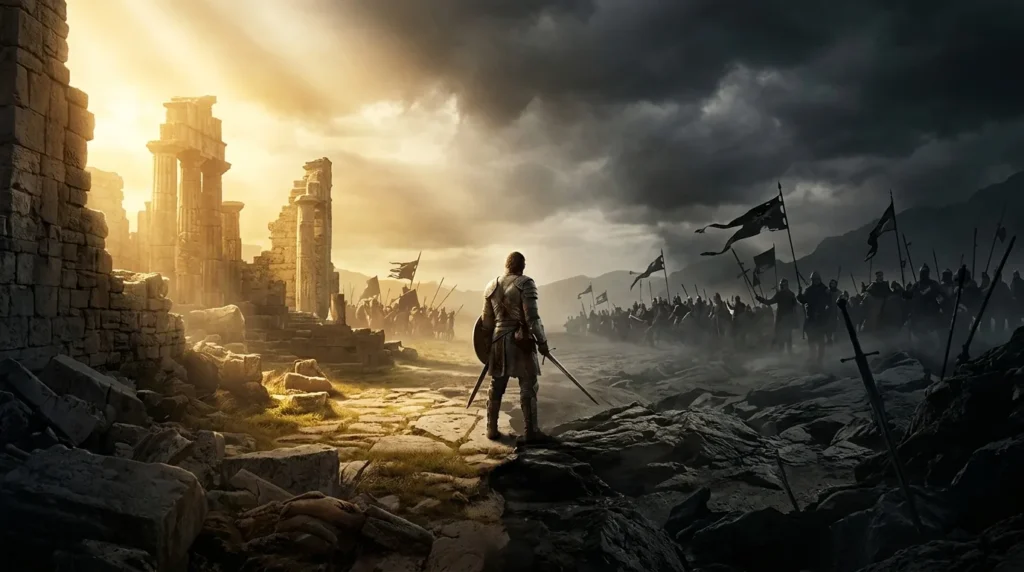
Good and evil exist in dark fantasy. They just stopped being teams you can join and became things you can do.
That’s a harder moral universe to live in than one with a Dark Lord conveniently holding all the evil, and I’d argue it’s a much more serious one.
A genre where anyone can commit atrocity and nobody is exempt by nature is a genre that takes wrongdoing more seriously than one where evil comes pre-sorted into a species you’re allowed to kill without thinking.
Related Articles
- 7 Dark Fantasy Tropes That Make The Genre Work
- Fate vs Free Will: Dark Fantasy’s Favorite Argument
- Grimdark vs Dark Fantasy: Are They One & The Same
- Why Millennials and Gen Z Love Dark Fantasy
- 7 Character Archetypes Every Dark Fantasy Needs
Written by Batin Khan, a curious free spirit who loves reading and exploring the worlds of fantasy, mythology, and ancient stories. Through this blog, B