
 By
By Quick Takeaways:
- Every book on this list has been selected specifically because it delivers a genuine best dark fantasy book experience without extra fuss.
- The list spans subgenre classics, genuinely overlooked gems, and everything between, so there’s an entry point regardless of your dark fantasy experience level
- Dark fantasy can be brutally honest about violence, loss, moral failure, and the cost of power, and every book here proves that
- Rankings reflect what each book does uniquely well rather than consensus popularity
- All 12 are either complete series or satisfying standalone experiences with no abandoned translations or unfinished stories
Disclosure: As an Amazon Associate, I earn from qualifying purchases. This means I may receive a small commission if you buy through links on this site, at no extra cost to you. I appreciate your support
I’ve always loved dark fantasy, but not because it’s bleak. I keep coming back to it for the impossible choices, morally gray characters, and the kind of stories that stay with you long after you’ve finished the last page. The best ones understand that darkness means something. It reveals character, tests convictions, and gives every victory a price.
That’s exactly what you’ll find in this list of the best dark fantasy books. Every recommendation earns its place through exceptional storytelling, memorable characters, and worlds that feel as dangerous as they are fascinating. If you’re looking for dark fantasy that delivers substance as well as atmosphere, I’d start with these.
What Makes These Picks Work
The Criteria
Three things determined placement:
- Quality of darkness – does the dark content serve the story’s meaning, or is it there for atmosphere alone?
- Craft – is the writing good enough to justify the investment the book demands?
- Unique contribution – what does this book offer that nothing else on the list quite replicates?
One thing I should make clear is that Violence is present across most of them, handled with varying degrees of intensity, and I’ve noted where it’s particularly intense.
The 12 Best Dark Fantasy Books
1. The Blade Itself – Joe Abercrombie
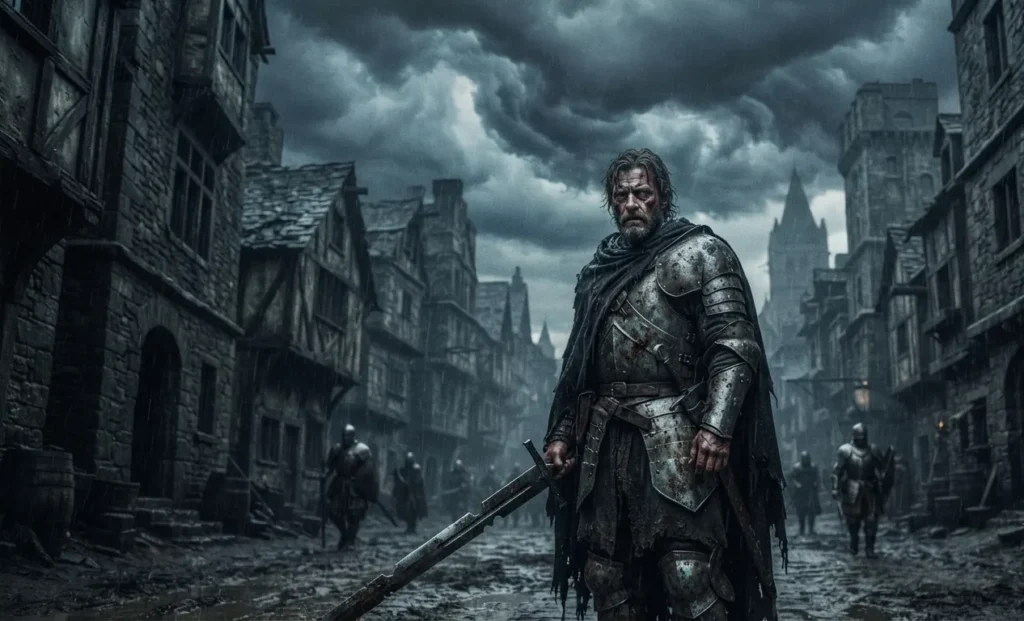
Series: The First Law Trilogy | Status: Complete trilogy plus standalones | Darkness Level: High
Joe Abercrombie’s debut created a template for intelligent grimdark that most successors still haven’t matched. The Blade Itself introduces three characters simultaneously, each one a deliberate subversion of a fantasy archetype, and uses them to construct an argument about violence, heroism, and the stories people tell themselves to justify what they’ve done and what they’re about to do.
Logen Ninefingers is a barbarian warrior with a specific and genuinely frightening problem: he sometimes loses himself in combat in ways he can’t control or remember afterward. He’s not presented as cool or aspirational. He’s presented as a man living with the consequences of having been very good at something terrible for a very long time.
The plotting across the trilogy is precise. Abercrombie sets up expectations methodically and then refuses them, not because he wants to subvert for the sake of subversion, but because the refusal is the point. The darkness here is earned by character investment.
Best For: Readers who want grimdark with genuine intellectual ambition and character depth.
Content Note: Significant violence and torture are depicted critically.
2. The Poppy War – R.F. Kuang
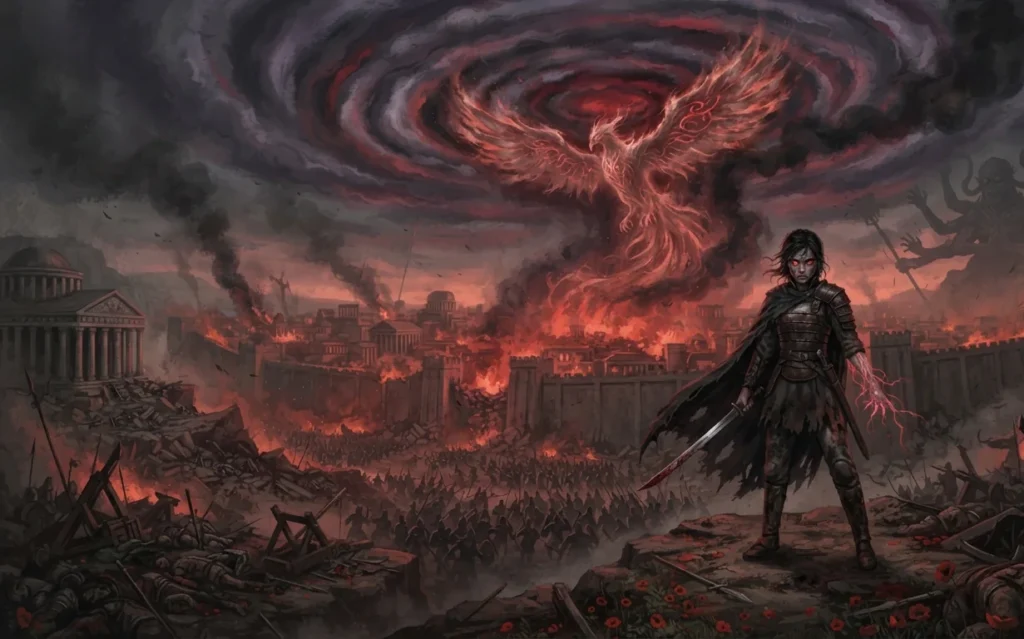
Series: The Poppy War Trilogy | Status: Complete | Darkness Level: Very High
This is the most historically grounded book on the list and the one that uses its darkness most deliberately. R.F. Kuang’s debut takes the framework of a Chinese military academy fantasy, a girl from a poor background who claws her way into the country’s most prestigious school, and uses it to engage with the history of the Second Sino-Japanese War.
The academy sections are compelling fantasy. Then the war begins. What the novel does with its historical subject is refuse to soften or aestheticize atrocity, and that refusal is the entire moral point.
The magic system, which draws on Chinese mythology and shamanic traditions, is genuinely original and deeply integrated with the story’s questions about what power costs and who pays for it.
Kuang’s prose is unflinching in a way that serves the story’s ethical commitments rather than its entertainment value. The darkness is serious and should be taken seriously.
Best For: Readers who want dark fantasy that engages honestly with historical trauma.
Content Note: Graphic war violence, depictions of genocide with historical intent. Author’s notes are essential reading.
3. Gardens of the Moon – Steven Erikson
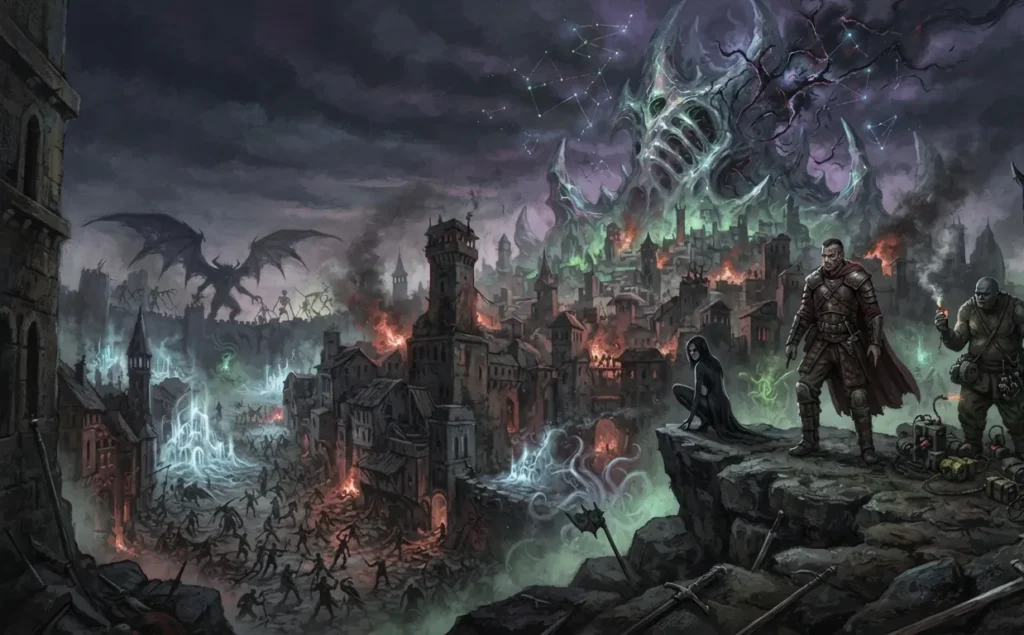
Series: Malazan Book of the Fallen | Status: Complete (10 volumes) | Darkness Level: High
The Malazan Book of the Fallen is the most ambitious completed dark fantasy project in English, and Gardens of the Moon is its entry point. Erikson drops you into a fully realized world with no orientation and trusts you to piece it together. The first hundred pages require commitment. What comes after is one of the richest reading experiences in the genre.
The scale alone is unlike anything else: thousands of years of documented history, dozens of significant viewpoint characters across ten volumes, a magic system of genuine complexity, and a thematic scope that takes grief, compassion, and the weight of history seriously across every volume.
The darkness in Malazan is philosophical rather than atmospheric. Erikson writes armies and battles but never lets you forget that each combatant is a person with their own history.
Character deaths hit with genuine weight because the books made you care specifically about who these people were before they died.
Best For: Readers willing to invest in the most ambitious dark fantasy project in the genre.
Content Note: Significant violence, war, death.
4. Malice – John Gwynne
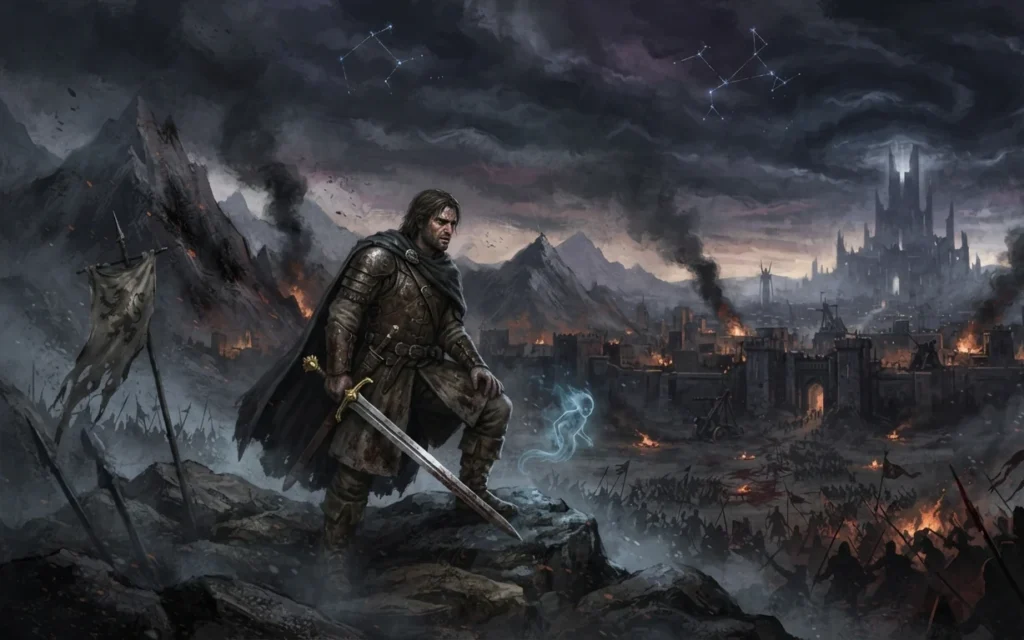
Series: The Faithful and the Fallen | Status: Complete (4 volumes) | Darkness Level: Moderate to High
John Gwynne is one of the genre’s most underrated writers, and Malice is his finest work. He takes a classic epic fantasy framework, a world shaped by an ancient war between good and evil with prophecy and chosen figures at its center, and commits so completely to the human cost of that framework that the result is genuinely affecting in ways that darker, edgier books often fail to be.
The multiple viewpoint structure includes characters on both sides of the central conflict, and Gwynne gives genuine humanity to every perspective rather than simplifying anyone into a narrative function.
The battles are among the best written in the genre because Gwynne doesn’t romanticize them. Fighting costs something. It costs differently for different characters, and the books track that cost across all four volumes.
What distinguishes Malice from most traditional epic fantasy is the emotional seriousness. The grief here is real. The loyalty is real. The moral questions don’t have clean answers.
Best For: Readers who want traditional epic fantasy structure carried with genuine emotional weight and no narrative shortcuts.
Content Note: Battle violence, significant character deaths.
5. Mother of Learning – Domagoj Kurmaic
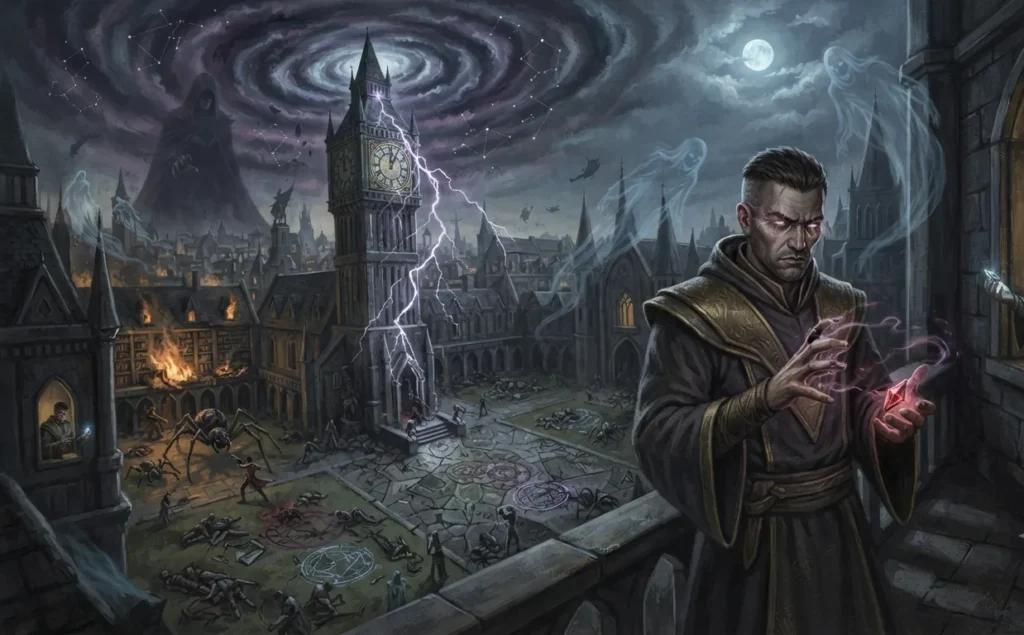
Series: Standalone (originally a web serial) | Status: Complete | Darkness Level: Moderate
Mother of Learning is the best case for the web serial format producing genuinely excellent fantasy, and it’s one of the cleanest reading experiences on this list in every sense. Zorian is trapped in a month-long time loop and uses the repeated time to accumulate magical knowledge and capability at a rate that linear time would never permit.
The progression here is specifically intellectual. Zorian advances by learning, by understanding, by solving problems that the loop gives him essentially unlimited opportunities to approach. The magic system is coherent and the loop mechanics are used with genuine creativity rather than becoming repetitive. Each loop section reveals something new.
Most importantly: it ends. The story is complete, the resolution is satisfying, and the accumulated weight of everything built across the loops makes the ending land with genuine emotional force.
Best For: Readers who want a complete, intellectually satisfying dark fantasy with a time loop premise and no waiting for future volumes.
Content Note: Violence, some dark themes. Accessible to younger readers as well as adults.
6. The Lies of Locke Lamora – Scott Lynch
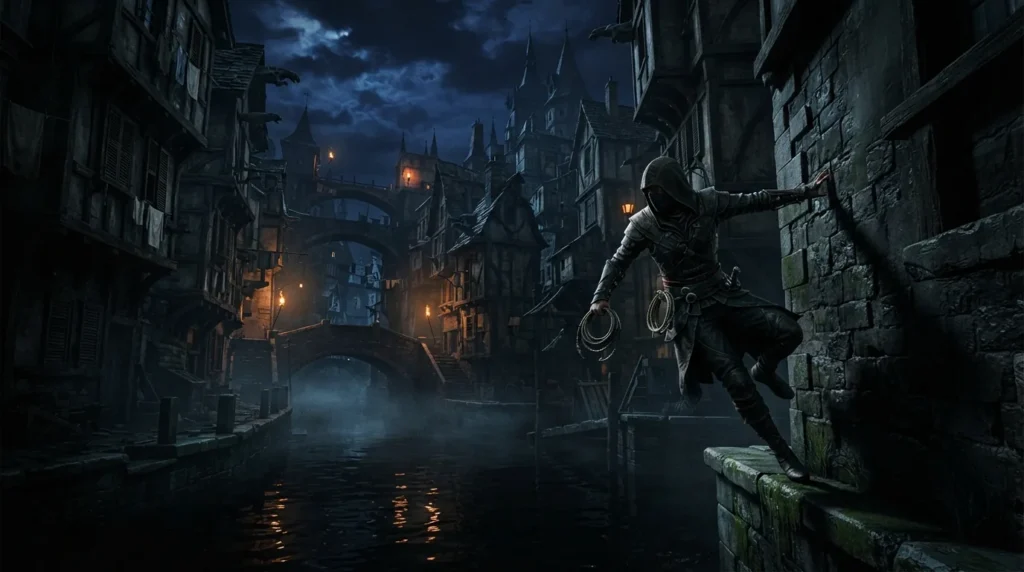
Series: The Gentleman Bastard Sequence | Status: Ongoing (3 published) | Darkness Level: Moderate to High
Scott Lynch’s debut is the most entertaining voice in dark fantasy, and that entertainment is doing real work rather than functioning as a distraction from the darkness underneath.
The Gentleman Bastards are thieves in a city built on the ruins of a more advanced civilization. The cons they run are elaborate and genuinely clever. The city’s criminal underworld is dangerous in ways that escalate throughout the novel.
Lynch uses the heist narrative as a delivery mechanism for genuine darkness about loyalty, loss, and the consequences of living outside conventional social structures.
The novel’s central tragedy is fully earned because the first half invests so completely in the relationships that the tragedy then dismantles.
The prose voice is exceptional: present, witty, and capable of pivoting between comedy and emotional devastation without losing coherence. It’s the kind of writing that makes a long book feel short.
Best For: Readers who want dark fantasy with genuine wit and the most entertaining prose voice in the genre.
Content Note: Violence, strong language, criminal activity.
7. The Way of Kings – Brandon Sanderson
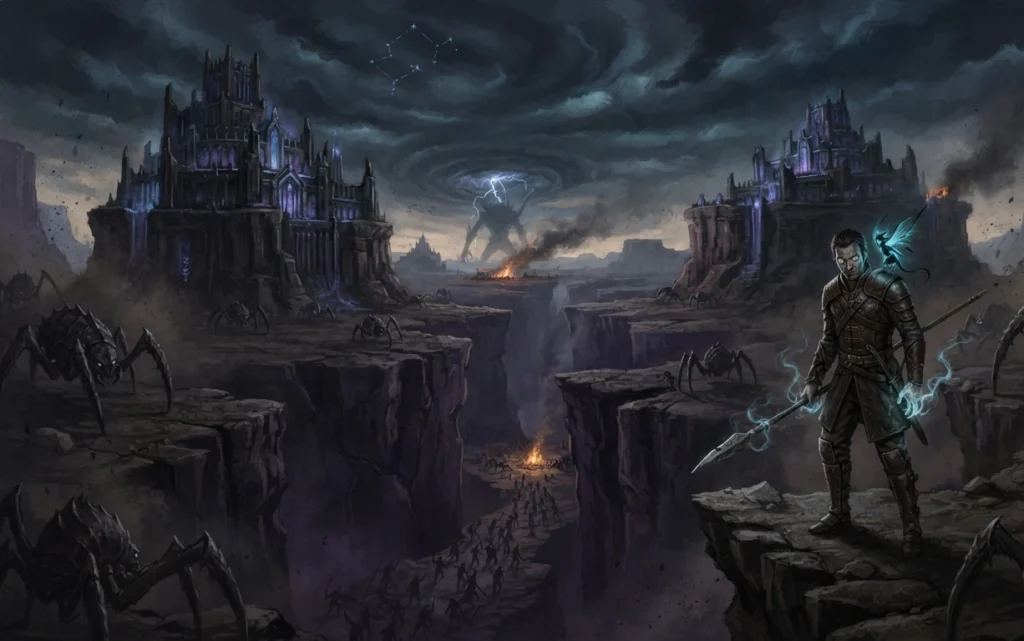
Series: The Stormlight Archive | Status: Ongoing (5 of 10 planned volumes published) | Darkness Level: Moderate
Brandon Sanderson’s most ambitious project is also his best. The Way of Kings takes three central characters whose lives intersect across a world where periodic supernatural storms reshape the ecology and where humanity is fighting a war against creatures they don’t fully understand.
The darkness here is primarily psychological. Kaladin, the main viewpoint character, is fighting depression as much as he’s fighting literal adversaries.
The book takes mental health seriously rather than using it as a character quirk, and the way his state of mind is rendered across the novel is some of the most honest writing about depression in genre fiction.
The magic system is characteristically intricate. The world-building is characteristically meticulous. What makes Stormlight stand apart from Sanderson’s other work is the emotional seriousness: this is a story about people who have been genuinely broken and about what it costs to keep going anyway.
Best For: Readers who want epic dark fantasy that takes psychological and emotional depth seriously alongside spectacular world-building.
Content Note: Violence, war, mature themes.
8. Jonathan Strange and Mr Norrell – Susanna Clarke

Series: Standalone | Status: Complete | Darkness Level: Moderate, building to high
Susanna Clarke’s debut is one of the most unique novels in the history of fantasy fiction, and ten years of recommending it hasn’t made me any less enthusiastic about what it does.
Set in an alternate early 19th century England where magic has returned, the novel follows two magicians whose very different personalities and approaches to their art produce a conflict with consequences neither anticipated.
Clarke writes in a deliberate pastiche of 19th century prose, complete with extensive footnotes describing England’s magical history, and the effect is extraordinary: the world feels genuinely, thoroughly real.
The darkness builds slowly. The faerie figure known as the Gentleman with the Thistle-Down Hair, who appears to help Strange and Norrell’s work and then does things with that help that neither of them fully understands, is one of fantasy fiction’s most genuinely unsettling antagonists.
He’s polite, he’s charming, and what he does to people is horrible in ways that the novel reveals gradually.
Best For: Readers who want slow-build atmospheric dark fantasy with exceptional prose and one of the genre’s most genuinely unsettling antagonist figures.
Content Note: Themes of captivity, psychological manipulation, and some violence.
9. The Goblin Emperor – Katherine Addison
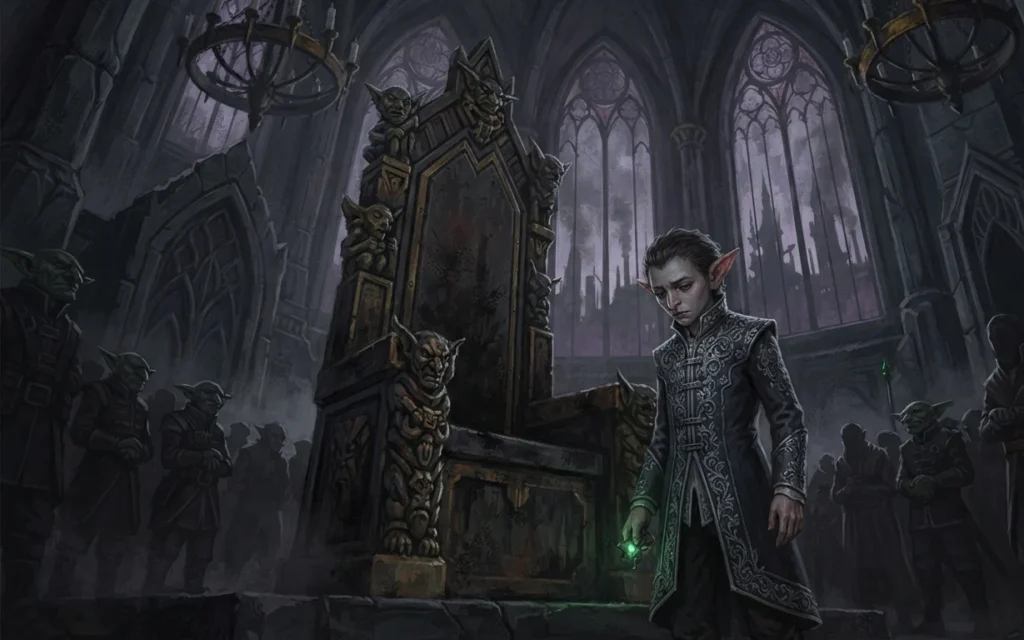
Series: Standalone (with a sequel novel) | Status: Complete | Darkness Level: Low to Moderate
This placement will surprise readers who expect a dark fantasy list to consist entirely of grim, brutal books.
The Goblin Emperor earns its place because the darkness it engages with, political violence, court intrigue, the weight of institutional power on individuals, and the specific difficulty of being a genuinely good person in an environment designed to reward something else, is real and seriously handled even if the tone is warmer than most entries on this list.
Maia is the half-goblin youngest son of the emperor, overlooked and isolated, who unexpectedly inherits the throne when his father and brothers are killed.
He knows almost nothing about court life. He has no allies. He is surrounded by people who either want to use him or undermine him, and he has to navigate all of this while also trying to be the kind of ruler he believes he should be.
The book’s darkness is quiet but genuine. What it means to hold power you didn’t seek, to maintain your principles when everything around you rewards abandoning them, to be kind when kindness isn’t strategically optimal: these aren’t trivial themes. They’re just handled with more warmth than the genre usually allows.
Best For: Readers who want dark fantasy themes handled with emotional warmth, and those who want to prove to themselves or others that the genre doesn’t require brutality to be meaningful.
Content Note: Political violence, court intrigue. Suitable for older teen readers.
10. Senlin Ascends – Josiah Bancroft
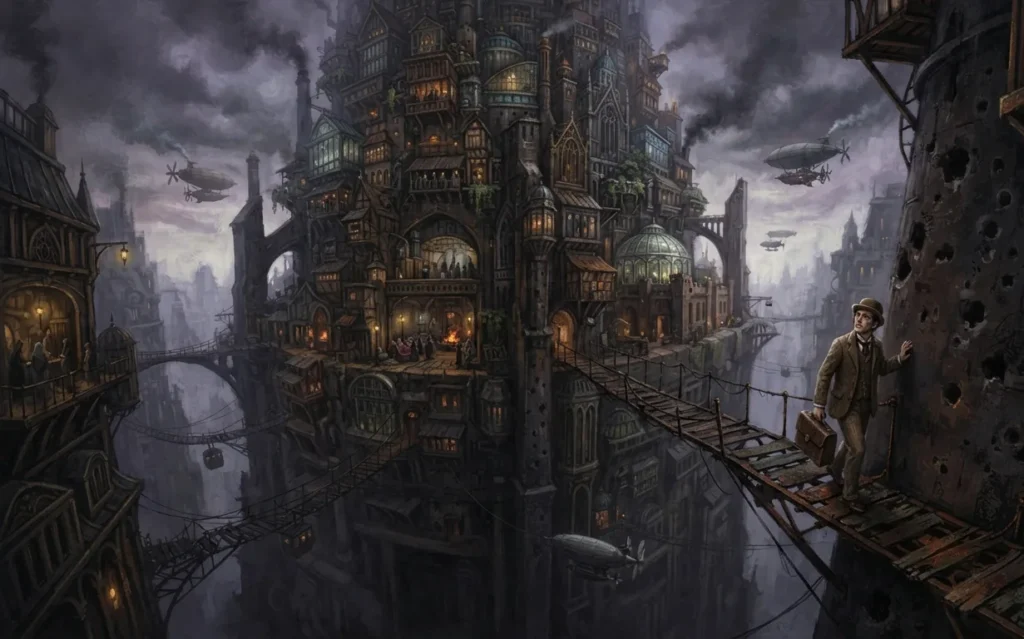
Series: The Books of Babel | Status: Complete (4 volumes) | Darkness Level: Moderate, building to high
Josiah Bancroft self-published Senlin Ascends before it was discovered by a traditional publisher, and the fact that it was nearly lost to obscurity is one of the genre’s more alarming near-misses. It’s genuinely one of the most original dark fantasy novels of the past decade.
Thomas Senlin is a schoolteacher on his honeymoon who enters the Tower of Babel, a vast and inexplicable structure that contains entire civilizations within its concentric rings, and immediately loses his wife in the crowd. The rest of the series is his attempt to find her by ascending through each level of the tower.
The darkness builds as Senlin moves higher. Each level of the tower is distinct, each has its own social structure, its own economics, its own relationship with the levels below it, and Senlin changes as he moves through them in ways that create genuine moral complexity. The person who began this journey would not recognize the person continuing it by the third book.
Best For: Readers who want genuinely original dark fantasy world-building and a protagonist whose moral transformation is as central to the story as the adventure itself.
Content Note: Violence, some thematic darkness around exploitation and power.
11. Children of Blood and Bone – Tomi Adeyemi
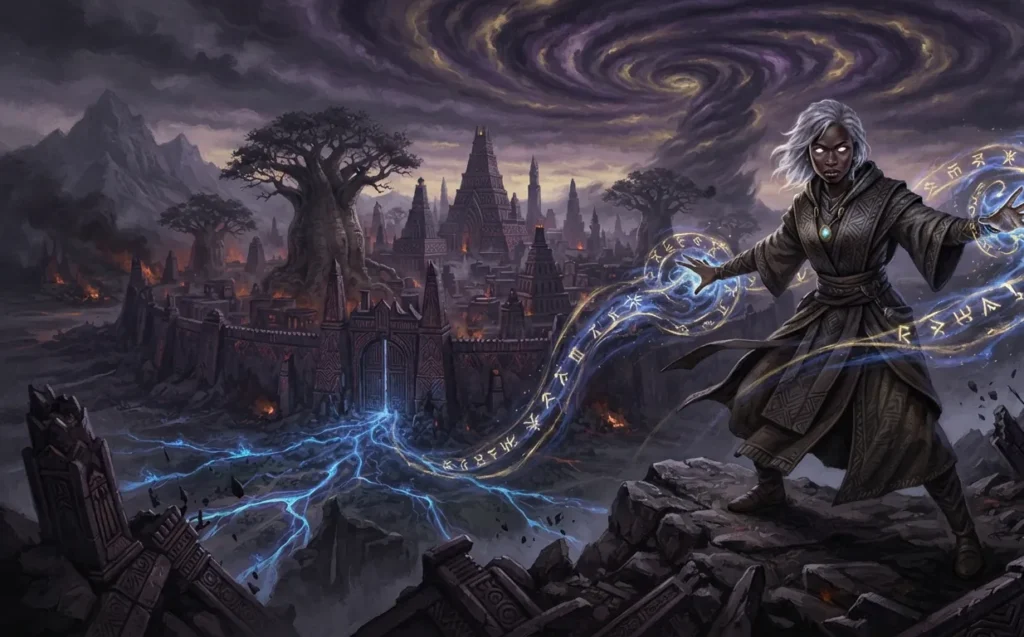
Series: Legacy of Orisha | Status: Complete (2 volumes) | Darkness Level: Moderate
Tomi Adeyemi’s debut is the most accessible book on this list and the one that demonstrates most clearly that dark fantasy doesn’t require complexity of style to be meaningful. The directness of the storytelling is itself a choice, and it’s the right choice for what the novel is doing.
The world of Orisha is built on West African mythology and culture rather than the European medieval framework that dominates the genre. Magic has been destroyed, and those who were born with the potential to use it are oppressed by a ruling class that fears its return.
Zélie, the central character, discovers a chance to restore magic and what follows is a genuinely dark story about oppression, resistance, the cost of fighting back, and what happens to people who’ve been ground down for long enough to be angry in ways that can’t be controlled.
The anger is the book’s most important quality. It’s not romanticized. It’s treated as the natural response to specific conditions, with specific consequences.
Best For: Readers new to dark fantasy, younger readers (the series is YA but fully satisfying for adult readers), and anyone who wants dark fantasy rooted in non-European mythology.
Content Note: Violence, themes of oppression and systemic cruelty. Appropriate for teen readers.
12. The Chronicles of the Black Company – Glen Cook
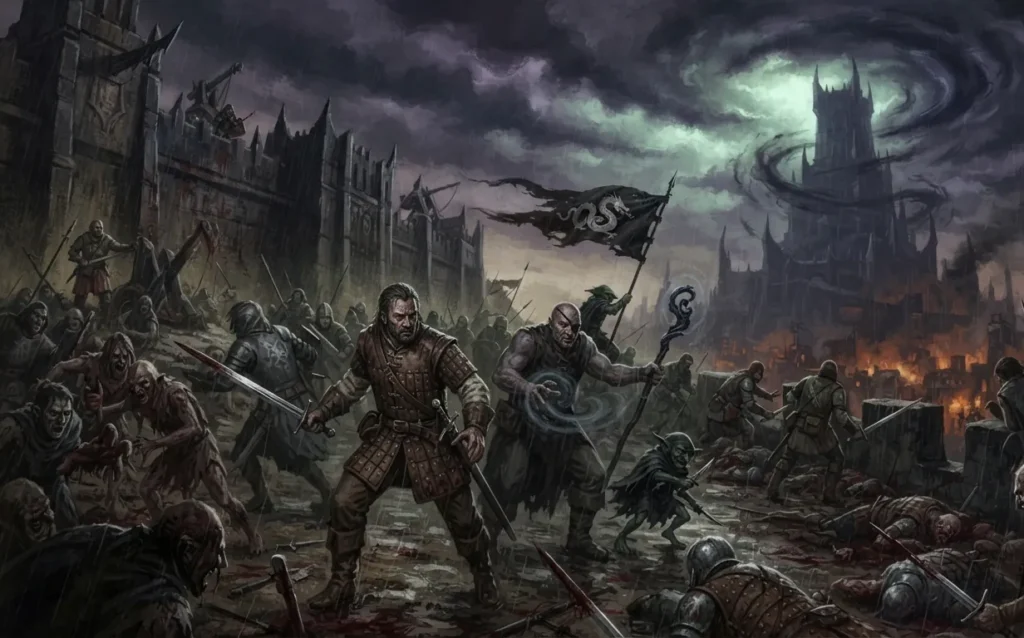
Series: The Black Company | Status: Complete (across multiple volumes) | Darkness Level: High
Glen Cook’s Black Company series is the hidden gem of this list, the book that most deserves more attention than it receives from contemporary readers who came to the genre after grimdark was established.
The series predates grimdark as a recognized category and arguably helped create it. The Black Company is a mercenary company that has taken a contract with an entity of enormous power and possibly evil nature, and the story is told from the perspective of Croaker, the company’s physician and annalist, who records events with the specific moral distance of someone who has made his peace with what he does for a living.
Cook’s prose is spare and deliberately unromantic. The magic is powerful and alien. The darkness comes from the consistent refusal to give the narrative the moral clarity that fantasy usually provides: the Black Company fights for the wrong side, knows it, and keeps fighting anyway because the contract matters and the company is all they have.
What emerges is one of fantasy’s most honest depictions of how people rationalize participation in morally compromised institutions.
Best For: Readers who want the genre’s historical starting point for morally ambiguous dark fantasy, and those who want clean, unromantic prose that earns its grimness.
Content Note: Violence, war, moral ambiguity throughout.
Quick Reference Table
| Rank | Title | Author | Accessibility | Tone | Status |
|---|---|---|---|---|---|
| 1 | The Blade Itself | Abercrombie | Moderate | Grim, sharp | Complete |
| 2 | The Poppy War | Kuang | Moderate | Unflinching | Complete |
| 3 | Gardens of the Moon | Erikson | Challenging | Epic, philosophical | Complete |
| 4 | Malice | Gwynne | High | Emotional, battle-focused | Complete |
| 5 | Mother of Learning | Kurmaic | High | Intellectual | Complete |
| 6 | The Lies of Locke Lamora | Lynch | High | Witty, dark | Ongoing |
| 7 | The Way of Kings | Sanderson | High | Epic, psychological | Ongoing |
| 8 | Jonathan Strange and Mr Norrell | Clarke | Moderate | Atmospheric, literary | Complete |
| 9 | The Goblin Emperor | Addison | Very High | Warm, political | Complete |
| 10 | Senlin Ascends | Bancroft | High | Original, building | Complete |
| 11 | Children of Blood and Bone | Adeyemi | Very High | Direct, angry | Complete |
| 12 | The Black Company | Cook | Moderate | Spare, honest | Complete |
Frequently Asked Questions
Which book on this list is best for a complete dark fantasy beginner?
The Goblin Emperor is the most accessible and least intense entry point. Malice is the best choice if you want something more traditionally action-focused. Mother of Learning works well for readers coming from fantasy with progression or magic system emphasis. All three are complete and completely clean.
Which books on this list are suitable for teen readers?
Children of Blood and Bone is YA and fully appropriate for teen readers. The Goblin Emperor is also suitable for older teens. Mother of Learning is clean enough for mature younger readers. The Way of Kings is appropriate for older teens who read at an adult level.
Are there any complete standalone novels on this list?
Yes. Jonathan Strange and Mr Norrell is a complete standalone (Piranesi by the same author is also an excellent standalone). The Goblin Emperor functions as a standalone despite having a sequel. Mother of Learning is a complete story in one volume.
Which book on this list has the most original world-building?
Senlin Ascends offers the most original setting: a tower containing entire civilizations that is genuinely unlike any other fantasy world-building I’ve encountered. Jonathan Strange and Mr Norrell’s alternate England is equally original in a different direction. Gardens of the Moon has the most elaborately constructed dark fantasy world.
Is The Poppy War appropriate for all readers despite the dark content?
The Poppy War is specifically not appropriate for readers who want to avoid depictions of war atrocity and genocide. The content is handled with serious intent rather than gratuitously, but it is genuinely intense. Kuang’s author’s notes provide important context. It’s appropriate for mature adult readers prepared for that specific type of darkness.
Final Thoughts
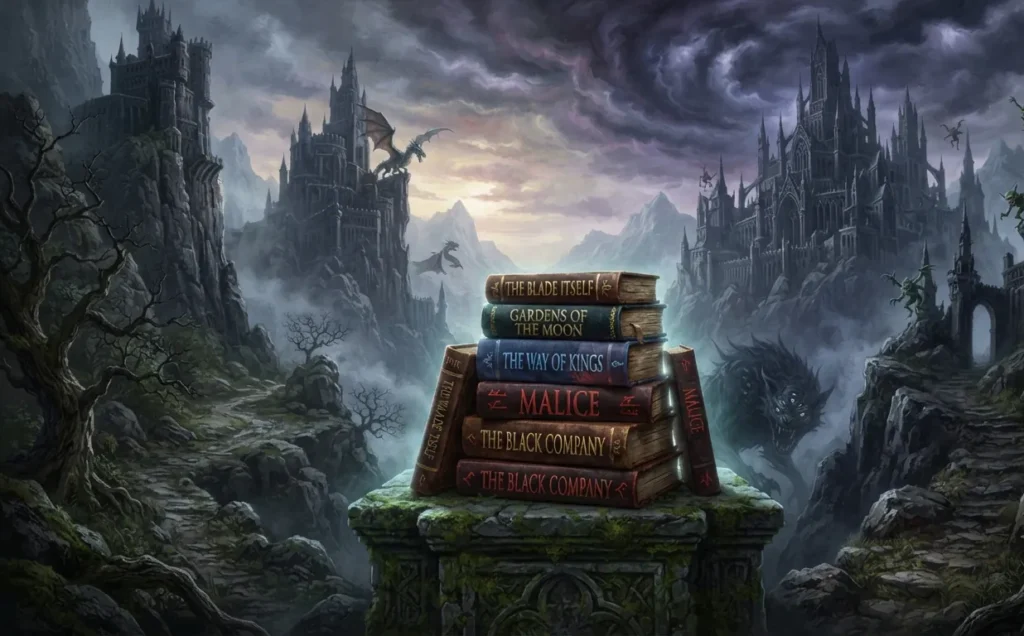
Twelve books. Twelve different answers to what dark fantasy can be when it takes its possibilities seriously without relying on explicit content to generate impact.
Abercrombie deconstructs heroism. Kuang uses fantasy to process historical trauma. Erikson builds philosophy into mass-scale military fiction. Gwynne proves emotional seriousness can coexist with traditional epic structure. Kurmaic shows the time loop premise working as genuine progression.
Lynch combines wit and devastation without sacrificing either. Sanderson takes psychological depth to epic scale. Clarke builds dread through exquisite period prose. Addison demonstrates warmth and darkness aren’t mutually exclusive. Bancroft creates a tower civilization unlike anything else in the genre.
Adeyemi brings genuine anger to an accessible YA frame. Cook strips away romantic illusion with four-decade-old precision.
There’s a starting point here for every kind of reader. The darkness is real. The craft is genuine. The content is clean.
Related Articles
- Grimdark vs Dark Fantasy: Are They One & The Same
- Why Millennials and Gen Z Love Dark Fantasy
- Is Dark Fantasy Horror? Where the Line Actually Falls
- Why Every Great Dark Fantasy Needs a Cursed Kingdom
- How to Build a Dark Fantasy World That Actually Disturbs
- Dark Fantasy vs Gothic Fantasy: Where’s the Line?
- 14 Dark Fantasy Books That Don’t Need a Sequel [2026]
- 13 Dark Fantasy Books That Show No Mercy [2026]
Written by Batin Khan, a curious free spirit who loves reading and exploring the worlds of fantasy, mythology, and ancient stories. Through this blog, Batin hopes to share that sense of wonder with readers while building an exciting future along the way.