

 By
Quick Takeaways:
- Hestia has almost no stories, but the Greek texts keep placing her at the center of oaths, supplications, newborn rituals, and meals.
- My reading is that she’s a place more than a character. The hearth is where Greek rules about belonging get enforced, so she doesn’t need a plot.
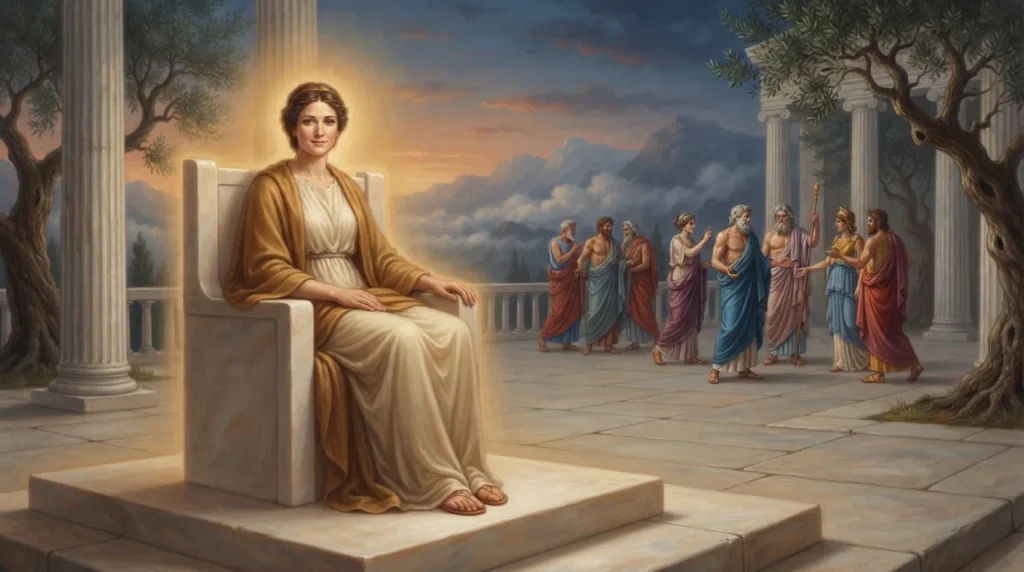
- Plato has the other gods drive their chariots across the sky while Hestia stays home. I think that’s the best one line summary of her.
- Her low profile might not mean reverence. I’ll lay out the case that it’s partly neglect.
In Plato’s Phaedrus, Socrates describes the gods setting out in procession, each driving a winged chariot toward the edge of heaven. Zeus leads, the other gods and spirits follow in ranks, and one god doesn’t go.
“Hestia alone remains at home,” the passage says. I love that line, because it’s funny, a little sad, and probably the truest thing anyone wrote about her.
I mentioned Hestia briefly in my piece on the twelve Olympians. This article asks why a goddess with so few stories shows up at nearly every important moment of Greek domestic life.
Almost Nothing Happens to Her
Born First, or Last
Hesiod lists Hestia first among the children Rhea bore to Cronus, ahead of Demeter, Hera, Hades, Poseidon, and Zeus. Cronus swallowed them in turn, and Zeus’s trick brought them back up.
Handbooks often add that since the first swallowed would be the last freed, Hestia is both eldest and youngest. I haven’t tracked that to an ancient source, so treat it as a tidy modern observation.
The Vow
The story with the most detail is in the Homeric Hymn to Aphrodite. It says Aphrodite can bend almost every god, but three goddesses are beyond her: Athena, Artemis, and Hestia.
Poseidon and Apollo both wanted to marry Hestia, and she refused. She swore a great oath by Zeus’s head to stay a virgin forever.
Zeus’s Reward
In return, the hymn says Zeus gave her a high honor instead of marriage. She sits in the middle of the house, gets the richest portion of offerings, and has a place in every temple.
That’s the closest thing to an origin story she has. Even here, nothing happens to her. She says no, and the poem moves on to the next god.
What’s Missing
She isn’t a character in the Iliad or the Odyssey. She has no famous lovers or children, no jealous rival, and no punishment story, which is unusual in a pantheon where Hera and Athena have dozens.
I find that absence striking. A Greek poet had every chance to give the oldest sister of Zeus an adventure, and none of them did.
The Place Where Rules Got Enforced
Why Odysseus Sits in the Ashes
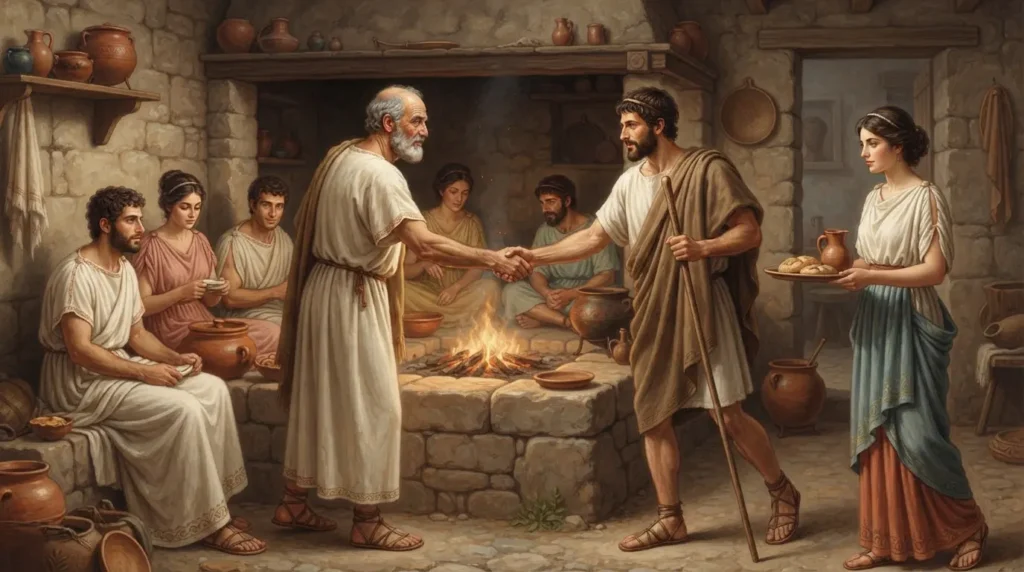
In Odyssey Book 7, Odysseus arrives at the palace of the Phaeacians and walks past King Alcinous to the queen, Arete. He wraps his arms around her knees and sits in the ashes by the hearth.
The room goes quiet. An elder tells Alcinous it isn’t proper to leave a stranger in the ashes, and Alcinous raises him up and offers food.
A Politician and a Child
Thucydides tells a more cold blooded version. When Themistocles fled Athens, he went to King Admetus of the Molossians, who was away and hostile to him.
Admetus’s wife told him to take the king’s young child and sit at the hearth. Thucydides calls that the most powerful form of supplication, and when Admetus came home, he refused to hand Themistocles over.
Oaths Made at the Fire
Odysseus, disguised as a beggar, swears in Book 14 by Zeus, by the host’s table, and by the hearth of blameless Odysseus. He’s swearing by the house itself.
Put the three scenes together and the pattern is clear. The hearth is where a stranger becomes protected and where a promise becomes binding.
The Mycenaean Hearth
Archaeology points the same way. The palace at Pylos has a big circular hearth in the central room, ringed by four columns, with a throne against one wall.
Excavators found it decorated and apparently used for libations. I’d treat the religious reading as an inference, but it suggests that the hearth was the ceremonial heart of the building more than a thousand years before Plato.
The Hearth and Life’s Thresholds
Babies Went Around the Fire
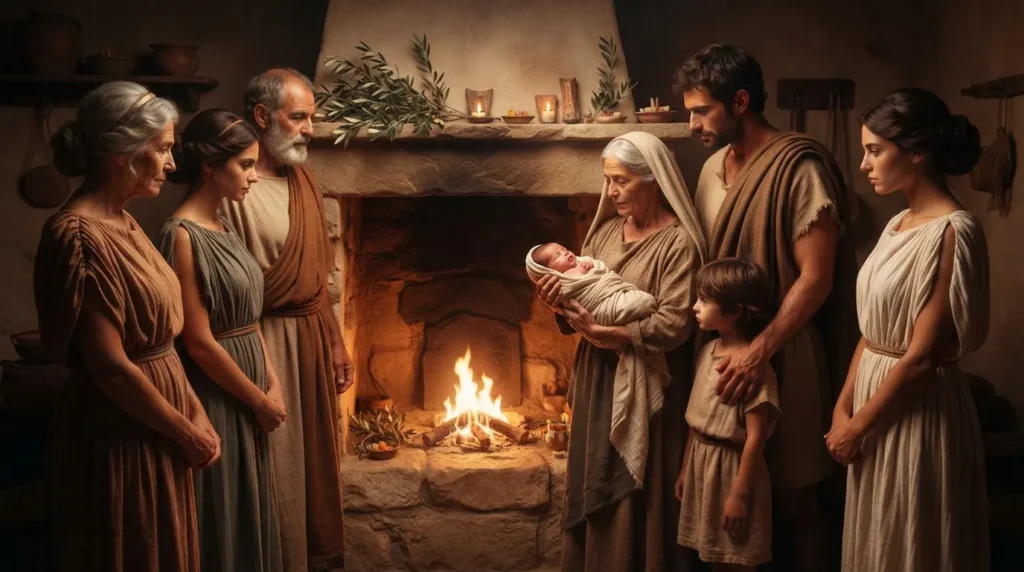
The Greeks had a household ritual called the Amphidromia, literally the running around. A few days after birth, the family carried the newborn around the hearth.
Plato’s Socrates uses it as a joke in the Theaetetus, asking whether a new idea should be run around the hearth to see if it’s worth rearing. The timing varies in later lexicographers, so I wouldn’t pin it to a day.
The Gateway Into the House
Aristophanes mentions showering a new slave with nuts and dried fruit at the hearth. Scholars treat that as part of how a newcomer was welcomed into the household.
I’m working from a few scattered references here, so I’d call the picture suggestive. The hearth seems to have been where you formally joined.
The Opening and Closing Pour
The Homeric Hymn to Hestia and Hermes says mortals hold no feast where one doesn’t pour sweet wine to Hestia first and last. The line is a statement about meals, and it gives her the first and last word.
Her first offering at a feast fits the pattern. She begins and ends things without ever appearing in the middle.
Hestia and Hermes, Inside and Outside
The Pairing
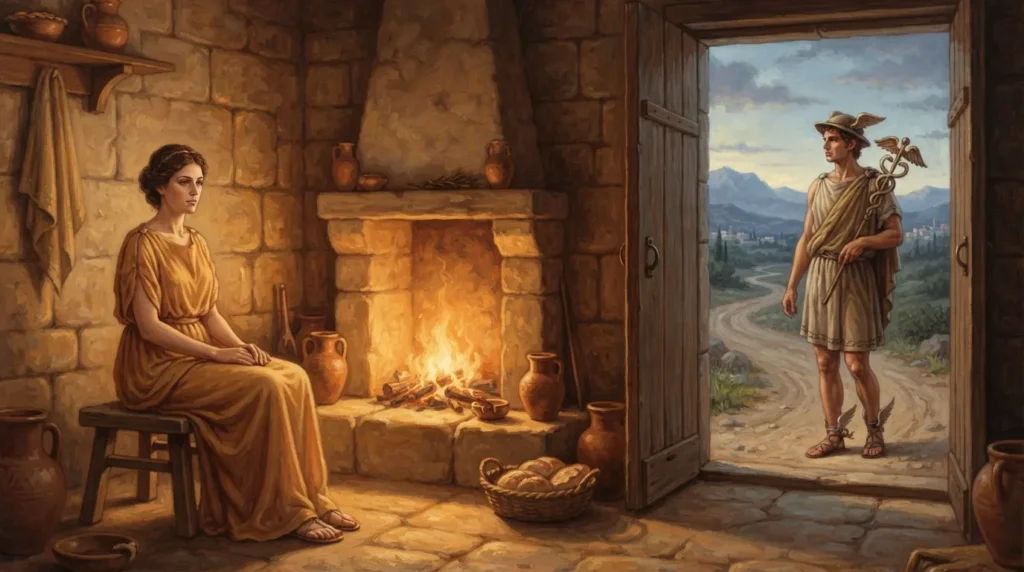
The shared hymn is short, but it isn’t random. Jean Pierre Vernant’s essay on Hestia and Hermes, first published in 1963, argued that the two gods express opposite poles of Greek space.
Hestia is the fixed center, the hearth inside the house. Hermes is movement, the herm pillar at the door and the road beyond it.
Why That Works
I wrote about Hermes in a separate article, where I argued he presides over exchange at the edge of things. Put the two together and you get a complete household: a center that doesn’t move and a boundary that lets things pass.
Hestia gives a house something to leave and return to. Hermes governs the leaving and returning.
A Reading I Like
Plato’s line about Hestia staying home belongs here too. Every other god is out in the sky, and she’s the reason there’s a home to come back to.
That’s my interpretation, though Vernant would likely agree with the basic idea.
A City Hearth and a Cosmic One
The Prytaneion
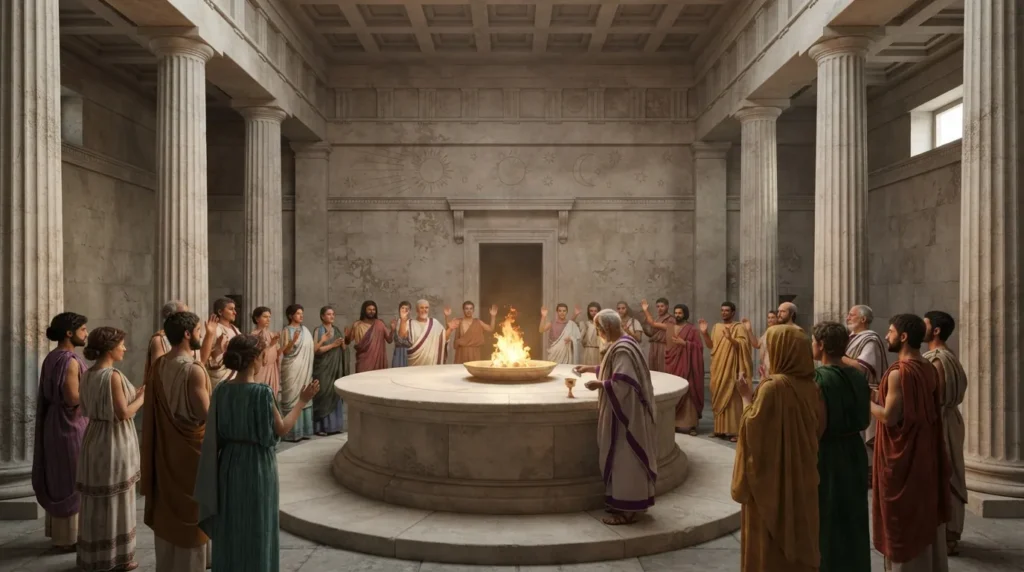
Every Greek city had a public hearth, usually in or near the council building, the prytaneion. The fire there was kept burning, and officials ate there.
Pindar opens his eleventh Nemean Ode with a prayer to Hestia, addressed as the guardian of a city’s council and the figure who holds the prytaneion as her portion. He wrote it for an official taking office on Tenedos.
Free Dinners for Heroes
Athens used its hearth to honor people. At his trial, Socrates joked that the right penalty for him was free meals in the prytaneion, a reward given to Olympic victors.
The jury didn’t find that funny. Pausanias also mentions statues of Hestia and Peace in the Athenian prytaneion, which shows the goddess had a presence in the civic building.
The Fire at the Center of Everything
Pythagorean astronomy took the idea further. Philolaus, a fifth century thinker, imagined a central fire at the heart of the cosmos, with the Earth and other bodies circling it.
Later writers called that central fire the hearth of the universe, and some tied it to Hestia’s name. Aristotle reports the Pythagorean view and criticizes it.
I wouldn’t overread this. It’s a philosophical use of a familiar word, but it fits the logic of a god who’s the fixed center.
Vesta in Rome
A Bigger Role at the Capital
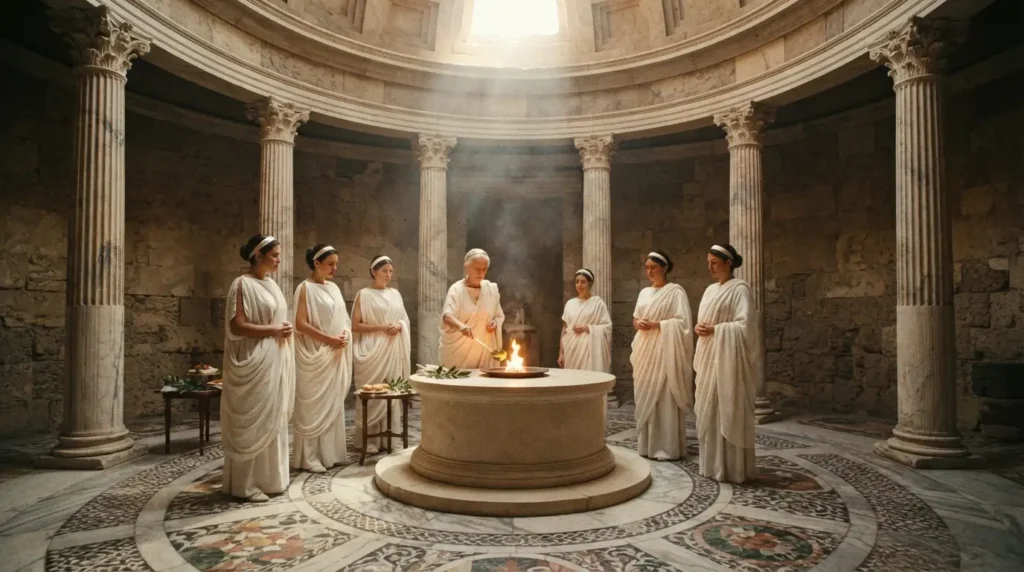
The Romans took the hearth goddess more seriously. Vesta’s temple in the Forum was round, and a sacred fire burned inside under the care of the Vestal Virgins.
Tradition credited Numa, Rome’s second king, with founding the order. The priestesses served for decades, and the fire’s survival was tied to the safety of the state.
Strict Penalties
According to later writers, a Vestal who let the fire go out could be flogged by the chief priest. One who broke her vow of chastity could be buried alive.
Those reports come from authors writing long after the origins of the cult, so I’d treat the specifics with caution. They show how much weight Romans placed on the fire.
Aeneas Carries the Fire
In Virgil’s Aeneid, Aeneas rescues Vesta and her eternal fire from burning Troy, along with the household gods. The hearth literally travels with the founder of Rome’s line.
That’s a Roman version of an old idea: when people move, they carry the hearth. It echoes the Greek practice of colonists taking fire from their mother city.
The Donkey Story
Ovid tells a comic tale in the Fasti. Priapus tries to assault the sleeping goddess, and a donkey’s bray wakes her and everyone else, ruining his plan.
Ovid says donkeys were garlanded at the Vestalia, her June festival, in thanks. It’s a late and playful explanation, so I wouldn’t treat it as a record of early practice.
My Reading: A Place, Not a Plot
Why She Needs No Story
I think Hestia is different from the other Olympians because she’s tied to a thing, the hearth, in a way the others aren’t. Zeus has a sky and Poseidon has a sea, but they also do things.
A hearth doesn’t do things. It’s there, and that’s the point.
Absence as Function
If her job is being the fixed center, a story would work against her. A god who travels, schemes, or marries stops being the place where everyone else returns.
That’s why I find her silence in the myths less puzzling than it looks. The oaths, supplications, and newborn rituals are her stories, and they just don’t read like myths.
I’d flag this as my interpretation. No ancient source states it, and the theory isn’t a replacement for evidence.
Quiet May Mean Overlooked
The title says “honored in every home,” and the evidence for that is real but patchy. It comes mostly from male authors writing about public and civic life, and household cult is poorly documented.
It’s possible that Hestia’s absence from stories reflects what male poets cared about, not a theology of the center. In that reading, the domestic world was valued rhetorically and neglected narratively.
The Hymns Might Be Aspirational
The Homeric Hymn to Aphrodite, where Zeus grants Hestia a seat in every house, tells us what a poet wanted to say about her. It doesn’t prove that every household performed the same rites.
Archaeologists find hearths in houses, but they can’t always tell which ones were used for offerings to a goddess and which were for cooking.
The Twelve Question
You’ll often read that Hestia gave up her seat among the twelve Olympians to Dionysus. I haven’t found an ancient text that says so, and ancient lists of the twelve vary.
If the story is a modern rationalization, it may unintentionally reflect a bias that sees her as the one to be edited out.
The Cosmic Fire Isn’t a Cult
The Pythagorean central fire might not have involved worship of Hestia at all. Calling it her hearth could be a poetic label for a scientific model.
So my use of it as evidence for her centrality is an analogy, and I’d rather say so.
What I Take From All This
Hestia shows what a goddess looks like when the culture’s most important rule is about staying. Greek religion has plenty of gods who go places, and she’s the one who makes the going meaningful.
The next time you light a candle at a dinner table, you’re doing something she’d recognize. She asked for a place at the center of the room and a bit of wine first and last, and she got both.
Frequently Asked Questions
Did Hestia have her own temples?
Rarely. Her cult was mostly in houses and public hearths. At Olympia, Pausanias describes a prytaneion with a hearth where a fire was kept burning and ashes were gathered, and some sanctuaries gave her a shared altar.
How is Hestia different from Hera as a household goddess?
Hera presided over marriage as an institution, with her own myths and temples. Hestia is the hearth itself, the physical center of the home, and she has almost no stories. One handles the relationship and the other handles the place.
Are there similar hearth gods elsewhere?
Yes. In the Vedic tradition, Agni is the fire god, honored through a household fire in the home. He’s also the messenger who carries offerings to the other gods, which combines Hestia’s and Hermes’s roles.
Where can I read the sources?
M. L. West’s Loeb translation of the Homeric Hymns includes the short hymns to Hestia and the longer Aphrodite hymn. Vernant’s essay appears in Myth and Thought among the Greeks, and Pindar’s Nemean 11 is in most editions.
Is there anything named after her in astronomy?
Yes. The main belt asteroid 46 Hestia was discovered by the astronomer Norman Pogson in 1857. It carries the Greek name, with Vesta, discovered earlier, taking the Roman one.
Final Thoughts
I started with a god who stays home while the others fly, and I’d end the same way. What’s easy to miss is that everything else in Greek religion depends on someone staying put.
The Greeks poured her wine first and last, which is how you honor the one who makes the middle of the meal possible.
Written by Batin Khan, a curious free spirit who loves reading and exploring the worlds of fantasy, mythology, and ancient stories. Through this blog, Batin hopes to share that sense of wonder with readers while building an exciting future along the way.