
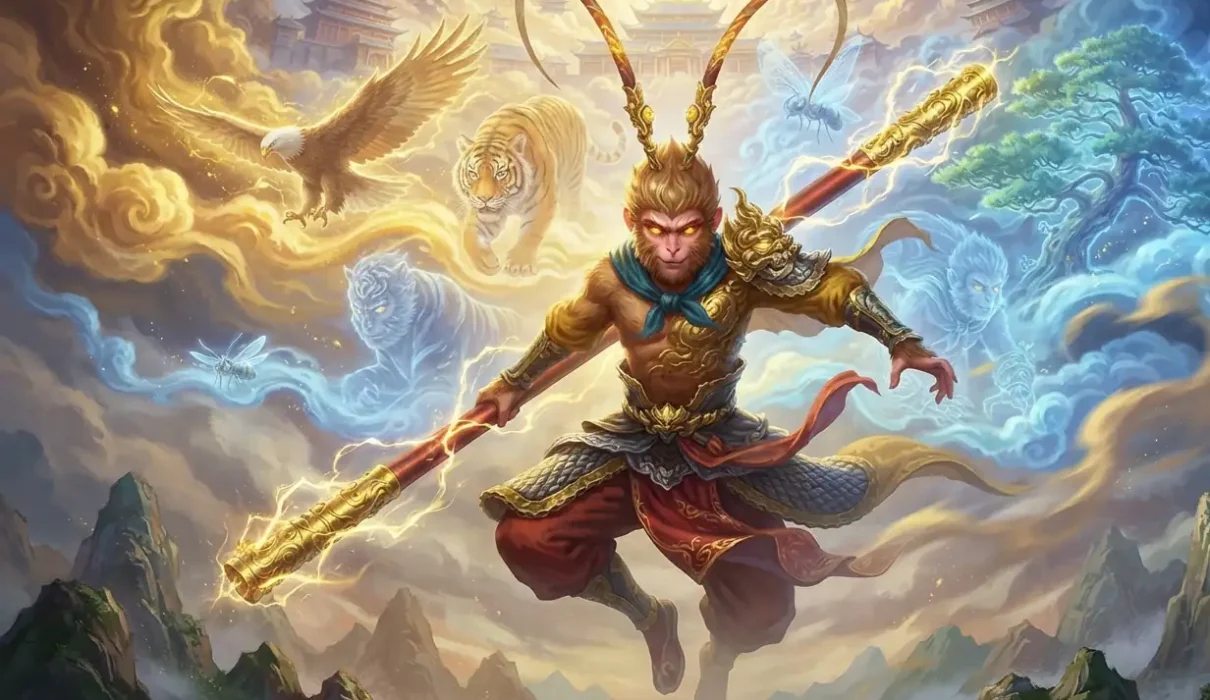
 By
By Quick Takeaways:
- Sun Wukong powers on this list comes directly from the classical text of Journey to the West, not from later adaptations or reinterpretations
- The ranking is based on three criteria: scope of effect, narrative irreplaceability, and demonstrated impact in the story’s most critical moments
- Sun Wukong’s most impressive powers aren’t his most visually spectacular ones, which is the counterintuitive insight this ranking tries to surface
- The most important limit on his power, what he can’t do, is as revealing as any individual ability
- Understanding this ranking changes how you read the Monkey King’s story, from a simple power fantasy to something considerably more philosophically interesting
I’ve spent countless hours on Journey to the West, and the question of how to rank Sun Wukong’s powers is one I’ve never found a satisfying answer to in popular accounts. Most lists just enumerate his abilities without addressing the genuinely interesting question: which ones actually matter most, and why?
The ranking below is my honest attempt at that question. The criteria are scope (how broadly does this power affect things), irreplaceability (what would he lose without it), and narrative impact (when did this power actually determine an outcome).
Let’s go from impressive but limited, up to the power that most defines what Sun Wukong is.
Sun Wukong Powers Ranking Criteria
Before diving in, I want to be transparent about how I’m ranking these.
A power ranks higher if it:
- Affects a larger scope of situations or has wider consequences
- Is something no other being in the text possesses in the same form
- Determined a critical narrative outcome that couldn’t have been solved otherwise
- Reveals something philosophically significant about the character
Speed alone doesn’t make a power rank high. Spectacle doesn’t either. What matters is what the power actually does in the story and how central it is to who Sun Wukong actually is.
Power 7: Cloud Somersault Speed
What It Is
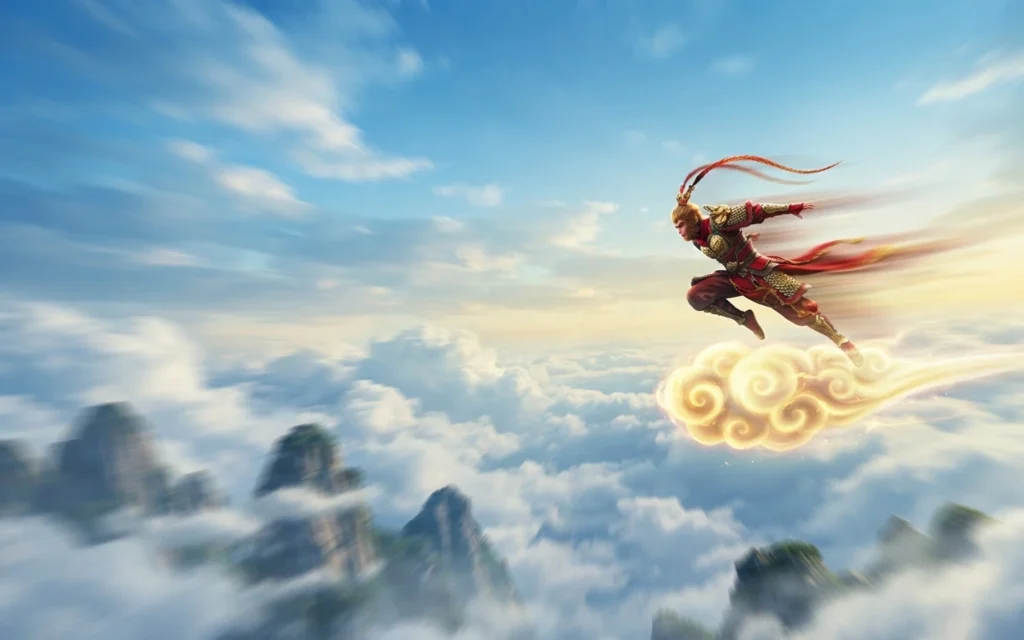
Sun Wukong can travel 108,000 li (approximately 54,000 kilometers) in a single somersault on his cloud. This speed makes him one of the fastest beings in the world the text describes.
Why It Ranks Seventh
Cloud somersault speed is impressive, but it’s ultimately just transportation. Faster travel makes the journey more efficient. It doesn’t solve philosophical problems, win battles that couldn’t otherwise be won, or determine outcomes in ways that slower travel couldn’t eventually achieve.
The 108,000 li figure is also famously used against him in the Buddha’s palm scene. He travels his maximum possible distance and never leaves the Buddha’s hand. His speed, however extraordinary, operates within a context he doesn’t understand. A power that can be neutralized this completely by a more fundamental force ranks lower than powers with more universal application.
Speed is the tool you use to get somewhere. What you do when you arrive is what actually matters.
Power 6: The 84,000 Hair Clones
What It Is
Sun Wukong can pluck hairs from his body and transform them into copies of himself, into weapons, into animals, or into other useful objects. He has 84,000 hairs available for this purpose, effectively giving him access to many clones that even Naruto probably can’t create.
Why It Ranks Sixth
The hair clone ability is tactically useful and visually spectacular. When facing large numbers of opponents, producing thousands of clones simultaneously creates genuine combat advantages.
But the clones are ultimately copies that inherit some of Sun Wukong’s capabilities without his full intelligence and adaptability. The limitation shows up in battles against opponents who can identify and deal with multiple simultaneous threats.
More importantly: the hair clone ability doesn’t solve the kinds of problems that Sun Wukong’s journey actually requires solving. The eighty-one tribulations of the pilgrimage are predominantly challenges requiring wisdom, specific knowledge, or relationships rather than large-scale military deployment. Having 84,000 clones doesn’t help you when the challenge is carrying the Tang monk safely through a specific type of supernatural threat.
Power 5: The 72 Transformations
What It Is
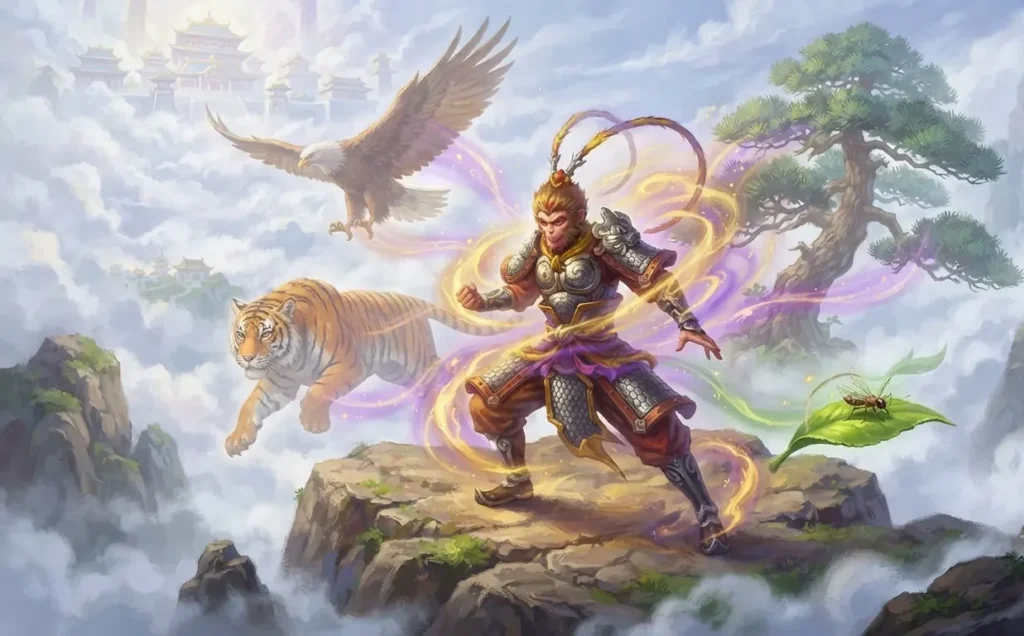
Sun Wukong can transform into any person, animal, plant, or object. The seventy-two transformations are a magical transformation technique that gives Sun Wukong extraordinary versatility in changing his form, with the limitation that when transforming into something with a tail, the tail remains visible as a tell.
Why It Ranks Fifth
The 72 transformations are genuinely one of Sun Wukong’s most narratively useful powers across the pilgrimage. Disguise, deception, infiltration, and intelligence-gathering all depend on this ability. Several of the eighty-one tribulations are resolved specifically because Sun Wukong can take a form that allows him to access information or locations that his true form couldn’t.
The tail limitation is important, though. The transformation isn’t perfect. And the tail is specifically a detail about Sun Wukong that hasn’t changed despite the outward form changing completely. His fundamental nature shows up in the detail he didn’t realize needed to change.
This limitation is philosophically precise: you can transform your appearance completely, but what you’ve grown, the ego’s particular formations, the attachments you haven’t noticed yet, those remain. The 72 transformations are powerful but operate within the limits of self-knowledge.
Power 4: The Ruyi Jingu Bang’s Adaptive Sizing
What It Is
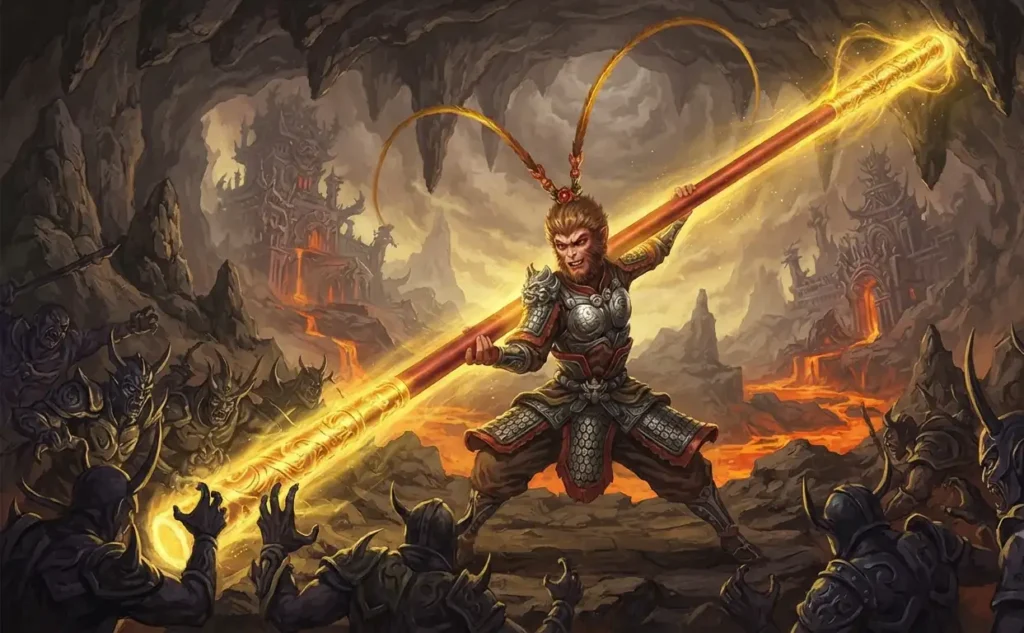
The Ruyi Jingu Bang can shrink to the size of a needle and be stored behind Sun Wukong’s ear. It can expand to reach between heaven and earth. The weapon adapts to any size needed, responds to its wielder’s intent, and is effectively indestructible.
Why It Ranks Fourth
The staff’s adaptive sizing is more than a convenient weapon feature. It makes the Ruyi Jingu Bang an extension of Sun Wukong’s own nature in a way that standard weapons aren’t.
The needle storage method means the weapon is always present and always available. The expansion to cosmic scale means it can operate at whatever scale a problem requires. The staff that measures the depth of the sea, the original function it served in the Dragon King’s palace, makes it the right weapon for a being who is learning to measure the depth of reality rather than simply overpower it.
The weapon ranks Fourth rather than higher because it’s a tool, however excellent. Tools extend capability. They don’t constitute it.
Power 3: Near-Physical Invulnerability
What It Is
Sun Wukong survived being placed in Laozi’s Eight Trigrams Furnace for seventy-seven days and emerged not dead but enhanced. He’d previously consumed immortality peaches of the highest tier, drunk the immortality wine, and consumed Laozi’s refined pills. The cumulative effect was a physical constitution that conventional weapons, fire, and many supernatural attacks couldn’t damage.
Why It Ranks Third
The invulnerability is what made Sun Wukong such an extreme problem for the divine court. Standard military force couldn’t end the situation. Every army that was sent against him failed not primarily because of skill or speed but because he genuinely couldn’t be killed by the instruments available.
The furnace episode is the clearest example of how his invulnerability was acquired rather than innate. He became nearly invulnerable through accumulated cultivation experiences, some of which (the furnace) were intended to destroy him. The attempted destruction produced the enhancement. This paradox is worth noting: what couldn’t kill him made him stronger in a quite literal, textually specific way.
The invulnerability ranks third rather than higher because it’s defensive. It prevents outcomes but doesn’t determine them. You need something beyond invulnerability to actually win anything.
Power 2: The Fiery Eyes and Golden Pupils
What It Is
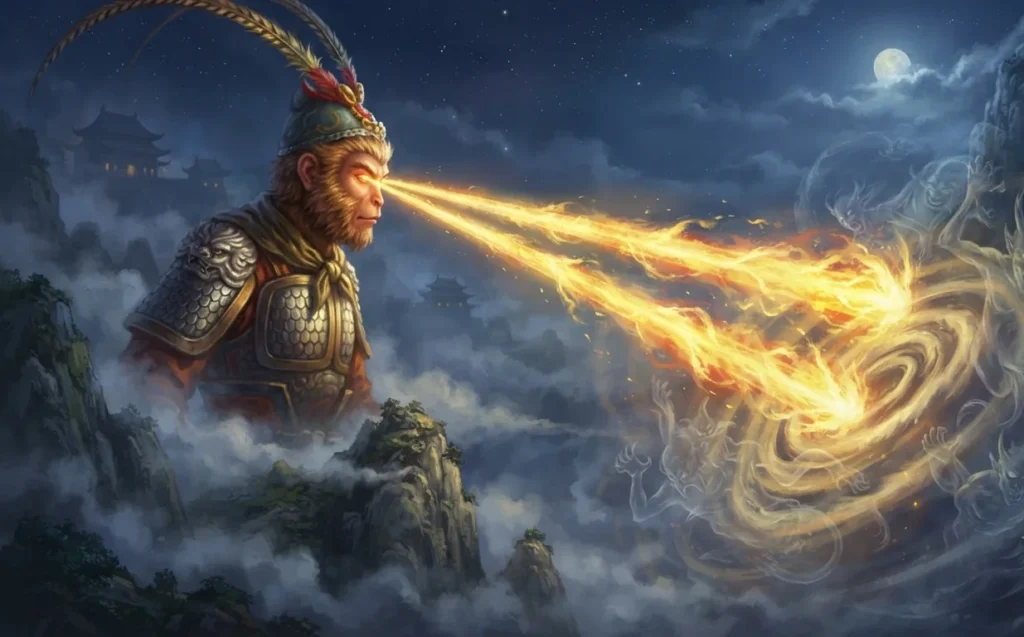
The same furnace ordeal that enhanced his physical constitution also affected his eyes. Seventy-seven days of exposure to the Eight Trigrams Furnace’s smoke and fire produced eyes that can see through all disguises, all illusions, and all demonic transformations.
Why It Ranks Second
This is where my ranking diverges most sharply from popular accounts, which tend to treat the Fiery Eyes as a secondary ability. I’d argue they’re the power that makes the pilgrimage most consistently solvable.
The eighty-one tribulations are primarily encounters with demons who disguise themselves as humans, who create illusions, or who impersonate virtuous figures to create confusion. The repeated pattern is Sun Wukong seeing through a deception that the Tang monk has fallen for and then dealing with the threat.
Without the Fiery Eyes, this pattern can’t work. Sun Wukong would be as deceivable as everyone else. His ability to see truth when others see illusion is more central to his function as the pilgrimage’s protector than his combat capability.
The power was also produced by an attempted destruction. Laozi tried to refine him into ashes. The smoke that should have killed him gave him perception that transcends deception. Again: what couldn’t destroy him gave him something irreplaceable.
Power 1: Defeating the Cycle of Death
What It Is
Early in the text, Sun Wukong obtains his 342-year lifespan through cultivation with the Immortal Zhenyuan, then is informed by the King of Hell that his death date has arrived. He goes to the underworld, modifies his own entry in the Book of Life and Death, and effectively removes himself from the cycle of death that governs all mortal beings.
Why It Ranks First
This is the power that most changes Sun Wukong’s relationship with mortality. Not just that he became harder to kill, but that he specifically disrupted the administrative mechanism that governs death for all beings.
The Book of Life and Death is the record that determines when every being dies. Modifying his entry doesn’t just extend his life. It removes him from the category of beings subject to that governance structure.
The scope of this is extraordinary. Sun Wukong didn’t just become immortal through cultivation. He went to the source of death’s administration, modified the record, and exempted himself. The Dragon King’s palace took his weapon. The underworld gave him immortality through his defiance of its record-keeping.
This power ranks first because its scope is broader than physical combat capability. It operates on the level of cosmic governance rather than individual encounters.
Bonus: The Undefeated Military Record Against All Heaven
What It Is
Sun Wukong defeated every divine general, every divine army, and every military force the Jade Emperor could assemble against him. One hundred thousand celestial troops. Erlang Shen, described as the finest individual fighter in the divine court. All available supernatural military force. None of it was sufficient.
Why It Ranks
The military record isn’t just about individual combat power. It’s about what it means for the cosmological framework.
The Jade Emperor’s authority is backed by the military force of heaven. Military force is what keeps the cosmic order operating when beings refuse to comply with it. Sun Wukong defeated that entire framework. He demonstrated, practically, that the military backing of cosmic authority wasn’t sufficient to stop a sufficiently capable and determined individual.
This has enormous implications. The divine court’s ability to govern the cosmos depends on its ability to enforce its authority. Sun Wukong temporarily broke that enforcement capability entirely. He wasn’t winning individual fights. He was demonstrating a structural failure in the cosmic order’s ability to govern itself.
This ranks because its implications are cosmic in scope. The Jade Emperor’s court couldn’t operate as a governance structure until the Sun Wukong problem was resolved.
Bonus: The Absolute Limit, and What It Reveals
The Buddha’s Palm
This is where it gets genuinely interesting, and it’s the reason I wanted to write this article.
Sun Wukong’s absolute most revealing power is not actually a power he has. It’s the limit he runs into.
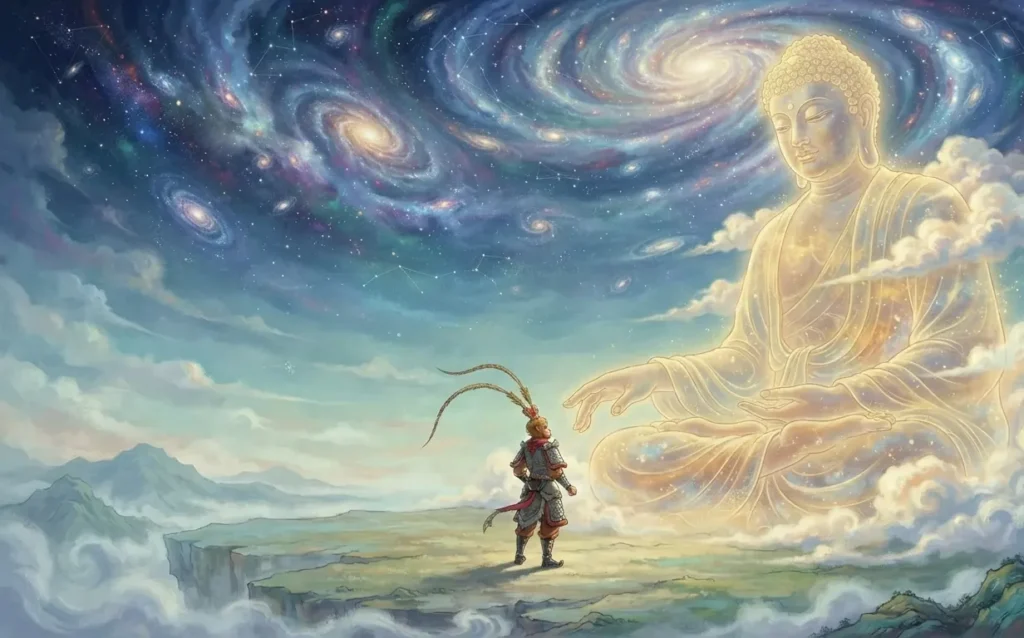
The Buddha’s palm scene: Sun Wukong bets that he can escape from the Buddha’s hand. He uses his cloud somersault, travels 108,000 li to the edge of the universe, inscribes his name on five pillars at the world’s boundary, and returns triumphant. The Buddha shows him the writing on his finger. The five pillars were the Buddha’s fingers. Sun Wukong never left the palm.
Why This Is the Most Important Point
Everything that ranks above this point in Sun Wukong’s power set, and everything that defeats the Jade Emperor’s army, and everything that survived the furnace, and everything that modified the Book of Life and Death, operated within a context that Sun Wukong didn’t know he was inside.
His speed, his transformations, his invulnerability, his record against heaven: all of it was real and all of it operated within the Buddha’s palm without exceeding it.
This isn’t a defeat in the conventional sense. It’s a demonstration that the framework within which Sun Wukong was measuring his capabilities wasn’t the actual framework. He thought he was measuring his power against the Jade Emperor’s authority. He was actually measuring it against something much larger that he hadn’t perceived.
What This Means About Power
The ranking’s most important insight is that Sun Wukong’s greatest “power” is the capacity to eventually understand this. Not immediately, not without five hundred years under a mountain and eighty-one tribulations, but eventually.
The Victorious Fighting Buddha title he earns at the end of the pilgrimage combines his original combat capability (victorious in fighting) with what the journey added (Buddha, the awakened one). The journey didn’t give him more powers in the conventional sense. It gave him understanding of what his powers actually were and weren’t, and what they were actually for.
That understanding is more powerful than any individual ability, because individual abilities operate within frameworks you can or can’t see. Understanding the framework itself is what changes what the abilities mean.
The Complete Ranking
| Rank | Power | Why It Ranks Here |
|---|---|---|
| 7 | Cloud somersault speed | Transportation only; neutralized by Buddha’s palm |
| 6 | 84,000 hair clones | Tactical, not strategic; doesn’t solve wisdom-required problems |
| 5 | 72 transformations | Very useful, but limited by self-knowledge (the tail) |
| 4 | Ruyi Jingu Bang sizing | Excellent tool, but a tool rather than a constitutive capability |
| 3 | Near-physical invulnerability | Defensive; prevents defeat but doesn’t achieve victory |
| 2 | Fiery Eyes and Golden Pupils | Most consistently useful in actual pilgrimage encounters |
| 1 | Exemption from the cycle of death | Cosmic scope; removed from the governance of mortality |
| Bonus | Military record against all heaven | Demonstrated structural failure of cosmic enforcement |
| Bonus | Understanding the limit of his power | Makes all other powers meaningful or transforms their use |
Frequently Asked Questions
Is Sun Wukong the strongest being in Journey to the West?
In combat terms, he’s undefeated against conventional divine force. But the Buddha demonstrates a form of authority he can’t overcome. Sun Wukong is the strongest fighter in the text’s conventional power hierarchy. He’s not the strongest being in every sense the text acknowledges.
What is Sun Wukong’s weakest point in the story?
The golden headband, activated by Xuanzang’s spell, is his most consistent vulnerability. But it’s a training tool rather than a weakness in the conventional sense. His genuine weakness early in the story is an incomplete understanding of what his power is actually for.
How does the Ruyi Jingu Bang compare to other weapons in the text?
The staff is effectively unique in the text’s hierarchy of weapons. Its adaptive sizing, its origin in the Dragon King’s palace, and its specific relationship with Sun Wukong make it distinct. Other weapons are powerful. The staff is specifically suited to its wielder in ways other weapons aren’t.
Why did the Eight Trigrams Furnace enhance him instead of destroying him?
The text is specific: the smoke affected his eyes rather than destroying him because his constitution was already enhanced by the immortality stacking. Laozi’s intent was destruction. The outcome was the Fiery Eyes. The text presents this as a consequence of accumulated prior cultivation rather than as planned.
What power does Sun Wukong gain on the pilgrimage that he didn’t have before?
He doesn’t gain conventional combat powers during the pilgrimage. What he gains is wisdom: the capacity to direct existing power toward purposes beyond ego satisfaction. The Victorious Fighting Buddha title reflects this. Combat capability plus wisdom is genuinely different from combat capability alone.
Final Thoughts
Sun Wukong’s powers are genuinely impressive across the board. But ranking them forces the most interesting insight: the highest-ranking “power” is understanding what his capabilities actually are and what they’re actually for.
Reading Journey to the West has led me to presume that this is the text’s central point. The pilgrimage isn’t about Sun Wukong getting stronger. He was already strong enough to defeat all of heaven before it started. It’s about him getting wise enough to understand what strength is for.
That’s the absolute.
Related Articles
- Journey to the West: The Chinese Classic Behind Fiction
- Was the Jade Emperor Weak? The Answer Might Surprise You
- Jade Emperor vs Sun Wukong: Who Really Won the Rivalry?
- Pantao Banquet: Queen Mother of the West’s Heavenly Feast
- The Three Pure Ones: Who Outranks the Jade Emperor
References
- Birrell, Anne. Chinese Mythology: An Introduction.
- Kohn, Livia. Daoism and Chinese Culture.
- Shiji (Records of the Grand Historian).
- Daozang – Daoist Canon
- Journey To The West
- Jade Emperor Origin Scripture
- Tao Te Ching – Translated by J. Legge
- Andrew H. Plaks – The Four Masterworks of the Ming Novel
- Records of the Western Regions in the Great Tang Dynasty – Xuanzang
- Stephen Teiser – The Spirits of Chinese Religion
- Analysis of Sun Wukong from Journey to the West using Joseph Campbell’s Concept of Monomyth