
 By
By A genre needs a specific test to actually mean something, and LitRPG has one that’s really simple to apply.
If a character’s mind flashes New Skill Acquired: Flame Bolt, formatted like an actual game notification interrupting the prose, you’re reading LitRPG. If the character just gets better at magic through vaguely described practice, you’re reading something else, however game inspired it feels.
The Russian Origin of LitRPG

A Brainstorming Session in Late 2013
The term LitRPG was coined during a specific meeting between author Vasily Mahanenko, EKSMO editor Dmitry Malkin, and author Alex Bobl, working for EKSMO, Russia’s largest publishing house, on a multi author project built around MMORPG inspired fiction. Sources differ slightly on which of the three actually proposed the exact word, but the session and the year aren’t in dispute.
EKSMO began running LitRPG writing competitions from 2014 onward, publishing the winning entries, which gave the genre something most emerging categories don’t get early on, an actual institutional home actively recruiting new work into it.
The Genre Existed Before Its Name Did
Dem Mikhailov’s Clan Dominance: The Sleepless Ones appeared on the Russian self publishing site samizdat.ru in 2012, a full year before anyone called this LitRPG.
Vasily Mahanenko’s Survival Quest, the opening volume of The Way of the Shaman, followed the same year and became the genre’s clearest breakout text once translated.
Magic Dome Books released that translation in English in April 2015, and it gave Western readers a ready-made canon before English original LitRPG had really found its own footing.
Dmitry Rus’s Play to Live arrived around the same period, and Rus personally established the LitRPG Forum specifically to carry the term into English speaking spaces.
The Actual Definitional Test
Three Tiers, Not One Blurry Category
Progression fantasy is the broadest category, any story where a character’s growing capability drives the plot, with no requirement that the growth be measured through game style mechanics at all.
GameLit sits inside that, fiction where games are truly central to the premise, characters reference leveling, classes, and systems, but the text doesn’t necessarily display a formal stat screen on the page.
LitRPG is the narrowest and most specific. The mechanics have to be explicit and visible, formatted stat blocks, system notifications, quest logs, level up announcements, appearing directly within the narrative rather than described in passing.
Why This Distinction Matters
Mother of Learning tracks Zorian’s growth across hundreds of time loops with real precision, but it never interrupts the prose with a formatted status screen.
That makes it progression fantasy, genuinely, without qualifying as LitRPG under the stricter definition. Dungeon Crawler Carl, by contrast, shows you Carl’s actual stats, and that visible formatting is exactly what earns it the label.
The Trademark Fight That Split the Community
A Documented Controversy
In 2016, author Aleron Kong attempted to trademark the term LitRPG itself. This produced real, lasting division within the writing community, since a term that had spread specifically through open, collective adoption suddenly had one individual attempting to claim exclusive commercial control over it.
I think this episode is worth including for a reason beyond trivia. It’s a true case study in what happens when a genre transitions from an informal, community-built label into something with real commercial stakes attached, and it shows the growing pains weren’t purely creative. They were also legal and territorial.
Why Visible Numbers Specifically Do Something Different
Locus of Control, Applied to Fiction
Psychologist Julian Rotter’s concept of locus of control describes whether a person believes outcomes result from their own actions, an internal locus, or from forces outside their control, an external one. People with a stronger internal locus of control generally report greater confidence in their ability to influence their own outcomes.
I think LitRPG’s explicit stat displays do something specific to reading experience that vaguer progression narratives don’t manage as directly. When a character sees exactly what raises a stat and by how much, the reader isn’t just watching growth happen.
They’re watching a legible, internally controllable system respond to specific, repeatable actions, which mirrors an internal locus of control far more directly than a character simply getting stronger through undefined training ever could.
Why This Produces a Different Reading Pleasure Than Progression Fantasy Generally
I’ve written in my earlier blog post about the psychological mechanisms behind progression fantasy broadly, variable reward, specific goal setting, sustained competence signals. LitRPG’s specific innovation is making the entire system legible and auditable.
A reader can check a stat block against an earlier one and verify the growth directly, which is a considerably more concrete form of the same underlying satisfaction.
Not All LitRPG Is Equally Mechanical
The Term Crunchy Exists for a Reason
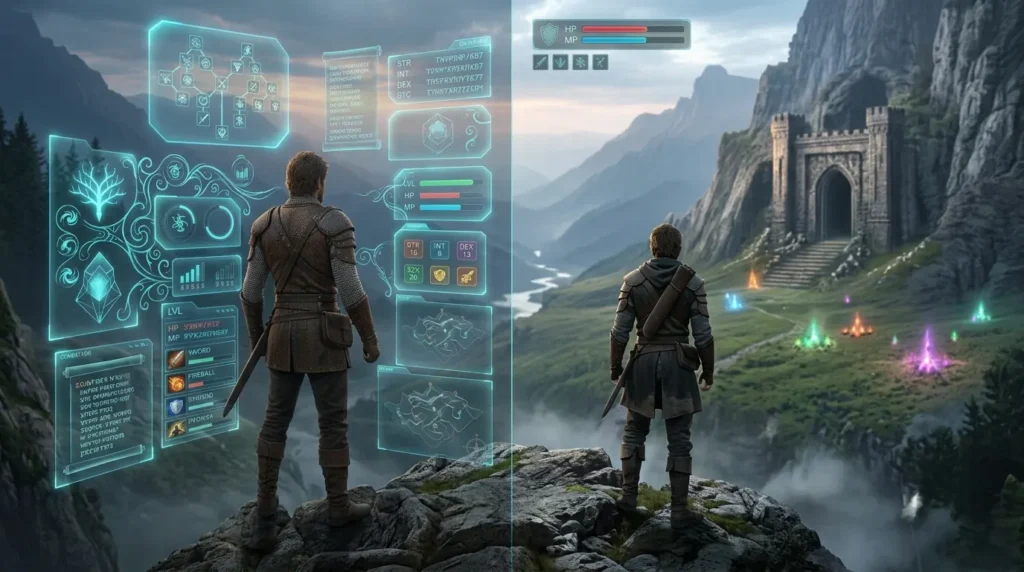
Genre readers use crunchy specifically to describe LitRPG that leans heavily into detailed mechanical systems, closer to reading an actual game manual embedded in a story.
Less crunchy entries use the same basic notification format more sparingly, keeping narrative and character development as the clear priority.
That internal spectrum matters if you’re picking your first LitRPG book. A heavily crunchy entry rewards readers who really enjoy parsing stat allocation and build optimization. A lighter entry gives you the genre’s core structure without demanding the same appetite for numbers.
Critics Have A Real Point

I want to take the genre’s harshest critics seriously rather than dismiss them, because the underlying complaint has real substance.
Constant system notifications interrupting prose can damage sentence level craft and narrative immersion, breaking tension at precisely the moments a scene most needs sustained momentum. A stat screen appearing mid battle can undercut exactly the urgency the surrounding prose was trying to build.
This isn’t a flaw unique to bad writing within the genre. It’s a structural tension built into LitRPG’s own defining feature. The explicit mechanics that make the genre legible and satisfying are the same mechanics that risk interrupting the prose readers came for in the first place.
The strongest LitRPG authors manage this tension deliberately, timing notifications for moments where the interruption itself adds tension rather than defusing it. Weaker execution simply lets the system intrude wherever the plot happens to require a mechanical update.
Frequently Asked Questions
Is Dungeon Crawler Carl considered heavily crunchy or lighter LitRPG?
It leans toward the crunchier end of the spectrum, with detailed stat progression and system mechanics playing a substantial role, though its dark comedic voice keeps narrative character work equally prominent alongside the mechanical detail throughout the series.
Did Aleron Kong’s trademark attempt on LitRPG ultimately succeed?
The attempt did not result in Kong gaining exclusive commercial control over the term, which remains in open, widespread use across the genre’s authors, publishers, and reader communities today, though the episode left lasting tension within parts of the community.
Are there earlier works with LitRPG style mechanics that predate the Russian originated term entirely?
Yes. Tad Williams’ Otherland series from 1996 and Yu Wo’s 2004 Taiwanese novel 1/2 Prince both feature game like structural elements predating the formal LitRPG label, showing the underlying concept existed in multiple literary traditions before receiving its current name.
What role did Royal Road play in LitRPG’s growth in English speaking markets?
Royal Road, a web fiction platform launched in 2013, gave English language LitRPG authors a direct venue to build audiences through serialized publishing, which many later converted into Patreon supported early access and eventual Kindle, audiobook, and traditional publishing deals.
Is GameLit older or newer as a term compared to LitRPG?
Sources generally treat GameLit as the broader umbrella term that developed alongside or shortly after LitRPG specifically to cover game inspired fiction that doesn’t meet LitRPG’s stricter requirement for explicit, formatted on page game mechanics.
Final Thoughts
A brainstorming session in a Russian publishing house, a translated breakout hit reaching English readers in 2015, and a trademark dispute two years later that nearly turned a shared community term into one author’s private property.
That’s a genuinely eventful decade for a genre this specific, and the actual definitional test underneath all of it stays exactly as simple as it started. Show me the stat block on the page, and I’ll show you LitRPG
Related Posts
- 9 Best Progression Fantasy Books 2026 [Ranked List]
- Cultivation vs Progression Fantasy: Which Should You Read?
- Best Xianxia Novels of 2026: From Hidden Gems to Legends
- 13 Best Cultivation Novels With No Harem [2026 Picks]
- 12 Best Cultivation Novels [Ranked by Genre Fans]
- 7 Best Completed Cultivation Novels [2026 Binge List]
- 9 Progression Fantasy Books With Female Leads [2026]
- Why Your Brain Loves Progression Fantasy & LitRPG
Written by Batin Khan, a curious free spirit who loves reading and exploring the worlds of fantasy, mythology, and ancient stories. Through this blog, Batin hopes to share that sense of wonder with readers while building an exciting future along the way.